The most frightening thing about The Fly is not that Seth Brundle’s teleportation experiment goes wrong. It is that it works. That distinction sits quietly at the centre of David Cronenberg’s 1986 masterpiece. The telepods are not some half-finished contraption that malfunctions because their creator has failed to understand the science. They do precisely what Seth Brundle has designed them to do. They disintegrate matter at one point and reintegrate it at another. They take the impossible idea of instantaneous transportation and make it real.
The horror begins when the machine becomes capable of doing something its creator has not yet considered. And that is a much more disturbing proposition. Science fiction has traditionally presented technological progress as a gateway to possibility. The invention opens the door. Humanity walks through it. In The Fly, Cronenberg asks what happens when the door opens onto somewhere humanity was never prepared to go.
Seth Brundle doesn’t invent a failed machine. He invents a successful one with consequences he cannot comprehend. That makes the telepods one of the great pieces of technology in horror cinema—not because they are impossible, but because Cronenberg understands that technological progress is rarely frightening because something doesn’t work. It is frightening because something does.
A Machine That Changes the Rules
When Seth first demonstrates the telepods to Veronica Quaife, the scene is almost charming. There is excitement in his voice. He is awkward, excitable and utterly convinced that he has achieved something extraordinary. And he has. The machine transports Veronica’s stocking from one pod to another. Matter has crossed space without travelling through it. Seth has effectively abolished the journey between two points. The achievement is staggering. It is also beautifully modest.
Cronenberg doesn’t introduce the telepods with the fanfare of a conventional science-fiction blockbuster. There is no enormous laboratory filled with gleaming machinery. The devices sit inside a grimy warehouse, resembling oversized phone booths. Veronica initially approaches them with understandable scepticism. Yet there they are. They work.
The film’s brilliance lies in making the technology seem plausible enough for us to accept it before we have had time to question what it actually means. What happens to something when it is disassembled? What constitutes the thing that arrives at the other end? If the original matter is destroyed and another arrangement of matter is created elsewhere, has the object travelled? Or has it died and been reconstructed?
These questions sit underneath The Fly without requiring the film to provide a philosophical lecture. The telepods simply operate, and the audience gradually realises that Seth has not merely invented transportation. He has invented a machine capable of rewriting matter. And eventually, himself.
The Telepod Doesn’t Understand Life
The first true warning comes when Seth attempts to teleport a living organism. The machine fails spectacularly. The baboon emerges mutilated, its body turned inside out.
This is perhaps the film’s most important technological moment because Seth has encountered a limitation he doesn’t initially understand. The telepods can recognise and reconstruct inorganic matter, but living flesh presents a problem. Seth’s response is not to abandon the experiment. He teaches the machine. That detail is crucial. He reprograms the computer so that it can understand the biological complexity of living tissue. The second baboon survives.
The technology has evolved. The problem has been solved. And that solution takes Seth one step closer to the catastrophe waiting for him. The machine isn’t evil. It isn’t defective. It is simply incapable of making the ethical distinction between what can be done and what should be done. Neither, increasingly, is Seth.
The Romance of Progress
Seth’s relationship with Veronica is intimately connected to his technological ambitions. She is not merely a journalist documenting his invention. She becomes the human presence capable of interrupting his increasingly isolated relationship with the machine. Their romance initially seems to make Seth more human. It also makes his technology more ambitious. The moment he begins thinking about living matter differently, the telepods move from being a means of transportation to a mechanism for manipulating biological existence.
The machine changes because Seth changes. And Seth changes because of the machine. The relationship becomes circular. Technology gives him power. Power gives him confidence. Confidence gives him recklessness. Recklessness sends him back into the machine. This is why his self-teleportation is not simply an act of scientific curiosity.
It is an act of arrogance. He has solved the problem. He believes he understands the system. He believes he understands himself. He is wrong.
The Fly Is Not the Accident
The housefly that enters the telepod with Seth has often been treated as the random accident that sets the tragedy in motion. But randomness isn’t really the point. The fly is merely the final variable in a system Seth has already chosen to trust. The machine detects two biological entities. It does not panic. It does not malfunction. It makes a decision. It fuses them.
The computer identifies the presence of two organisms and produces a result that is, according to the logic of the machine, perfectly coherent: a new biological entity created from both sources. The film describes this as fusion at a molecular-genetic level.
The horror is therefore not that the computer fails to understand what it is doing. The horror is that it understands exactly enough to do it. Seth has built a machine capable of interpreting life as information. And once life becomes information, the distinction between human and insect becomes a problem of data. That is a profoundly Cronenbergian nightmare.
Technology Has No Morality
The telepods don’t know that Seth is a human being. They don’t know that he has a history. They don’t know that he loves Veronica. They don’t know that he has hopes for his future. They don’t know that a fly is a fly. They process information. That is their function. And this is where the film’s technological horror becomes more interesting than the conventional “mad scientist” narrative.
Seth does not unleash an evil machine upon the world. He creates a machine without a moral framework. It can perform the operation. It cannot determine whether the operation should occur. That responsibility remains with the human being operating it. And Seth gradually becomes incapable of carrying that responsibility. The machine isn’t corrupting him. It is revealing the danger of giving enormous power to someone who has mistaken intelligence for wisdom.
The Illusion of Purification
Immediately after his teleportation, Seth initially believes the machine has improved him. He is stronger. He is more energetic. His sexual confidence increases. He becomes almost evangelical about the experience.
Teleportation, he believes, has purified him. This is one of the film’s darkest jokes. The scientist has just undergone the most profound biological transformation imaginable and interprets the result as technological progress. He isn’t horrified by his body. He is impressed by it. He believes he has been upgraded. That word is important.
Seth doesn’t initially think he is becoming something else. He thinks he is becoming something better. The language of technological progress has entered his understanding of his own body. He has not become ill. He has evolved. He has not deteriorated. He has improved. The horror is that the distinction between those ideas becomes increasingly difficult to maintain.
The Body as Software
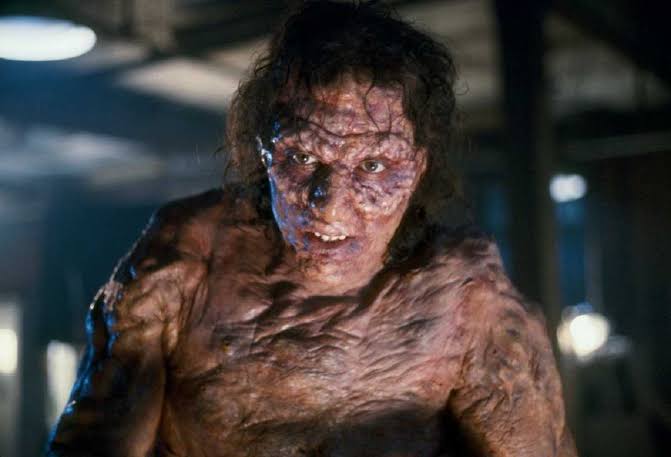
Cronenberg’s great innovation is to make biological transformation feel like technological transformation. Seth’s body begins behaving as though it has received a corrupted software update. His fingernails detach. His skin changes. His bodily functions alter. His strength increases. His instincts become increasingly insectoid. The machine has rewritten him. And yet the process isn’t presented as a simple mutation. Seth becomes fascinated by the logic of what is happening to him. He studies his own transformation. He documents it. He gives it a name.
Brundlefly.
The scientist turns himself into the subject. He becomes both experiment and experimenter. This is one of the film’s most unsettling ideas: Seth retains enough scientific curiosity to observe his own destruction. He can see what is happening. He simply cannot stop it.
The Horror of Improvement
There is something particularly disturbing about the way Seth initially embraces his transformation because it reflects a very human faith in progress. We are conditioned to believe that new technology will make us faster, stronger, healthier and more efficient. Seth experiences exactly those things. He becomes stronger. He becomes faster. He develops abilities that his human body never possessed. If the transformation had stopped there, the telepods might have been celebrated as a technological miracle. Instead, Cronenberg asks the question that technological optimism frequently avoids:
What if becoming more efficient means becoming less human?
That is the heart of The Fly. Seth’s transformation isn’t simply from man to insect.It is from human complexity to biological efficiency. The fly doesn’t possess human morality.
It doesn’t possess human empathy. It doesn’t worry about dignity. It simply survives. Seth’s physical improvement therefore corresponds with a moral deterioration. The better his body becomes at being a fly, the worse he becomes at being Seth Brundle.
The Machine Cannot Give Him Back
Eventually Seth understands what the telepods have done. He tries to reverse the process. And once again, the technology works. The problem is that Seth’s understanding of the machine has changed. He is no longer simply trying to teleport himself. He is trying to manipulate identity.
He wants to use another human being to dilute the fly genes within his body. The telepod has become a mechanism for genetic reconstruction. The scientist who once wanted to transport matter across space now wants to use the same machine to decide what species he should belong to. This escalation is one of the film’s most devastating ideas. The technology never changes. Seth’s ambitions do.
Every solution creates a larger problem because the underlying assumption remains the same:
If something can be altered, it should be altered.
The telepods have given Seth extraordinary power. They have not given him wisdom.
The Telepods as a Modern Faustian Bargain
There is a distinctly Faustian structure to The Fly. Seth possesses knowledge that appears almost miraculous. He has achieved something that should be impossible. And the achievement transforms his understanding of what is possible. But unlike the traditional Faustian bargain, there is no demon standing outside the laboratory demanding payment. There doesn’t need to be. The invention itself is the bargain. Seth gets what he wants. He simply discovers that wanting it was the problem.
The telepods offer him freedom from physical distance. They ultimately imprison him inside his own biology. They promise instantaneous transportation. They leave him unable to escape his own body. They represent the conquest of nature. They demonstrate how little Seth understands nature in the first place. The machine therefore becomes a perfect symbol of technological hubris.
The Horror of Progress
Cronenberg made The Fly in the middle of a decade obsessed with technological acceleration. Computers were becoming increasingly embedded within everyday life. Biotechnology was advancing. Corporate science was becoming increasingly powerful. The language of innovation was increasingly associated with progress, wealth and human advancement. And yet Cronenberg’s film refuses to celebrate progress unconditionally.
It asks who controls it. Who benefits from it? Who understands its consequences? And what happens when the person operating the machine is so fascinated by what it can do that they stop asking whether it should be done? Those questions remain remarkably contemporary.
The real-world concept of teleportation is vastly different from Cronenberg’s fictional technology. Modern quantum teleportation concerns the transfer of quantum information rather than transporting a person or physical object intact from one place to another. Even speculative models of reconstructing a human being raise enormous questions concerning information, matter and identity. But The Fly doesn’t require its science to be literally predictive. It is using science fiction to explore a philosophical anxiety. What happens when technology gives us the ability to alter the fundamental conditions of existence before we have decided what those conditions mean?
The Technology That Worked
This is why the telepods are so important to The Fly. They are not a failed invention. They are an extraordinary success. Seth Brundle genuinely changes the world. His invention would transform civilisation if it could be perfected and controlled. Distance becomes irrelevant. Transportation is revolutionised. Matter can apparently be broken apart and reconstructed elsewhere. The miracle is real. And that is precisely why the film is horrifying. If the telepods had simply exploded, there would be no tragedy. If they had never worked, Seth would have remained a scientist pursuing an impossible dream. Instead, he succeeds. He creates the future. And then discovers that the future has no obligation to preserve him.
The Last Teleportation
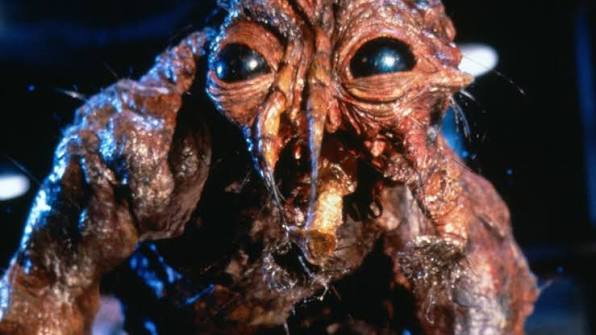
By the end of The Fly, the telepods have ceased to represent progress. They represent inevitability. Seth enters the machine one final time not as the brilliant young scientist who first demonstrated his invention to Veronica, but as something barely recognisable as human. His body has become a fusion of flesh, insect and technology. His final transformation is grotesquely appropriate. He is no longer merely a man who has been changed by technology. He has become an entity created by technology.
The telepod has completed its journey from transportation device to biological engine. And when the final creature crawls from the wreckage and silently asks Veronica to end its suffering, the machine has achieved something almost unbearably tragic. It has worked perfectly. It has simply delivered its creator somewhere he never intended to go.
The Prognosis:
The genius of The Fly is that David Cronenberg never asks us to fear science itself. Science is not the villain. Technology is not inherently evil. Progress is not inherently destructive. The telepods are magnificent. That is what makes them terrifying. The film instead interrogates the faith we place in our inventions and the assumption that technological capability automatically represents human progress.
Seth Brundle can move matter through space. He cannot understand the meaning of being human. He can teach a machine to understand living tissue. He cannot understand the ethical consequences of altering it. He can rewrite biology. He cannot rewrite mortality. And when he finally attempts to use his own invention to escape what he has become, the machine does what it has always done. It obeys.
The horror is not that technology fails us. It is that technology can succeed perfectly while we fail ourselves. That is the true nightmare inside The Fly. The telepods don’t open a gateway to the future. They reveal the cost of arriving there too quickly.
- Saul Muerte