• About
  • podcasts
  • Shop

Surgeons of Horror

~ Dissecting horror films

Surgeons of Horror

Tag Archives: david cronenberg

Cronenberg’s Body: From Shivers to The Fly

31 Friday Jul 2026

Posted by surgeons of horror in retrospective

≈ Leave a comment

Tags

body horror, david cronenberg, Geena Davis, jeff goldblum, the fly

How David Cronenberg Turned Flesh Into Fear

Before Seth Brundle stepped into the telepod, David Cronenberg had already spent more than a decade asking audiences to look at the human body differently. Not as something sacred. Not as something inviolable. But as something vulnerable. Something porous. Something capable of changing without permission.

From the parasitic creatures of Shivers to the psychic violence of Scanners, from the biological mutation of Rabid to the technological nightmare of Videodrome, Cronenberg’s cinema has repeatedly returned to the same unsettling proposition:

The body is not a fixed thing.

It is a process.

And processes can go wrong.

By the time The Fly arrived in 1986, Cronenberg had already established himself as one of cinema’s great anatomists of fear. Yet the film represents something more than another entry in his growing body of work. It is a culmination. Everything Cronenberg had been exploring—the relationship between flesh and identity, science and mutation, sexuality and disease, technology and transformation—converges in Seth Brundle’s tragic metamorphosis. The fly did not arrive from nowhere. Cronenberg had been building towards it for years.

The Parasite Within

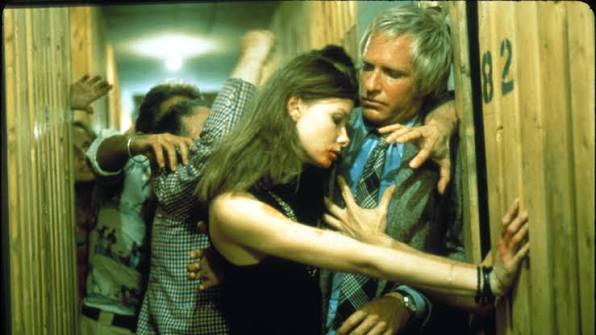
Shivers—released in 1975—announced Cronenberg as a filmmaker fascinated by the vulnerability of the human body. Its premise is deliberately grotesque. Parasitic creatures spread through a luxury apartment complex, transforming the residents into sexually driven hosts. But beneath the visceral horror lies an idea that would become central to Cronenberg’s cinema. The body can be invaded. Worse still, it can be persuaded to betray us.

The parasites in Shivers do not simply attack their victims from outside. They become part of them. The boundary between self and other begins to collapse.

This is a recurring Cronenberg anxiety. What happens when something enters the body and cannot be removed? What happens when the thing we fear is no longer outside us? What happens when we become the host? These questions would return repeatedly throughout his career. And eventually, in The Fly, the invader would be almost impossibly small.

A single insect.

A moment of contamination.

One microscopic intrusion capable of changing everything.

Rabid: The Body as Transmission

If Shivers introduced the idea of bodily invasion, Rabid developed it into something more recognisably biological. Rose is transformed following experimental surgery. The result is not merely physical alteration. Her body becomes a vector. An instrument of transmission. Those she encounters are infected. The personal becomes communal. The individual body becomes a threat to everyone around it.

Cronenberg’s fascination with disease is already apparent. The horror does not remain contained within one person.

It spreads.

It moves.

It crosses boundaries.

The body becomes both victim and perpetrator. That duality is crucial to understanding The Fly. Seth Brundle is both the person suffering from his transformation and the creature capable of causing harm. His tragedy is therefore not simply that his body is changing. It is that the transformation begins to change his relationship with everyone else. The disease becomes identity.

The Brood: Trauma Made Flesh

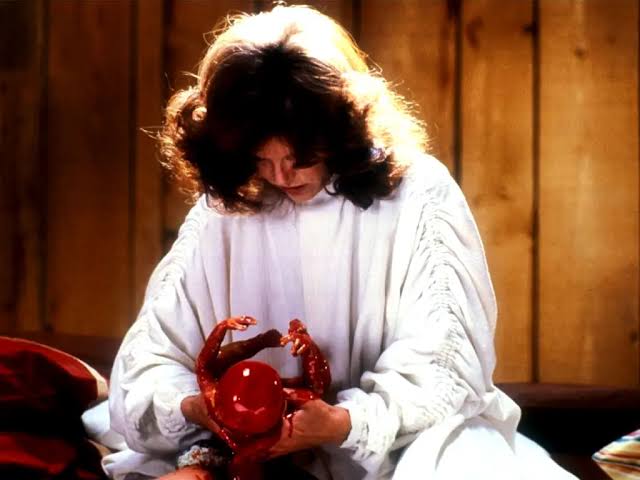
With The Brood, Cronenberg moved away from conventional infection and towards something more psychologically complex. The body becomes an expression of trauma. Pain becomes physical. Emotion becomes biological. The distinction between psychological and physiological suffering begins to disappear.

It is an idea that would become increasingly important to Cronenberg’s work. The body doesn’t simply experience the mind. It expresses it. This makes The Brood an important stepping stone towards The Fly. Seth Brundle’s transformation may be caused by science, but his experience is fundamentally emotional.

Fear.

Denial.

Anger.

Desperation.

Isolation.

His body becomes the physical manifestation of an existential crisis. Cronenberg’s monsters are therefore rarely just monsters. They are states of being.

Scanners: The Mind Is Flesh Too

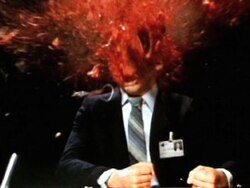
If The Brood explored the relationship between emotion and the body, Scanners expanded Cronenberg’s investigation into the relationship between mind and matter. The film’s infamous exploding-head sequence remains one of the most iconic images in Cronenberg’s cinema. Yet its deeper significance lies in the idea that the body cannot be separated from consciousness. The mind is not an abstract entity floating above the physical world.

It exists within flesh.

It is vulnerable to flesh.

And when the mind is overwhelmed, the body pays the price.

This becomes crucial in The Fly.

Seth’s intellect survives even as his physical form deteriorates.

He remains conscious.

He remains aware.

The tragedy is not that his mind disappears alongside his body. It is that it remains. The monster knows what is happening.

Videodrome: Welcome to the New Flesh

If there is a single film that provides the philosophical bridge between Cronenberg’s early body horror and The Fly, it is Videodrome.

“Long live the new flesh.”

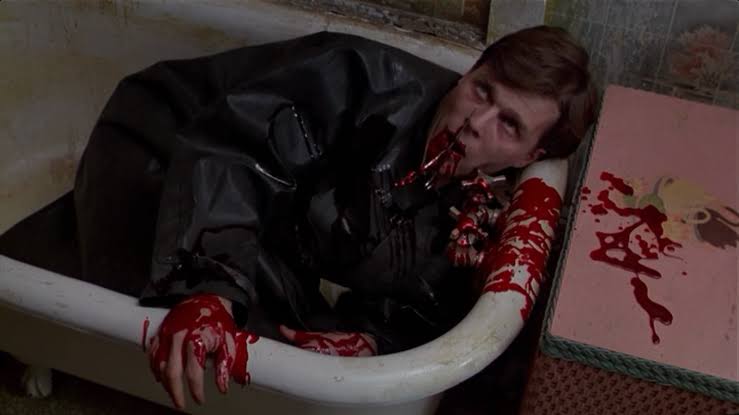
The phrase became a defining statement of Cronenberg’s cinema. In Videodrome, technology doesn’t simply affect the body. It becomes part of the body. The boundaries between human flesh, media and machinery collapse. Reality becomes unstable. The body becomes something that can be rewritten.

Transformed.

Reprogrammed.

The concept of the “New Flesh” is not simply about mutation. It is about the end of certainty. The human body is no longer a stable category. It can be altered by technology.

By disease.

By desire.

By trauma.

By information.

By the world around it.

By the time Seth Brundle enters the telepod, the question is no longer whether the body can change. Cronenberg has already answered that. The question is:

What happens when we discover that change cannot be stopped?

The Dead Zone: The Body as Burden

The Dead Zone is sometimes treated as an outlier in Cronenberg’s filmography. It shouldn’t be. Although it lacks the overt grotesquerie of Shivers or Videodrome, its protagonist is still trapped inside a body that has become unfamiliar. Johnny Smith wakes from a coma with extraordinary abilities. But those abilities come at a cost.

His body has changed.

His life has changed.

His identity has changed.

He is forced to live with knowledge that isolates him from everyone else.

The supernatural premise is different from Cronenberg’s earlier films, but the emotional territory remains familiar. The individual becomes trapped within a condition they did not choose. The body becomes a prison. The person remains inside.

The Human Animal

Cronenberg’s fascination with transformation has always extended beyond disease. It is also about evolution.

What separates humans from animals?

What happens when that boundary begins to disappear?

This question sits at the centre of The Fly.

Seth initially interprets his transformation as evolution. He calls it “Brundlefly.” He imagines that he has transcended the limitations of humanity. He has become something new.

Something stronger.

Something better.

The tragedy is that he is not entirely wrong. There is something seductive about his transformation.

He is faster.

Stronger.

More energetic.

His body initially appears to improve.

But Cronenberg turns evolutionary optimism into existential horror.

Evolution has no moral compass. New does not mean better. Stronger does not mean happier. Survival does not mean humanity. Seth’s transformation becomes a grotesque parody of progress.

Sex, Desire and the Body

Sexuality has always been deeply embedded within Cronenberg’s body horror. From Shivers onwards, physical intimacy is rarely presented as entirely safe. Desire creates vulnerability.

Bodies come together.

Boundaries disappear.

Something is exchanged.

In The Fly, the relationship between Seth and Veronica begins with attraction. Their intimacy becomes the emotional centre of the film. And then the body that Veronica loves begins to change. The horror is therefore deeply connected to intimacy.

To touch someone is to know their body.

To love someone is to recognise them.

What happens when the body becomes unrecognisable?

What happens when the person you desire becomes someone—or something—you fear?

The film’s body horror is therefore inseparable from its love story. The transformation is frightening because it happens to someone. Not something.

Technology as the Catalyst

Cronenberg’s relationship with technology is rarely simplistic. Technology is not necessarily evil. It is simply powerful. And human beings are often incapable of understanding the consequences of their own inventions.

This is why the telepods are so important. They work. Seth has succeeded. The experiment is a triumph of scientific ingenuity. The tragedy comes from an unforeseen consequence. Technology has done exactly what Seth asked it to do. It simply doesn’t understand what he meant. The telepod cannot distinguish between the scientist and the fly. It sees matter. It sees patterns. It sees two organisms occupying the same space. And it creates something new. The horror is therefore not technological failure. It is technological success without human wisdom.

The Body as Identity

Perhaps the most important idea connecting Cronenberg’s films is the relationship between physical form and identity.

If the body changes, are we still ourselves?

If the mind survives, does the person survive?

If the face changes, does identity change with it?

If desire changes, does the self change?

Cronenberg never provides easy answers.

Instead, his films continually destabilise the idea of a fixed identity.

The body becomes fluid.

The self becomes unstable.

The boundary between human and non-human becomes increasingly difficult to define. Seth Brundle represents the ultimate expression of this philosophy. He is neither entirely human nor entirely fly. He exists between categories. And that is precisely where Cronenberg’s cinema has always been most comfortable.

From Infection to Transformation

Looking across Cronenberg’s career, a progression becomes visible.

Shivers asks what happens when the body is invaded.

Rabid asks what happens when the body becomes contagious.

The Brood asks what happens when psychological trauma becomes physical.

Scanners asks what happens when the mind itself becomes a biological weapon.

Videodrome asks what happens when technology rewrites the body.

The Dead Zone asks what happens when the body becomes a prison for unwanted knowledge.

And then comes The Fly.

A film that asks all of these questions at once.

What happens when the body is invaded?

What happens when it becomes contagious?

What happens when the mind remains trapped inside it?

What happens when technology causes the transformation?

What happens when identity itself begins to dissolve?

The answer is Seth Brundle.

The Fly as Culmination

That is why The Fly occupies such a significant place within Cronenberg’s filmography.

It is not simply his most famous body-horror film.

It is his most complete.

The film takes the ideas that had occupied him for more than a decade and brings them together within a single character.

Seth is infected.

He is transforming.

His body is becoming contagious.

His mind is changing.

Technology has caused the mutation.

His identity is dissolving.

And the people who love him are forced to watch.

Everything is connected.

The horror is physical.

Psychological.

Sexual.

Technological.

Existential.

And emotional.

The body becomes the battlefield upon which all of these fears collide.

After Brundlefly

Cronenberg’s later career would move increasingly away from the visceral body horror that defined his early work. But the body never truly disappeared. It simply became less visible. The themes remained.

Identity.

Transformation.

Desire.

Technology.

Mortality.

The instability of the self.

Even when Cronenberg’s films moved into crime drama, psychological thriller or literary adaptation, the same fascination remained beneath the surface. His characters continued to inhabit bodies that could not be trusted.

Bodies that betrayed them.

Bodies that desired things the mind could not control.

Bodies that became sites of transformation.

The flesh remained.

The Prognosis:

David Cronenberg did not invent body horror. But he transformed its possibilities. He understood that the most disturbing thing about the human body is not what happens when something attacks it. It is what happens when it changes.

When it stops behaving as expected.

When it becomes unfamiliar.

When it begins to reveal something about ourselves that we would rather not see.

From the parasites of Shivers to the mutation of Rabid.

From the psychic violence of Scanners to the New Flesh of Videodrome.

From the isolated body of The Dead Zone to the tragic metamorphosis of The Fly.

Cronenberg’s cinema has always been asking variations of the same question.

Where does the human end?

Is it the skin?

The mind?

The memory?

The face?

The body?

The answer becomes increasingly difficult to locate. And perhaps that is the point. Because in Cronenberg’s universe, the body is never fixed. It is always becoming something else.

Sometimes that transformation is terrifying.

Sometimes it is liberating.

Sometimes it is both.

But eventually, every one of us must confront the uncomfortable truth at the centre of Cronenberg’s work.

We are not separate from our bodies.

We are them.

And when the body changes, so does the person inside it. Seth Brundle simply takes that journey further than most of us ever will. He becomes the ultimate Cronenbergian nightmare. Not because he stops being human. But because he discovers, far too late, just how fragile the idea of being human really was.

  • Saul Muerte

The Fly (1986) at 40: The Body Is the Horror

27 Monday Jul 2026

Posted by surgeons of horror in retrospective

≈ Leave a comment

Tags

body horror, brundlefly, david cronenberg, Geena Davis, jeff goldblum, seth brundle, the fly

There are monsters that lurk in the shadows.

There are monsters that emerge from beneath the bed.

There are monsters that arrive from another planet, another dimension, another time.

And then there are monsters that begin with us.

David Cronenberg’s The Fly is often described as one of the greatest body-horror films ever made. But that description, while accurate, feels strangely inadequate. Because The Fly isn’t frightening simply because a man’s body begins to change. It is frightening because he knows it is happening. He watches himself disappear.

Released in 1986, Cronenberg’s reimagining of the 1958 science-fiction horror film transformed a familiar monster-movie premise into something far more intimate and devastating. Where Kurt Neumann’s original film explored the consequences of scientific experimentation, Cronenberg turned the story inward, making the body itself the site of an existential catastrophe.

At its centre is Seth Brundle. A brilliant scientist. A man who believes technology can overcome the limitations of human existence. A man who falls in love. And then, through a moment of scientific accident, becomes something else entirely. The horror is not that Seth becomes a monster. The horror is that, for a while, he remains human enough to understand exactly what he is losing.

The Beautiful Lie of Progress

Seth Brundle’s teleportation experiment begins with optimism. He has created something extraordinary. The telepods can transport matter from one location to another. Instantaneously. The impossible has become possible.

In the world of The Fly, science is not inherently sinister. The experiment works. That is what makes it so terrifying. The telepods aren’t defective. Seth isn’t punished because his invention fails. He is punished because it succeeds in a way he never anticipated.

A fly enters the pod. Seth enters after it. The computer doesn’t understand that two organisms have occupied the same space. It simply combines them. The result is not an explosion. It is not immediate death. It is transformation. And transformation, as Cronenberg understands better than almost any filmmaker, is infinitely more frightening than destruction.

Death is an ending.

Change is a process.

The Horror of Becoming

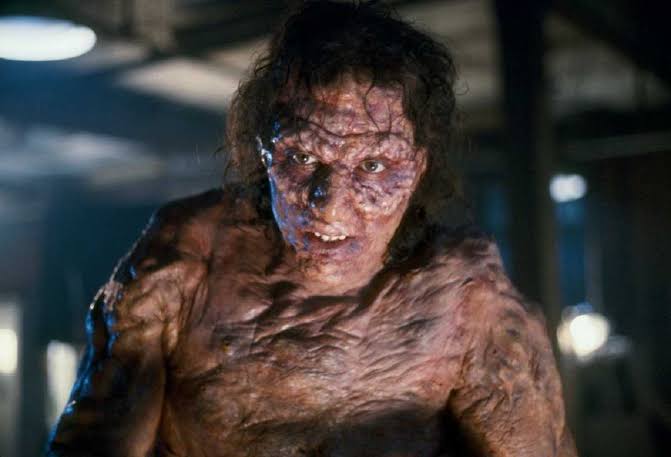
Seth doesn’t wake up one morning as Brundlefly. He becomes Brundlefly. That distinction forms the emotional foundation of the entire film. At first, the changes appear almost miraculous. Seth is stronger. More energetic. More confident. He moves with an exhilarating physicality. His body appears to have been improved. He calls it “the next step” in human evolution. For a brief moment, he believes he has transcended humanity.

This is perhaps the most seductive stage of the transformation. The monster doesn’t initially feel like a monster. It feels like an upgrade. Cronenberg’s genius is to make that idea both exhilarating and horrifying. Seth believes he has discovered something wonderful. The audience understands that he has discovered something terrible.

Then the body begins to betray him. The skin changes. The hair disappears. The fingernails loosen. The teeth become unstable. The body begins shedding itself. And Seth watches. That is the true horror.

The Body as Betrayal

Cronenberg’s cinema has always been fascinated by the fragile boundary between mind and flesh. In Shivers, the body becomes an instrument of infection. In Rabid, physical transformation becomes inseparable from sexuality. In The Brood, emotional trauma manifests physically. In Scanners, the mind becomes a weapon. In Videodrome, technology invades the body and consciousness itself.

By the time Cronenberg made The Fly, the body had become his most important cinematic landscape. But here, the body isn’t merely invaded. It is changing from within. Seth cannot escape himself. There is nowhere to run. No monster outside the window. No external force to defeat. His enemy is his own biology. The horror becomes profoundly intimate.

The Disease Film

It is tempting to view The Fly entirely through the lens of science fiction. But the film increasingly resembles something else. A disease narrative.

Seth develops symptoms. He rationalises them. He searches for explanations. He tries to understand what is happening. He becomes increasingly isolated. The people around him struggle to comprehend the transformation. And eventually, there is no cure.

The science-fiction premise provides the mechanism. The emotional experience is recognisably human. This is the horror of illness. Of watching someone change. Of witnessing the deterioration of someone you love. Of knowing that the person standing in front of you is still there somewhere, even as the body becomes unrecognisable. The fly is therefore not simply a monster. It is a metaphor for the terrifying unpredictability of mortality.

The Love Story at the Centre

Without Veronica Quaife, The Fly would still be an extraordinary piece of horror cinema. With her, it becomes something else. A tragedy.

Veronica isn’t merely the witness to Seth’s transformation. She is the person who loves him while it happens. That distinction gives the film its emotional weight. She meets Seth before the accident. She knows the man beneath the changing flesh. She remembers his voice, his humour, his intelligence and his vulnerability. As his body deteriorates, she is forced to confront an impossible question.

At what point does the person you love cease to be the person you know?

Cronenberg refuses to provide an easy answer. Seth remains Seth. And yet he doesn’t. He is simultaneously himself and something else. The film’s horror exists in that uncertainty.

Jeff Goldblum’s Transformation

Much has been written about the physical transformation of Jeff Goldblum’s Seth Brundle. The prosthetics. The makeup. The practical effects. The grotesque imagery. All of it remains extraordinary. But the true achievement belongs to Goldblum’s performance.

He doesn’t simply play a man becoming an insect. He plays a man discovering that he is becoming an insect. The distinction is enormous. The early Seth is charismatic and restless. He is brilliant but socially awkward. His excitement is infectious. As the transformation progresses, that energy becomes something more dangerous.

Confidence becomes arrogance.

Curiosity becomes obsession.

Euphoria becomes desperation.

The physical performance changes because the psychological performance changes. Goldblum doesn’t disappear beneath the makeup. He remains visible within it. That is why the transformation is so disturbing. We never forget who is underneath.

The New Flesh

Cronenberg’s concept of the “New Flesh” had already emerged through Videodrome, but The Fly offers perhaps its most accessible expression. Seth believes that he has evolved. He imagines himself as something beyond humanity. Yet the film presents evolution as indifferent rather than glorious.

There is no moral progression. No guarantee that “new” means “better.” The body changes because biology demands change. The universe doesn’t care whether the result is beautiful. It doesn’t care whether Seth is ready. And it certainly doesn’t care whether Veronica can bear to watch.

The New Flesh is therefore both promise and nightmare. Transformation without consent Evolution without morality. Progress without compassion.

The Monster We Pity

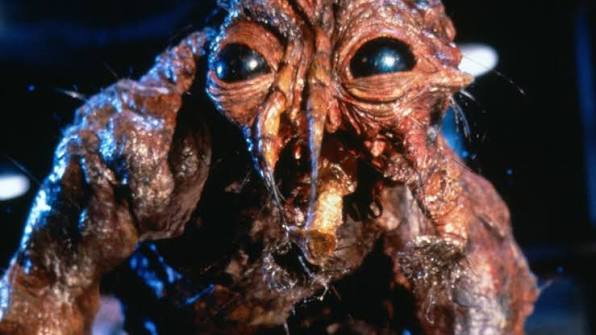
The great achievement of The Fly is that it makes the audience pity its monster. We don’t simply fear Brundlefly. We mourn him. The film continually asks us to remember the man who existed before the transformation. That memory becomes increasingly painful.

The more monstrous Seth becomes, the more desperately we want to find him. And eventually, the film confronts us with an unbearable possibility. Perhaps there is no Seth left to save. Or perhaps there is. Perhaps he is trapped somewhere inside the creature. Perhaps the monster understands exactly what it has become. The uncertainty is devastating.

The Horror of Care

There is another dimension to The Fly that becomes more apparent with age. The film is about caregiving. About witnessing decline. About loving someone whose body is changing beyond their control. Veronica’s experience is therefore not simply that of a horror heroine. She becomes a caretaker. A witness. An advocate. And eventually, the person who must confront the limits of compassion.

There is a profound cruelty in asking someone to remain beside you while you disappear. There is an equal cruelty in asking someone to leave. The Fly understands that love does not always provide solutions. Sometimes love simply means staying long enough to witness the truth.

The Horror of Mortality

Every great monster story contains a fear of death. The Fly contains something worse. It contains the fear of living while dying. Seth’s transformation is gradual. There is time to understand it. Time to fear it. Time to deny it. Time to rage against it. That makes the film more devastating than a simple creature feature.

Death is unavoidable. But the prospect of watching ourselves deteriorate piece by piece is something far more difficult to contemplate. Cronenberg forces the audience to confront that fear through flesh. The body becomes a clock. Every new symptom marks another step towards the inevitable.

Forty Years of Rot

Four decades after its release, The Fly remains one of the most extraordinary examples of mainstream body horror ever produced. The film was released by a major Hollywood studio. It featured recognisable stars. It possessed a substantial budget. And yet it refused to soften its central nightmare.

The practical effects remain shocking because they serve the story rather than overwhelm it. The gore is not decoration. It is narrative Every transformation tells us something about Seth’s physical and psychological decline. The body horror is therefore inseparable from the emotional horror. We recoil because we understand what the images mean.

The Remake That Became Something Else

Cronenberg’s film is technically a remake. But it feels less like a remake than a reinvention. The 1958 The Fly emerged from an era fascinated by atomic science and the dangers of experimentation. Cronenberg’s 1986 film belongs to another age. An era increasingly anxious about technology, genetic transformation, disease and the instability of the human body. The premise remains familiar. The nightmare changes.

That is what makes The Fly such a fascinating example of cinematic reinterpretation. The same story can be told twice. The monster can remain the same. Yet the fears surrounding it can evolve completely.

The Final Transformation

By the film’s conclusion, Seth Brundle has become almost entirely unrecognisable. But the tragedy is not that he has become an insect. It is that he knows what he has become. The final moments are not about defeating a monster. They are about acknowledging one. Veronica’s final act is not triumphant. It is devastating.

There is no victory. No cure. No restoration of the natural order. Only an ending. The kind of ending that forces us to confront the fact that some transformations cannot be reversed.

The Prognosis:

Forty years after David Cronenberg’s The Fly first entered cinemas, its reputation as a masterpiece of body horror remains entirely justified. But to describe it only as a body-horror film is to underestimate what Cronenberg achieved.

This is a film about disease.

About technology.

About evolution.

About sexuality.

About mortality.

About love.

And ultimately, about the terrifying fragility of identity.

Seth Brundle does not become frightening because he becomes less human. He becomes frightening because some part of his humanity remains. We recognise him. We remember him. We understand what he is losing. And because we understand that loss, we understand the film’s deepest horror.

The body is not a vessel we inhabit. It is the thing through which we experience ourselves. It is how we recognise one another.

How we touch.

How we love.

How we move through the world.

And eventually, it is the thing that betrays us.

That is why The Fly remains so powerful at forty. The monster is not the fly. The monster is the knowledge that none of us can remain unchanged forever. Seth Brundle simply gets to experience that truth sooner than the rest of us.

  • Saul Muerte

Shivers (1975) – Cronenberg’s Parasites of Paranoia

26 Friday Sep 2025

Posted by surgeons of horror in retrospective

≈ Leave a comment

Tags

allan kolman, barbara steele, david cronenberg, joe silver, lynn lowry, paul hampton, shivers, susan petrie

Being terrified is just the beginning!

Fifty years on, David Cronenberg’s Shivers still crawls under the skin with its unnerving mix of clinical detachment and raw, bodily horror. Long before he became a household name with The Fly or Videodrome, Cronenberg was already sketching out the blueprint for what would define his career: a fascination with the fragility of the body, the corruption of the mind, and the terrifyingly thin barrier between civilized society and primal chaos.

Set in a sterile, luxury apartment complex on the outskirts of Montreal, the film wastes no time in subverting its backdrop. The sleek modernity of Starliner Towers becomes the perfect incubator for dread when a strain of parasites begins infecting its residents. What starts as a medical curiosity spirals into an epidemic of violent, lust-fueled mania, leaving Dr. Roger St. Luc (Paul Hampton) desperately trying to contain the outbreak before it spills into the wider city.

Seen today, Shivers is more than just a scrappy feature—it’s a disturbing excavation of suburban sanity itself. Cronenberg peels back the polished façade of modern living to expose the harrowing paranoia festering beneath. The parasites aren’t just creatures; they’re symbols of desire, repression, and contagion, spreading through the building like gossip at a cocktail party, reminding us how easily fear and panic can travel.

While the low budget occasionally betrays its ambition, the rough edges only enhance the sense of unease. This is Cronenberg at his most raw and uncompromising, testing boundaries that would echo across his career. From here, he would refine his obsessions into the sleek terror of Scanners, the grotesque intimacy of The Fly, and the icy eroticism of Crash. But in Shivers, we see the first burst of infection—the moment body horror and social commentary fused into something unshakably his own.

The Prognosis:

Shivers hasn’t lost its bite. It’s grim, it’s uncomfortable, and it’s as relevant as ever in a world still haunted by viral outbreaks and communal fear. Cronenberg reminds us that the real horror doesn’t just come from outside—it festers within, waiting patiently to consume us all, one by one.

  • Saul Muerte

The Shrouds (2024) – Cronenberg’s Grief-Laced Techno-Tomb

02 Wednesday Jul 2025

Posted by surgeons of horror in Movie review

≈ Leave a comment

Tags

david cronenberg, diane kruger, film, guy pearce, movies, reviews, the-shrouds, vincent cassel

How dark are you willing to go? For David Cronenberg, The Shrouds marks another step into the abyss—one not of body horror, but of soul-rattling grief. This is arguably his most intimate and meditative work in decades, stitched together from threads of personal mourning, speculative technology, and the philosophical weight of death’s final curtain.

At the centre is Karsh (played with measured intensity by Vincent Cassel), a widower and tech entrepreneur who creates a radical new device: one that allows the living to peer into the graves of their deceased loved ones via digitally monitored “shrouds.” This deeply invasive (yet oddly spiritual) concept is classic Cronenberg—scientific progress colliding with deeply human frailty. But when a series of graves, including that of Karsh’s wife, are mysteriously desecrated, the film pivots into a sombre, noir-like mystery driven more by obsession than resolution.

From the turn of the century, Cronenberg’s work—Spider, A History of Violence, Cosmopolis, and Crimes of the Future—has leaned away from his earlier grotesque sensibilities and toward psychological excavation. The Shrouds is a continuation of that journey, and perhaps his most self-reflective piece since The Fly. With the recent passing of his wife, the film becomes a stark act of cinematic mourning—less a story than a eulogy.

The concept of the shroud here operates on multiple levels: biblically, as the linen of death and resurrection; metaphorically, as the veil between life and death; and narratively, as the enigma that cloaks Karsh’s unraveling. There’s also the ever-present shroud of mystery that clouds the truth—not only of the graveyard desecrations, but of Karsh himself. As the film progresses, Karsh becomes more opaque, his motives murkier, and his grief increasingly pathological. These twists are fascinating but also frustrating, leading the narrative into a fog of unanswered questions that might leave some viewers cold.

Yet Cronenberg surrounds Cassel with a stellar cast that brings warmth and depth. Diane Kruger and Guy Pearce, both enigmatic and grounded, help anchor the film in emotional reality even as it drifts into cerebral territory. Their performances are subtle yet compelling, with Pearce offering a particularly nuanced turn.

The Prognosis:

The Shrouds isn’t easy to love—but then again, grief rarely is. What it offers is a look into one man’s private hell, filtered through the lens of a director who has never shied away from uncomfortable truths. If its philosophical weight sometimes outweighs its dramatic clarity, it remains a compelling, mournful meditation from one of cinema’s most fearless auteurs.

  • Saul Muerte

The Shrouds will be screening in cinemas nationwide from Thu 3rd July.

Movie review: Crimes of the Future (2022)

27 Saturday Aug 2022

Posted by surgeons of horror in Movie review

≈ Leave a comment

Tags

david cronenberg, kristen stewart, lea seydoux, metaphysical horror, scott speedman, venereal horror, viggo mortensen

For a director considered one of a kind, and creating a unique vision for film with the birth of venereal horror, it seems interesting that David Cronenberg should return to the horror genre having been absent from the scene for 23 years. And yet, his latest entry, Crimes of the Future, (which shares the same title as his 1970 feature, but there the similarity ends) bears all the hallmarks of these earlier films in his canon of work combined with his more recent and psychological ventures. Where Cronenberg built his name through the physical and sensual characteristics of humanity, his other fascination in the metaphysical realm and human psyche has risen to the fore. 

There are familiar themes at play here with the advancements of humanity through biotechnology in this instance, but still the harbouring of infectious disease to remind us of our own frailty. The twist though is that infectious disease has been eradicated and humankind has been left with pushing the boundaries of morality without the risk of harm that can come about through surgical measures. These actions are now considered an art form; Cronenberg’s playground, a balance of art and physical horror with an intellectual bent, firmly in the mix. Confrontation is always at the heart of Cronenberg’s features, his curiosity to look at the way we shift and squirm a prime scrutiny of his work. In the opening scenes Crimes of the Future forces us into the realms of discomfort when a mother smothers her child with a pillow because she believes him to be inhuman.

In the film’s journey, we primarily follow Saul Tenser (Viggo Mortensen), who has an accelerated evolution syndrome, where he can develop new internal organs. This leads him to perform live surgical procedures carried out by his partner Caprice (Lea Seydoux). Much like Max Renn in Videodrome, Tenser is driven by his pursuit of truth and this exploration spirals deeper into a loss of control and a fatal resolution.

Tenser weaves his way through an investigation that sees him employed by a governmental agency to infiltrate a group of radicals. This sees him rub shoulders with the National Organ Registry where Timlin (Kristen Stewart) and Wippet (Don McKellar) work. Timlin is immediately enamoured by Tenser and is sexually drawn to him. 

There’s also Lang (Scott Speedman) who is the father of the afore-mentioned boy killed by his mother. Lang’s story is also a tragic one, driven to investigate his son’s condition that allowed him to consume plastics with no detriment to the human body. 

All these avenues intertwine into one complete examination of the human soul, immersed in a world where the physical is no longer a barrier. With no obstacles in place, what does it mean to be human? A question that continues to guide Cronenberg’s pursuit.

The Prognosis:

Mortality is and always be the vessel of David Cronenberg’s interests, be it through venereal horror, metaphysical horror, or sensual and intellectual obsessions. His latest vehicle is a culmination of them all, and through his uniqueness Cronenberg manages to project potentially his most complete image of himself, but in doing so, some of that identity gets lost in this portrayal. Without the edges; Without the pointy edges of quirkiness; David Cronenberg, much like his own lead characters, Max Renn; Seth Brundle; Beverly and Elliot Mantle, become lost in his pursuits and finds his own personality engulfed into obscurity.  Yet I still find myself drawn by his vision.

  • Saul Muerte

Retrospective: Scanners (1981)

26 Tuesday Jan 2021

Posted by surgeons of horror in Movie review, retrospective

≈ Leave a comment

Tags

david cronenberg, jennifer o'neill, michael ironside, patrick mcgoohan, scanners, stephen lack

It’s been 40 years since David Cronenberg’s visionary tale of telepathy, telekinesis and by now a recurring theme in the Canadian director’s work, espionage surrounded by political and government conspiracies embedded in a deeply psychoanalytical point of view. 

It’s hard to believe that this is Cronenberg’s seventh outing in the director’s chair, having already produced body horror films such as Shivers and Rabid, the latter of which had been reimagined by The Soska Sisters and is well worth your time. Scanners still has that low budget, earth feel to it that is often expected in the first few films in one’s career, and only two years later he would serve up a double hitter in the classics Videodrome and The Dead Zone.

Another theme that is prevalent throughout Cronenberg’s work is that of an uprising, often from an oppressed group or individual, but also that of misguided intentions that lead to their true calling.

In the case of Scanners, we are first introduced to Cameron Vale (Stephen Lack), who is ostracized from society by appearance at first, being a homeless figure trying to survive on the streets, but we quickly learn that he harbours the ability to read people’s minds and inflict pain on those who torment or ridicule him through telekinesis. This ability comes attached to a group in society known as scanners and when he is detected in a shopping mall, he is soon hunted down and subjected to close scrutiny and rehabilitation by Dr. Paul Ruth (Patrick McGoohan). 

Once he conforms to the will of Ruth and with it the Government agency that takes advantage of Ruth’s knowledge, Vale is then charged with hunting down a group of vigilantes led by Revok (Another fine turn from Michael Ironside). Can Revok be controlled? Or is there more to Revok’s revolution than meets the eye?

Scanners can be bookmarked as the film that changed Cronenberg’s career, moving away from the body horror image that had shaped his career at this point, and moving him into the mainstream playing field.
It still has some moments that reflect the style and substance that made Croeneberg’s name on screen, most notably this head explosion scene…

The prognosis:

Scanners does suffer a little in exposition and the lead performance from Stephen Lack, is somewhat stilted which detracts from engaging with the narrative. Whether this is down to the performance of the actor in question or the director’s choice in portrayal is hard to pin down, but it certainly curbs the film from being Cronenberg’s finest moment. It is still an enjoyable ride though and well worth your time to explore a master visionist honing his craft. 

  • Saul Muerte

Subscribe

  • Entries (RSS)
  • Comments (RSS)

Archives

  • August 2026
  • July 2026
  • June 2026
  • May 2026
  • April 2026
  • March 2026
  • February 2026
  • January 2026
  • December 2025
  • November 2025
  • October 2025
  • September 2025
  • August 2025
  • July 2025
  • June 2025
  • May 2025
  • April 2025
  • March 2025
  • February 2025
  • January 2025
  • December 2024
  • November 2024
  • October 2024
  • September 2024
  • August 2024
  • July 2024
  • June 2024
  • May 2024
  • April 2024
  • March 2024
  • February 2024
  • January 2024
  • November 2023
  • October 2023
  • September 2023
  • August 2023
  • July 2023
  • June 2023
  • May 2023
  • April 2023
  • March 2023
  • February 2023
  • January 2023
  • November 2022
  • October 2022
  • September 2022
  • August 2022
  • July 2022
  • June 2022
  • April 2022
  • March 2022
  • February 2022
  • January 2022
  • December 2021
  • November 2021
  • October 2021
  • September 2021
  • August 2021
  • July 2021
  • June 2021
  • May 2021
  • April 2021
  • March 2021
  • February 2021
  • January 2021
  • December 2020
  • November 2020
  • October 2020
  • September 2020
  • August 2020
  • July 2020
  • June 2020
  • May 2020
  • April 2020
  • March 2020
  • February 2020
  • January 2020
  • December 2019
  • November 2019
  • October 2019
  • September 2019
  • July 2019
  • June 2019
  • May 2019
  • April 2019
  • March 2019
  • February 2019
  • January 2019
  • December 2018
  • November 2018
  • October 2018
  • September 2018
  • August 2018
  • July 2018
  • June 2018
  • May 2018
  • April 2018
  • March 2018
  • February 2018
  • January 2018
  • December 2017
  • November 2017
  • October 2017
  • September 2017
  • August 2017
  • July 2017
  • June 2017
  • May 2017
  • April 2017
  • March 2017
  • February 2017
  • January 2017
  • December 2016
  • November 2016
  • October 2016
  • September 2016
  • August 2016
  • July 2016
  • June 2016
  • May 2016

Categories

  • A Night of Horror Film Festival
  • Alien franchise
  • Alliance Francaise French Film Festival
  • Australian Horror
  • Best Movies and Shows
  • Competition
  • dark nights film fest
  • episode review
  • Flashback Fridays
  • Friday the 13th Franchise
  • Full Moon Sessions
  • Halloween franchise
  • In Memorium
  • Interview
  • japanese film festival
  • John Carpenter
  • killer pigs
  • Library of the Occult
  • midwest weirdfest
  • MidWest WierdFest
  • MonsterFest
  • movie article
  • movie of the week
  • Movie review
  • New Trailer
  • News article
  • podcast episode
  • podcast review
  • press release
  • retrospective
  • Rialto Distribution
  • Ring Franchise
  • series review
  • Sounds of Horror
  • Soundtracks
  • Spanish horror
  • sydney film festival
  • Sydney Underground Film Festival
  • The Blair Witch Franchise
  • the conjuring franchise
  • the evil dead franchise
  • The Exorcist
  • The Howling franchise
  • Top 10 list
  • Top 12 List
  • top 13 films
  • Trash Night Tuesdays on Tubi
  • umbrella entertainment
  • Uncategorized
  • Universal Horror
  • Wes Craven
  • wes craven's the scream years

Meta

  • Create account
  • Log in

Blog at WordPress.com.

  • Subscribe Subscribed
    • Surgeons of Horror
    • Join 226 other subscribers
    • Already have a WordPress.com account? Log in now.
    • Surgeons of Horror
    • Subscribe Subscribed
    • Sign up
    • Log in
    • Report this content
    • View site in Reader
    • Manage subscriptions
    • Collapse this bar
Loading Comments...