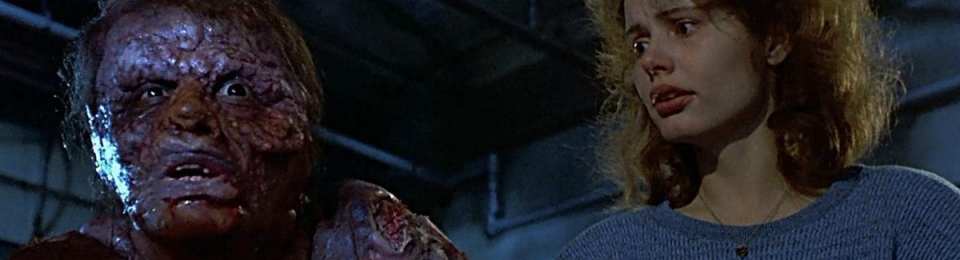
When audiences think back to David Cronenberg’s The Fly, the images that usually come first are those of Jeff Goldblum’s extraordinary transformation. They remember the telepods, the deteriorating flesh, the grotesque practical effects and the slow evolution of Seth Brundle into Brundlefly. It is one of horror cinema’s most iconic metamorphoses and, rightly, Goldblum’s performance has become inseparable from the film’s legacy.
Yet focusing solely on Seth’s transformation risks overlooking the character who gives the film its emotional centre. Without Veronica Quaife, The Fly would still be a landmark of body horror. With her, it becomes something far more devastating: a love story about watching someone disappear while they are still standing in front of you.
Geena Davis does far more than play the romantic lead. She becomes the audience’s emotional anchor, guiding us through a tragedy that is as much about witnessing irreversible change as it is about enduring it. While Seth experiences the horror from within, Veronica experiences it from the outside. She cannot stop the transformation, cannot reverse it and cannot fully understand it. All she can do is watch, hope and eventually accept what neither science nor love can overcome.
One of the reasons Veronica remains such a compelling character is that she is never written as a passive participant in the story. Horror cinema has often relegated women to the role of victim or survivor, but Veronica occupies a far more nuanced position. She is an accomplished science journalist whose curiosity introduces her to Seth Brundle’s revolutionary work. She is intelligent, professionally ambitious and emotionally independent long before romance enters the picture.
That independence is crucial because it establishes the relationship on equal terms. Veronica is not drawn to Seth because he rescues her or because the screenplay requires a romance. She falls in love with his brilliance, his awkward humour and his boundless enthusiasm. Seth’s eccentricity becomes part of his charm, and Goldblum and Davis’ real-life relationship lends these early scenes a warmth that feels remarkably natural. Before The Fly becomes a horror film, it is almost a romantic drama, allowing audiences to invest in two people whose affection feels authentic rather than manufactured.
This emotional groundwork is what transforms the film’s second half into something so painful. The audience is not simply watching a scientist mutate into a monster; they are watching a relationship slowly disintegrate under the weight of something neither partner can control. Veronica remains committed to Seth long after most people would have walked away, continually searching for traces of the man she first met beneath the increasingly grotesque exterior.
In many ways, Veronica’s journey resembles what psychologists now describe as anticipatory grief. It is the experience of mourning someone before they have physically died—a gradual process of recognising that the person you love is slipping away while still being physically present. Cronenberg captures this emotional reality with remarkable sensitivity. Seth is alive throughout the film, yet every stage of his transformation places another layer of distance between who he was and who he is becoming.
Geena Davis communicates this progression with extraordinary restraint. Rather than relying on dramatic emotional outbursts, she allows Veronica’s heartbreak to accumulate quietly. Small changes in expression, lingering silences and hesitant glances often reveal more than pages of dialogue ever could. As Seth becomes increasingly isolated within his own body, Veronica becomes increasingly isolated within her own grief. She is forced to watch events unfold with growing helplessness, recognising long before Seth does that there may be no cure.
Veronica’s profession also becomes surprisingly significant. As a journalist, she is trained to observe, investigate and seek evidence before reaching conclusions. Those instincts shape her response to Seth’s transformation. She refuses to dismiss what she is seeing, yet equally refuses to surrender to hysteria. Instead, she approaches the impossible with the same intellectual curiosity that first attracted her to Seth. Ironically, it is that shared belief in reason that makes the tragedy so much harder to bear. Knowledge offers neither of them comfort. It simply confirms the inevitability of what is happening.
As Seth’s physical deterioration accelerates, Veronica’s role gradually shifts from partner to caregiver. This aspect of The Fly often receives less attention than its spectacular body horror, yet it remains one of the film’s most emotionally truthful elements. She worries about Seth’s wellbeing, encourages him to seek help, attempts to protect him from his own increasingly destructive impulses and continues to care for him even as his appearance becomes almost unrecognisable.
Cronenberg presents caregiving not as heroic spectacle but as an act of quiet endurance. Veronica cannot fight the disease consuming Seth because there is no external enemy to defeat. Her greatest act of courage lies simply in remaining present. That emotional commitment gives The Fly much of its enduring humanity. The horror does not stem solely from physical mutation but from the painful recognition that love cannot always prevent loss.
The film’s infamous nightmare sequence, in which Veronica dreams of giving birth to a grotesque larval creature, extends these themes even further. On the surface, it functions as one of Cronenberg’s most memorable moments of body horror. Beneath that shock lies a profound anxiety about the body’s unpredictability. Seth’s mutation has infected Veronica’s imagination, transforming pregnancy—a symbol of hope and new life—into another source of terrifying uncertainty. It reinforces one of Cronenberg’s central ideas: the human body can never be fully controlled, even by those who inhabit it.
Throughout the film, Geena Davis never competes with the extraordinary makeup effects surrounding her. Instead, she grounds them. Every grotesque transformation Seth undergoes becomes emotionally meaningful because Veronica reacts not simply with fear, but with compassion, disbelief and lingering affection. She continually reminds both Seth and the audience that there is still a person worth saving beneath the decaying flesh.
This emotional perspective reaches its devastating conclusion during the film’s final moments. The horrific fusion of Brundlefly and the telepod remains one of horror cinema’s most unforgettable images, yet the true emotional climax belongs to Veronica. When the grotesque creature silently raises the shotgun towards itself, she immediately understands the request being made.
She is not destroying a monster.
She is granting mercy to the man she still recognises.
That distinction is what elevates the ending beyond conventional horror. Veronica’s final act is not one of victory but of compassion. She sees Seth when almost every visible trace of him has disappeared. In doing so, she reminds the audience that humanity cannot always be measured by appearance alone.
Looking back forty years later, Veronica Quaife feels more relevant than ever. Modern audiences, particularly those who have experienced serious illness, degenerative disease or the responsibilities of caregiving, often recognise her journey as much as Seth’s. While The Fly is frequently celebrated for its astonishing practical effects, its emotional longevity owes just as much to Davis’ understated performance. She transforms a story of physical mutation into a meditation on love, grief and acceptance.
The Prognosis:
If Seth Brundle embodies the horror of losing oneself, Veronica Quaife embodies the heartbreak of watching someone you love disappear piece by piece. Geena Davis gives The Fly its emotional soul, ensuring that beneath every layer of prosthetic makeup remains a relationship worth mourning. Her performance reminds us that monsters are rarely frightening simply because of what they become. They are frightening because someone remembers who they used to be.
Forty years after its release, The Fly continues to move audiences not solely because of Brundlefly’s extraordinary transformation, but because Veronica never stops searching for Seth beneath it. In the end, she teaches us the film’s most profound truth: love does not end when bodies change. It simply asks more of those who remain.
- Saul Muerte

