There are remakes that attempt to improve upon their predecessors, remakes that attempt to modernise them and remakes that seem almost determined to prove that the original was never really the story we thought it was.
David Cronenberg’s The Fly belongs to the last category.
Kurt Neumann’s 1958 film and Cronenberg’s 1986 version share a title, a basic premise and a grisly fascination with the consequences of scientific experimentation. Both feature a scientist who accidentally merges his genetic material with that of a fly. Both involve a transformation that cannot be reversed. Both ultimately arrive at tragedy.
And yet, watching them side by side, they barely feel like the same film.
That difference is precisely what makes the two Flies so fascinating.
The 1958 The Fly is a film about scientific transgression. Cronenberg’s The Fly is a film about the body itself becoming the transgression.
One looks outward at the dangers of scientific progress.
The other looks inward.
One asks what happens when man plays God.
The other asks what happens when the person you love begins to disappear inside a body that is no longer human.
Forty years after Cronenberg’s film, the relationship between these two movies remains one of the great case studies in how a filmmaker can take the skeleton of an existing story and discover an entirely different horror film living inside it.
The Same Accident
The basic premise is remarkably similar.
In The Fly (1958), brilliant scientist André Delambre has developed a teleportation device capable of transporting matter from one location to another. During an experiment, an ordinary housefly enters the teleportation chamber with him.
Something goes wrong.
When André emerges, his atoms have been combined with those of the fly.
In Cronenberg’s film, Seth Brundle has also developed a teleportation system. His “telepods” are capable of transporting matter across space, although Brundle has yet to perfect the process for living organisms.
After a drunken night, Brundle decides to teleport himself.
A fly is already inside the pod.
The experiment works.
Except that it doesn’t.
The difference is crucial.
In Neumann’s film, the accident is essentially a malfunction.
In Cronenberg’s, the machine has worked perfectly.
That small alteration changes everything.
The horror of the 1958 film comes from failure.
The horror of the 1986 film comes from success.
That is one of Cronenberg’s most brilliant conceptual changes.
Seth hasn’t broken his machine.
He has demonstrated that it works.
The problem is what happens when technology does precisely what we ask it to do.
André Delambre: The Scientist as Victim
David Hedison’s Seth Brundle is perhaps the character most audiences associate with The Fly, but Al Hedison’s André Delambre—credited under the name David Hedison—is an equally fascinating creation.
André is a traditional 1950s mad-scientist figure, although the film is careful not to make him particularly mad.
He isn’t seeking immortality.
He isn’t trying to conquer the world.
He isn’t attempting to create a superior species.
He is a scientist fascinated by the possibility of instantaneous transportation.
His experiment is driven by intellectual curiosity.
That makes his transformation tragic rather than punitive.
André has not really done anything deserving of his fate.
He has simply gone too far.
That distinction reflects the anxieties of the era.
The post-war world had witnessed scientific achievements that once would have seemed impossible. Nuclear technology had demonstrated that scientific advancement could radically alter the human condition, while the Space Race and rapid technological development continued to expand the boundaries of what seemed possible.
The question wasn’t necessarily whether science could change the world.
It was whether humanity understood the consequences of doing so.
The Fly turns that anxiety into flesh.
Seth Brundle: The Scientist as Experiment
Jeff Goldblum’s Seth Brundle begins in a very different place.
He is younger, eccentric and almost charmingly socially dysfunctional. His relationship with science is not merely professional. It defines him.
When Veronica Quaife enters his world, she becomes fascinated by the telepods and by the man behind them.
Seth isn’t simply experimenting with teleportation.
He is experimenting with possibility.
And this is where Cronenberg radically alters the emotional architecture of the story.
André’s tragedy is largely experienced by those around him.
Seth’s transformation becomes increasingly intimate.
We watch it happen.
We experience it with him.
His body changes.
His mind changes.
His appetites change.
His sexuality changes.
His relationship with Veronica changes.
His understanding of himself changes.
The transformation therefore isn’t simply something that happens to Seth.
It becomes something he is forced to experience from inside.
Cronenberg turns the scientist into both protagonist and specimen.
The Fly as Science Fiction
The 1958 film is fundamentally a science-fiction horror movie.
Its central invention—the matter-transmitting machine—is the story’s great technological marvel.
The horror comes from what happens when the technology goes wrong.
There is still a wonderful sense of wonder in the film. The teleportation device is treated as something extraordinary, almost miraculous. André has achieved something that could revolutionise transportation.
The tragedy is that his breakthrough becomes his undoing.
The film therefore maintains a certain optimism about scientific progress even while warning about its dangers.
Science is powerful.
Science is dangerous.
Science must be respected.
It is a very 1950s conception of technological horror.
Cronenberg has almost no interest in preserving that optimism.
By 1986, the machine is no longer the miracle.
It is simply the mechanism through which the body becomes corrupted.
The technology is cold, clinical and increasingly irrelevant once the transformation begins.
The machine gets Seth into trouble.
His body is what keeps him there.
The Fly as Body Horror
This is where Cronenberg’s The Fly ceases to be a remake in the conventional sense.
It becomes a body-horror film.
The transformation isn’t merely a special effect.
It is the narrative.
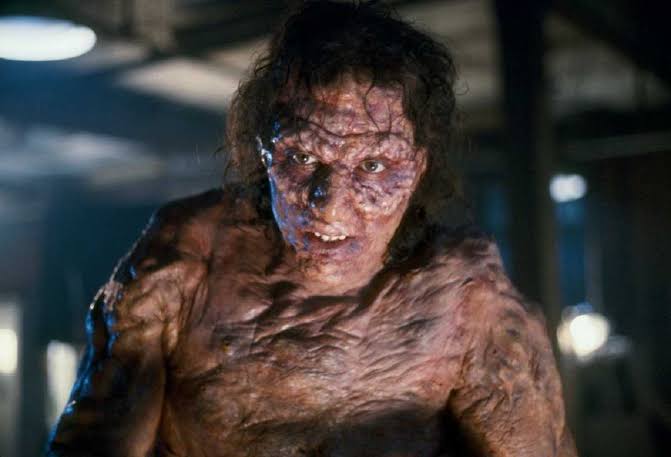
Seth begins losing his fingernails.
His skin changes.
His teeth fall out.
His hair disappears.
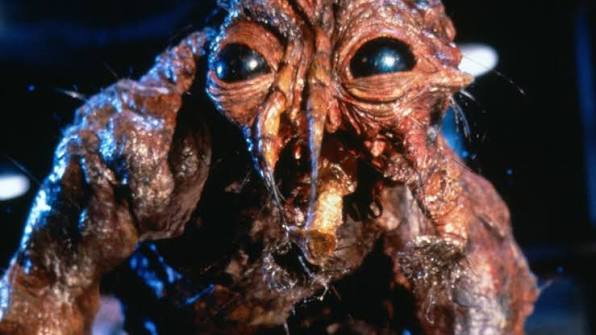
His body becomes increasingly insectoid.
His physical strength increases while his humanity diminishes.
Eventually, his body begins literally coming apart.
Cronenberg doesn’t allow the transformation to remain abstract.
We see it.
We hear it.
We watch Seth touch the things that are falling away from him.
The famous vomiting sequence is not simply grotesque comedy. It is a declaration of intent.
This film is going to make biological transformation unavoidable.
The body isn’t a metaphor placed on top of the story.
The body is the story.
And that is arguably the defining difference between the two films.
The Fly and the Fear of Ageing
There is another significant difference hidden inside the transformation.
The 1958 film is concerned with scientific catastrophe.
The 1986 film is also concerned with ageing.
Seth’s transformation is horrifying partly because it accelerates something all human beings experience.
His body begins changing without his consent.
His appearance deteriorates.
His physical abilities alter.
His body becomes unfamiliar.
He becomes increasingly aware that he cannot stop the process.
There is something brutally human beneath the science-fiction premise.
We are all, eventually, forced to confront a body that changes without asking our permission.
Cronenberg simply makes that process immediate, grotesque and impossible to ignore.
Seth doesn’t gradually age.
He metamorphoses.
And in doing so, he becomes a grotesque embodiment of the fear of losing ownership over one’s own body.
The Fly and Sexuality
Cronenberg also makes sexuality central to the transformation.
Seth and Veronica’s relationship begins with attraction and curiosity.
Their sexual relationship becomes one of the film’s most important emotional anchors.
Then Seth changes.
His sexuality changes with him.
His confidence becomes aggression.
His desire becomes increasingly animalistic.
His relationship with Veronica becomes complicated by his transformation.
This is a crucial departure from the 1958 film.
The earlier movie is concerned with scientific catastrophe and the destruction of a family.
Cronenberg’s film is concerned with intimacy.
What happens when the person you desire begins transforming into something you can no longer recognise?
What happens when attraction becomes repulsion?
What happens when love survives longer than the body it was attached to?
These questions make The Fly profoundly uncomfortable because the horror is not happening somewhere distant.
It is happening between two people.
Veronica Quaife Changes Everything
Patricia Owens’ Helene Delambre is central to the 1958 film, but Veronica Quaife serves a very different dramatic purpose.
Geena Davis isn’t simply an observer of Seth’s transformation.
She is emotionally entangled in it.
Her relationship with Seth gives Cronenberg’s film its human centre.
The horror is not merely that Seth is becoming a fly.
The horror is that Veronica is watching someone she loves disappear.
That distinction becomes crucial in the film’s final act.
The question is no longer:
Can Seth be saved?
It becomes:
What does love mean when there is almost nothing left to save?
The 1958 film ultimately remains a tragedy of scientific accident.
Cronenberg transforms it into a tragedy of intimacy.
And that is a far more painful proposition.
Two Different Monsters
The two films also offer radically different ideas of the monster.
In the 1958 film, the monstrous form is externalised.
André’s head and arm become fly-like while his body remains recognisably human.
The famous white-headed fly becomes a separate object of horror.
The audience can look at the monster.
There is a degree of distance.
Cronenberg destroys that distance.
There is no separate monster.
Seth is the monster.
The fly is inside him.
The fly is becoming him.
And eventually, the distinction between the two becomes meaningless.
This is one of the reasons Cronenberg’s creature effects remain so effective.
The audience isn’t watching an actor in a monster costume.
We are watching a human body progressively cease to obey the definition of human.
That is far more disturbing.
The Question of Identity
The transformation in both films raises the question of whether the transformed scientist remains the same person.
But Cronenberg pushes the question much further.
At what point does Seth stop being Seth?
Is it when his body changes?
When his behaviour changes?
When his thoughts become increasingly insect-like?
When he begins referring to himself as “Brundlefly”?
Or is Seth still present right until the end?
The film never provides a comfortable answer.
That ambiguity is essential.
If Seth simply dies and a monster takes his place, the story becomes straightforward.
But that isn’t what happens.
There is still a consciousness inside the creature.
There is still memory.
There is still love.
There is still recognition.
And that makes the final stages of the transformation so devastating.
The monster remembers being human.
The Tragedy of Progress
Both films ultimately contain a warning about progress, but they express it very differently.
The 1958 film essentially says:
Be careful what science makes possible.
Cronenberg’s film asks something more troubling:
What if progress works?
The telepods are not a failure.
They function.
Seth has genuinely solved teleportation.
The discovery could change civilisation.
It could revolutionise transportation.
It could transform medicine.
It could fundamentally alter the relationship between humans and physical space.
And that is precisely why the film’s horror works.
Seth’s catastrophe doesn’t invalidate his invention.
It proves its potential.
The machine has done exactly what it was designed to do.
It simply wasn’t designed to understand what a human being actually is.
1958: The Horror of the Machine
Kurt Neumann’s film therefore remains fascinating because its horror is ultimately technological.
The machine represents a threshold.
André crosses it.
He cannot come back.
There is something wonderfully old-fashioned about the film’s anxiety.
The scientist has opened a door that should perhaps have remained closed.
It is the same basic fear that runs through countless science-fiction stories of the period.
We discover something extraordinary.
We use it before understanding it.
The consequences are catastrophic.
Yet there is still a sense that the technology itself is morally neutral.
It is the human error surrounding it that creates the disaster.
1986: The Horror of the Body
Cronenberg is much less interested in whether the technology is morally neutral.
He is interested in what happens once technology enters the body.
The telepods are almost incidental.
They are the catalyst.
The real horror is biological.
This is what makes The Fly such an important film in the development of modern body horror.
Cronenberg understands that the human body is already a terrifying thing.
It grows.
It changes.
It heals.
It decays.
It produces fluids.
It breaks.
It ages.
And eventually it dies.
The science-fiction premise simply gives him permission to accelerate all of those processes.
The fly is therefore less frightening because it is an insect than because it provides a mechanism through which Seth can lose control of his own physical existence.
Two Films About Death
Ultimately, both The Fly films are about death.
But they arrive at death from opposite directions.
The 1958 film begins with science and ends with tragedy.
The 1986 film begins with science and ends with dissolution.
André’s transformation is a horrible accident that must be reversed.
Seth’s transformation becomes an irreversible process that must eventually be accepted.
That difference changes the emotional impact of the endings.
The 1958 film offers a conventional horror resolution.
The 1986 film offers something much closer to mourning.
Veronica doesn’t simply lose Seth.
She watches him disappear.
Piece by piece.
Cell by cell.
Memory by memory.
The horror lies in being forced to remain present for the process.
A Remake That Became Something Else
Perhaps the greatest achievement of Cronenberg’s The Fly is that it doesn’t require the 1958 film to be inferior.
The two films simply operate on different frequencies.
Kurt Neumann’s film is an elegant piece of 1950s science-fiction horror, built around the anxieties of technological progress and scientific experimentation.
Cronenberg’s film takes the same premise and turns it into something more intimate, sexual, biological and existential.
One is about a machine that goes wrong.
The other is about a body that goes wrong.
One is concerned with the danger of discovering something humanity isn’t ready to control.
The other is concerned with the terrifying possibility that we may never have been in control of our bodies in the first place.
That is why the 1986 film doesn’t feel like an attempt to replace its predecessor.
It feels like an excavation.
Cronenberg finds the body horror buried underneath the science fiction.
He finds the tragedy buried underneath the accident.
He finds the love story buried underneath the monster movie.
And then he drags all three into the light.
Which Fly Is More Frightening?
The answer depends entirely on what frightens you.
If the idea of scientific experimentation escaping human control is your nightmare, the 1958 film remains remarkably effective.
If your fear lies in bodily deterioration, disease, ageing, sexuality, loss of identity and watching someone you love become something you can no longer recognise, Cronenberg’s The Fly is in another category entirely.
But perhaps the most interesting way to view them is not as competitors.
It is as a conversation across generations.
The 1958 film asks what happens when science moves too quickly.
The 1986 film asks what happens when science moves inside us.
The first fears the machine.
The second fears the flesh.
And between them, the two films chart a remarkable shift in the language of horror itself.
The Fly at 40
Forty years after Cronenberg’s film arrived, it is tempting to talk about The Fly as though it simply perfected an existing story.
It didn’t.
It reinterpreted it.
That distinction matters.
The original The Fly remains the foundation. Without Neumann’s film, there would be no telepods, no André Delambre and no basic story of a scientist whose experiment merges him with an insect.
But Cronenberg understood that a remake becomes worthwhile when it discovers something the original could not—or did not—say.
His The Fly takes a Cold War-era science-fiction cautionary tale and turns it into an existential horror story about the body, identity, love and mortality.
It is a film about progress, but it is also a film about regression.
It is about scientific achievement, but also about biological inevitability.
It is about becoming something new.
And it is about losing everything that made you who you were.
That is why the two Flies remain so fascinating together.
1958 asks what happens when man becomes a monster because science fails.
1986 asks what happens when science succeeds—and the human body is the price.
The first Fly gave us the accident.
Cronenberg gave us the transformation.
And forty years later, it is the transformation that still refuses to let us look away.
The machine worked.
The body didn’t.
- Saul Muerte