
How David Cronenberg Turned Flesh Into Fear
Before Seth Brundle stepped into the telepod, David Cronenberg had already spent more than a decade asking audiences to look at the human body differently. Not as something sacred. Not as something inviolable. But as something vulnerable. Something porous. Something capable of changing without permission.
From the parasitic creatures of Shivers to the psychic violence of Scanners, from the biological mutation of Rabid to the technological nightmare of Videodrome, Cronenberg’s cinema has repeatedly returned to the same unsettling proposition:
The body is not a fixed thing.
It is a process.
And processes can go wrong.
By the time The Fly arrived in 1986, Cronenberg had already established himself as one of cinema’s great anatomists of fear. Yet the film represents something more than another entry in his growing body of work. It is a culmination. Everything Cronenberg had been exploring—the relationship between flesh and identity, science and mutation, sexuality and disease, technology and transformation—converges in Seth Brundle’s tragic metamorphosis. The fly did not arrive from nowhere. Cronenberg had been building towards it for years.
The Parasite Within
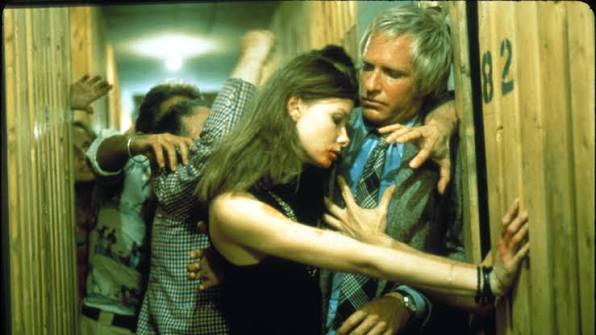
Shivers—released in 1975—announced Cronenberg as a filmmaker fascinated by the vulnerability of the human body. Its premise is deliberately grotesque. Parasitic creatures spread through a luxury apartment complex, transforming the residents into sexually driven hosts. But beneath the visceral horror lies an idea that would become central to Cronenberg’s cinema. The body can be invaded. Worse still, it can be persuaded to betray us.
The parasites in Shivers do not simply attack their victims from outside. They become part of them. The boundary between self and other begins to collapse.
This is a recurring Cronenberg anxiety. What happens when something enters the body and cannot be removed? What happens when the thing we fear is no longer outside us? What happens when we become the host? These questions would return repeatedly throughout his career. And eventually, in The Fly, the invader would be almost impossibly small.
A single insect.
A moment of contamination.
One microscopic intrusion capable of changing everything.
Rabid: The Body as Transmission

If Shivers introduced the idea of bodily invasion, Rabid developed it into something more recognisably biological. Rose is transformed following experimental surgery. The result is not merely physical alteration. Her body becomes a vector. An instrument of transmission. Those she encounters are infected. The personal becomes communal. The individual body becomes a threat to everyone around it.
Cronenberg’s fascination with disease is already apparent. The horror does not remain contained within one person.
It spreads.
It moves.
It crosses boundaries.
The body becomes both victim and perpetrator. That duality is crucial to understanding The Fly. Seth Brundle is both the person suffering from his transformation and the creature capable of causing harm. His tragedy is therefore not simply that his body is changing. It is that the transformation begins to change his relationship with everyone else. The disease becomes identity.
The Brood: Trauma Made Flesh
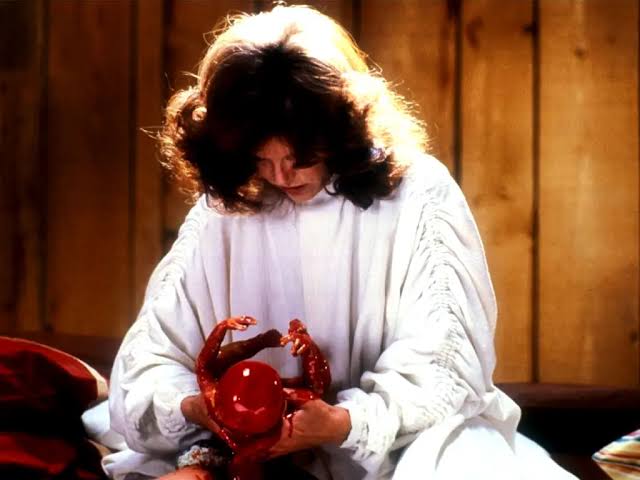
With The Brood, Cronenberg moved away from conventional infection and towards something more psychologically complex. The body becomes an expression of trauma. Pain becomes physical. Emotion becomes biological. The distinction between psychological and physiological suffering begins to disappear.
It is an idea that would become increasingly important to Cronenberg’s work. The body doesn’t simply experience the mind. It expresses it. This makes The Brood an important stepping stone towards The Fly. Seth Brundle’s transformation may be caused by science, but his experience is fundamentally emotional.
Fear.
Denial.
Anger.
Desperation.
Isolation.
His body becomes the physical manifestation of an existential crisis. Cronenberg’s monsters are therefore rarely just monsters. They are states of being.
Scanners: The Mind Is Flesh Too
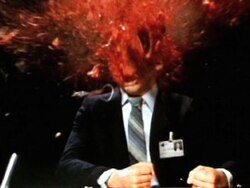
If The Brood explored the relationship between emotion and the body, Scanners expanded Cronenberg’s investigation into the relationship between mind and matter. The film’s infamous exploding-head sequence remains one of the most iconic images in Cronenberg’s cinema. Yet its deeper significance lies in the idea that the body cannot be separated from consciousness. The mind is not an abstract entity floating above the physical world.
It exists within flesh.
It is vulnerable to flesh.
And when the mind is overwhelmed, the body pays the price.
This becomes crucial in The Fly.
Seth’s intellect survives even as his physical form deteriorates.
He remains conscious.
He remains aware.
The tragedy is not that his mind disappears alongside his body. It is that it remains. The monster knows what is happening.
Videodrome: Welcome to the New Flesh

If there is a single film that provides the philosophical bridge between Cronenberg’s early body horror and The Fly, it is Videodrome.
“Long live the new flesh.”
The phrase became a defining statement of Cronenberg’s cinema. In Videodrome, technology doesn’t simply affect the body. It becomes part of the body. The boundaries between human flesh, media and machinery collapse. Reality becomes unstable. The body becomes something that can be rewritten.
Transformed.
Reprogrammed.
The concept of the “New Flesh” is not simply about mutation. It is about the end of certainty. The human body is no longer a stable category. It can be altered by technology.
By disease.
By desire.
By trauma.
By information.
By the world around it.
By the time Seth Brundle enters the telepod, the question is no longer whether the body can change. Cronenberg has already answered that. The question is:
What happens when we discover that change cannot be stopped?
The Dead Zone: The Body as Burden
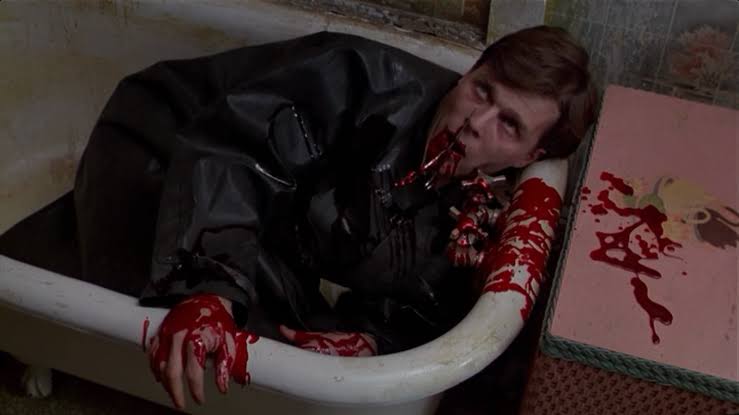
The Dead Zone is sometimes treated as an outlier in Cronenberg’s filmography. It shouldn’t be. Although it lacks the overt grotesquerie of Shivers or Videodrome, its protagonist is still trapped inside a body that has become unfamiliar. Johnny Smith wakes from a coma with extraordinary abilities. But those abilities come at a cost.
His body has changed.
His life has changed.
His identity has changed.
He is forced to live with knowledge that isolates him from everyone else.
The supernatural premise is different from Cronenberg’s earlier films, but the emotional territory remains familiar. The individual becomes trapped within a condition they did not choose. The body becomes a prison. The person remains inside.
The Human Animal
Cronenberg’s fascination with transformation has always extended beyond disease. It is also about evolution.
What separates humans from animals?
What happens when that boundary begins to disappear?
This question sits at the centre of The Fly.
Seth initially interprets his transformation as evolution. He calls it “Brundlefly.” He imagines that he has transcended the limitations of humanity. He has become something new.
Something stronger.
Something better.
The tragedy is that he is not entirely wrong. There is something seductive about his transformation.
He is faster.
Stronger.
More energetic.
His body initially appears to improve.
But Cronenberg turns evolutionary optimism into existential horror.
Evolution has no moral compass. New does not mean better. Stronger does not mean happier. Survival does not mean humanity. Seth’s transformation becomes a grotesque parody of progress.
Sex, Desire and the Body
Sexuality has always been deeply embedded within Cronenberg’s body horror. From Shivers onwards, physical intimacy is rarely presented as entirely safe. Desire creates vulnerability.
Bodies come together.
Boundaries disappear.
Something is exchanged.
In The Fly, the relationship between Seth and Veronica begins with attraction. Their intimacy becomes the emotional centre of the film. And then the body that Veronica loves begins to change. The horror is therefore deeply connected to intimacy.
To touch someone is to know their body.
To love someone is to recognise them.
What happens when the body becomes unrecognisable?
What happens when the person you desire becomes someone—or something—you fear?
The film’s body horror is therefore inseparable from its love story. The transformation is frightening because it happens to someone. Not something.
Technology as the Catalyst
Cronenberg’s relationship with technology is rarely simplistic. Technology is not necessarily evil. It is simply powerful. And human beings are often incapable of understanding the consequences of their own inventions.
This is why the telepods are so important. They work. Seth has succeeded. The experiment is a triumph of scientific ingenuity. The tragedy comes from an unforeseen consequence. Technology has done exactly what Seth asked it to do. It simply doesn’t understand what he meant. The telepod cannot distinguish between the scientist and the fly. It sees matter. It sees patterns. It sees two organisms occupying the same space. And it creates something new. The horror is therefore not technological failure. It is technological success without human wisdom.
The Body as Identity
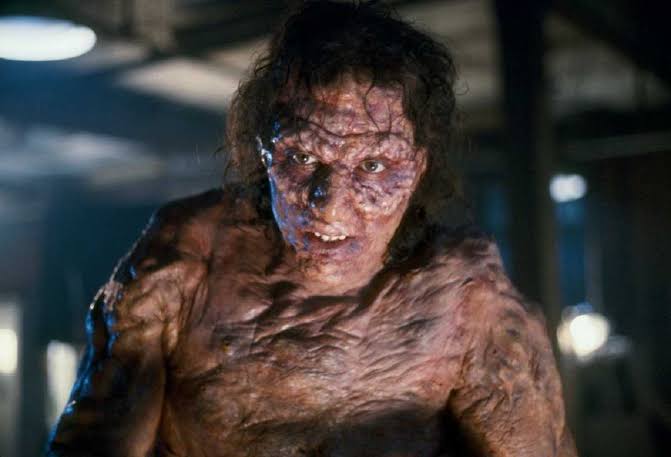
Perhaps the most important idea connecting Cronenberg’s films is the relationship between physical form and identity.
If the body changes, are we still ourselves?
If the mind survives, does the person survive?
If the face changes, does identity change with it?
If desire changes, does the self change?
Cronenberg never provides easy answers.
Instead, his films continually destabilise the idea of a fixed identity.
The body becomes fluid.
The self becomes unstable.
The boundary between human and non-human becomes increasingly difficult to define. Seth Brundle represents the ultimate expression of this philosophy. He is neither entirely human nor entirely fly. He exists between categories. And that is precisely where Cronenberg’s cinema has always been most comfortable.
From Infection to Transformation
Looking across Cronenberg’s career, a progression becomes visible.
Shivers asks what happens when the body is invaded.
Rabid asks what happens when the body becomes contagious.
The Brood asks what happens when psychological trauma becomes physical.
Scanners asks what happens when the mind itself becomes a biological weapon.
Videodrome asks what happens when technology rewrites the body.
The Dead Zone asks what happens when the body becomes a prison for unwanted knowledge.
And then comes The Fly.
A film that asks all of these questions at once.
What happens when the body is invaded?
What happens when it becomes contagious?
What happens when the mind remains trapped inside it?
What happens when technology causes the transformation?
What happens when identity itself begins to dissolve?
The answer is Seth Brundle.
The Fly as Culmination
That is why The Fly occupies such a significant place within Cronenberg’s filmography.
It is not simply his most famous body-horror film.
It is his most complete.
The film takes the ideas that had occupied him for more than a decade and brings them together within a single character.
Seth is infected.
He is transforming.
His body is becoming contagious.
His mind is changing.
Technology has caused the mutation.
His identity is dissolving.
And the people who love him are forced to watch.
Everything is connected.
The horror is physical.
Psychological.
Sexual.
Technological.
Existential.
And emotional.
The body becomes the battlefield upon which all of these fears collide.
After Brundlefly
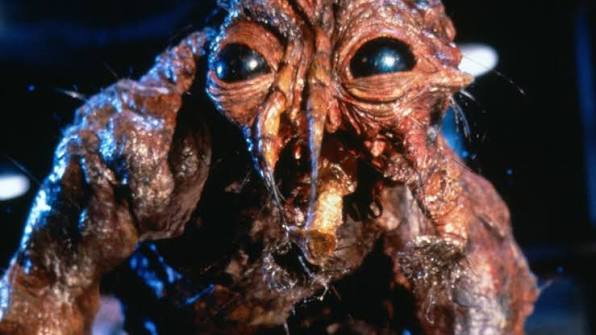
Cronenberg’s later career would move increasingly away from the visceral body horror that defined his early work. But the body never truly disappeared. It simply became less visible. The themes remained.
Identity.
Transformation.
Desire.
Technology.
Mortality.
The instability of the self.
Even when Cronenberg’s films moved into crime drama, psychological thriller or literary adaptation, the same fascination remained beneath the surface. His characters continued to inhabit bodies that could not be trusted.
Bodies that betrayed them.
Bodies that desired things the mind could not control.
Bodies that became sites of transformation.
The flesh remained.
The Prognosis:
David Cronenberg did not invent body horror. But he transformed its possibilities. He understood that the most disturbing thing about the human body is not what happens when something attacks it. It is what happens when it changes.
When it stops behaving as expected.
When it becomes unfamiliar.
When it begins to reveal something about ourselves that we would rather not see.
From the parasites of Shivers to the mutation of Rabid.
From the psychic violence of Scanners to the New Flesh of Videodrome.
From the isolated body of The Dead Zone to the tragic metamorphosis of The Fly.
Cronenberg’s cinema has always been asking variations of the same question.
Where does the human end?
Is it the skin?
The mind?
The memory?
The face?
The body?
The answer becomes increasingly difficult to locate. And perhaps that is the point. Because in Cronenberg’s universe, the body is never fixed. It is always becoming something else.
Sometimes that transformation is terrifying.
Sometimes it is liberating.
Sometimes it is both.
But eventually, every one of us must confront the uncomfortable truth at the centre of Cronenberg’s work.
We are not separate from our bodies.
We are them.
And when the body changes, so does the person inside it. Seth Brundle simply takes that journey further than most of us ever will. He becomes the ultimate Cronenbergian nightmare. Not because he stops being human. But because he discovers, far too late, just how fragile the idea of being human really was.
- Saul Muerte

