There are few expressions more insidious than “the daily grind.”
It suggests something mundane. Something repetitive. A little unpleasant, perhaps, but ultimately survivable. Get up. Go to work. Put in the hours. Do it again tomorrow.
In Species, the daily grind becomes something considerably more literal.
Marion Le Corroller’s electrifying debut takes the familiar anxieties of professional burnout and pushes them through the meat grinder of body horror, imagining a generation so thoroughly consumed by work that exhaustion becomes a physical transformation.
Margot wants to be a doctor.
For an ambitious young intern working in one of France’s most competitive emergency rooms, however, the dream is rapidly becoming a nightmare. The pressure is relentless, the hours punishing and the stream of young patients arriving with mysterious symptoms linked to extreme burnout is becoming increasingly difficult to ignore.
Then Margot begins experiencing changes of her own.
The harder she works, the more her body begins to betray her.
It is an appropriately grotesque premise for a film about workplace exhaustion. Rather than depicting burnout as a vague psychological malaise, Species gives it flesh, blood and plenty of opportunities for it to tear itself apart.
Le Corroller is clearly interested in the traditions of body horror, but Species isn’t simply an exercise in mutation for mutation’s sake. The transformations are an extension of the film’s social commentary. Margot’s body becomes the ultimate workplace casualty — an organism pushed beyond its limits by a system that expects productivity regardless of the consequences.
The horror is that nobody seems particularly surprised.
There is something darkly comic in the way Species treats this environment. The absurdity of professional expectations gradually becomes indistinguishable from the grotesque. The emergency room is already a pressure cooker before Margot’s physical transformation begins, and the film finds humour in the bureaucratic machinery surrounding people who are quite literally falling apart.
It is social satire with a viscous coating.
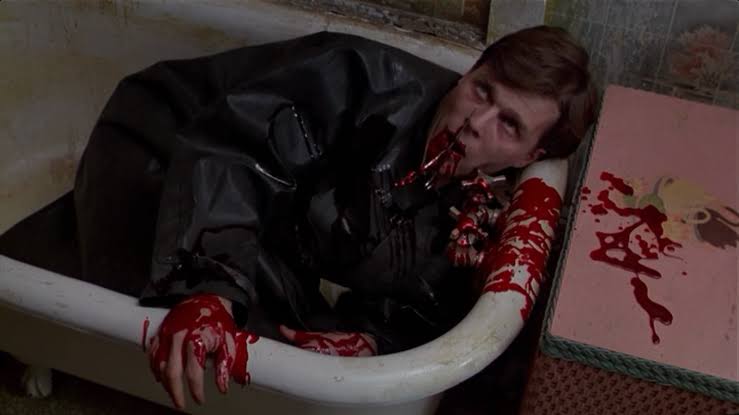
Le Corroller also demonstrates a clear affection for practical effects. When Species gets its hands dirty, it doesn’t hold back. Flesh stretches, ruptures and mutates with the kind of tactile unpleasantness that reminds us why practical body horror remains so effective. There is an immediacy to seeing physical matter behave in ways it absolutely shouldn’t.
The influence of contemporary French body horror is certainly apparent. There are echoes of Titane in its collision of identity, flesh and societal expectation, while the workplace anxieties inevitably invite comparison with The Substance. Yet Species is less interested in abstraction than in taking a very recognisable contemporary problem — exhaustion — and asking what it might look like if we could actually see it happening to the human body.
The answer is not pretty.
Nor is it subtle.
But subtlety isn’t necessarily the point.
Species operates at the intersection of visceral horror and social satire, and its best moments understand that the two can amplify one another. The more grotesque Margot’s transformation becomes, the more ridiculous the expectations placed upon her begin to seem.
The film’s central conceit also taps into something particularly recognisable about contemporary working life: the idea that exhaustion is not necessarily regarded as a warning sign, but as evidence of commitment.
You’re tired?
Work harder.
You’re struggling?
Push through.
Your body is changing?
There are patients waiting.
It is here that Species finds its most uncomfortable joke. The system doesn’t necessarily need to destroy you deliberately. It simply needs to keep demanding more until there is nothing left to give.
And Margot is very much a product of that system.
Le Corroller’s direction is energetic and visually confident, particularly for a debut feature. There is an infectious willingness to push the material into increasingly strange territory, and the film’s mixture of blood-soaked practical effects, absurd humour and social commentary gives it an identity of its own.
At times, however, Species can feel as though it is operating at maximum intensity when a little restraint might have made its sharper ideas hit harder. Its satirical targets are rarely difficult to identify, and the film occasionally favours escalation over deeper exploration.
But there is something refreshing about a debut that would rather overreach than play it safe.
And Species certainly overreaches.
Thankfully, it does so with enthusiasm.
The result is an exhilarating piece of contemporary body horror that understands the grotesque potential of modern working life. Its monsters aren’t simply lurking in the shadows. They are sitting in fluorescent-lit offices, hospital corridors and examination rooms, smiling politely while asking you to work another shift.
Because that’s the real horror of the daily grind.
Eventually, something has to give.
In Species, it’s the flesh.
SUFF #20
Species screens Friday 11 September at 9:45pm in Cinema 1 as part of Sydney Underground Film Festival’s 20th anniversary program at Factory Theatre, Marrickville.
The body has always been one of horror’s most reliable battlegrounds. We fear what can enter it, what can escape from it and, perhaps most disturbingly, what it might become when it is no longer entirely under our control. With Saccharine, Australian filmmaker Natalie Erika James takes that anxiety and feeds it through one of contemporary culture’s most persistent obsessions: the desire to change the body into something supposedly better.
Hana is a medical student consumed by dissatisfaction with her weight and appearance. When she encounters an obscure weight-loss craze promising extraordinary results, the temptation proves impossible to resist. The secret ingredient, however, is not some miracle pharmaceutical. It is human ash. And when Hana begins consuming it, she discovers that the dead aren’t necessarily prepared to become part of somebody else’s pursuit of perfection.
What begins as a grotesque diet-culture satire gradually develops into something stranger: a ghost story, a psychological horror film and a piece of body horror that asks how much of ourselves we are prepared to destroy in the pursuit of becoming somebody else.
It is an ambitious premise, and James is an ambitious filmmaker. The result doesn’t always manage to reconcile all of its ideas, but when Saccharine sinks its teeth into its central concerns, it demonstrates exactly why James has become such an interesting voice in Australian horror.
The James Body
Viewed alongside Relic, Saccharine begins to reveal something particularly fascinating about Natalie Erika James as a filmmaker.
These are very different horror films, dealing with very different forms of suffering, yet they are connected by an increasingly recognisable preoccupation: what happens when an internal experience becomes impossible to contain inside the mind and begins to manifest upon the body.
In Relic, that experience is dementia. Edna’s cognitive deterioration becomes increasingly physical, with the house itself seeming to absorb and reproduce the decay taking place within her. Mould spreads across the walls and eventually across Edna’s body, turning the invisible horror of neurological decline into something tangible.
Saccharine takes that same principle and turns it inward.
Hana isn’t losing control of her body because disease has taken it from her. She is attempting to take control of it herself. The horror emerges from the space between those two impulses. She wants to improve herself, to become thinner, more desirable and more acceptable, but the pursuit of that ideal gradually becomes an act of self-erasure.
James has described Saccharine as exploring the thin line between self-improvement and self-erasure, and that distinction provides perhaps the most useful key to understanding her cinema.
Her characters aren’t necessarily confronted by monsters that exist independently of their emotional lives. Instead, horror gives physical form to something they are already carrying.
In Relic, grief, ageing and the terror of watching a loved one disappear become an environment that literally decays around the characters. In Saccharine, shame, hunger and the desire to alter one’s body become a presence that enters Hana from within and gradually assumes control.
The monster is therefore never entirely external.
It is an expression.
From Decay to Self-Erasure
The connection between Relic and Saccharine becomes particularly striking when we consider their attitudes towards the body.
Edna’s body is betraying her.
Hana believes her body is betraying her.
The distinction is enormous, but James approaches both characters with the same fundamental empathy. Neither woman is simply a vessel for a horror metaphor. The supernatural allows James to explore experiences that are difficult to represent literally, while the human being remains at the centre of the film.
That is why the body horror in both films feels more tragic than sensational.
In Relic, the horror lies in the inevitability of deterioration and the helplessness of those watching it happen. In Saccharine, the horror lies in the possibility that the desire to escape dissatisfaction can become another form of destruction.
One woman cannot stop her body changing.
The other cannot stop trying to change hers.
Both are trapped by an increasingly hostile relationship with the physical self.
And in both cases, James makes that psychological imprisonment literal.
The House and the Body
There is also a fascinating architectural connection between the two films.
Relic is inseparable from its house. The building becomes an extension of Edna’s deteriorating mind, with rooms, corridors and walls transforming into expressions of confusion, entrapment and decay. The physical environment becomes a manifestation of the psychological experience.
Saccharine moves that idea into the body.
Hana’s environment still matters, but the primary architecture is now physical. Her body becomes the space through which the horror operates. The film’s medical settings are particularly appropriate because they turn the human form into something that can be examined, measured, dissected and categorised.
That is precisely what Hana is doing to herself.
She has internalised the idea that her body can be treated as a problem to solve.
James simply turns that idea into horror.
The result is a continuation of the spatial thinking that made Relic so effective. In both films, characters are trapped inside environments that increasingly reflect their psychological states. The difference is that Relic makes the house feel like a body, while Saccharine makes the body feel like a haunted house.
An Australian Body-Horror Tradition
This makes Saccharine part of a particularly interesting moment in Australian horror.
Australian genre cinema has long had an appetite for the grotesque, but recent years have seen filmmakers increasingly combine physical horror with sophisticated psychological and social themes. The Babadook, Relic, Sissy and Talk to Me are very different films, but each demonstrates the capacity of Australian horror to transform intimate anxieties into something monstrous.
Saccharine comfortably belongs within that tradition.
The horror doesn’t simply arrive from outside.
It grows from something recognisably human.
Hana’s obsession with her body is not an abstract concept. It is connected to the pressures surrounding beauty, desirability, self-worth and the seemingly endless cultural demand to improve ourselves.
James simply pushes those pressures to their most grotesque conclusion.
What if the shortcut actually worked?
What if you could consume something and become thinner almost immediately?
And what if the price of that transformation was another human being?
What Are We Willing to Consume?
The film’s weight-loss substance, Gray, is one of its most inspired concepts.
Initially, it appears almost miraculous. Users lose weight at an extraordinary rate, turning the fantasy of effortless transformation into reality.
But Hana is a medical student.
She investigates.
And what she discovers is horrifying.
The substance is human ash.
At that moment, Saccharine reveals its most deliciously perverse idea. The modern miracle cure isn’t some futuristic invention. It is simply death repackaged as a consumer product.
The body that society has taught Hana to despise can apparently be transformed through the consumption of another body.
It is cannibalism disguised as wellness.
And the more Hana understands about Gray, the further she is prepared to go to continue using it.
James is at her strongest when she allows this idea to speak for itself. She doesn’t need to explain the metaphor because the metaphor is already horrifying.
We have simply taken the language of dieting and pushed it into nightmare territory.
The Dead Fight Back
The film’s second major idea arrives when Hana begins to realise that the human remains she is consuming belonged to someone.
That someone does not necessarily appreciate what has happened.
The resulting ghost story gives Saccharine another layer of unease. Hana isn’t merely haunted because she has violated some supernatural rule. She is being confronted by the humanity she has tried to reduce to an ingredient.
The ghost becomes a physical manifestation of the moral consequence of Hana’s obsession.
The dead woman is no longer simply a body.
She is a person.
That distinction becomes increasingly important.
The more Hana becomes obsessed with changing herself, the more she begins to lose sight of the humanity of other people. The haunting therefore isn’t simply punishment.
It is confrontation.
Midori Francis’ Hana
Midori Francis carries much of the film’s emotional weight.
Hana could easily have become an unpleasant protagonist. Her decisions become increasingly disturbing, and her obsession leads her into ethically appalling territory. Yet Francis gives her enough vulnerability to make those choices comprehensible without excusing them.
There is desperation beneath the vanity.
There is loneliness beneath the obsession.
And there is an almost tragic belief that if Hana can simply fix her body, the rest of her life will somehow fall into place.
Francis understands that contradiction.
Hana knows that what she is doing is wrong.
She continues anyway.
That is much more interesting than a protagonist who simply doesn’t understand the consequences of her actions.
Her intelligence becomes part of the tragedy. She has enough medical knowledge to understand exactly what is happening, but knowledge cannot overcome obsession.
The Anatomy of Horror
James’ visual confidence is particularly evident in the way she treats the human body.
The medical environment provides an appropriately clinical backdrop. Bodies are dissected, examined and categorised. Human remains become objects of scientific study.
Then the film gradually turns those same bodies into objects of desire and consumption.
The clinical becomes corporeal.
The corporeal becomes edible.
The edible becomes supernatural.
James repeatedly finds ways of making the human body appear simultaneously fascinating and disgusting. Flesh, organs and food begin to occupy the same visual territory.
This is where Saccharine demonstrates some of its greatest confidence.
Body horror doesn’t necessarily require mutilation.
Sometimes the most disturbing image is something completely ordinary presented from the wrong perspective.
A meal becomes grotesque.
A body becomes food.
Food becomes flesh.
And the distinction between nourishment and destruction begins to disappear.
The Beautiful and the Grotesque
James’ visual evolution between Relic and Saccharine is equally revealing.
Relic is dominated by oppressive darkness, Gothic architecture, mould, shadow and gradual decay. Saccharine initially appears almost to reject that visual language. Its colours are brighter, its surfaces more artificial and its imagery more tactile.
But the underlying philosophy is remarkably similar.
James has spoken about wanting Saccharine to occupy a space between “candy and grime” — the artificial sweetness of pleasure alongside the physical rot underneath it.
That tension is central to her work.
The beautiful and the grotesque are never entirely separate.
In Relic, the family home contains both memories of love and the horror of deterioration. In Saccharine, the promise of beauty and self-improvement contains the possibility of self-destruction.
James seems instinctively drawn to the point where attraction becomes repulsion.
Something is beautiful because we desire it.
Something is horrifying because we understand what that desire can cost.
That is a sophisticated foundation for body horror.
A Ghost Story Inside a Body-Horror Film
The film’s most interesting structural decision is also one of its weaknesses.
James is essentially making two horror films at once.
One is a body-horror story about eating, weight loss and the desire to transform the physical self.
The other is a supernatural ghost story about a dead woman whose body has been violated and whose presence begins to haunt the person responsible.
Individually, both ideas are compelling.
Together, they don’t always fit comfortably.
The ghost story occasionally threatens to pull the film away from its strongest material. Just as the body-horror metaphor begins to bite, the narrative shifts towards more conventional supernatural mechanics.
This doesn’t make those sequences ineffective, but they are less distinctive.
James is at her best when the supernatural and physical become indistinguishable — when we aren’t quite sure whether Hana is being haunted by a ghost, by her own guilt or by the increasingly distorted relationship she has with her body.
The more conventional the haunting becomes, the less interesting the film feels.
When the Metaphor Starts Showing
There is no great subtlety to Saccharine.
That isn’t necessarily a criticism. Horror has always been capable of taking social anxieties and turning them into grotesque literalism.
James understands that the metaphor becomes more powerful when it becomes physically impossible to ignore.
But there are moments when the film explains what its imagery has already communicated.
We understand what Hana is experiencing.
We understand why she wants to change.
We understand the destructive nature of the culture surrounding her.
The film occasionally continues explaining after the horror has already made the point.
This becomes more noticeable as the narrative progresses. The film’s second half doesn’t always maintain the intensity established by its opening sections.
The irony is that the repetition has a thematic logic.
Obsession is repetitive.
The same thought returns.
The same ritual is repeated.
The same dissatisfaction resurfaces.
But what works psychologically doesn’t always work dramatically.
The Horror of Wanting More
One of the film’s strongest ideas is that Hana never reaches a point at which enough is enough.
The first transformation isn’t sufficient.
The next one isn’t sufficient.
The goal moves.
The body changes.
The dissatisfaction remains.
This is perhaps the most disturbing aspect of Saccharine because it doesn’t require a supernatural explanation.
The promise of perfection is inherently unstable.
There is always another flaw.
Another kilogram.
Another improvement.
Another version of ourselves waiting to be manufactured.
Hana’s horror comes from discovering that the thing she believes will finally make her happy has no finish line.
The body can always be changed.
The appetite can always return.
The obsession can always demand more.
The Horror of Self-Erasure
This is where Saccharine most clearly extends the ideas of Relic.
Edna’s body is being taken away from her.
Hana is voluntarily giving hers away.
The first is a horror of inevitable deterioration. The second is a horror of chosen transformation.
Yet both films ultimately arrive at a similar question:
What happens when the body ceases to feel like home?
James doesn’t provide an easy answer because neither film is really interested in easy answers.
Instead, she uses horror to make psychological experiences physical.
In Relic, decay becomes architecture.
In Saccharine, insecurity becomes consumption.
In both films, the body becomes the place where emotional and psychological damage can no longer remain invisible.
That may ultimately be the defining characteristic of James’ cinema.
She doesn’t use horror to escape reality.
She uses horror to make reality impossible to ignore.
The Australian Body-Horror Renaissance
There is something particularly encouraging about Saccharine existing within the current Australian horror landscape.
The country has always produced filmmakers willing to confront the grotesque, but there is now a remarkable confidence in Australian genre cinema’s ability to explore serious emotional and social issues through horror.
Saccharine doesn’t merely want us to recoil.
It wants the recoil to mean something.
The body becomes the battleground where social pressure, personal insecurity, desire, grief and guilt collide.
That makes James’ work part of a broader Australian horror tradition that treats genre as a means of examining the things we might otherwise find difficult to discuss directly.
And James is clearly developing a visual language of her own.
There is a confidence here that goes beyond the script’s occasional structural uncertainty.
A Film That Bites, But Doesn’t Always Chew
The frustrating thing about Saccharine is that its best ideas are genuinely excellent.
The concept of a weight-loss drug made from human ashes is inspired.
The collision of body horror and ghost story is fertile territory.
The Australian setting gives it a distinct identity.
Midori Francis is compelling.
And James has an instinct for visual horror that remains impressive.
But the film sometimes feels like it is carrying too many ideas at once.
The social commentary wants to be sharp.
The ghost story wants to be frightening.
The body horror wants to be disgusting.
The character drama wants to be emotional.
The romantic material wants to give Hana something to desire.
And the family material wants to explain where her relationship with her body originated.
Some of these elements complement one another beautifully.
Others simply compete for attention.
The result is a film that is frequently fascinating without always being completely satisfying.
The Prognosis:
Saccharine is an ambitious Australian horror film that deserves credit for taking a genuinely grotesque premise and using it to interrogate something far more familiar: our complicated relationship with our own bodies.
Natalie Erika James remains an assured visual filmmaker, and Saccharine confirms that the concerns emerging from Relic were not simply the product of a singular premise. There is a developing body of work here, one increasingly concerned with the physical manifestation of internal suffering.
Relic asked us to confront the horror of watching a body and mind deteriorate.
Saccharine asks us to confront the horror of desperately trying to prevent that body from being what it is.
One woman cannot stop herself changing.
The other cannot stop trying to change herself.
Both become trapped inside bodies that no longer feel like their own.
That continuity makes Saccharine more interesting than its individual successes and shortcomings might suggest. It establishes James as a filmmaker fascinated by the point at which psychological suffering crosses the threshold into physical horror.
The film doesn’t always achieve the devastating impact its premise promises. Its supernatural elements occasionally feel more conventional than its body-horror ideas, and its thematic commentary can sometimes become too explicit.
But there is enough ambition, imagination and outright grotesquerie here to make the film worthwhile.
James has created a horror story in which appetite becomes addiction, transformation becomes self-destruction and the dead refuse to remain reduced to ingredients.
It doesn’t always digest its ideas cleanly.
But when Saccharine sinks its teeth into its subject, it does so with considerable force.
And in an Australian horror landscape increasingly willing to make the body its canvas, that is something worth celebrating.
Relic made the house feel like a body.
Saccharine makes the body feel like a haunted house.
The next question is what James will choose to haunt.
When audiences think back to David Cronenberg’s The Fly, the images that usually come first are those of Jeff Goldblum’s extraordinary transformation. They remember the telepods, the deteriorating flesh, the grotesque practical effects and the slow evolution of Seth Brundle into Brundlefly. It is one of horror cinema’s most iconic metamorphoses and, rightly, Goldblum’s performance has become inseparable from the film’s legacy.
Yet focusing solely on Seth’s transformation risks overlooking the character who gives the film its emotional centre. Without Veronica Quaife, The Fly would still be a landmark of body horror. With her, it becomes something far more devastating: a love story about watching someone disappear while they are still standing in front of you.
Geena Davis does far more than play the romantic lead. She becomes the audience’s emotional anchor, guiding us through a tragedy that is as much about witnessing irreversible change as it is about enduring it. While Seth experiences the horror from within, Veronica experiences it from the outside. She cannot stop the transformation, cannot reverse it and cannot fully understand it. All she can do is watch, hope and eventually accept what neither science nor love can overcome.
One of the reasons Veronica remains such a compelling character is that she is never written as a passive participant in the story. Horror cinema has often relegated women to the role of victim or survivor, but Veronica occupies a far more nuanced position. She is an accomplished science journalist whose curiosity introduces her to Seth Brundle’s revolutionary work. She is intelligent, professionally ambitious and emotionally independent long before romance enters the picture.
That independence is crucial because it establishes the relationship on equal terms. Veronica is not drawn to Seth because he rescues her or because the screenplay requires a romance. She falls in love with his brilliance, his awkward humour and his boundless enthusiasm. Seth’s eccentricity becomes part of his charm, and Goldblum and Davis’ real-life relationship lends these early scenes a warmth that feels remarkably natural. Before The Fly becomes a horror film, it is almost a romantic drama, allowing audiences to invest in two people whose affection feels authentic rather than manufactured.
This emotional groundwork is what transforms the film’s second half into something so painful. The audience is not simply watching a scientist mutate into a monster; they are watching a relationship slowly disintegrate under the weight of something neither partner can control. Veronica remains committed to Seth long after most people would have walked away, continually searching for traces of the man she first met beneath the increasingly grotesque exterior.
In many ways, Veronica’s journey resembles what psychologists now describe as anticipatory grief. It is the experience of mourning someone before they have physically died—a gradual process of recognising that the person you love is slipping away while still being physically present. Cronenberg captures this emotional reality with remarkable sensitivity. Seth is alive throughout the film, yet every stage of his transformation places another layer of distance between who he was and who he is becoming.
Geena Davis communicates this progression with extraordinary restraint. Rather than relying on dramatic emotional outbursts, she allows Veronica’s heartbreak to accumulate quietly. Small changes in expression, lingering silences and hesitant glances often reveal more than pages of dialogue ever could. As Seth becomes increasingly isolated within his own body, Veronica becomes increasingly isolated within her own grief. She is forced to watch events unfold with growing helplessness, recognising long before Seth does that there may be no cure.
Veronica’s profession also becomes surprisingly significant. As a journalist, she is trained to observe, investigate and seek evidence before reaching conclusions. Those instincts shape her response to Seth’s transformation. She refuses to dismiss what she is seeing, yet equally refuses to surrender to hysteria. Instead, she approaches the impossible with the same intellectual curiosity that first attracted her to Seth. Ironically, it is that shared belief in reason that makes the tragedy so much harder to bear. Knowledge offers neither of them comfort. It simply confirms the inevitability of what is happening.
As Seth’s physical deterioration accelerates, Veronica’s role gradually shifts from partner to caregiver. This aspect of The Fly often receives less attention than its spectacular body horror, yet it remains one of the film’s most emotionally truthful elements. She worries about Seth’s wellbeing, encourages him to seek help, attempts to protect him from his own increasingly destructive impulses and continues to care for him even as his appearance becomes almost unrecognisable.
Cronenberg presents caregiving not as heroic spectacle but as an act of quiet endurance. Veronica cannot fight the disease consuming Seth because there is no external enemy to defeat. Her greatest act of courage lies simply in remaining present. That emotional commitment gives The Fly much of its enduring humanity. The horror does not stem solely from physical mutation but from the painful recognition that love cannot always prevent loss.
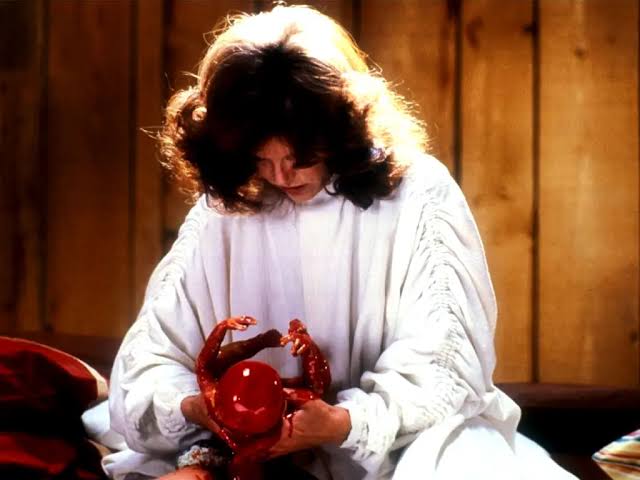
The film’s infamous nightmare sequence, in which Veronica dreams of giving birth to a grotesque larval creature, extends these themes even further. On the surface, it functions as one of Cronenberg’s most memorable moments of body horror. Beneath that shock lies a profound anxiety about the body’s unpredictability. Seth’s mutation has infected Veronica’s imagination, transforming pregnancy—a symbol of hope and new life—into another source of terrifying uncertainty. It reinforces one of Cronenberg’s central ideas: the human body can never be fully controlled, even by those who inhabit it.
Throughout the film, Geena Davis never competes with the extraordinary makeup effects surrounding her. Instead, she grounds them. Every grotesque transformation Seth undergoes becomes emotionally meaningful because Veronica reacts not simply with fear, but with compassion, disbelief and lingering affection. She continually reminds both Seth and the audience that there is still a person worth saving beneath the decaying flesh.
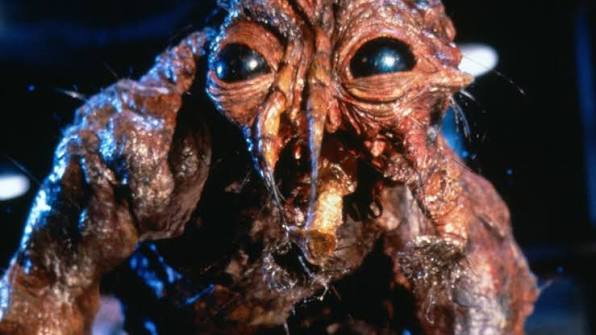
This emotional perspective reaches its devastating conclusion during the film’s final moments. The horrific fusion of Brundlefly and the telepod remains one of horror cinema’s most unforgettable images, yet the true emotional climax belongs to Veronica. When the grotesque creature silently raises the shotgun towards itself, she immediately understands the request being made.
She is not destroying a monster.
She is granting mercy to the man she still recognises.
That distinction is what elevates the ending beyond conventional horror. Veronica’s final act is not one of victory but of compassion. She sees Seth when almost every visible trace of him has disappeared. In doing so, she reminds the audience that humanity cannot always be measured by appearance alone.
Looking back forty years later, Veronica Quaife feels more relevant than ever. Modern audiences, particularly those who have experienced serious illness, degenerative disease or the responsibilities of caregiving, often recognise her journey as much as Seth’s. While The Fly is frequently celebrated for its astonishing practical effects, its emotional longevity owes just as much to Davis’ understated performance. She transforms a story of physical mutation into a meditation on love, grief and acceptance.
The Prognosis:
If Seth Brundle embodies the horror of losing oneself, Veronica Quaife embodies the heartbreak of watching someone you love disappear piece by piece. Geena Davis gives The Fly its emotional soul, ensuring that beneath every layer of prosthetic makeup remains a relationship worth mourning. Her performance reminds us that monsters are rarely frightening simply because of what they become. They are frightening because someone remembers who they used to be.
Forty years after its release, The Fly continues to move audiences not solely because of Brundlefly’s extraordinary transformation, but because Veronica never stops searching for Seth beneath it. In the end, she teaches us the film’s most profound truth: love does not end when bodies change. It simply asks more of those who remain.
Before Seth Brundle stepped into the telepod, David Cronenberg had already spent more than a decade asking audiences to look at the human body differently. Not as something sacred. Not as something inviolable. But as something vulnerable. Something porous. Something capable of changing without permission.
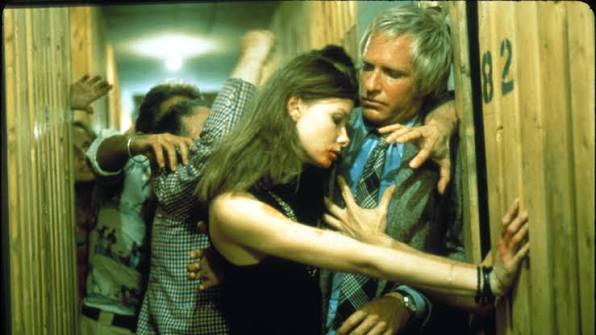
From the parasitic creatures of Shivers to the psychic violence of Scanners, from the biological mutation of Rabid to the technological nightmare of Videodrome, Cronenberg’s cinema has repeatedly returned to the same unsettling proposition:
The body is not a fixed thing.
It is a process.
And processes can go wrong.
By the time The Fly arrived in 1986, Cronenberg had already established himself as one of cinema’s great anatomists of fear. Yet the film represents something more than another entry in his growing body of work. It is a culmination. Everything Cronenberg had been exploring—the relationship between flesh and identity, science and mutation, sexuality and disease, technology and transformation—converges in Seth Brundle’s tragic metamorphosis. The fly did not arrive from nowhere. Cronenberg had been building towards it for years.
The Parasite Within
Shivers—released in 1975—announced Cronenberg as a filmmaker fascinated by the vulnerability of the human body. Its premise is deliberately grotesque. Parasitic creatures spread through a luxury apartment complex, transforming the residents into sexually driven hosts. But beneath the visceral horror lies an idea that would become central to Cronenberg’s cinema. The body can be invaded. Worse still, it can be persuaded to betray us.
The parasites in Shivers do not simply attack their victims from outside. They become part of them. The boundary between self and other begins to collapse.
This is a recurring Cronenberg anxiety. What happens when something enters the body and cannot be removed? What happens when the thing we fear is no longer outside us? What happens when we become the host? These questions would return repeatedly throughout his career. And eventually, in The Fly, the invader would be almost impossibly small.
A single insect.
A moment of contamination.
One microscopic intrusion capable of changing everything.
Rabid: The Body as Transmission
If Shivers introduced the idea of bodily invasion, Rabid developed it into something more recognisably biological. Rose is transformed following experimental surgery. The result is not merely physical alteration. Her body becomes a vector. An instrument of transmission. Those she encounters are infected. The personal becomes communal. The individual body becomes a threat to everyone around it.
Cronenberg’s fascination with disease is already apparent. The horror does not remain contained within one person.
It spreads.
It moves.
It crosses boundaries.
The body becomes both victim and perpetrator. That duality is crucial to understanding The Fly. Seth Brundle is both the person suffering from his transformation and the creature capable of causing harm. His tragedy is therefore not simply that his body is changing. It is that the transformation begins to change his relationship with everyone else. The disease becomes identity.
The Brood: Trauma Made Flesh
With The Brood, Cronenberg moved away from conventional infection and towards something more psychologically complex. The body becomes an expression of trauma. Pain becomes physical. Emotion becomes biological. The distinction between psychological and physiological suffering begins to disappear.
It is an idea that would become increasingly important to Cronenberg’s work. The body doesn’t simply experience the mind. It expresses it. This makes The Brood an important stepping stone towards The Fly. Seth Brundle’s transformation may be caused by science, but his experience is fundamentally emotional.
Fear.
Denial.
Anger.
Desperation.
Isolation.
His body becomes the physical manifestation of an existential crisis. Cronenberg’s monsters are therefore rarely just monsters. They are states of being.
Scanners: The Mind Is Flesh Too
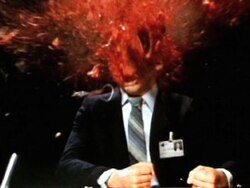
If The Brood explored the relationship between emotion and the body, Scanners expanded Cronenberg’s investigation into the relationship between mind and matter. The film’s infamous exploding-head sequence remains one of the most iconic images in Cronenberg’s cinema. Yet its deeper significance lies in the idea that the body cannot be separated from consciousness. The mind is not an abstract entity floating above the physical world.
It exists within flesh.
It is vulnerable to flesh.
And when the mind is overwhelmed, the body pays the price.
This becomes crucial in The Fly.
Seth’s intellect survives even as his physical form deteriorates.
He remains conscious.
He remains aware.
The tragedy is not that his mind disappears alongside his body. It is that it remains. The monster knows what is happening.
Videodrome: Welcome to the New Flesh
If there is a single film that provides the philosophical bridge between Cronenberg’s early body horror and The Fly, it is Videodrome.
“Long live the new flesh.”
The phrase became a defining statement of Cronenberg’s cinema. In Videodrome, technology doesn’t simply affect the body. It becomes part of the body. The boundaries between human flesh, media and machinery collapse. Reality becomes unstable. The body becomes something that can be rewritten.
Transformed.
Reprogrammed.
The concept of the “New Flesh” is not simply about mutation. It is about the end of certainty. The human body is no longer a stable category. It can be altered by technology.
By disease.
By desire.
By trauma.
By information.
By the world around it.
By the time Seth Brundle enters the telepod, the question is no longer whether the body can change. Cronenberg has already answered that. The question is:
What happens when we discover that change cannot be stopped?
The Dead Zone: The Body as Burden
The Dead Zone is sometimes treated as an outlier in Cronenberg’s filmography. It shouldn’t be. Although it lacks the overt grotesquerie of Shivers or Videodrome, its protagonist is still trapped inside a body that has become unfamiliar. Johnny Smith wakes from a coma with extraordinary abilities. But those abilities come at a cost.
His body has changed.
His life has changed.
His identity has changed.
He is forced to live with knowledge that isolates him from everyone else.
The supernatural premise is different from Cronenberg’s earlier films, but the emotional territory remains familiar. The individual becomes trapped within a condition they did not choose. The body becomes a prison. The person remains inside.
The Human Animal
Cronenberg’s fascination with transformation has always extended beyond disease. It is also about evolution.
What separates humans from animals?
What happens when that boundary begins to disappear?
This question sits at the centre of The Fly.
Seth initially interprets his transformation as evolution. He calls it “Brundlefly.” He imagines that he has transcended the limitations of humanity. He has become something new.
Something stronger.
Something better.
The tragedy is that he is not entirely wrong. There is something seductive about his transformation.
He is faster.
Stronger.
More energetic.
His body initially appears to improve.
But Cronenberg turns evolutionary optimism into existential horror.
Evolution has no moral compass. New does not mean better. Stronger does not mean happier. Survival does not mean humanity. Seth’s transformation becomes a grotesque parody of progress.
Sex, Desire and the Body
Sexuality has always been deeply embedded within Cronenberg’s body horror. From Shivers onwards, physical intimacy is rarely presented as entirely safe. Desire creates vulnerability.
Bodies come together.
Boundaries disappear.
Something is exchanged.
In The Fly, the relationship between Seth and Veronica begins with attraction. Their intimacy becomes the emotional centre of the film. And then the body that Veronica loves begins to change. The horror is therefore deeply connected to intimacy.
To touch someone is to know their body.
To love someone is to recognise them.
What happens when the body becomes unrecognisable?
What happens when the person you desire becomes someone—or something—you fear?
The film’s body horror is therefore inseparable from its love story. The transformation is frightening because it happens to someone. Not something.
Technology as the Catalyst
Cronenberg’s relationship with technology is rarely simplistic. Technology is not necessarily evil. It is simply powerful. And human beings are often incapable of understanding the consequences of their own inventions.
This is why the telepods are so important. They work. Seth has succeeded. The experiment is a triumph of scientific ingenuity. The tragedy comes from an unforeseen consequence. Technology has done exactly what Seth asked it to do. It simply doesn’t understand what he meant. The telepod cannot distinguish between the scientist and the fly. It sees matter. It sees patterns. It sees two organisms occupying the same space. And it creates something new. The horror is therefore not technological failure. It is technological success without human wisdom.
The Body as Identity
Perhaps the most important idea connecting Cronenberg’s films is the relationship between physical form and identity.
If the body changes, are we still ourselves?
If the mind survives, does the person survive?
If the face changes, does identity change with it?
If desire changes, does the self change?
Cronenberg never provides easy answers.
Instead, his films continually destabilise the idea of a fixed identity.
The body becomes fluid.
The self becomes unstable.
The boundary between human and non-human becomes increasingly difficult to define. Seth Brundle represents the ultimate expression of this philosophy. He is neither entirely human nor entirely fly. He exists between categories. And that is precisely where Cronenberg’s cinema has always been most comfortable.
From Infection to Transformation
Looking across Cronenberg’s career, a progression becomes visible.
Shivers asks what happens when the body is invaded.
Rabid asks what happens when the body becomes contagious.
The Brood asks what happens when psychological trauma becomes physical.
Scanners asks what happens when the mind itself becomes a biological weapon.
Videodrome asks what happens when technology rewrites the body.
The Dead Zone asks what happens when the body becomes a prison for unwanted knowledge.
And then comes The Fly.
A film that asks all of these questions at once.
What happens when the body is invaded?
What happens when it becomes contagious?
What happens when the mind remains trapped inside it?
What happens when technology causes the transformation?
What happens when identity itself begins to dissolve?
The answer is Seth Brundle.
The Fly as Culmination
That is why The Fly occupies such a significant place within Cronenberg’s filmography.
It is not simply his most famous body-horror film.
It is his most complete.
The film takes the ideas that had occupied him for more than a decade and brings them together within a single character.
Seth is infected.
He is transforming.
His body is becoming contagious.
His mind is changing.
Technology has caused the mutation.
His identity is dissolving.
And the people who love him are forced to watch.
Everything is connected.
The horror is physical.
Psychological.
Sexual.
Technological.
Existential.
And emotional.
The body becomes the battlefield upon which all of these fears collide.
After Brundlefly
Cronenberg’s later career would move increasingly away from the visceral body horror that defined his early work. But the body never truly disappeared. It simply became less visible. The themes remained.
Identity.
Transformation.
Desire.
Technology.
Mortality.
The instability of the self.
Even when Cronenberg’s films moved into crime drama, psychological thriller or literary adaptation, the same fascination remained beneath the surface. His characters continued to inhabit bodies that could not be trusted.
Bodies that betrayed them.
Bodies that desired things the mind could not control.
Bodies that became sites of transformation.
The flesh remained.
The Prognosis:
David Cronenberg did not invent body horror. But he transformed its possibilities. He understood that the most disturbing thing about the human body is not what happens when something attacks it. It is what happens when it changes.
When it stops behaving as expected.
When it becomes unfamiliar.
When it begins to reveal something about ourselves that we would rather not see.
From the parasites of Shivers to the mutation of Rabid.
From the psychic violence of Scanners to the New Flesh of Videodrome.
From the isolated body of The Dead Zone to the tragic metamorphosis of The Fly.
Cronenberg’s cinema has always been asking variations of the same question.
Where does the human end?
Is it the skin?
The mind?
The memory?
The face?
The body?
The answer becomes increasingly difficult to locate. And perhaps that is the point. Because in Cronenberg’s universe, the body is never fixed. It is always becoming something else.
Sometimes that transformation is terrifying.
Sometimes it is liberating.
Sometimes it is both.
But eventually, every one of us must confront the uncomfortable truth at the centre of Cronenberg’s work.
We are not separate from our bodies.
We are them.
And when the body changes, so does the person inside it. Seth Brundle simply takes that journey further than most of us ever will. He becomes the ultimate Cronenbergian nightmare. Not because he stops being human. But because he discovers, far too late, just how fragile the idea of being human really was.
There are monsters that emerge from beneath the bed.
There are monsters that arrive from another planet, another dimension, another time.
And then there are monsters that begin with us.
David Cronenberg’s The Fly is often described as one of the greatest body-horror films ever made. But that description, while accurate, feels strangely inadequate. Because The Fly isn’t frightening simply because a man’s body begins to change. It is frightening because he knows it is happening. He watches himself disappear.
Released in 1986, Cronenberg’s reimagining of the 1958 science-fiction horror film transformed a familiar monster-movie premise into something far more intimate and devastating. Where Kurt Neumann’s original film explored the consequences of scientific experimentation, Cronenberg turned the story inward, making the body itself the site of an existential catastrophe.
At its centre is Seth Brundle. A brilliant scientist. A man who believes technology can overcome the limitations of human existence. A man who falls in love. And then, through a moment of scientific accident, becomes something else entirely. The horror is not that Seth becomes a monster. The horror is that, for a while, he remains human enough to understand exactly what he is losing.
The Beautiful Lie of Progress
Seth Brundle’s teleportation experiment begins with optimism. He has created something extraordinary. The telepods can transport matter from one location to another. Instantaneously. The impossible has become possible.
In the world of The Fly, science is not inherently sinister. The experiment works. That is what makes it so terrifying. The telepods aren’t defective. Seth isn’t punished because his invention fails. He is punished because it succeeds in a way he never anticipated.
A fly enters the pod. Seth enters after it. The computer doesn’t understand that two organisms have occupied the same space. It simply combines them. The result is not an explosion. It is not immediate death. It is transformation. And transformation, as Cronenberg understands better than almost any filmmaker, is infinitely more frightening than destruction.
Death is an ending.
Change is a process.
The Horror of Becoming
Seth doesn’t wake up one morning as Brundlefly. He becomes Brundlefly. That distinction forms the emotional foundation of the entire film. At first, the changes appear almost miraculous. Seth is stronger. More energetic. More confident. He moves with an exhilarating physicality. His body appears to have been improved. He calls it “the next step” in human evolution. For a brief moment, he believes he has transcended humanity.
This is perhaps the most seductive stage of the transformation. The monster doesn’t initially feel like a monster. It feels like an upgrade. Cronenberg’s genius is to make that idea both exhilarating and horrifying. Seth believes he has discovered something wonderful. The audience understands that he has discovered something terrible.
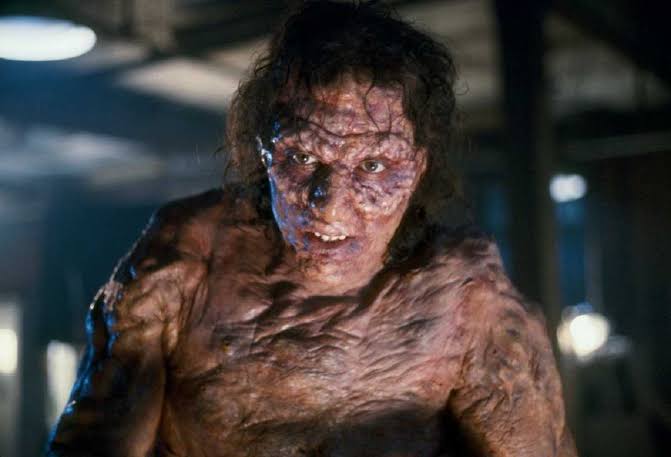
Then the body begins to betray him. The skin changes. The hair disappears. The fingernails loosen. The teeth become unstable. The body begins shedding itself. And Seth watches. That is the true horror.
The Body as Betrayal
Cronenberg’s cinema has always been fascinated by the fragile boundary between mind and flesh. In Shivers, the body becomes an instrument of infection. In Rabid, physical transformation becomes inseparable from sexuality. In The Brood, emotional trauma manifests physically. In Scanners, the mind becomes a weapon. In Videodrome, technology invades the body and consciousness itself.
By the time Cronenberg made The Fly, the body had become his most important cinematic landscape. But here, the body isn’t merely invaded. It is changing from within. Seth cannot escape himself. There is nowhere to run. No monster outside the window. No external force to defeat. His enemy is his own biology. The horror becomes profoundly intimate.
The Disease Film
It is tempting to view The Fly entirely through the lens of science fiction. But the film increasingly resembles something else. A disease narrative.
Seth develops symptoms. He rationalises them. He searches for explanations. He tries to understand what is happening. He becomes increasingly isolated. The people around him struggle to comprehend the transformation. And eventually, there is no cure.
The science-fiction premise provides the mechanism. The emotional experience is recognisably human. This is the horror of illness. Of watching someone change. Of witnessing the deterioration of someone you love. Of knowing that the person standing in front of you is still there somewhere, even as the body becomes unrecognisable. The fly is therefore not simply a monster. It is a metaphor for the terrifying unpredictability of mortality.
The Love Story at the Centre
Without Veronica Quaife, The Fly would still be an extraordinary piece of horror cinema. With her, it becomes something else. A tragedy.
Veronica isn’t merely the witness to Seth’s transformation. She is the person who loves him while it happens. That distinction gives the film its emotional weight. She meets Seth before the accident. She knows the man beneath the changing flesh. She remembers his voice, his humour, his intelligence and his vulnerability. As his body deteriorates, she is forced to confront an impossible question.
At what point does the person you love cease to be the person you know?
Cronenberg refuses to provide an easy answer. Seth remains Seth. And yet he doesn’t. He is simultaneously himself and something else. The film’s horror exists in that uncertainty.
Jeff Goldblum’s Transformation
Much has been written about the physical transformation of Jeff Goldblum’s Seth Brundle. The prosthetics. The makeup. The practical effects. The grotesque imagery. All of it remains extraordinary. But the true achievement belongs to Goldblum’s performance.
He doesn’t simply play a man becoming an insect. He plays a man discovering that he is becoming an insect. The distinction is enormous. The early Seth is charismatic and restless. He is brilliant but socially awkward. His excitement is infectious. As the transformation progresses, that energy becomes something more dangerous.
Confidence becomes arrogance.
Curiosity becomes obsession.
Euphoria becomes desperation.
The physical performance changes because the psychological performance changes. Goldblum doesn’t disappear beneath the makeup. He remains visible within it. That is why the transformation is so disturbing. We never forget who is underneath.
The New Flesh
Cronenberg’s concept of the “New Flesh” had already emerged through Videodrome, but The Fly offers perhaps its most accessible expression. Seth believes that he has evolved. He imagines himself as something beyond humanity. Yet the film presents evolution as indifferent rather than glorious.
There is no moral progression. No guarantee that “new” means “better.” The body changes because biology demands change. The universe doesn’t care whether the result is beautiful. It doesn’t care whether Seth is ready. And it certainly doesn’t care whether Veronica can bear to watch.
The New Flesh is therefore both promise and nightmare. Transformation without consent Evolution without morality. Progress without compassion.
The Monster We Pity
The great achievement of The Fly is that it makes the audience pity its monster. We don’t simply fear Brundlefly. We mourn him. The film continually asks us to remember the man who existed before the transformation. That memory becomes increasingly painful.
The more monstrous Seth becomes, the more desperately we want to find him. And eventually, the film confronts us with an unbearable possibility. Perhaps there is no Seth left to save. Or perhaps there is. Perhaps he is trapped somewhere inside the creature. Perhaps the monster understands exactly what it has become. The uncertainty is devastating.
The Horror of Care
There is another dimension to The Fly that becomes more apparent with age. The film is about caregiving. About witnessing decline. About loving someone whose body is changing beyond their control. Veronica’s experience is therefore not simply that of a horror heroine. She becomes a caretaker. A witness. An advocate. And eventually, the person who must confront the limits of compassion.
There is a profound cruelty in asking someone to remain beside you while you disappear. There is an equal cruelty in asking someone to leave. The Fly understands that love does not always provide solutions. Sometimes love simply means staying long enough to witness the truth.
The Horror of Mortality
Every great monster story contains a fear of death. The Fly contains something worse. It contains the fear of living while dying. Seth’s transformation is gradual. There is time to understand it. Time to fear it. Time to deny it. Time to rage against it. That makes the film more devastating than a simple creature feature.
Death is unavoidable. But the prospect of watching ourselves deteriorate piece by piece is something far more difficult to contemplate. Cronenberg forces the audience to confront that fear through flesh. The body becomes a clock. Every new symptom marks another step towards the inevitable.
Forty Years of Rot
Four decades after its release, The Fly remains one of the most extraordinary examples of mainstream body horror ever produced. The film was released by a major Hollywood studio. It featured recognisable stars. It possessed a substantial budget. And yet it refused to soften its central nightmare.
The practical effects remain shocking because they serve the story rather than overwhelm it. The gore is not decoration. It is narrative Every transformation tells us something about Seth’s physical and psychological decline. The body horror is therefore inseparable from the emotional horror. We recoil because we understand what the images mean.
The Remake That Became Something Else
Cronenberg’s film is technically a remake. But it feels less like a remake than a reinvention. The 1958 The Fly emerged from an era fascinated by atomic science and the dangers of experimentation. Cronenberg’s 1986 film belongs to another age. An era increasingly anxious about technology, genetic transformation, disease and the instability of the human body. The premise remains familiar. The nightmare changes.
That is what makes The Fly such a fascinating example of cinematic reinterpretation. The same story can be told twice. The monster can remain the same. Yet the fears surrounding it can evolve completely.
The Final Transformation
By the film’s conclusion, Seth Brundle has become almost entirely unrecognisable. But the tragedy is not that he has become an insect. It is that he knows what he has become. The final moments are not about defeating a monster. They are about acknowledging one. Veronica’s final act is not triumphant. It is devastating.
There is no victory. No cure. No restoration of the natural order. Only an ending. The kind of ending that forces us to confront the fact that some transformations cannot be reversed.
The Prognosis:
Forty years after David Cronenberg’s The Fly first entered cinemas, its reputation as a masterpiece of body horror remains entirely justified. But to describe it only as a body-horror film is to underestimate what Cronenberg achieved.
This is a film about disease.
About technology.
About evolution.
About sexuality.
About mortality.
About love.
And ultimately, about the terrifying fragility of identity.
Seth Brundle does not become frightening because he becomes less human. He becomes frightening because some part of his humanity remains. We recognise him. We remember him. We understand what he is losing. And because we understand that loss, we understand the film’s deepest horror.
The body is not a vessel we inhabit. It is the thing through which we experience ourselves. It is how we recognise one another.
How we touch.
How we love.
How we move through the world.
And eventually, it is the thing that betrays us.
That is why The Fly remains so powerful at forty. The monster is not the fly. The monster is the knowledge that none of us can remain unchanged forever. Seth Brundle simply gets to experience that truth sooner than the rest of us.
Sasha Rainbow’s Grafted is an unsettling body horror film that blends themes of identity, beauty standards, and cultural pressure with grotesque yet effective visuals. The film explores the psychological and physical toll of striving for perfection, offering an eerie commentary on how far one might go to fit in.
The story unfolds at a deliberate pace, which can feel sluggish at times, making it difficult to fully connect with the protagonist’s journey. However, the film’s strong pulse comes from its commitment to disturbing imagery and practical effects, which elevate the horror elements. The lead performance is commendable, portraying both vulnerability and a creeping sense of detachment as the character undergoes a grotesque transformation.
Visually, Grafted is striking, utilising cold, sterile environments that contrast with the organic and unsettling nature of the body horror sequences. The cinematography and lighting work to create an almost dreamlike quality, amplifying the protagonist’s descent into obsession. However, the screenplay struggles to maintain a gripping narrative, often losing momentum in its quieter moments.
Despite its flaws, Grafted offers enough unsettling moments to leave an impression. Fans of slow-burning horror with a focus on psychological and body horror will find much to appreciate, even if the film doesn’t fully capitalise on its intriguing premise.
The Prognosis:
A visually striking yet sluggish horror film that explores beauty and obsession through an unsettling lens. While Grafted may not resonate with all audiences, its strong effects and eerie atmosphere make it worth a watch for genre enthusiasts.
Johannes Grenzfurthner’s Solvent is a visceral dive into both the found footage and body horror sub-genres, subverting expectations at every turn. The film introduces us to a team of experts searching for Nazi documents in an isolated Austrian farmhouse, only to uncover a far more sinister secret hidden in the shadows of history. As the team leader becomes obsessed with revealing the truth, his sanity slips away, revealing the true horror that lies beneath—the corrosive force of obsession itself.
What sets Solvent apart from typical found footage films is its refusal to adhere to the genre’s usual tropes. While many found footage films struggle to balance realism with narrative tension, Solvent blends body horror and the obsessive drive for truth, immersing the audience in a descent into madness that feels both surreal and grotesque. Grenzfurthner’s approach to this format is deliberate, calculated, and refreshingly inventive. The faux-documentary style doesn’t just feel like a device to capture jump scares but becomes an integral part of the narrative’s tension, one that slowly unravels with each disturbing discovery.
The film’s brilliance lies in how it explores the toll that the pursuit of truth can take on the human spirit. As the leader of the investigation digs deeper into the farmhouse’s disturbing past, the very act of seeking knowledge becomes a self-destructive obsession. The further he delves, the more he sacrifices his humanity, willingly eroding his moral compass in exchange for answers. This theme is amplified by the body horror elements, where the human form begins to mirror the mental and emotional decay taking place within. It’s a journey through fluid debauchery—one that seeps into every pore of the film, leaving the viewer unsettled and questioning how much one should risk in pursuit of the unknown.
Admittedly, found footage has never been my favorite genre. However, Solvent shifts the direction enough to make it a harrowing and engaging experience. The film hooks you from the very beginning, pulling you deep into its underworld of depravity and insanity. Each moment feels like a gamble with pure evil, and the tension builds to an unbearable crescendo, leaving you wondering whether anyone can truly negotiate with forces so dark and extreme.
Solvent isn’t just a film about unearthing historical horrors; it’s a philosophical exploration of the lengths people will go to when consumed by obsession. Grenzfurthner takes the familiar tropes of body horror and found footage, blends them with a slow-burning narrative, and crafts something perversely unique. It’s a dizzying descent into madness, but for those willing to follow it down the rabbit hole, it’s a ride that will infect you long after the credits roll.
Since Julia Ducournau’s debut feature Raw was released back in 2016 and marked my favourite movie of the year, I’ve been keen to see what she would produce next. Titane has been critically lauded and Ducournau has picked up the Palme d’Or for her thought provoking and confrontational body horror film.
So while this has resonated with a certain audience tailored to a more highbrow concept, how does this relate to the general public?
It’s a film that buries itself deeply into the trauma of its narrative. From this the true horror of human conditioning is on screen and Ducournau never shies away from the impact that this has on not just the central character but also for those that associate with her.
Our lead protagonist Alexia, (played by Agathe Rousselle) has survived a horrific car accident as a child and was fitted with a titanium plate as part of her recovery. The physical surgery scar is often on display as a constant reminder of the burden that this episode has had on Alexia. The result of which leads her on an internal struggle that leads her towards a level of hypersexuality that often eventuate in violent ends. Agatha’s sexual awakening is one born out of depression, anxiety, and oppression that is heavily drawn through a feeling of shame about her own identity and the feelings that she is experiencing that cannot be contained. Instead these emotions spill outward and are often enacted on those she is having a sexual experience with.
After essentially going on a killing spree to mask this oversensualised feelings, she finds salvage in her own automobile, to come full circle with the instrument of her torment and is encapsulated through gratification. This however has its own ramifications as Alexia fall pregnant and appears to be secrete motor oil from her vagina and her bodily transformations suggests that she has fallen pregnant as a result of her automobile encounter. This forces Alexia to go into hiding by masking her own feminity.
The masculisation of her character is an act out of desperation. With no connection to society, Alexia becomes a lonely island who seeks refuge in the only place that will accept her new form, as Adrien, a boy who disappeared 10 years ago. Adrien’s father Vincent (Vincent Lindon) a man healing from his own trauma from losing his son, is only too willing to accept the mirage that has entered back into his fold, and a male dominated world of firefighting. As is often the way it is the broken who can heal one another. Trauma, however can never be masked and no matter how hard you try to mask it, if left untreated the effects will find a way of coming to the surface.
The prognosis:
Director Julia Ducournau has gone on record stating that this film is not a horror movie. And while this may be true in terms of what we consider the horror genre to contain, Titane carries some horrific elements of brandishing the scars that trauma can have.
The journey that Alexia takes is a brutal one that not only sheds light on what trauma can do to a person, but more importantly the extremes that a woman must endure in order to be accepted, in this case to the detriment of her own femininity. A theme that Julia Ducournau explores well and places Titane as one of my contenders for film of the year.
Possession marks one of those unsung movies from the early 80s that oozed its way along the grapevine, causing the occasional ripple among viewers and critics alike across the years. Recently the film celebrated 40 years since its release and is now considered a cult classic among some. Ashamedly, it is a movie that passed me by and I only recently caught the film in time for its anniversary. In a way, it’s not too surprising that I missed out on its initial release as it was criminally shafted into the video nasties group that so many were subject to at the time and perhaps the reason why it has become something of a forgotten gem.
Recently to commemorate this feature, Umbrella Entertainment released a Blu-ray/Dvd edition as part of their Beyond Genres collection and it’s jam-packed with over 4 hours of extra footage which I’ll list at the foot of this article.
So, why does it deserve such recognition?
Possession is a visionary film, where every scene is a spectacle and eviscerates the human soul and exposes every ounce of humanity at its most controlling. All the characters strive for power and control and with every movement, vibrating, convulsing, and straining to reach resolution but bound to repeat the cycle of events all over again. This raw energy stems from Director Andrzej Zulawski who would draw from personal experience to write the screenplay, and the anger and vitriol is part of what we see evicted onto the screen.
Fueling these emotions is an incredible leading cast in Isabelle Adjani in her dual role of Anna, a domestiecised and sexuallay repressed wife, and Helen, a teacher and picture of innocence and virtuosity. Sam Neill also stars as Mark, a spy with a mysterious connection with the political underbelly of Eastern Europe, and a man who is set in his time, expecting that his home life should remain in a certain state and not alter. Threatened by change and a loss of identity, Mark constantly is fighting to remain at the heart of all that surrounds him, tightening his grip, only to watch it slip further from his grasp.
There are many levels that are at play here, which elevates the movie into highbrow territory, none more so than the depiction of a city under political unrest with the physical divide between Berlin’s East and West. The constant threat of destruction in a world hinged on uncertainty. There are a series of doppelgangers at play too with Adjani’s Anna/Helen characters and Neill’s two versions of Mark, where one version symbolises all that is wrong with humanity, and the other, all that seems right, a yin and yang of balance and imbalance. The viewer is placed at the epicentre of the carnage. As the characters fight for their ideological past, they rip apart their very surroundings destroying all that once was. The infamous scene in the underground passage where we bear witness to Adjani’s electrifying performance as Anna experiences a violent miscarriage, is one of the most brutal scenes that I’ve seen on screen. This scene alone is a dark and disturbing depiction of the core being ripped out due to the trauma and conflict that humanity subjects itself to. Infused with cutting edge creature effects that would fit perfectly in any Cronenberg feature, spearheaded by Italian special effects maestro Carlo Rambaldi (Alien, Deep Red).
By the films conclusion as the world seems to be setting itself right again, we’re left with a dubious outcome with Mark and Anna’s son Bob in the wake of turmoil, afraid of both his ‘parents’ and the sounds of war and destruction in the background, a sign that we are all doomed to repeat the same mistakes over and over if we insist on our ridiculous pursuits of perfection; possessed by this ideal and obsessed with fulfilling our desires, unwilling to relinquish control.
For more thoughts and discussions on Possession check out the Surgeons of Horror podcast here:
The first lines spoken in The Soska Sisters latest feature is something of an odd choice seeing that the film itself is a remake of David Cronenberg’s science fiction body horror feature that was released back in 1977, but then the ‘Twisted Twins’ have built a reputation on face-lifts and transformations within their features that it should come as no surprise that should revamp a cult classic. Cronenberg is clearly an inspiration in the Soska Sisters previous features where body horror, mutilation, and the butchering of the beautiful is constantly a running theme through their narrative. From their low-budget debut feature, Dead Hooker In A Truck, they have been willing to their bodies on the line for the sake of their vision and in doing so, continuously look to raise the stakes, but arguably haven’t attained this since their brilliant sophomore outing behind the director’s chair with American Mary.
So, how does this modern transformation of Rabid fair and does it amount to the twin directors’ previous outings?
I have enjoyed watching the Soska Sisters’ journey, even their paint by numbers WWE venture, See No Evil 2, and I found that Rabid had the right pulse to entertain and satiate the gruesome, and bloody fascination with the human aesthetic and its ultimate destruction. We cast ourselves deep in the fashion world, where there is an expected elegance and if you don’t measure up, then you’re cast aside and considered insignificant.
This is where we meet our lead protagonist, Rose (Laura Vandervoot) who works for a fashion designer, Gunther (Mackenzie Gray), but struggles to meet her mark. One night she is invited out by photographer Brad (Ben Hollingsworth) and believes that her luck could potentially be turning, but soon discovers that it’s a pity date, set up by her best friend, Chelsea (Hanneke Talbot). Humiliated, Rose attempts to flee on her bike but is plowed down by an unseen vehicle and rushed to hospital leaving her disfigured and more depressed. It is only when she learns of a scientific breakthrough that could potentially restore her figure that Rose seizes the opportunity to be considered normal. Once again though, trust comes into question as we are only willing to expose the mask we choose to wear with people and only every so often do we allow our true selves be seen. This is a common theme throughout the movie where we should question everyone’s motives and always be suspicious of the characters we encounter, even within the medical profession as hinted by Stephen McHattie’s doctor when he asks his assistant to lend a deformed Rose a mirror, only to contradict himself by saying that Rose should never look at a mirror.
So, Rose undergoes a significant and delicate operation that not only restores her looks but metamorphosed her whole demeanour with mesmerising effect on her persona. Whilst her life suddenly flips for the better, Rose is consumed with lust for blood and meat that sends her into a frenzy and unleashing a creature within that leaves her victims with something that closely resembles rabies, but spreads as quickly as the black plague.
From here on in the action becomes frenetic and just as uncontrollable as the disease, which is obviously a directorial choice, but I can understand some viewers who might find this approach grating.
Stuck between pursuing her dreams of having her own design on the catwalk and recognition of her style, and seeking medical aid, Rose steers closer to self-destruction and chaos.
Prognosis:
The Soska Sisters are back in their domain of stripping the human facade and revealing the tortured soul lurking within in their latest turn in the directors’ chair. Yes, it’s a remake, but there is enough spin on the original and more of the visual style and substance that makes Jen and Sylvia a force to be reckoned with when they are at their best. As always their films are beautifully shot, and manage to infuse some raw energy within the beats, and Rabid continues to project the Soskas into a twisted limelight that feels gnarly and fresh.