Standing in the school canteen queue, waiting to be served up some nutritious cuisine and to fuel up and energise for the day only to be presented with some disgusting slop that wouldn’t be worth giving to the dogs.
We may groan and show our disgust, but no one thinks about the poor souls who have to serve up this muck day in, day out.
No one spares a thought for the lunch ladies.
And this is where this fantastic short feature places us. In the heart of the school kitchen, where two lunch ladies, Seretta (Donna Pieroni) and LouAnne (Mary Manofsky) bust a gut to serve the hungry horde with a crap amount of decent food and very little recognition to go along with it.
Thank God for Johnny Depp, the shining light for these ladies’ way out of their dire world with the chance to become his personal chefs on the order.
But with the stakes so high and the pressure at breaking point, it won’t take long for something or someone to snap.
And when it does it comes in a bloody glorious fashion as the Lunch Ladies resort to drastic measures to cover up murder and keep their eye on the prize the only way they know how… in the kitchen.
With a nod to Sweeney Todd, it’s time to churn up their victims and deliver the best lunch order of their careers to pull them through.
Gloriously written by Clarissa Jacobson, who carves up a a delicious blend of macabre and humour, combined with director J.M. Logan’s eye for detail and Lunch Ladies stands tall amongst its counterparts as a result.
Our only regret is that there wasn’t a larger portion on offer as the characters and story could well amount to much more of time were given for them to breathe on screen.
Thankfully the producers are working on getting a long feature ready, so keep your eyes peeled for more from these great filmmakers down the track.
Upon writing this review I have to premise my following thoughts by stating that I am a huge fan of everything that Ruth Wilson stars in and as such am fully prepared to admit that I may well have views this movie with Rose-tinted glasses on.
Throw into the mix that Osgood Perkins (son of actor, Anthony Perkins) who in his sophomore outing offers an atmospheric ‘vintage style’ horror that resonates and chills.
Much like his directorial debut, The Blackcoat’s Daughter, Perkins tells a slow-burn tale which is both it’s pro and con.
Fans of this style of storytelling will immerse themselves into the narrative whereas equally I can see how some viewers will and can struggle. Perhaps in some cases nod off to its sense of lull that barely registers a heartbeat in places.
In essence the story hinges on the performance of its lead, which brings me back to those aforementioned glasses and Ruth Wilson once again cuts a fine performance as Lily Saylor, a live-in nurse who status to suspect that her elderly employees house maybe haunted.
Carrying the lions share of the screen throughout the 87min running time, Wilson weaves an intriguing character who appears to suit the lifestyle of a ‘loner’ and through her character delves into the history of the house and its owner which slowly unravels a mystery where she may not return from.
Whilst watching this film, it’s easy to see why it has been likened to the works of David Lynch and Stanley Kubrick with its rich stylisation.
Whilst it might not be for everyone, Perkins paints a story that stays firmly in the mind and from this writers perspective, is fast becoming a director to keep firm tabs on.
I wouldn’t be surprised if we followed see some awards thrown his way down the track if he continues on this kind of trajectory.
The Blackcoat’s Daughter churns away at the soul and the psyche with a slow and effective grind that resonates deeply.
Osgood Perkins directorial debut which he also penned may not be for everyone with a pace that is so slow you’d be forgiven for that thinking that you were positively stationary.
What lifts this above most standard fare is the performances of Kiernan Shipka (Mad Men) who continues to show a level of maturity that belies her age and Emma Roberts (Nerve), who is also carving a strong career path with her film choices.
Told in two separate timelines that isn’t revealed until the climax, we initially follow Shipka’s Kat, a freshman who is waiting for her parents to pick her up from a prestigious boarding school for the holidays.
Surrounded by snow in a wintry climate that is reminiscent of Let The Right One In, Kat becomes increasingly more aloof and her behaviour more peculiar as a result.
Her sense of isolation is further exasperated as she fails to connect with the nuns at the school and the only other student on the premises, Rose (Lucy Boynton) who is herself too consumed with her own pregnancy that she fails to see Kat’s shrinking from the world and inner turmoil.
Meanwhile, Roberts’ Joan is making her own journey towards said boarding school where she is offered a lift by two parents grieving for the loss of their daughter.
The father seems sympathetic to Joan’s plight as if he recognises hisown daughter within her. The irony being that she is far from it and actually the perpetrator of his daughters death.
The struggle of human connectivity or lack thereof is front and centre of this film as the characters are minimal on number and those that we do see are so trapped in their own world that it’s no wonder that Kat is drawn to the darkness that surrounds us all and bows to the whims of a being that lurks beyond our own existence.
Perkins first attempt in the directors chair certainly impresses and it will be interesting to see what he does next as his vision feels like a strong one and for that he’s made a fan from this writer.
By now most people would be familiar with this film as the self-financed project of Andrew Getty,an American oil heir, businessman, film director and philanthropist.
A project that would take 15 years to make, primarily shot within his mansion including one room that was converted into an edit suite.
The tragedy though would be that Getty wouldn’t see the completion of his passion due to an untreated ulcer that would take his life.
The question though comes down to whether or not all that turmoil was worth it?
Without wanting to speak ill of the dead, the answer is partly yes, but mainly no.
The premise is simple enough, telling the story of a special needs boy, Dennis (played by Frederick Poehler), providing a highly credible performance.
Dennis begins to talk to his reflection in the mirror, which takes on a demonic presence portrayed by horror veteran Michael Berryman.
This demonic presence starts by haunting Dennis in his dreams before manipulating him to commit acts of murder.
‘The Evil Within‘ references the Dark history that lurks in Dennis past. A genius who was allegedly pushed down the stairs by his elder brother, John (Sean Patrick Flanery). The injuries of which resulted in his physical and mental state.
On paper, it feels like there is enough material there to make this an exceptional film, but the end result comes across as more of a misfire, perhaps down to being too scrutinised and worked over, that it feels more like a late night television movie as a result.
It’s a shame as it could have been so much more.
Worth a watch as there are some pretty cool effects before but just barely.
Grab your stapler or whatever you can find to turn your office utensils into a weapon as The Belko Experiment sets up this Battle Royale fight for survival.
Greg McLean follows up his disappointing feature The Darkness with this highly enjoyable movie that pits peers against peers where there can be only one person to survive.
Although the film does fall into predictable terrain, The Belko Experiment has a strong enough cast to propel the narrative along and provide the audience with the sort of delights that brought McLean to the attention of horror film lovers with Wolf Creek.
John Gallagher Jr who’s is fast making some smart choices following Mike Flanagan’s Hush and 10 Cloverfield Lane plays the heart of the movie, striving to keep everyone alive whilst sticking to his strong principles.
To counter his stance are some prolific performances from Tony Goldwyn (Scandal) and John C McGinley (Scrubs) alongside some comedic elements delivered by Josh Brener (Silicon Valley) and Sean Gunn (Guardians of the Galaxy, and writer for this film) to inject some much-needed humour into the macabre environment find themselves in.
And I haven’t even mentioned Michael Rooker’s involvement into the proceedings which is highly welcoming and an example of how awesome he can be despite his short screen time.
The Belko Experiment romps along with some awesome set pieces that feel realistic and not just shoved into place for the gore factor.
By its conclusion the movie rewards with a potential for further franchise development among a faceless nemesis in a human experiment that is purely set up on the basis of some ‘bigwigs’ scientific enjoyment.
McLean could well be back to finding his voice again, and with the Daniel Radcliffe film, Jungle next on the horizon, there’s more promise that this success will continue.
Of all the movies listed in the SUFF schedule, It Stains The Sands Red was the one that had me the most intrigued.
Directed by Colin Minihan, one half of the Vicious Brothers who brought Grave Encounters to the screen, but don’t let that deter you from seeing this movie.
Although, much like our last review on The Bad Batch and the podcast on It Comes At Night, the trailer much belies the film.
I did wonder how the premise of a woman stranded out in the Nevada desert during a zombie apocalypse whilst being pursued by a a lone walking dead, could possibly maintain its narrative without straining at the seems.
Whilst it does struggle in places, there is some nice enough moments broken with flashbacks detailing Molly’s dilemma.
Having fallen from grace and found her life spiral out of control Molly has landed in with a questionable crowd.
Heavily reliant on drugs, her clouded mind begins to clear as she is forced to endure the environment and head for an airport and ultimately salvation.
The fact that It Stains The Sands Red never shies away from what it means to be a woman from dealing with menstruation and turning that into empowerment is a huge salute to Minihan’s direction.
Brittany Allen cuts a fine performance as our lead Molly who is believable as we learn that she had left behind her son in what she believes is the safe hands of her sister.
The realisation soon sinks in that she must act, and take responsibility for him by getting back to him but not before going through a journey of humiliation, desperation, and appreciation.
One could argue that the BIG flaw of this film comes in the guise of the afore-mentioned Zombie, who Molly dubs Smalls after the size of his appendage.
But to state that means that you miss the point of the film, where Molly must find redemption in order to get her life back on track.
Her domestication of Smalls, ultimately lends her to adapt and by looking out for him, she can take on the skills she needs to look after her son once again.
By the time the film concludes, Molly could easily stand shoulder to shoulder with Ash (Evil Dead) in Her battle for survival.
Yes, she is a bad-ass, but needed to be forced into the unimaginable to get there.
This might not be for everyone and those expected an all-out gore fest in the heart of a desert wasteland maybe sorely disappointed, but I for one really enjoyed It Stains The Blood Red and feel that Minihan is growing from strength to strength as a director.
Cannibalism, amputees, Jason Mamoa, and a Cult leader / DJ called The Dream, who lures people into a false sense of sanctity played by Keanu Reeves.
Throw in a dash Giovani Ribisi’s quirkiness and Jim Carrey playing an estranged hermit living on the outer rim and you have all the ingredients that take up Ana Lily Armipour’s sophomore outing following A Girl Walks Home Alone At Night.
Both The Bad Batch and Armipour’s previous effort deal with isolation and the notion of the outsider struggling to fit into a post-apocalyptic world.
In this instance, The Bad Batch sees Arlen (Suki Waterhouse) as our protagonist, forced to suffer an early ordeal at the hands of a family of cannibals living by their own means in a desert landscape.
In what feels like a deviation from what the trailer and film write-up had promised, Arlen soon resolves her predicament albeit with the loss of her arm and leg on her road to recovery.
And therein lies the beginning of a series of thinly-veiled metaphors that are riddled throughout the movie.
One could forgive this, if the plot line was strong enough to carry you through buy even this falls on the light side, so much so that the films failings become even more noticeable.
Not that it doesn’t have some strong points. Armipour certainly has a strong eye for creating some visual imagery from Arlen’s pop-culture style shorts to The Dream’s trance-like rhythms. Plus, you know, the whole Jason Mamoa brooding thing.
Whilst part of me really wanted to like like this film, because I genuinely like Armipour’s style and strongly believe that she is a talent to watch with a keen eye, ultimatelyThe Bad Batch struggles and much like Arlen limps its way to finding a conclusion or a way to ‘fit-in’.
Having said that, I don’t believe the movie needs to bow to conformity.
In doing so would go against the grain of the filmmakers vision.
With a little more time though, Armipour could well have crafted a stronger narrative that would have continued her unique style and story.
Instead it comes across as a unfinished symphony a half thought, waiting to be voiced with any sense of clarity as we’re left trailing like a tumbleweed in the wind.
Aka: The other horror movie released alongside It this past week.
Is John R. Leonetti the polar opposite of Mike Flanagan?
Where the latter has been going from strength to strength, knocking out three pretty solid movies in 2016, with Hush, Ouija: Origin of Evil, and Before I Wake, Leonetti has struggled to transfer his impressive skills as a cinematographer to the director’s chair.
After helming mediocre material with Mortal Kombat: Annihilation and The Butterfly Effect 2, Leonetti had the chance to redeem himself with what on paper looked like a winner in Annabelle.
Unfortunately, he missed the mark by an epic margin and failed to deliver the scares. So much so, that when it was announced that there would be a prequel movie in the works, people were left scratching their heads, but Annabelle: Creation director, David F. Sandberg proved those naysayers wrong.
Leonetti would follow up with Wolves At The Door, a harrowingtale of the Sharon Tate murders, which should have been a confronting film of one of the most notorious crimes in Hollywood, but once again rode the line of safety and never offering anything new or stimulating to lift it above the ‘norm.’
With horror movies breaking records in the light of the recent It movie, there is a high expectancy to bring the goods and offer something compelling.
On paper, Wish Upon already sounds like a weak proposition with its premise of a girl who discovers an ancient Chinese box that can reward you with 7 wishes but holds a heavy caveat that with every wish, a blood pact must be served.
There’s further promise with some strong support players in Ryan Phillippe and Sherilyn Fenn, but instead of produced what could have been this generations answer to The Craft, we’re provided with a feeble attempt within the teen horror market that would barely make an impact on the small screen.
Joey King (The Conjuring, Independence Day: Resurgence) tries her best to carry this film as the lead, Clare Shannon, but ultimately she was let down by a poor plot that left us sadly wanting.
It’s little wonder that the International market were left pondering what to do with this film once it had tanked in the States, and one can’t blame them for trying to sneak it under the radar by riding on the coattails of It.
There are worse movies out there, but we’re now used to seeing high calibre efforts on the big screen and in order to impress, genre filmmakers need to lift their game and not rest on their laurels.
Here’s the thing about the golden age of drama we’re currently living in: it has put movies on the back-foot. Which would be a really good analogy if The Endless were a boxing movie.
But it’s not. It’s not even a horror movie – but we’ll circle back to that.
Back to high end TV drama and their ability to craft complex story-lines and characters over a solid (but not too long) period of time. It’s clear these days movies (with their relatively short 2-3 hour sittings) are losing ground as a “competing” format.
It did have cinematic-ness in its corner (which is a real word, no need to look it up) until CGI balanced that ledger too. Sure as a science and an art-form computer imagery is still evolving, but if done right, big screen special FX can be just a mouse click away for even the tiniest micro-budget film.
So what do these two developments have to do with The Endless – the latest offerings from Indie filmmakers Aaron Moorhead and Justin Benson?
Well for a start it has the 5D aesthetic of an Indie offering (although no doubt it was shot on a much bigger gauge) but towards the end it has surprising quality special FX for a movie that initially looks so sparse, it almost feels like a found footage film!
And secondly it is an adjunct to Moorhead and Benson’s 2012 effort, Resolution. By that I mean The Endless takes place parallel to the events in Resolution (and literally about a block away from it).
So yes – TheEndless is a cross-over film. And this brings me to an interesting thing film has done to “push back” against the serialised superiority of TV drama. And that’s franchising, i.e. Movies that aren’t sequels per se, ‘cause not all sequels respect or even acknowledge films in their own canon (James Bond much?) but rather ‘share the same universe’.
Marvel are the current bar setters of this trend, and movie studios everywhere are following suit (lack of originality will ‘always’ be a universal constant with Hollywood).
But it also appears independent filmmakers don’t need an excuse to franchise off their own bat. Which would have helped to know in advance when events from The Endless crossed over into Resolution.
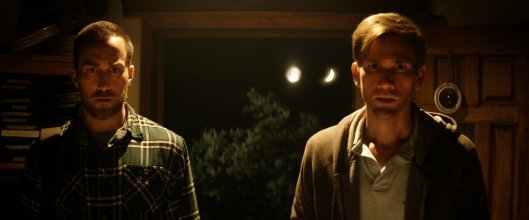
But on with some actual review stuff! The Endless centres around 2 cult “survivors” (played by Moorhead and Benson themselves). They are brothers trying to subsist in an ‘ordinary world’ that cult living failed to prepare them for.
The younger brother especially (Aaron played by Aaron) feels rudderless and out of sync, and retains more good memories about the compound they grew up in, and as such convinces his older brother Justin (played by Justin) to go back and visit for a day or two.
This is after they mysteriously receive a VHS tape featuring a woman who used to babysit them there (played by Callie Hernandez of Blair Witch and Alien Covenant fame).
And this is where the first confusion sets in, as all the characters we meet ‘appear’ to be roughly the same age. Throw in the fact that the boys themselves seem to have left the compound in the 90’s (if news footage of them exiting is to be believed) yet they themselves look to not have aged a day in 20 years.
Yet continual references by Justin to his younger brother that there appears to be a “spark” between him and their former sitter seem odd, as Hernandez looks several years younger than both of them. Yet no one makes any attempt to explain these discrepancies in any sort of story-telling capacity; and so you’re left confused. No doubt this is a deliberate ploy from the filmmaking duo who brought us the Bonestorm segment from VHS Viral, but unfortunately it does tend to come across as if the film is gleefully disappearing up its own mythos (something re-enforced when it crosses over into Resolution).
Now despite all this, The Endless does evolve at an intriguing pace and is a sci-fi page turner that has the courage to be both sparse and visually spectacular where it needs to be. Something ‘is’ going on at the compound, and you ‘do’ want to see it to the end.
The movie’s central theme is time, whereas Resolution was story. Where & when they cross over – once you know what’s going on – does work.
But is it a horror film? Not by a long stretch. Is it worth seeing? Definitely.
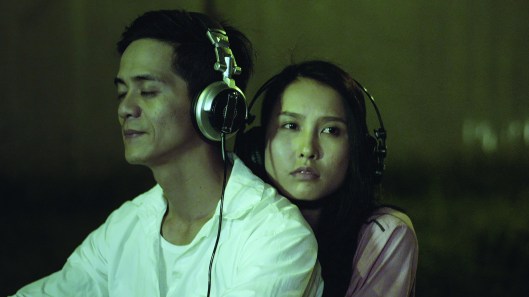
The beating heart of writer, director Le Binh Giang’s debut feature, Kfc is laid bare with no holds barred and all guts, no glory.
At least not for the characters portrayed in this gritty, violent, and sadistic world, we find ourselves in.
With a short running time of 69 minutes is certainly not to be scoffed at as Le manages to cram enough twisted, blood-fuckery to warp the mind and melt the soul.
Straight from the off-set, we’re provided with the confronting images of violence and mayhem that will flow through the narrative like a gushing artery, with a guys casually talking with a motionless figure before ripping up a coke can and stabbing them in the neck with it.
Said character is mowed down outside of his abode by a passing vehicle and from here-on-in, we’re sentenced down into a whirlpool of loathing and disgust that leaves the head reeling in response to the grotesque that is on display.
That’s not to mention the necrophilia doctor and his accomplice that deliberately hunt for their victims in their ambulance by smashing into them and dragging their bodies away to be defiled and cut to pieces.
In some ways this film reminds me of Fernando Meirelles’ City of God, minus the beauty of Rio.
There’s no shying away from the brutality of Kfc, but does paint a similar picture of the rough terrain and gang mentality, where only the most deranged will survive.
The films focus is on a trio of sadists, who inflict their cruelty on the world around them without any inflection of emotion, which only adds to the haunting carnage that they leave in their wake.
And it’s only when emotions play a part and brim to the surface with themes of love/lust, anger, and revenge that these three accomplices fall apart.
The energy of the piece propels you forward and there’s enough material to keep you engaged without feeling too violated.
Le Binh Giang manages to craft a cyclical tale with some key observations on how parentage and society can have a serious negative impact on the way we carry out our lives.
Anarchy and chaos will reign but only for a period of time before something or someone else comes along to wipe you off the streets and a new world of pain will begin.
The director apparently wasn’t able to graduate from the University of Ho Chi Minh, due to the extreme violence in Kfc, and although it may not be suited for the faint-hearted, it certainly offers up a fresh take on the body horror genre and could very well propel Le Binh Giang onto greater things as a result.