Tags
The body has always been one of horror’s most reliable battlegrounds. We fear what can enter it, what can escape from it and, perhaps most disturbingly, what it might become when it is no longer entirely under our control. With Saccharine, Australian filmmaker Natalie Erika James takes that anxiety and feeds it through one of contemporary culture’s most persistent obsessions: the desire to change the body into something supposedly better.
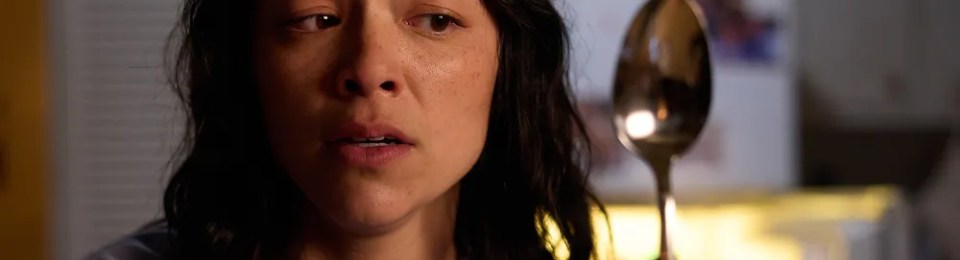
Hana is a medical student consumed by dissatisfaction with her weight and appearance. When she encounters an obscure weight-loss craze promising extraordinary results, the temptation proves impossible to resist. The secret ingredient, however, is not some miracle pharmaceutical. It is human ash. And when Hana begins consuming it, she discovers that the dead aren’t necessarily prepared to become part of somebody else’s pursuit of perfection.
What begins as a grotesque diet-culture satire gradually develops into something stranger: a ghost story, a psychological horror film and a piece of body horror that asks how much of ourselves we are prepared to destroy in the pursuit of becoming somebody else.
It is an ambitious premise, and James is an ambitious filmmaker. The result doesn’t always manage to reconcile all of its ideas, but when Saccharine sinks its teeth into its central concerns, it demonstrates exactly why James has become such an interesting voice in Australian horror.
The James Body
Viewed alongside Relic, Saccharine begins to reveal something particularly fascinating about Natalie Erika James as a filmmaker.
These are very different horror films, dealing with very different forms of suffering, yet they are connected by an increasingly recognisable preoccupation: what happens when an internal experience becomes impossible to contain inside the mind and begins to manifest upon the body.
In Relic, that experience is dementia. Edna’s cognitive deterioration becomes increasingly physical, with the house itself seeming to absorb and reproduce the decay taking place within her. Mould spreads across the walls and eventually across Edna’s body, turning the invisible horror of neurological decline into something tangible.
Saccharine takes that same principle and turns it inward.
Hana isn’t losing control of her body because disease has taken it from her. She is attempting to take control of it herself. The horror emerges from the space between those two impulses. She wants to improve herself, to become thinner, more desirable and more acceptable, but the pursuit of that ideal gradually becomes an act of self-erasure.
James has described Saccharine as exploring the thin line between self-improvement and self-erasure, and that distinction provides perhaps the most useful key to understanding her cinema.
Her characters aren’t necessarily confronted by monsters that exist independently of their emotional lives. Instead, horror gives physical form to something they are already carrying.
In Relic, grief, ageing and the terror of watching a loved one disappear become an environment that literally decays around the characters. In Saccharine, shame, hunger and the desire to alter one’s body become a presence that enters Hana from within and gradually assumes control.
The monster is therefore never entirely external.
It is an expression.
From Decay to Self-Erasure
The connection between Relic and Saccharine becomes particularly striking when we consider their attitudes towards the body.
Edna’s body is betraying her.
Hana believes her body is betraying her.
The distinction is enormous, but James approaches both characters with the same fundamental empathy. Neither woman is simply a vessel for a horror metaphor. The supernatural allows James to explore experiences that are difficult to represent literally, while the human being remains at the centre of the film.
That is why the body horror in both films feels more tragic than sensational.
In Relic, the horror lies in the inevitability of deterioration and the helplessness of those watching it happen. In Saccharine, the horror lies in the possibility that the desire to escape dissatisfaction can become another form of destruction.
One woman cannot stop her body changing.
The other cannot stop trying to change hers.
Both are trapped by an increasingly hostile relationship with the physical self.
And in both cases, James makes that psychological imprisonment literal.
The House and the Body
There is also a fascinating architectural connection between the two films.
Relic is inseparable from its house. The building becomes an extension of Edna’s deteriorating mind, with rooms, corridors and walls transforming into expressions of confusion, entrapment and decay. The physical environment becomes a manifestation of the psychological experience.
Saccharine moves that idea into the body.
Hana’s environment still matters, but the primary architecture is now physical. Her body becomes the space through which the horror operates. The film’s medical settings are particularly appropriate because they turn the human form into something that can be examined, measured, dissected and categorised.
That is precisely what Hana is doing to herself.
She has internalised the idea that her body can be treated as a problem to solve.
James simply turns that idea into horror.
The result is a continuation of the spatial thinking that made Relic so effective. In both films, characters are trapped inside environments that increasingly reflect their psychological states. The difference is that Relic makes the house feel like a body, while Saccharine makes the body feel like a haunted house.
An Australian Body-Horror Tradition
This makes Saccharine part of a particularly interesting moment in Australian horror.
Australian genre cinema has long had an appetite for the grotesque, but recent years have seen filmmakers increasingly combine physical horror with sophisticated psychological and social themes. The Babadook, Relic, Sissy and Talk to Me are very different films, but each demonstrates the capacity of Australian horror to transform intimate anxieties into something monstrous.
Saccharine comfortably belongs within that tradition.
The horror doesn’t simply arrive from outside.
It grows from something recognisably human.
Hana’s obsession with her body is not an abstract concept. It is connected to the pressures surrounding beauty, desirability, self-worth and the seemingly endless cultural demand to improve ourselves.
James simply pushes those pressures to their most grotesque conclusion.
What if the shortcut actually worked?
What if you could consume something and become thinner almost immediately?
And what if the price of that transformation was another human being?
What Are We Willing to Consume?
The film’s weight-loss substance, Gray, is one of its most inspired concepts.
Initially, it appears almost miraculous. Users lose weight at an extraordinary rate, turning the fantasy of effortless transformation into reality.
But Hana is a medical student.
She investigates.
And what she discovers is horrifying.
The substance is human ash.
At that moment, Saccharine reveals its most deliciously perverse idea. The modern miracle cure isn’t some futuristic invention. It is simply death repackaged as a consumer product.
The body that society has taught Hana to despise can apparently be transformed through the consumption of another body.
It is cannibalism disguised as wellness.
And the more Hana understands about Gray, the further she is prepared to go to continue using it.
James is at her strongest when she allows this idea to speak for itself. She doesn’t need to explain the metaphor because the metaphor is already horrifying.
We have simply taken the language of dieting and pushed it into nightmare territory.
The Dead Fight Back
The film’s second major idea arrives when Hana begins to realise that the human remains she is consuming belonged to someone.
That someone does not necessarily appreciate what has happened.
The resulting ghost story gives Saccharine another layer of unease. Hana isn’t merely haunted because she has violated some supernatural rule. She is being confronted by the humanity she has tried to reduce to an ingredient.
The ghost becomes a physical manifestation of the moral consequence of Hana’s obsession.
The dead woman is no longer simply a body.
She is a person.
That distinction becomes increasingly important.
The more Hana becomes obsessed with changing herself, the more she begins to lose sight of the humanity of other people. The haunting therefore isn’t simply punishment.
It is confrontation.
Midori Francis’ Hana
Midori Francis carries much of the film’s emotional weight.
Hana could easily have become an unpleasant protagonist. Her decisions become increasingly disturbing, and her obsession leads her into ethically appalling territory. Yet Francis gives her enough vulnerability to make those choices comprehensible without excusing them.
There is desperation beneath the vanity.
There is loneliness beneath the obsession.
And there is an almost tragic belief that if Hana can simply fix her body, the rest of her life will somehow fall into place.
Francis understands that contradiction.
Hana knows that what she is doing is wrong.
She continues anyway.
That is much more interesting than a protagonist who simply doesn’t understand the consequences of her actions.
Her intelligence becomes part of the tragedy. She has enough medical knowledge to understand exactly what is happening, but knowledge cannot overcome obsession.
The Anatomy of Horror
James’ visual confidence is particularly evident in the way she treats the human body.
The medical environment provides an appropriately clinical backdrop. Bodies are dissected, examined and categorised. Human remains become objects of scientific study.
Then the film gradually turns those same bodies into objects of desire and consumption.
The clinical becomes corporeal.
The corporeal becomes edible.
The edible becomes supernatural.
James repeatedly finds ways of making the human body appear simultaneously fascinating and disgusting. Flesh, organs and food begin to occupy the same visual territory.
This is where Saccharine demonstrates some of its greatest confidence.
Body horror doesn’t necessarily require mutilation.
Sometimes the most disturbing image is something completely ordinary presented from the wrong perspective.
A meal becomes grotesque.
A body becomes food.
Food becomes flesh.
And the distinction between nourishment and destruction begins to disappear.
The Beautiful and the Grotesque
James’ visual evolution between Relic and Saccharine is equally revealing.
Relic is dominated by oppressive darkness, Gothic architecture, mould, shadow and gradual decay. Saccharine initially appears almost to reject that visual language. Its colours are brighter, its surfaces more artificial and its imagery more tactile.
But the underlying philosophy is remarkably similar.
James has spoken about wanting Saccharine to occupy a space between “candy and grime” — the artificial sweetness of pleasure alongside the physical rot underneath it.
That tension is central to her work.
The beautiful and the grotesque are never entirely separate.
In Relic, the family home contains both memories of love and the horror of deterioration. In Saccharine, the promise of beauty and self-improvement contains the possibility of self-destruction.
James seems instinctively drawn to the point where attraction becomes repulsion.
Something is beautiful because we desire it.
Something is horrifying because we understand what that desire can cost.
That is a sophisticated foundation for body horror.
A Ghost Story Inside a Body-Horror Film
The film’s most interesting structural decision is also one of its weaknesses.
James is essentially making two horror films at once.
One is a body-horror story about eating, weight loss and the desire to transform the physical self.
The other is a supernatural ghost story about a dead woman whose body has been violated and whose presence begins to haunt the person responsible.
Individually, both ideas are compelling.
Together, they don’t always fit comfortably.
The ghost story occasionally threatens to pull the film away from its strongest material. Just as the body-horror metaphor begins to bite, the narrative shifts towards more conventional supernatural mechanics.
This doesn’t make those sequences ineffective, but they are less distinctive.
James is at her best when the supernatural and physical become indistinguishable — when we aren’t quite sure whether Hana is being haunted by a ghost, by her own guilt or by the increasingly distorted relationship she has with her body.
The more conventional the haunting becomes, the less interesting the film feels.
When the Metaphor Starts Showing
There is no great subtlety to Saccharine.
That isn’t necessarily a criticism. Horror has always been capable of taking social anxieties and turning them into grotesque literalism.
James understands that the metaphor becomes more powerful when it becomes physically impossible to ignore.
But there are moments when the film explains what its imagery has already communicated.
We understand what Hana is experiencing.
We understand why she wants to change.
We understand the destructive nature of the culture surrounding her.
The film occasionally continues explaining after the horror has already made the point.
This becomes more noticeable as the narrative progresses. The film’s second half doesn’t always maintain the intensity established by its opening sections.
The irony is that the repetition has a thematic logic.
Obsession is repetitive.
The same thought returns.
The same ritual is repeated.
The same dissatisfaction resurfaces.
But what works psychologically doesn’t always work dramatically.
The Horror of Wanting More
One of the film’s strongest ideas is that Hana never reaches a point at which enough is enough.
The first transformation isn’t sufficient.
The next one isn’t sufficient.
The goal moves.
The body changes.
The dissatisfaction remains.
This is perhaps the most disturbing aspect of Saccharine because it doesn’t require a supernatural explanation.
The promise of perfection is inherently unstable.
There is always another flaw.
Another kilogram.
Another improvement.
Another version of ourselves waiting to be manufactured.
Hana’s horror comes from discovering that the thing she believes will finally make her happy has no finish line.
The body can always be changed.
The appetite can always return.
The obsession can always demand more.
The Horror of Self-Erasure
This is where Saccharine most clearly extends the ideas of Relic.
Edna’s body is being taken away from her.
Hana is voluntarily giving hers away.
The first is a horror of inevitable deterioration. The second is a horror of chosen transformation.
Yet both films ultimately arrive at a similar question:
What happens when the body ceases to feel like home?
James doesn’t provide an easy answer because neither film is really interested in easy answers.
Instead, she uses horror to make psychological experiences physical.
In Relic, decay becomes architecture.
In Saccharine, insecurity becomes consumption.
In both films, the body becomes the place where emotional and psychological damage can no longer remain invisible.
That may ultimately be the defining characteristic of James’ cinema.
She doesn’t use horror to escape reality.
She uses horror to make reality impossible to ignore.
The Australian Body-Horror Renaissance
There is something particularly encouraging about Saccharine existing within the current Australian horror landscape.
The country has always produced filmmakers willing to confront the grotesque, but there is now a remarkable confidence in Australian genre cinema’s ability to explore serious emotional and social issues through horror.
Saccharine doesn’t merely want us to recoil.
It wants the recoil to mean something.
The body becomes the battleground where social pressure, personal insecurity, desire, grief and guilt collide.
That makes James’ work part of a broader Australian horror tradition that treats genre as a means of examining the things we might otherwise find difficult to discuss directly.
And James is clearly developing a visual language of her own.
There is a confidence here that goes beyond the script’s occasional structural uncertainty.
A Film That Bites, But Doesn’t Always Chew
The frustrating thing about Saccharine is that its best ideas are genuinely excellent.
The concept of a weight-loss drug made from human ashes is inspired.
The collision of body horror and ghost story is fertile territory.
The Australian setting gives it a distinct identity.
Midori Francis is compelling.
And James has an instinct for visual horror that remains impressive.
But the film sometimes feels like it is carrying too many ideas at once.
The social commentary wants to be sharp.
The ghost story wants to be frightening.
The body horror wants to be disgusting.
The character drama wants to be emotional.
The romantic material wants to give Hana something to desire.
And the family material wants to explain where her relationship with her body originated.
Some of these elements complement one another beautifully.
Others simply compete for attention.
The result is a film that is frequently fascinating without always being completely satisfying.
The Prognosis:
Saccharine is an ambitious Australian horror film that deserves credit for taking a genuinely grotesque premise and using it to interrogate something far more familiar: our complicated relationship with our own bodies.
Natalie Erika James remains an assured visual filmmaker, and Saccharine confirms that the concerns emerging from Relic were not simply the product of a singular premise. There is a developing body of work here, one increasingly concerned with the physical manifestation of internal suffering.
Relic asked us to confront the horror of watching a body and mind deteriorate.
Saccharine asks us to confront the horror of desperately trying to prevent that body from being what it is.
One woman cannot stop herself changing.
The other cannot stop trying to change herself.
Both become trapped inside bodies that no longer feel like their own.
That continuity makes Saccharine more interesting than its individual successes and shortcomings might suggest. It establishes James as a filmmaker fascinated by the point at which psychological suffering crosses the threshold into physical horror.
The film doesn’t always achieve the devastating impact its premise promises. Its supernatural elements occasionally feel more conventional than its body-horror ideas, and its thematic commentary can sometimes become too explicit.
But there is enough ambition, imagination and outright grotesquerie here to make the film worthwhile.
James has created a horror story in which appetite becomes addiction, transformation becomes self-destruction and the dead refuse to remain reduced to ingredients.
It doesn’t always digest its ideas cleanly.
But when Saccharine sinks its teeth into its subject, it does so with considerable force.
And in an Australian horror landscape increasingly willing to make the body its canvas, that is something worth celebrating.
Relic made the house feel like a body.
Saccharine makes the body feel like a haunted house.
The next question is what James will choose to haunt.
- Saul Muerte

