Luz is a film that is ultimately about demonic possession, but it certainly isn’t your typical window into the occult.
It is not some simple, paired down student project shot on a low budget, instead director Tilman Singer offers a minimalistic style reminiscent of playwright Bertolt Brecht and is set in a handful of isolated interior locations.
This adds to the harrowing and strange feeling that is carried throughout the film, all the more haunting for the powerful performances on display. Nora’s odd twitchy movements and the intensity of police psychiatrist Dr Rossini simply add more fuel to the stifled ambience.
Everything is incredibly stylised and each movement no matter how small is charged with emotion or reason. If anything, the minimalism forces the actors to bare their souls on screen that is ironic as the story centres around a demon, hell-bent on taking the soul of our lead, Luz.
The starkness of the décor coming straight out of the heart of the 70s adds to this sense of isolation and bewilderment. This coupled with the awesome retro soundtrack by Simon Waskow thrusts the viewer into a world far removed from their own and into a world of despair.
As the demonic presence homes in on its prey, the more potent the drama becomes and the free fall into madness becomes ever more present.
The short running time of 70 mins only compliments the movie more, keeping the story in a tight and succinct timeframe packing enough depth to the plot line whilst keeping the audience gripped.
The Diagnosis:
Singer manages to balance the highs and lows in a harmony of beautifully constructed cinematography and movement.
The performances are strong across the board and all the components tie together in an interesting and unique approach to demonic possession.
– Saul Muerte
Who do they call upon when other ‘Surgeons’ fear to tread? but yours truly, “Howling Mad Moon” Maguire. The assignment presented to me has been described as “the most shocking, brutal and extreme horror film in recent times”, and with a title like Trauma you can only expect some kind of residual scarring after witnessing the events that unfold through its narrative.
This film sure ain’t for the faint-hearted and sets the tone straight away by ramming it straight down your throat in such a confronting way that its not surprising that it has been likened to A Serbian Film in its nature and depiction of humanity at its worst. There’s rape, torture, and incest all within the first scene that leaves you feeling sick to the stomach and grimacing at the prospect of where Chilean director Lucio A Rojas will take his audience next.
Where he does take you almost teases the audience into a false-sense of security to juxtapose the intro, as we see an incredibly intimate scene between two women, breaking the cardinal rule of any horror film, so our hopes of their survival are in doubt, if Rojas were to play by those rules.
But what is survival? It’s as if the meaning of that word is irrelevant in this world in upheaval through the turmoil of General Pinochet’s rule in Chile.
The question should be more about ‘What does it takes to exist?’ as Rojas shines a spotlight on the plight of the country of his birth at a time when the world just turned its head. (This echoed by one of the police officials in the storyline) Rojas does everything he can to deny you this right, by forcing you to watch.
The pain is highlighted further as we journey alongside four female characters in search of a weekend getaway and slowly getting to know each of them through some wonderful character development, only to be crushed by the realisation that their world is about to clash with the dark and twisted underbelly that resides in their haven.
The Diagnosis:
You have to have a strong stomach for this one and the opening scene may turn viewers away. That’s not to mention the harrowing ordeal that takes place throughout the films narrative. If you can brace yourself, prepare to be educated in a time that the world wanted to ignore and forget by a director who has a firm grasp on what that reality means to him and those of his country.
The most shocking thing is that this is just a whisper of time that we bear witness to. There are other stories are left untold are the ones that leave you haunted and scarred by the unknown. Trauma lives up to its name and then some.
Personally I find the Norwegian title (Yuleblod) creates more of an impact than its English transcription, but everything else about this film translates superbly for the wider audience, and is a great addition to the Sydney Underground Film Festival.
Director Reinert Kiil (great name for a horror director by the way) is no stranger to the genre, cutting his art with a distinctive Nordic vibe throughout his credits thus far.
The premise of this movie has a killer Santa on the loose, murdering his victims with his trusty pickaxe during the festive season every year. For those who might be turned off by this premise, or are still recovering from the scars that Silent Night, Deadly Night produced in the 80’s, fear not. Kiil delivers a fun, psychological, slasher movie that doesn’t shy away from its nostalgic roots whilst still delivering the sucker punch that fans of the subgenre will love.
Part of Christmas Blood’s lure is in the way it plays its straight and by setting the scene in his childhood town of NordKapp, Kiil is able to draw on what he knows for the setting of Santa’s most recent rampage.
All the hallmarks are there, Killer soundtrack with metal riffs and the psychotic Santa even has his own theme for when he bears down on his next victim, which Kiil does through the use of POV to both direct and on occasion misdirect the audience.
There’s also the stranded females in an isolated location, waiting to be picked off one by one, and Kiil does a great job in making us questions who if anyone will survive. And let’s not forget the hard-boiled alcoholic detective who has been through this before and is destined to try and bring down Santa once and for all, accompanied by the brash, new upstart detective who is hoping to leave his mark in hunting down the notorious serial killer.
And there are plenty of gruesome kills to satiate fans of the slasher genre.
The diagnosis:
Kiil takes the viewer where others have dared to tread but rarely succeeded and offers a decent stab at the slasher horror genre with some yuletide flavour. Expect a fun-ride, great kills, and a Santa who is completely off his sleigh.
Now in its sixth year the Sydney Underground Film Festival has firmly laid claim to the weird and wonderful world of movies on the festival circuit. In doing so it has provided Australian audiences with access to a unique, colourful and bizarre celluloid landscape that wouldn’t ordinarily see the light of day.
Thank God they do, because films like Tokyo Vampire Hotel fits the criteria perfectly, offering a diverse and delightful skew on the tried genre of vampirism, which is so refreshing to see.
Japanese director Sion Sono provides a theatrical cut to his 9 part miniseries for the festival, with a rich and striking pallet that sometimes feels like it is dripping off the screen.
The characters are instantly iconic and ooze charisma, from the magnanimous Yamada to the sword-wielding K, the latter cutting a familiar figure in Japanese folk mythology and on occasion triggers images of Lady Snowblood to the mind’s eye.
K’s character complements the old and new world of vampire legend, hailing from the Dracula dynasty and charged with locating and protecting soon-to-be 22 year old Manami from rival vampire clan, the Corvins.
Manami becomes the core focus for the warring families as they vie for her pure blood and become victors once and for all.
It’s obvious that this film originated in broken down segments with the pace and energy peppering the narrative at a cracking pace, and constantly pushing the viewer onto the next scenario. The soundtrack also helps to fire the action along thanks to math-rock act Tricot’s catchy upbeat anthems. To Sono’s credit he does this seamlessly and with each instance he up’s the ante and trebles the crazy much to the delight of this reviewer.
The result has us see some beautiful images and strange scenarios from total annihilation by a sugary sweet assassin, armed with crazy dialogue and an endless supply of ammo and arsenal to take out an entire café; to massive gunfights and explosions on the streets of Tokyo; and full-on gore, mayhem, and bloody carnage, as vampires and mortals rip each other to shreds.
It’s a glorious sight to behold and leaves you wanting more from the world that Sono has created on-screen.
The Diagnosis: Tokyo Vampire Hotel has cult viewing written all over it and deserves a global audience. Go see the theatrical cut while you can.
Okay. There are some people who will watch this movie and instinctively think that it’s a pile of artistic wank within the first few minutes, but for those who stick it out through the admittedly slow pace will find themselves lured into a fantastical journey, that leaves you entranced by the sheer bloody beauty that is depicted on screen.
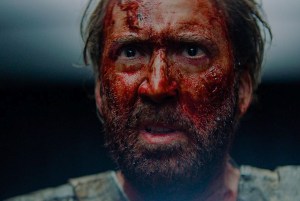
Italian director Panos Cosmatos’ sophomore outing is an attack on the senses that is delivered in a trance-like state, enamoring you by its beauty of rich colours and kaleidoscopic fluidity. This false-sense of sedateness is doubled further with the deep dialogue between kindred couple Red Miller (Nic Cage) and Mandy Bloom (Andrea Riseborough) which lends itself to the hippy-life that they lead in the remote northern wilderness.
Enter cult leader Jeremiah Sand awesomely portrayed by Linus Roache, oscillating between delusional insanity and vulnerability sublimely. From a chance encounter with Mandy, Jeremiah like the audience is intoxicated and feels compelled to delve further into her mystery, so he brings his entourage of devotees and sadistic fucks to rip apart this idyllic sanctuary and claim Mandy for his own. The problem is that perfection doesn’t exist and when Mandy doesn’t meet his expectations, Jeremiah wants to tear it up and destroy everything. By severing open the guts of peace and bliss, Jeremiah unwittingly sours the land of milk and honey and from that moment on, the turmoil and angst that has been contained, pours forth in a devastating form that has no means of slowing down until the balance is restored once more.
The depredation is the trigger for Red to resort to his base instincts and exact pure bloody hell and revenge on Mandy’s tormentors. This dark and twisted journey that Red undertakes is filled with pure anarchy and hatred that it feels only an actor like Cage can portray. The beauty of his performance though isn’t from his stereotypical over-the-top exuberance but in the stifled and restrained approach that he plays his role, which is a testament to both Cage’s acting prowess and Cosmatos’ direction. By ever so slowly dialing up the heat, Red reaches the pique of frenzy at the right moment in the film to make it both believable and a delight to see.
The diagnosis: Beware of your strive for beauty and perfection. Slice it open and you get a reign of anarchy and destruction.
Cage taps into the life of a man who has his whole world savagely ripped wide open and ventures out on a path for vengeance and fury, delivering one of his finest performances to date.
It’s a visually stunning movie with an amazing cast including a welcome cameo from Bill Duke in the midst of the mind-fuckery that goes on.
Whilst it’s not for everyone, this movie will delight many in its unique style and approach to the celluloid form.
Directed by McG and a Netflix original, The Babysitter is one of those films you could easily watch while scrolling through Facebook or feeding the dog and still get the general idea.
Twelve-year-old Cole (Judah Lewis) has the world’s best babysitter, Bee (Samara Weaving). She’s got her sci- fi trivia- down pat, hot tips on beating bullies, and she’s a drop dead gorgeous American dream. As in, pass me the Blu Tack and stick her poster up on my wall kind of hot. Cole and Bee are the best of friends (go Cole) until one day his parents are away and he stays up past his bedtime. He discovers Bee is eeevilll and plans to use him as a blood sacrifice in a magic ritual (Noooo we thought you were perfect, Bee).
The Babysitter isn’t trying to be brilliant, it tries to mirror your eighties teen slasher flick. A little bit of horror and a little bit of comedy mashed up with a side of teen titillation. We see a cheerleader get shot in the boob, we see a nerd get his first– kiss, a girl on girl make out sesh and stacks of cheesy graphics. If the full frame “what the fuck” graphic doesn’t alert you that the plot is taking a turn, then maybe Thomas the Tank Engine might be a better choice for you. Those who aren’t into McG’s male gazy lens better steer clear too.
If we wipe away the blood and teen slasher film cliché’s the film is really a coming of age story about a twelve-year-old that overcomes his fear of needles, bullies and not being accepted. Judah Lewis does a great job of pulling on our heartstrings and doing the whole nerd -becomes -hero thing. The early scenes with Lewis and Weaving are the film’s strongest. Bee and Cole have real chemistry. Even the other villains do what they can to make their cliché characters dance. McG nails slowing down the background action whenever the pair are together. These scenes provide much needed depth balancing out the one-dimensional horror to come.
The Diagnosis:
Look, you’re probably not going to be talking about this one over drinks at the pub or even remembering what it was about next week (caution: you may lose a few brain cells throughout). However, respect for not trying to be something it’s not and giving us a few cheap laughs along the way.
Here’s the thing about the golden age of drama we’re currently living in: it has put movies on the back-foot. Which would be a really good analogy if The Endless were a boxing movie.
But it’s not. It’s not even a horror movie – but we’ll circle back to that.
Back to high end TV drama and their ability to craft complex story-lines and characters over a solid (but not too long) period of time. It’s clear these days movies (with their relatively short 2-3 hour sittings) are losing ground as a “competing” format.
It did have cinematic-ness in its corner (which is a real word, no need to look it up) until CGI balanced that ledger too. Sure as a science and an art-form computer imagery is still evolving, but if done right, big screen special FX can be just a mouse click away for even the tiniest micro-budget film.
So what do these two developments have to do with The Endless – the latest offerings from Indie filmmakers Aaron Moorhead and Justin Benson?
Well for a start it has the 5D aesthetic of an Indie offering (although no doubt it was shot on a much bigger gauge) but towards the end it has surprising quality special FX for a movie that initially looks so sparse, it almost feels like a found footage film!
And secondly it is an adjunct to Moorhead and Benson’s 2012 effort, Resolution. By that I mean The Endless takes place parallel to the events in Resolution (and literally about a block away from it).
So yes – TheEndless is a cross-over film. And this brings me to an interesting thing film has done to “push back” against the serialised superiority of TV drama. And that’s franchising, i.e. Movies that aren’t sequels per se, ‘cause not all sequels respect or even acknowledge films in their own canon (James Bond much?) but rather ‘share the same universe’.
Marvel are the current bar setters of this trend, and movie studios everywhere are following suit (lack of originality will ‘always’ be a universal constant with Hollywood).
But it also appears independent filmmakers don’t need an excuse to franchise off their own bat. Which would have helped to know in advance when events from The Endless crossed over into Resolution.
But on with some actual review stuff! The Endless centres around 2 cult “survivors” (played by Moorhead and Benson themselves). They are brothers trying to subsist in an ‘ordinary world’ that cult living failed to prepare them for.
The younger brother especially (Aaron played by Aaron) feels rudderless and out of sync, and retains more good memories about the compound they grew up in, and as such convinces his older brother Justin (played by Justin) to go back and visit for a day or two.
This is after they mysteriously receive a VHS tape featuring a woman who used to babysit them there (played by Callie Hernandez of Blair Witch and Alien Covenant fame).
And this is where the first confusion sets in, as all the characters we meet ‘appear’ to be roughly the same age. Throw in the fact that the boys themselves seem to have left the compound in the 90’s (if news footage of them exiting is to be believed) yet they themselves look to not have aged a day in 20 years.
Yet continual references by Justin to his younger brother that there appears to be a “spark” between him and their former sitter seem odd, as Hernandez looks several years younger than both of them. Yet no one makes any attempt to explain these discrepancies in any sort of story-telling capacity; and so you’re left confused. No doubt this is a deliberate ploy from the filmmaking duo who brought us the Bonestorm segment from VHS Viral, but unfortunately it does tend to come across as if the film is gleefully disappearing up its own mythos (something re-enforced when it crosses over into Resolution).
Now despite all this, The Endless does evolve at an intriguing pace and is a sci-fi page turner that has the courage to be both sparse and visually spectacular where it needs to be. Something ‘is’ going on at the compound, and you ‘do’ want to see it to the end.
The movie’s central theme is time, whereas Resolution was story. Where & when they cross over – once you know what’s going on – does work.
But is it a horror film? Not by a long stretch. Is it worth seeing? Definitely.
The beating heart of writer, director Le Binh Giang’s debut feature, Kfc is laid bare with no holds barred and all guts, no glory.
At least not for the characters portrayed in this gritty, violent, and sadistic world, we find ourselves in.
With a short running time of 69 minutes is certainly not to be scoffed at as Le manages to cram enough twisted, blood-fuckery to warp the mind and melt the soul.
Straight from the off-set, we’re provided with the confronting images of violence and mayhem that will flow through the narrative like a gushing artery, with a guys casually talking with a motionless figure before ripping up a coke can and stabbing them in the neck with it.
Said character is mowed down outside of his abode by a passing vehicle and from here-on-in, we’re sentenced down into a whirlpool of loathing and disgust that leaves the head reeling in response to the grotesque that is on display.
That’s not to mention the necrophilia doctor and his accomplice that deliberately hunt for their victims in their ambulance by smashing into them and dragging their bodies away to be defiled and cut to pieces.
In some ways this film reminds me of Fernando Meirelles’ City of God, minus the beauty of Rio.
There’s no shying away from the brutality of Kfc, but does paint a similar picture of the rough terrain and gang mentality, where only the most deranged will survive.
The films focus is on a trio of sadists, who inflict their cruelty on the world around them without any inflection of emotion, which only adds to the haunting carnage that they leave in their wake.
And it’s only when emotions play a part and brim to the surface with themes of love/lust, anger, and revenge that these three accomplices fall apart.
The energy of the piece propels you forward and there’s enough material to keep you engaged without feeling too violated.
Le Binh Giang manages to craft a cyclical tale with some key observations on how parentage and society can have a serious negative impact on the way we carry out our lives.
Anarchy and chaos will reign but only for a period of time before something or someone else comes along to wipe you off the streets and a new world of pain will begin.
The director apparently wasn’t able to graduate from the University of Ho Chi Minh, due to the extreme violence in Kfc, and although it may not be suited for the faint-hearted, it certainly offers up a fresh take on the body horror genre and could very well propel Le Binh Giang onto greater things as a result.
It’s hard not to view the directorial debut from Flying Lotus without uttering these words into the mix.
Kuso is a film best described as an experimental, avant-garde piece that suits the twisted mind of it’s artist.
His music that blends hip-hop and electronic into a stylistic and fresh approach to the scene that has had people both gripped in either love or despair, so it should come as no surprise that Flying Lotus carries this across onto the visual canopy of film.
When the film premiered in Cannes, there were reports of people walking out of the movie in disgust. The numbers of which may have been grossly overestimated, but when viewing Kuso, you can understand the temptation to turn away.
Whilst I too felt the compulsion to revolt in the comfort of my chair when watching the film, I felt compelled to see it through and challenge myself not to resort to the knee-jerk reaction to what was being laid bare.
Flying Lotus flings everythingat the viewer not only to confront our visual senses but also to shed light on the grotesque and ugly of society.
The film is essentially broken into 4 vignettes that are interspersed throughout the post-apocalyptic narrative following the mutated survivors of an earthquake in Los Angeles.
Labelled as a body horror that would have the likes of Cronenberg and Lynch proud.
We’re thrust into a world with a talking, singing boil; inter-dimensional creatures getting stoned in an apartment, and a large bug that lives inside a doctor’s anus set to cure a man from his fear of breasts; a kid who is prone to self-defecating and feeding his faeces to a creature in the forest; and a woman who eats concrete and steered by God to travel down a hole in search of her missing baby.
The end result is a mishap of the strange, vulgar, and wonderful.
It’s not for the faint of heart and could steer the hardened viewer away from the screen.
While it may suit the fans of experimental and challenging films, I challenge the average viewer to step outside their comfort zones and witness a spectacle like no other.
But be warned, some of the images may scar you. It’s been a while since a movie from this genre has warped the senses and disturbed the soul.
Driven by the voice of her unborn child, seven month pregnant Ruth embarks on a homicidal killing spree to avenge the recent death of her husband.
This slasher black comedy is the brilliant directorial debut of its star Alice Lowe. Seen in various low budget Brit flicks particularly the absolutely outstanding Ben Wheatley classic “Sightseers”, she cements her role as that crazy woman you wouldn’t sit anywhere near on a bus.
“Prevenge” is a low budget low key thriller that appears influenced by the days when Hammer Horror ditched the monster creature features and produced a couple of contemporary horrors, see “Straight On till Morning” if you haven’t already. It’s the real life monsters that are in fact the scariest, and in this case; pregnant widows.
Partly reliant on what appears as a largely improvised or bare bones dialogue script it’s the editing, cinematography and the understated music that’s the real driving force here. Music from ex-Unkle members now Toydrum, the synth atmospheric score creates an unsettling edge complimented by Lowes insanely real performance.
Naturalistically shot, clearly using available light, the cinematography places the audience deep into this gritty grainy story whether they want to or not.
The supporting cast are excellent too, with the female supports getting the biggest slice of the corpse. Jo Hartley (This is England, The Mimic), Gemma Whelan (Game of Thrones, The Moorside), & Kate Dickie (The Witch, Prometheus), the standouts.
If I did have one quibble, it would be that the demises were mostly one note. A bit of gore-induced variety wouldn’t have gone astray.
I absolutely applaud Lowes tenacity in making this film whilst being 7-8 months pregnant herself. Her drive, or axe to grind, very apparent in getting this beautifully crafted horror comedy out of her system.
There’s a message here deep at the films core…don’t piss off Alice Lowe…EVER!!




 Surgeons of Horror