• About
  • podcasts
  • Shop

Surgeons of Horror

~ Dissecting horror films

Surgeons of Horror

Tag Archives: cinema

Underground Horrors: Geisha War

09 Wednesday Sep 2026

Posted by surgeons of horror in Sydney Underground Film Festival

≈ Leave a comment

Tags

cinema, film, horror, movies, reviews, suff, Sydney Underground Film Festival

There are filmmakers who make films, and then there are filmmakers who seem to have wandered into a film laboratory, knocked over several shelves of chemicals and decided to see what happened.

Yoshihiro Nishimura was very much the latter.

With Geisha War, the Japanese cult filmmaker delivers one final eruption of blood, absurdity, political provocation and gloriously impractical visual effects. It is a film that frequently appears less interested in whether its story makes sense than in whether the next image can possibly be more outrageous than the last.

The answer, more often than not, is yes.

Set in the historic pleasure district of Yoshiwara, Geisha War pits an American gangster and his associates against the local community, led by Kiki, a ramen vendor who finds herself caught up in the struggle to protect the district from outside control. The basic premise provides Nishimura with an excuse to stage a collision between American gangster mythology, Japanese popular culture and his own particular brand of cinematic insanity.

And insanity is certainly the operative word.

Nishimura’s cinema has never been particularly interested in restraint. From Tokyo Gore Police to Helldriver, his films transform bodies into weapons, flesh into sculpture and practical effects into a kind of gleeful visual assault. Geisha War carries that tradition forward with an arsenal of bizarre weaponry, outrageous transformations and fountains of artificial blood. FilmInk describes the film’s visual approach as a combination of solid practical gore and cartoonish digital effects, with everything from chainsaw weaponry to giant scissors entering the fray.

It is less a film than a fever dream with a production budget.

Yet beneath the carnage is something considerably more pointed.

The conflict between Carmine and the residents of Yoshiwara is essentially a battle over cultural ownership. The American gangster sees the district as something to acquire, exploit and reshape for his own purposes. Nishimura responds by turning that clash into an exaggerated piece of exploitation spectacle, where cultural imperialism is answered with severed limbs, weaponised geisha and enough blood to repaint the streets.

Subtle it isn’t.

But subtlety was never particularly high on Nishimura’s list of priorities.

The film’s greatest strength is its willingness to embrace the ridiculous. A conventional action film might introduce a weapon and expect us to accept it as part of the world. Nishimura introduces something completely absurd and then seems determined to make it even more absurd. The result is a cinematic universe in which rickshaws become vehicles of lunacy, weapons emerge from unexpected places and characters can transform into things that would be difficult to describe without sounding like the result of a particularly feverish drinking session.

This is Gallows Horror stripped of the gallows and given a flamethrower.

There is also something strangely poignant about watching Geisha War as Nishimura’s final film. The director died in May 2026, making this an unintentional farewell from one of Japanese genre cinema’s great visual anarchists.

It is certainly an appropriate final statement.

Nishimura never seemed particularly interested in behaving himself. His cinema was messy, confrontational, juvenile, political, horny, grotesque and frequently hilarious. He understood that practical effects could be more than technical achievements: they could be jokes, provocations and punctuation marks. A severed limb wasn’t merely a piece of gore. It was a punchline.

Geisha War occasionally struggles beneath the weight of its own excess. The narrative is skeletal, characterisation is largely functional and the film’s relentless barrage of ideas can become exhausting. For all the visual invention, there are moments when it feels as though Nishimura has several films fighting for space inside the same one.

But perhaps that is part of its charm.

This isn’t polished underground cinema. It isn’t attempting to disguise its seams or convince us that its world is realistic. It is handmade, excessive and proudly artificial. The practical effects have weight; the digital effects deliberately flirt with cartoonishness; the action seems designed around the question of what could possibly make an audience yell what the hell was that?

And then, just when the film seems incapable of slowing down, it finds an unexpectedly reflective note beneath all the bloodshed.

That contradiction is what makes Geisha War work.

For all its ridiculousness, there is a genuine sense of resistance running through the film. Its grotesque spectacle becomes a weapon against the forces attempting to commodify and control its world. Nishimura takes the familiar machinery of exploitation cinema and turns it back upon itself, producing something that is simultaneously crude, playful and politically mischievous.

It is not his most accomplished film.

It may not even be his most outrageous.

But it is unmistakably his.

And as the final film from a director who spent decades proving that there was still room for strange, handmade, bloody and completely unclassifiable cinema, Geisha War makes for one hell of a final curtain call.

Underground Horrors is a series of reviews exploring the strange, confrontational and boundary-pushing films emerging from the underground of contemporary horror cinema.

  • Saul Muerte

DEAD-END DRIVE-IN AT 40: WELCOME TO THE END OF THE WORLD

28 Friday Aug 2026

Posted by surgeons of horror in retrospective

≈ Leave a comment

Tags

Aussie horror, brian trenchard-smith, cinema, film, horror, movies, ozploitation, reviews

There are Australian films that attempt to explain Australia. There are Australian films that attempt to romanticise it. Then there is Dead-End Drive-In, Brian Trenchard-Smith’s magnificent, deranged vision of a country that has looked at its own future, shrugged, and decided the best thing to do is throw everyone into a drive-in, feed them cheeseburgers, give them drugs and make sure they never leave.

Forty years on, Dead-End Drive-In remains one of the strangest and most exhilarating films to emerge from the great Australian exploitation boom. Released in 1986, it is ostensibly a dystopian science-fiction thriller, but that description hardly begins to contain the thing. It is a car movie, a punk movie, a prison movie, a satire of consumer culture, a portrait of youth alienation, a social nightmare and, inevitably for a Brian Trenchard-Smith film, an excuse to launch increasingly large pieces of machinery through the air.

It is also one of those rare films that becomes more interesting the more seriously you take it.

Because beneath the outrageous costumes, the spectacular stunt work, the burnt-out cars and the general sensation that someone has spiked the national cinema with amphetamines, Dead-End Drive-In is asking an unnervingly serious question: what happens when a society decides that its unwanted people are easier to contain than to help?

The answer, according to Trenchard-Smith, is apparently to build a prison that looks exactly like a Saturday night at the movies.

THE MAN WHO NEVER KNEW HOW TO BEHAVE

To understand Dead-End Drive-In, you have to understand Brian Trenchard-Smith. Not because the film is some carefully controlled expression of auteurist intent, but because his career represents almost the exact opposite of the respectable model of Australian filmmaking. Trenchard-Smith has always seemed happiest when genre conventions are being thrown into the air and collided together at considerable velocity.

He could make martial-arts exploitation, horror, science fiction, children’s adventure, action cinema and television, often with the same gleeful disregard for the boundaries separating them. The Man from Hong Kong, Turkey Shoot, BMX Bandits and Dead-End Drive-In may appear to belong to entirely different cinematic universes, yet they share an unmistakable physicality. Trenchard-Smith likes movement. He likes spectacle. He likes bodies being thrown around spaces. He likes machinery being pushed beyond its sensible limits. Most importantly, he understands that exploitation cinema does not have to choose between being entertaining and being about something.

Dead-End Drive-In might be the clearest expression of that philosophy.

It is ridiculous, but it is not stupid. It is politically charged without ever becoming a lecture. It is visually extravagant despite its relatively modest resources. It is adolescent, lurid and occasionally uncomfortable, but beneath all that noise is a remarkably clear understanding of the social anxieties of the Australia that produced it.

Trenchard-Smith simply refuses to deliver those ideas politely.

He gives them a chainsaw.

WELCOME TO THE STAR

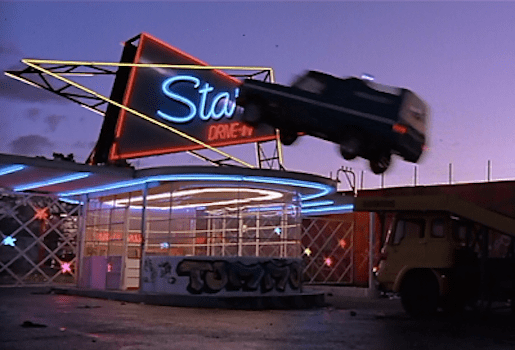
The premise is brutally simple. Jimmy “Crabs” Rossini and his girlfriend Carmen arrive at the Star Drive-In after suffering car trouble. They expect an evening at the movies. Instead, they discover that the drive-in has effectively become a detention centre for unemployed and socially unwanted young people.

The government does not need to execute them. It does not even need to rehabilitate them. It simply needs to remove them from the functioning parts of society and make their confinement sufficiently comfortable that they stop asking questions.

The Star provides food, entertainment, drugs and companionship. It becomes a world within a world, a brightly illuminated enclosure where the inmates are encouraged to consume themselves into submission.

This is where Dead-End Drive-In becomes considerably more sophisticated than its lurid surface suggests. The prison does not look like a prison. There are no obvious dungeon walls or endless corridors of concrete. There is a snack bar. There are cars. There is music. There are movies playing on a huge screen.

The inmates are not simply denied freedom. They are given enough distractions that freedom begins to seem unnecessary.

THE PERFECT PRISON IS ONE YOU DON’T WANT TO ESCAPE

That remains the film’s most disturbing idea.

The authorities have not created a traditional authoritarian nightmare. They have created a lifestyle. The inmates are surrounded by the very things that a consumer society tells them should make them happy. Food, television, entertainment, drugs, sex and material possessions become substitutes for employment, purpose and political agency.

The genius of the Star is that it doesn’t have to convince its inhabitants that they are free. It only has to convince them that freedom is inconvenient.

Why leave when there is food?

Why work when there is television?

Why build a future when the present is entertaining?

Why protest when you can get high?

The film’s dystopia therefore operates through distraction as much as repression. The system has discovered that the easiest way to control a population is not necessarily to terrify it, but to keep it occupied.

That makes Dead-End Drive-In feel remarkably prescient. Its junk food, consumerism and endless entertainment are not simply background details. They are the architecture of the prison.

THE DRIVE-IN AS AUSTRALIA

The choice of the drive-in is particularly inspired because the drive-in was itself such a recognisable part of Australian popular culture. It was a place associated with freedom, leisure, adolescence and the ability to temporarily escape the routines of everyday life.

Trenchard-Smith takes that cultural memory and turns it inside out.

The drive-in is no longer somewhere you visit to escape society.

It is somewhere society sends you when it has decided that you are no longer useful.

That reversal gives the film’s central location a strange melancholy. The Star feels simultaneously futuristic and nostalgic, like a discarded piece of Australian culture that has been repurposed as a holding pen for the future.

The cars remain. The screen remains. The food remains. The entertainment continues.

Only the audience has become the prisoner.

AND THEN THERE ARE THE CARS

Of course, this is Brian Trenchard-Smith, so the automobile cannot merely be symbolic.

The car in Dead-End Drive-In is a status symbol, a shelter, a weapon, an object of desire and, most importantly, an expression of mobility. Yet the film takes particular pleasure in turning that symbolism against itself. Cars are everywhere, but nobody is actually going anywhere.

The inhabitants of the Star sleep in their vehicles. They decorate them. They identify with them. They use them to establish status within the enclosed society. The automobile, traditionally one of the great symbols of freedom, has become another part of the prison.

That contradiction is everywhere in the film. The people have cars but no roads to freedom. They have entertainment but no meaningful future. They have food but no purpose. They have choices, provided those choices remain within the boundaries established for them.

The whole film can almost be understood as a gigantic metaphor for having the accelerator pressed firmly against the floor while the vehicle remains stationary.

Naturally, Trenchard-Smith eventually decides that the metaphor requires an actual vehicle to fly through the air.

THE GONZO AUSTRALIA OF BRIAN TRENCHARD-SMITH

There is something gloriously Australian about the film’s refusal to be subtle. Economic collapse becomes a wasteland of burnt-out vehicles. Youth alienation becomes a sea of punk costumes and leather. Government oppression becomes an electrified fence around a drive-in. Consumerism becomes junk food and television. Social exclusion becomes a population of young people deliberately abandoned inside a recreational complex.

The apocalypse is not presented as some distant future catastrophe.

It is the present turned up to eleven.

This is one of Trenchard-Smith’s great gifts. He understands that exploitation cinema can exaggerate reality until the exaggeration becomes a form of truth. Dead-End Drive-In does not seriously attempt to predict what Australia will look like. Instead, it takes the anxieties already present in Australian society and magnifies them until they become almost absurd.

The result is a kind of gonzo social realism.

Everything is too loud. Everything is too colourful. Everyone is slightly too grotesque. The cars are too damaged. The violence is too spectacular. The costumes are too outrageous.

And yet you can recognise the world underneath it.

That is where the satire bites.

A WORLD BUILT FROM JUNK

The Star itself looks as though civilisation has been put through a meat grinder and then handed over to a gang of teenagers with a spray can. Burnt-out cars, graffiti, concrete, rubbish, punk fashion and industrial decay transform the location into a junkyard version of the future.

The film’s production design is crucial because Trenchard-Smith does not need to build some enormous futuristic metropolis. He can find the apocalypse in the Australian landscape that already exists.

The apocalypse is a car park.

The apocalypse is a takeaway counter.

The apocalypse is an abandoned industrial space.

The apocalypse is a generation of young people who have been told that there is no future and have consequently stopped behaving as though one exists.

Most disturbingly, the apocalypse is brightly lit.

THE UNCOMFORTABLE POLITICS OF THE STAR

It would be easy to celebrate Dead-End Drive-In entirely on the basis of its aesthetic pleasures, but doing so would ignore some of the film’s more uncomfortable dimensions.

Its treatment of race, immigration and Australian identity deserves scrutiny. The film emerges from a period when anxieties surrounding immigration, economic decline and the changing nature of Australian society were deeply embedded in political and popular culture. Those anxieties find their way into the Star, where displaced populations are effectively contained and removed from the mainstream.

This is one of the reasons Dead-End Drive-In is more interesting than simply being an anarchic Ozploitation spectacle. The film does not merely show us a dystopian Australia. It shows us what that Australia is afraid of.

It is afraid of unemployment.

It is afraid of youth.

It is afraid of social disorder.

It is afraid of outsiders.

It is afraid of economic collapse.

It is afraid that the institutions supposedly responsible for maintaining order might themselves be incapable of solving the problems they have created.

Those fears do not necessarily make the film politically progressive. Some of its imagery remains troubling. But that does not make it irrelevant. Quite the opposite. The discomfort is part of what makes the film worth revisiting.

Dystopian cinema can reveal a culture’s anxieties as clearly as it reveals its aspirations.

JIMMY CRABS AND THE REFUSAL TO STAY PUT

Ned Manning’s Jimmy is therefore crucial because he refuses the bargain.

Everyone else has adapted to the Star. Jimmy hasn’t.

His rebellion is not particularly intellectual. He doesn’t deliver great political speeches. He simply refuses to accept that this is all there is.

That makes him strangely radical.

In a world where the system has convinced people to accept captivity as comfort, the simple desire to leave becomes an act of resistance.

Jimmy still believes that there is something beyond the fence.

That belief is the most dangerous thing about him.

CARMEN AND THE HORROR OF ADAPTATION

Natalie McCurry’s Carmen complicates the film’s simplistic notion of resistance. She begins to adapt to the Star, and that adaptation is both understandable and disturbing.

Because people do adapt.

They adapt to poverty. They adapt to confinement. They adapt to political instability. They adapt to bad conditions. They adapt because sometimes adaptation is the only available survival mechanism.

The Star does not need everyone to love it.

It simply needs people to stop imagining anything else.

Jimmy wants to escape.

Carmen learns how to survive inside.

Neither response is entirely comfortable.

THE MOVIES WITHIN THE MOVIE

The films being screened inside the Star provide another layer to Trenchard-Smith’s satire. The inmates watch exploitation movies while simultaneously living inside one.

Violence is entertainment.

Violence is fantasy.

Violence is spectacle.

Then violence spills beyond the screen.

The audience watches people watching movies, and those people are themselves watching images that reflect the world they inhabit. It creates an endless feedback loop between screen violence and social violence.

Trenchard-Smith’s answer to this complicated observation is, naturally, not to stop making violent movies.

He makes the violence bigger.

That is part of the joke.

Dead-End Drive-In is itself an exploitation movie critiquing a culture of exploitation.

It knows exactly what it is doing.

THE TRUCK JUMP

Eventually, all of this social commentary has to give way to the inevitable.

The truck jumps.

The climactic stunt remains one of the film’s great moments because it encapsulates Trenchard-Smith’s entire filmmaking philosophy. The film has spent all this time talking about captivity, consumerism, social control and the collapse of Australian society, and then suddenly a vehicle is flying through the air.

There is something almost philosophically perfect about that.

The truck is not merely escaping the Star.

It is escaping the limitations of the film itself.

After all the political anxiety, the satire and the symbolism, Trenchard-Smith simply says: enough.

Make it bigger.

Make it faster.

Make it fly.

That is not a failure of seriousness.

It is Trenchard-Smith’s definition of seriousness.

OZPLOITATION WITH A BRAIN

This is perhaps the mistake people make when discussing Australian exploitation cinema. They assume a film must either be trash or a masterpiece.

Dead-End Drive-In is both.

It is trashy.

It is intelligent.

It is adolescent.

It is politically loaded.

It is visually sophisticated.

It is exploitative.

It is genuinely interested in Australian society.

The contradiction is precisely what makes it work.

Trenchard-Smith understands that audiences might come for the cars, the punk costumes, the violence and the dystopian spectacle. So he gives them all of it.

Then he hides the political argument inside the popcorn.

A FILM THAT ARRIVED TOO EARLY

Perhaps Dead-End Drive-In was simply released at the wrong moment.

Australian audiences were still being encouraged to think of Australian genre cinema as something inferior to Hollywood. A film this strange, this aggressively Australian and this unwilling to behave itself was never going to fit comfortably into the mainstream.

Its initial commercial failure is therefore one of cinema’s more satisfying ironies.

The film depicts a society that has failed to recognise the value of its own discarded population.

Australian cinema subsequently spent years doing something similar to Dead-End Drive-In itself.

It was sitting there.

Covered in graffiti.

Surrounded by wrecked cars.

Waiting for someone to realise what they were looking at.

Eventually, the audience arrived.

THE GREAT AUSTRALIAN ANARCHIST

Forty years later, perhaps the best way to celebrate Dead-End Drive-In is not to pretend that it is perfect.

It isn’t.

Some of its politics are uncomfortable. Some of its ideas are more fully developed than others. Its aesthetic is unmistakably tied to the decade that produced it.

But perfection would almost miss the point.

Brian Trenchard-Smith has never been a filmmaker of polite surfaces. His cinema is physical. It is interested in impact, movement and spectacle. The machinery matters. The bodies matter. The stunt matters.

His films want you to feel the physicality of cinema.

The car hits the barrier.

The engine screams.

The body flies.

The gate electrifies.

The world collapses.

And Dead-End Drive-In might be his purest expression of that sensibility.

It is a dystopian science-fiction film, a punk film, a car movie, a prison movie, a social satire, a romance, an exploitation picture and an Australian nightmare.

And somehow, against all reason, it is also enormous fun.

THE PRICE OF ADMISSION

The title is perfect.

Dead-End Drive-In is not merely a description of the place in which Jimmy finds himself trapped. It is a description of the society surrounding him.

Everyone has arrived at the end of the road.

There is no future.

So consume.

There is no meaningful employment.

So entertain yourself.

There is no escape.

So decorate the prison.

There is no hope.

So turn the music up.

And if anyone complains, give them another cheeseburger.

That is the genius of Trenchard-Smith’s dystopia. It is not controlled by some grand totalitarian mastermind. It is maintained by administrative indifference and the quiet acceptance of everyone who has decided that resistance is too much trouble.

The system does not need to explain itself.

It simply keeps operating.

People disappear into the Star.

The movies continue playing.

The food keeps coming.

The cars keep burning.

And outside the fence, everybody else carries on.

FORTY YEARS IN THE REAR-VIEW MIRROR

Forty years later, Dead-End Drive-In feels less like a relic than a warning that has become increasingly difficult to ignore.

Its anxieties about unemployment, consumerism, youth alienation, social exclusion and institutional neglect remain remarkably potent. Its punk aesthetic has become retro. Its cars have become objects of affection. Its drive-in has disappeared.

Its future, meanwhile, has arrived in fragments.

Perhaps that is why the film has endured.

It never really predicted Australia.

It exaggerated Australia.

It took existing anxieties and turned the volume knob until the speakers exploded.

That is what Brian Trenchard-Smith does.

He does not whisper.

He does not gently suggest.

He kicks the door in, sets the car on fire, throws the television through the window and then asks whether you’ve noticed what is happening.

THE GATES ARE STILL CLOSED

There is a moment in Dead-End Drive-In when the absurdity finally becomes clear. The prison isn’t simply the electrified fence. It isn’t the guards. It isn’t the government. It isn’t even the Star.

The prison is the idea that there is nowhere else to go.

That is why Jimmy has to escape. Not simply because he wants freedom, but because he still believes freedom exists.

And perhaps that is the film’s most enduring act of rebellion.

In a genre packed with nihilism, Dead-End Drive-In still believes that someone can look at the wreckage and say no. No, I don’t want this. No, I don’t accept this. No, this isn’t the future.

I’m getting in the car.

I’m hitting the accelerator.

I’m going through the fence.

And if Brian Trenchard-Smith is directing, there will probably be a truck flying overhead when you do it.

That is Dead-End Drive-In at 40: a film about a country staring into the abyss and deciding to install a snack bar; a film about capitalism, captivity and consumption disguised as a car chase; a film about a generation being told that the future has already been cancelled.

And a filmmaker who responded to that bleak proposition with the only reasonable answer he could think of.

Make it louder.

Make it stranger.

Make it faster.

And, for God’s sake, make the truck jump.

  • Saul Muerte

Playtime Turns Predatory: Dolly

23 Thursday Apr 2026

Posted by surgeons of horror in Movie review

≈ Leave a comment

Tags

cinema, Ethan Suplee, Fabianne Therese, film, horror, Max the Impaler, movies, reviews, seann william scott, shudder, shudder australia, slasher

There is a familiar rhythm to Dolly, a film that arrives wrapped in the well-worn trappings of captivity horror and slasher sensibilities, yet occasionally hints at something more psychologically curious beneath its surface. Premiering as a Shudder original, it treads a precarious line between formula and subversion — rarely straying too far from the former, but not entirely devoid of the latter.


A Familiar Game of Survival

At its core, Dolly is disarmingly simple. A young woman, Macy — played with a grounded resilience by Fabianne Therese — is abducted by a grotesque, childlike figure intent on “raising” her. The premise is unsettling in theory, tapping into distorted notions of family, control, and psychological regression.

In execution, however, the film largely adheres to a paint-by-numbers structure. The beats are recognisable: capture, resistance, escalation, and survival. Tension rises and falls in expected intervals, rarely deviating from the genre’s established blueprint.


Flashes Beneath the Surface

And yet, it would be reductive to dismiss Dolly entirely.

There are fleeting moments — brief, almost intrusive — where the film gestures toward a more complex identity. The central antagonist, portrayed with unnerving physicality by Max the Impaler, carries a disquieting blend of menace and arrested development. The idea of imposed infantilisation, of forced dependency, lingers as an underexplored but compelling thematic thread.

Similarly, the inclusion of dark humour — often abrupt, sometimes jarring — suggests a film aware of its own absurdity, even if it struggles to fully integrate that awareness into a cohesive tone.


Violence as Punctuation

Where Dolly finds its most immediate impact is in its bursts of gore. These moments arrive sporadically, punctuating the narrative with flashes of brutality that momentarily jolt the film to life.

They are effective, if fleeting — less a sustained atmosphere of dread than intermittent reminders of the stakes. In this sense, the film operates more as a sequence of peaks and valleys than a steadily mounting crescendo.


The Weight of Simplicity

The film’s greatest strength — its simplicity — ultimately becomes its limitation.

By adhering so closely to familiar genre mechanics, Dolly never quite earns the psychological depth it gestures toward. Its exploration of trauma, control, and identity remains surface-level, hinted at rather than interrogated.

Even performances from recognisable faces like Seann William Scott and Ethan Suplee feel underutilised, existing more as texture than as integral components of the narrative.


The Prognosis:

Dolly is a film caught between impulses — the desire to deliver straightforward genre thrills and the ambition to probe something darker, more psychological. It succeeds intermittently on both fronts, but never fully commits to either.

A serviceable slasher with flashes of twisted promise, where moments of gore and uneasy humour briefly break through an otherwise familiar and simplistic framework.

  • Saul Muerte

Dolly streams on Shudder from Fri 24th April.

Bad Taste as Baptism: Fuck My Son! (2026)

04 Saturday Apr 2026

Posted by surgeons of horror in Movie review

≈ 1 Comment

Tags

cinema, controversial, film, horror, movies, reviews, taboo, Todd Rohal, x rated

There are films that provoke… and then there are films that weaponise provocation as their entire identity.
Fuck My Son!, directed by Todd Rohal, firmly belongs in the latter camp — a grotesque, confrontational descent into taboo that feels less like storytelling and more like an endurance test.

Adapted from the underground comic by Johnny Ryan, the film embraces its origins with unapologetic aggression. Narrative coherence is secondary. Characterisation is almost incidental. What matters here is impact — how far it can push, how hard it can hit, and how long an audience can withstand the onslaught before recoiling.


The Aesthetics of Offence

Rohal’s approach is not without craft. In fact, what makes Fuck My Son! so confronting is how deliberately constructed it is. This is not chaos by accident — it is chaos curated.

The practical creature effects, in particular, demand attention. There is a tactile, squirm-inducing quality to the film’s physical grotesqueries that places it in lineage with boundary-pushing auteurs who understand that revulsion is most effective when it feels real. Flesh stretches. Fluids flow. The body becomes both canvas and battleground.

In an age of digital sanitisation, this commitment to the physical image is perversely admirable.


Taboo as Currency

But provocation, when used as currency, quickly devalues itself.

The film’s central conceit — deliberately offensive, aggressively transgressive — initially shocks, then unsettles, and eventually… numbs. Without thematic grounding or emotional counterpoint, the transgression begins to feel repetitive rather than revelatory.

This is where Fuck My Son! falters.

The most effective works of extreme cinema often use taboo as a gateway to deeper commentary — on society, morality, repression. Here, the suggestion of meaning is fleeting at best. The film gestures toward satire, but rarely commits to it.


Know Your Audience

And yet, to dismiss the film outright would be to misunderstand its purpose.

There is an audience for this. A dedicated, discerning subset of genre fans who seek out the extreme not for narrative satisfaction, but for experiential confrontation. For them, Fuck My Son! is not a failure — it is a badge of honour. A film to be survived, debated, and worn like a scar.

It is cinema as dare.


The Prognosis:

Fuck My Son! is not interested in pleasing you. It barely cares if you understand it. It exists to provoke, to repel, and to challenge the limits of what can be put on screen.

A technically committed but narratively hollow exercise in taboo, elevated by its practical effects and sustained only by the endurance of its audience.

  • Saul Muerte

Fuck My Son will be screening at select cinemas from Apr 9 for a limited time.

Filth, Flesh and Freedom: A Brief History of Trash Cinema

Blue Light Special on Mayhem: Revisiting Chopping Mall (1986)

23 Monday Mar 2026

Posted by surgeons of horror in retrospective

≈ Leave a comment

Tags

barbara crampton, cinema, film, horror, jim wynorski, kelli maroney, movies, russell todd, science-fiction, tony o'dell

Few films capture the peculiar charm of 1980s B-movie excess quite like Chopping Mall, the gleefully silly sci-fi slasher directed by Jim Wynorski. Promising a blend of high-tech terror and consumerist satire, the film strands a group of teenagers in a shopping centre stalked by malfunctioning security robots. On paper, it’s a wonderfully ridiculous premise — Short Circuit by way of Dawn of the Dead — but the result is a somewhat uneven cult oddity that never quite lives up to its gleeful concept.


A Mall After Midnight

The setup is pure 1980s sci-fi pulp. The Park Plaza Mall installs a trio of sophisticated security robots — affectionately dubbed “Killbots” — designed to patrol the complex after hours. Naturally, the system works perfectly… until a lightning strike short-circuits the controls, turning the machines into lethal enforcers with a very loose definition of trespassing.

Meanwhile, a group of young mall employees decide to throw a secret after-hours party inside one of the stores. Predictably, their night of rebellious fun quickly transforms into a cat-and-mouse game as the robots begin hunting them through the darkened corridors.

It’s a premise that promises chaos and ingenuity, yet the film often settles for repetition. The Killbots trundle through the mall with mechanical persistence, firing lasers and delivering the occasional electrocution, while the teens scramble from store to store in search of escape.


Campy Energy, Limited Bite

To its credit, Chopping Mall embraces its B-movie identity with enthusiasm. Director Jim Wynorski, who would become a prolific figure in low-budget genre filmmaking, keeps the tone playful rather than frightening. The film operates firmly in the realm of camp rather than suspense.

Unfortunately, that playful spirit doesn’t always translate into momentum. Much of the middle section consists of characters hiding, running, or debating their next move while the robots slowly patrol the premises. The mechanical villains themselves — squat, boxy machines topped with blinking lights — look more like malfunctioning appliances than unstoppable killing machines.

The result is a film that feels more goofy than dangerous.


Barbara Crampton Brings Some Spark

One of the film’s more enjoyable elements is the presence of Barbara Crampton, who would soon become a beloved icon of 1980s horror thanks to films like Re-Animator and From Beyond. Even within the confines of a lightweight script, Crampton manages to bring charisma and a touch of sincerity to her role.

She stands out in a cast largely composed of archetypal 80s teens, providing moments of charm that briefly elevate the otherwise disposable proceedings.


Consumer Culture Meets Killer Robots

There’s also a faint whiff of satire running through the film’s premise. The idea of automated security systems turning on the very consumers they were designed to protect carries a subtle commentary about technological overreach and corporate obsession with efficiency.

Yet these ideas never develop beyond the surface level. Unlike Dawn of the Dead, which used the shopping mall as a biting critique of consumer culture, Chopping Mall seems more interested in using the setting as a convenient playground for laser blasts and exploding heads.

The film gestures toward satire but ultimately settles for spectacle.


A Mildly Amusing Cult Curio

Despite its shortcomings, Chopping Mall has endured as a minor cult favorite — and it’s easy to see why. The premise is delightfully absurd, the setting wonderfully nostalgic, and the film’s brisk runtime prevents the silliness from overstaying its welcome.

Still, nostalgia can only carry a film so far. While it offers a handful of entertaining moments and plenty of retro charm, the movie never quite capitalizes on the chaotic potential of its killer-robot-in-a-mall setup.

  • Saul Muetre

Link (1986) — When Intelligence Turns Hostile

08 Thursday Jan 2026

Posted by surgeons of horror in Movie review

≈ Leave a comment

Tags

ape horror, cinema, elisabeth shue, film, horror, link, movies, reviews, terence stamp

Released in the mid-1980s, when natural horror and animal-attack films were enjoying a second life on VHS and late-night television, Link occupies an unusual and often overlooked position within the killer ape subgenre. Directed by Richard Franklin—best known for his Hitchcockian leanings and his brief but curious detour into franchise horror with Psycho II—the film is less interested in primal savagery than in the unnerving implications of intelligence, hierarchy, and control.

The setup flirts with eccentricity. Graduate student Jane Chase arrives at the isolated home of an ageing zoology professor, only to discover that the household hierarchy has already been rewritten. The professor’s chimpanzees operate with eerie autonomy, while Link, an elderly orangutan dressed and treated like a gentleman’s butler, observes quietly from the margins. When one chimp is found dead and the professor vanishes, Franklin slowly inverts the power dynamic. Jane is no longer studying behaviour—she is subject to it.

Franklin directs Link with a measured, classical restraint that sets it apart from the more exploitative entries in the killer ape cycle. There is little in the way of sensational gore or overt shock tactics. Instead, tension is built through framing, pacing, and a creeping sense of domestic invasion. The house becomes a laboratory, and Jane its most vulnerable test subject. The horror emerges not from sudden violence but from the dawning realisation that the apes understand far more than they should—and may be capable of resentment, planning, and cruelty.

Elisabeth Shue, still early in her career, delivers a performance that anchors the film’s escalating unease. Her Jane is intelligent and resourceful, but never impervious. Shue excels at conveying fear through restraint, allowing the terror to register in hesitation and watchfulness rather than outright hysteria. It’s a performance that would foreshadow her later genre credibility, grounding increasingly absurd situations in emotional reality.

Terence Stamp, meanwhile, brings an off-kilter gravitas to the role of the eccentric professor. Though his screen time is limited, his presence lingers over the film, lending it an air of intellectual arrogance and ethical negligence. Stamp embodies a familiar horror archetype: the man of science who mistakes authority for control, and curiosity for dominion. His disappearance feels less like a mystery than an inevitability.

Within the broader killer ape genre, Link sits closer to Monkey Shines than to more bombastic entries like Congo or Rampage. This is not a film about nature striking back in spectacular fashion, nor is it interested in giant monsters or environmental collapse. Instead, Link taps into a subtler fear—the idea that intelligence, once nurtured and confined, may turn possessive and violent when its boundaries are tested.

When Apes Strike Back: A Brief, Bloody History of Killer Ape Cinema

That said, the film is not without its shortcomings. The third act leans into melodrama, and the film’s central conceit occasionally strains credulity. The mechanics of ape behaviour are pushed beyond plausibility, and some of the symbolism—particularly around class, servitude, and dominance—remains underdeveloped. Franklin’s restraint, while admirable, sometimes blunts the film’s impact, leaving it hovering between psychological thriller and creature feature without fully committing to either.

Viewed in retrospect, Link is a solid, thoughtful entry in the killer ape canon—more curious than terrifying, more cerebral than visceral. It lacks the cultural weight of Planet of the Apes or the grindhouse audacity of exploitation-era ape horror, but it compensates with atmosphere, performance, and an unsettling moral undercurrent.

For readers interested in the broader lineage of killer ape cinema—where Link fits alongside films that interrogate humanity’s uneasy relationship with intelligence, dominance, and the natural world—this film acts as a quiet but essential connective tissue, bridging prestige thrillers and pulp horror traditions.

The Prognosis:

A restrained, intelligent thriller that favours implication over excess, Link remains a peculiar but worthwhile footnote in the long, uneasy history of killer apes on screen.

  • Saul Muerte

Subscribe

  • Entries (RSS)
  • Comments (RSS)

Archives

  • September 2026
  • August 2026
  • July 2026
  • June 2026
  • May 2026
  • April 2026
  • March 2026
  • February 2026
  • January 2026
  • December 2025
  • November 2025
  • October 2025
  • September 2025
  • August 2025
  • July 2025
  • June 2025
  • May 2025
  • April 2025
  • March 2025
  • February 2025
  • January 2025
  • December 2024
  • November 2024
  • October 2024
  • September 2024
  • August 2024
  • July 2024
  • June 2024
  • May 2024
  • April 2024
  • March 2024
  • February 2024
  • January 2024
  • November 2023
  • October 2023
  • September 2023
  • August 2023
  • July 2023
  • June 2023
  • May 2023
  • April 2023
  • March 2023
  • February 2023
  • January 2023
  • November 2022
  • October 2022
  • September 2022
  • August 2022
  • July 2022
  • June 2022
  • April 2022
  • March 2022
  • February 2022
  • January 2022
  • December 2021
  • November 2021
  • October 2021
  • September 2021
  • August 2021
  • July 2021
  • June 2021
  • May 2021
  • April 2021
  • March 2021
  • February 2021
  • January 2021
  • December 2020
  • November 2020
  • October 2020
  • September 2020
  • August 2020
  • July 2020
  • June 2020
  • May 2020
  • April 2020
  • March 2020
  • February 2020
  • January 2020
  • December 2019
  • November 2019
  • October 2019
  • September 2019
  • July 2019
  • June 2019
  • May 2019
  • April 2019
  • March 2019
  • February 2019
  • January 2019
  • December 2018
  • November 2018
  • October 2018
  • September 2018
  • August 2018
  • July 2018
  • June 2018
  • May 2018
  • April 2018
  • March 2018
  • February 2018
  • January 2018
  • December 2017
  • November 2017
  • October 2017
  • September 2017
  • August 2017
  • July 2017
  • June 2017
  • May 2017
  • April 2017
  • March 2017
  • February 2017
  • January 2017
  • December 2016
  • November 2016
  • October 2016
  • September 2016
  • August 2016
  • July 2016
  • June 2016
  • May 2016

Categories

  • A Night of Horror Film Festival
  • Alien franchise
  • Alliance Francaise French Film Festival
  • Australian Horror
  • Best Movies and Shows
  • Competition
  • dark nights film fest
  • episode review
  • Flashback Fridays
  • Friday the 13th Franchise
  • Full Moon Sessions
  • Halloween franchise
  • In Memorium
  • Interview
  • japanese film festival
  • John Carpenter
  • killer pigs
  • Library of the Occult
  • midwest weirdfest
  • MidWest WierdFest
  • MonsterFest
  • movie article
  • movie of the week
  • Movie review
  • New Trailer
  • News article
  • podcast episode
  • podcast review
  • press release
  • retrospective
  • Rialto Distribution
  • Ring Franchise
  • series review
  • Sounds of Horror
  • Soundtracks
  • Spanish horror
  • sydney film festival
  • Sydney Underground Film Festival
  • The Blair Witch Franchise
  • the conjuring franchise
  • the evil dead franchise
  • The Exorcist
  • the fly
  • The Howling franchise
  • Top 10 list
  • Top 12 List
  • top 13 films
  • Trash Night Tuesdays on Tubi
  • umbrella entertainment
  • Uncategorized
  • Universal Horror
  • Wes Craven
  • wes craven's the scream years

Meta

  • Create account
  • Log in

Blog at WordPress.com.

  • Subscribe Subscribed
    • Surgeons of Horror
    • Join 226 other subscribers
    • Already have a WordPress.com account? Log in now.
    • Surgeons of Horror
    • Subscribe Subscribed
    • Sign up
    • Log in
    • Report this content
    • View site in Reader
    • Manage subscriptions
    • Collapse this bar
Loading Comments...