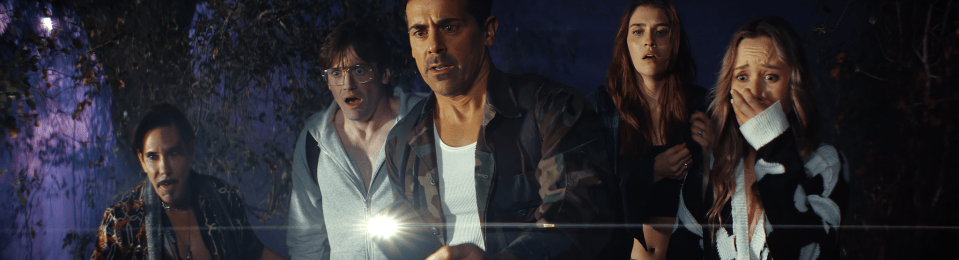
When the killer-doll movie crawls out of the video-store bargain bin
There are films that arrive at a festival demanding to be taken seriously.
There are films that arrive hoping to be discovered.
And then there are films like Jeffrey Dollmer, which seem to arrive carrying a petrol can, a fake moustache and absolutely no intention of apologising for themselves.
A possessed doll.
The spirit of Jeffrey Dahmer.
A remote photo shoot.
A collection of models.
Murder, exploitation and a title that sounds like somebody ran a serial killer’s name through a children’s toy catalogue.
You could spend an enormous amount of time asking whether Jeffrey Dollmer is in good taste.
The film would probably prefer you didn’t.
Monster Fest’s own program copy essentially throws the gauntlet down before the screening even begins, describing the film as “cheap, nasty, ridiculous” and openly celebrating its capacity to offend. That is not an accidental side effect of the film’s identity. It is the sales pitch.
And perhaps that is the most interesting thing about Jeffrey Dollmer.
It feels like a movie from a parallel universe in which the video store never died.
WELCOME TO THE WRONG SHELF
There is a particular kind of horror movie that used to be everywhere.
You would walk into a video shop and find it lurking beneath the more respectable releases. The artwork promised something outrageous. The title promised something worse. The synopsis seemed to have been written by somebody who had been dared to make it sound as filthy and violent as possible.
You picked it up.
You read the back.
You knew absolutely nothing about it.
And that was precisely the point.
Jeffrey Dollmer feels like it belongs in that ecosystem.
Not because it resembles a lost 1980s film in any literal sense, but because it understands the ancient exploitation-movie equation that a sufficiently outrageous premise is itself an invitation.
This is not “a film about a possessed doll.”
It is Jeffrey Dollmer.
The title is already the trailer.
THE FULL MOON CONNECTION
The obvious comparison is Charles Band’s Full Moon Pictures.
That comparison is not intended as an insult.
Quite the opposite.
Full Moon built an entire cottage industry around the idea that horror did not have to be respectable to be entertaining. The company understood the peculiar alchemy of killer toys, demonic objects, mad scientists, miniature monsters, erotic nightmares and concepts that would probably sound insane if explained outside the context of a video-store shelf.
Puppet Master is perhaps the obvious reference point, but the larger Full Moon tradition is what matters here.
The concept comes first.
The spectacle follows.
Logic can take the evening off.
The viewer is not necessarily being promised prestige.
They are being promised something.
A hook.
A monster.
A ridiculous premise.
A reason to press play.
Jeffrey Dollmer appears to understand that tradition instinctively.
It does not seem interested in asking how a possessed serial killer doll could function within a rigorously constructed supernatural mythology.
It asks a much more important exploitation question:
Wouldn’t it be insane if this happened?
And then it goes ahead and makes the movie.
MARK SAVAGE’S HOUSE OF BAD TASTE
At the centre of this particular descent is Australian filmmaker Mark Savage, a director whose career has never suggested an overwhelming interest in staying safely inside the boundaries of good taste.
Monster Fest describes Savage as a fiercely independent filmmaker responsible for titles including Marauders, Sensitive New Age Killer and The Masturbating Gunman.
Those titles alone should tell you something about the cinematic neighbourhood in which Jeffrey Dollmer has chosen to build its house.
Savage is not approaching the material as though somebody has accidentally handed an arthouse director the wrong script.
The premise is the destination.
The bad taste is part of the architecture.
And that places Jeffrey Dollmer in an increasingly interesting corner of contemporary genre filmmaking: movies made with the awareness that there is still an audience for horror that does not need to justify its existence through seriousness.
THE KILLER DOLL THAT SHOULD NOT EXIST
The killer doll is one of horror’s most enduring ideas because the concept itself contains a contradiction.
A doll is supposed to be an object of childhood affection.
It is small.
It is harmless.
It sits where you leave it.
Until it doesn’t.
From The Twilight Zone to Child’s Play and beyond, the killer doll works because it turns an object designed to be controlled into something that controls the room instead.
Jeffrey Dollmer takes that familiar mechanism and pours something considerably uglier into it.
Jeffrey Dahmer.
The historical Dahmer was a real serial killer whose crimes involved the murder and dismemberment of seventeen males between 1978 and 1991. Turning his identity into a killer-doll premise is therefore considerably more provocative than simply inventing another fictional psychopath.
The film’s outrageousness depends upon that collision between the recognisable and the absurd.
The name carries real-world horror.
The doll carries fantasy.
The film slams them together.
And the result is deliberately uncomfortable.
EXPLOITATION KNOWS IT IS EXPLOITATION
This is where the film’s relationship with exploitation cinema becomes particularly useful.
Exploitation has always understood that controversy can function as currency.
The title gets you to stop.
The poster gets you to look.
The premise gets you to wonder whether the filmmakers can possibly pull it off.
And then the movie has to deliver enough of the promised excess to justify the journey.
Jeffrey Dollmer is practically engineered around that principle.
The Monster Fest program doesn’t disguise the film’s intentions. It practically shouts them through a megaphone. A group of models arrive at a photo shoot and encounter a doll possessed by the spirit of Dahmer. The language itself becomes part of the experience.
There is no elaborate mystery box.
No twelve-minute prologue designed to establish an expansive mythology.
No solemn announcement that this is “a meditation on trauma.”
There is a doll.
There is Dahmer.
Things go badly.
Sometimes horror knows exactly how much explanation it needs.
THE PHOTO SHOOT FROM HELL
The choice of a photo shoot is also perfectly suited to this kind of cinema.
The setting already contains an element of artificiality.
Models.
Cameras.
Posing.
Performance.
Bodies being arranged for consumption.
Everyone is already participating in a manufactured spectacle before the supernatural horror arrives.
That creates an interesting secondary layer beneath the exploitation.
The characters are being photographed.
The audience is watching them.
The doll is watching them.
And the film itself is turning the whole situation into entertainment.
It is a hall of mirrors made out of bodies, cameras and voyeurism.
That is not necessarily a reason to suddenly transform Jeffrey Dollmer into a dissertation on the gaze.
Sometimes a killer doll is just a killer doll.
But exploitation cinema has always understood that looking is part of the bargain.
The audience comes to see something they probably shouldn’t.
The movie knows it.
CHEAP ISN’T ALWAYS A CRITICISM
There is a tendency to use words such as “cheap” and “low-budget” as though they automatically represent failures.
They don’t.
Sometimes they represent freedom.
A large studio production has committees.
Insurance requirements.
Brand concerns.
Marketing departments.
Executives asking whether the premise is appropriate for the company’s image.
A film like Jeffrey Dollmer does not appear to have suffered from an excess of corporate supervision.
And thank God for that.
The result may be rough around the edges. It may occasionally feel like it was constructed with whatever was available. It may possess the visual fingerprints of independent exploitation rather than polished studio horror.
But that can be part of the pleasure.
There is something perversely liberating about a film that looks as though somebody simply decided:
We can make a movie about a serial killer doll.
And then did.
THE RETURN OF THE VIDEO-STORE MOVIE
This is where the Full Moon comparison becomes more than a convenient reference.
There was a time when the direct-to-video market provided a vast parallel cinema.
Films could be strange.
Films could be cheap.
Films could be derivative.
Films could be glorious.
Films could be terrible.
Sometimes they could be all five simultaneously.
But they existed.
The video store gave these films a physical geography.
You could wander through the horror section and discover something you had never heard of.
You could judge a movie by its cover.
You could rent it because the title made you laugh.
You could rent it because the artwork frightened you.
You could rent it because your friends dared you.
Streaming has made enormous amounts of cinema available, but it has also changed the nature of discovery. The algorithm wants to know what you already like.
The video store wanted to know what you were willing to risk.
Jeffrey Dollmer feels like a film made for that older form of cinematic gambling.
THE PROBLEM WITH TASTE
Good taste has its uses.
It stops us from making terrible decisions.
It also stops people from making interesting ones.
Horror has always benefited from filmmakers willing to step outside respectable boundaries. Some of the genre’s most memorable films emerged precisely because somebody thought an idea was too ridiculous, too grotesque or too tasteless to work.
Sometimes they were right.
Sometimes they were gloriously wrong.
The important thing is that somebody tried.
Monster Fest has always understood this part of genre culture. Its program is deliberately broad enough to accommodate serious genre filmmaking alongside movies that appear to have been assembled from the contents of a deranged filmmaker’s garage.
That is why Jeffrey Dollmer makes sense here.
It is not an interruption.
It is part of the ecosystem.
THE ELEPHANT IN THE TITLE
Of course, there is one unavoidable problem with the film.
Jeffrey Dahmer was real.
There is an ethical difference between a fictional serial killer and a real person whose crimes destroyed actual lives.
That makes the film’s premise more complicated than something like Puppet Master or Child’s Play.
The exploitation of notorious killers has become a familiar part of contemporary horror and true-crime culture, but familiarity does not make the ethical question disappear.
What does it mean to turn a real killer into entertainment?
Where is the line between grotesque fantasy and commercial exploitation?
And when the killer is transformed into a ridiculous object like a doll, does that distance us from the reality of the crimes—or simply make the spectacle easier to consume?
Those questions sit uncomfortably underneath the film.
Perhaps that discomfort is unavoidable.
Perhaps it is part of what happens when horror takes real-world evil and turns it into genre material.
Either way, Jeffrey Dollmer is not something that can be discussed entirely outside that context.
BUT THEN THERE’S THE TITLE AGAIN
And yet.
There is also the sheer absurdity of the concept.
This is a film called Jeffrey Dollmer.
That name alone tells you that the filmmakers are not trying to disguise the exploitation.
The title is a punchline.
It is a dare.
It is the sort of title that exists specifically to make somebody say:
“Wait. What is that?”
And if your response to that question is to immediately want to see it, then the film has already done its job.
THE ART OF THE RIDICULOUS
The best exploitation cinema has always understood one simple truth:
Ridiculous does not necessarily mean worthless.
Sometimes ridiculous is a legitimate aesthetic.
It allows filmmakers to take ideas that would collapse under the weight of seriousness and turn them into something energetic, strange and entertaining.
Jeffrey Dollmer appears to belong to that tradition.
The film is not asking to be mistaken for The Silence of the Lambs.
It is not competing with prestige psychological horror.
It is not trying to make you forget that you are watching a movie about a serial killer’s spirit inhabiting a doll.
It is making sure you never forget.
And perhaps that is exactly the point.
THE FULL MOON OF IT ALL
Imagine finding this on a video-store shelf thirty years ago.
You have already watched Puppet Master.
You’ve exhausted the obvious Ghoulies.
You’ve seen Demonic Toys.
You’ve wandered through the Full Moon catalogue far enough that the phrase “possessed object” no longer sounds like a warning.
Then you see Jeffrey Dollmer.
You pick it up.
You read the back.
You laugh.
You grimace.
You wonder whether the film can possibly be as outrageous as the title suggests.
Then you rent it.
That is the cinematic experience Jeffrey Dollmer seems determined to resurrect.
Not prestige.
Not cultural respectability.
Not awards-season seriousness.
Discovery.
The glorious possibility that somebody, somewhere, has made a movie so completely bonkers that you simply have to see what happens.
THE MONSTER FEST FACTOR
That is why Jeffrey Dollmer feels particularly well placed at Monster Fest.
The 2026 festival is already presenting films ranging from Australian premieres and world premieres to retrospectives and documentaries about genre filmmakers, including Full Moon Rising: The Charles Band Story.
That makes the Full Moon comparison almost impossible to ignore.
There is something beautifully appropriate about having a film that appears to belong to the same extended cinematic bloodline sitting within a festival program that is also examining Charles Band’s career and the machinery of cult filmmaking.
One film looks back at the man who helped make low-budget genre excess into an international cottage industry.
The other seems determined to remind us that the disease is still alive.
The video store may have disappeared.
The spirit remains.
And apparently it has possessed a doll.
SO, WHAT DO WE DO WITH JEFFREY DOLLMER?
The answer may depend entirely on what you want from horror.
If you want subtlety, this probably isn’t the address.
If you want restrained psychological terror, there are other doors.
If you want a meticulously constructed meditation on the nature of evil, perhaps keep walking.
But if you want a film that looks you directly in the eye and says, “You know what would be funny? A Jeffrey Dahmer killer doll,” then congratulations.
You’ve found your movie.
And there is something oddly refreshing about that.
Horror does not always need to be tasteful.
It does not always need to be important.
It does not always need to justify itself.
Sometimes it can simply be outrageous.
Sometimes the title really is the premise.
Sometimes the premise really is the movie.
And sometimes the best thing you can do with a film this ridiculous is stop asking whether it should exist and start asking the far more important question:
Did they have the guts to actually make it?
Mark Savage did.
The Prognosis:
Jeffrey Dollmer looks like the kind of movie that might have been discovered on a battered VHS cassette after midnight, somewhere between the killer dolls and the films whose titles you were embarrassed to admit you’d rented.
And that may be its greatest virtue.
In an era increasingly dominated by polished horror, elevated horror, franchise horror and algorithmically assembled horror, there is still something gloriously defiant about a film that simply embraces the exploitation impulse.
A serial killer.
A doll.
A photo shoot.
A terrible idea.
A feature-length commitment to that terrible idea.
Maybe that’s not the death of good taste.
Maybe it’s a reminder that horror has always needed a place where good taste can be left outside.
Jeffrey Dollmer is playing at Monster Fest 2026 as a World Premiere, with Mark Savage behind the camera. The Melbourne screening is at Cinema Nova on Tuesday 6 October at 8:45pm.
Bring your sense of humour.
Leave your dignity at the door.
The doll is waiting.
- Saul Muerte

