
There are Australian films that attempt to explain Australia. There are Australian films that attempt to romanticise it. Then there is Dead-End Drive-In, Brian Trenchard-Smith’s magnificent, deranged vision of a country that has looked at its own future, shrugged, and decided the best thing to do is throw everyone into a drive-in, feed them cheeseburgers, give them drugs and make sure they never leave.
Forty years on, Dead-End Drive-In remains one of the strangest and most exhilarating films to emerge from the great Australian exploitation boom. Released in 1986, it is ostensibly a dystopian science-fiction thriller, but that description hardly begins to contain the thing. It is a car movie, a punk movie, a prison movie, a satire of consumer culture, a portrait of youth alienation, a social nightmare and, inevitably for a Brian Trenchard-Smith film, an excuse to launch increasingly large pieces of machinery through the air.
It is also one of those rare films that becomes more interesting the more seriously you take it.
Because beneath the outrageous costumes, the spectacular stunt work, the burnt-out cars and the general sensation that someone has spiked the national cinema with amphetamines, Dead-End Drive-In is asking an unnervingly serious question: what happens when a society decides that its unwanted people are easier to contain than to help?
The answer, according to Trenchard-Smith, is apparently to build a prison that looks exactly like a Saturday night at the movies.
THE MAN WHO NEVER KNEW HOW TO BEHAVE
To understand Dead-End Drive-In, you have to understand Brian Trenchard-Smith. Not because the film is some carefully controlled expression of auteurist intent, but because his career represents almost the exact opposite of the respectable model of Australian filmmaking. Trenchard-Smith has always seemed happiest when genre conventions are being thrown into the air and collided together at considerable velocity.
He could make martial-arts exploitation, horror, science fiction, children’s adventure, action cinema and television, often with the same gleeful disregard for the boundaries separating them. The Man from Hong Kong, Turkey Shoot, BMX Bandits and Dead-End Drive-In may appear to belong to entirely different cinematic universes, yet they share an unmistakable physicality. Trenchard-Smith likes movement. He likes spectacle. He likes bodies being thrown around spaces. He likes machinery being pushed beyond its sensible limits. Most importantly, he understands that exploitation cinema does not have to choose between being entertaining and being about something.
Dead-End Drive-In might be the clearest expression of that philosophy.
It is ridiculous, but it is not stupid. It is politically charged without ever becoming a lecture. It is visually extravagant despite its relatively modest resources. It is adolescent, lurid and occasionally uncomfortable, but beneath all that noise is a remarkably clear understanding of the social anxieties of the Australia that produced it.
Trenchard-Smith simply refuses to deliver those ideas politely.
He gives them a chainsaw.
WELCOME TO THE STAR
The premise is brutally simple. Jimmy “Crabs” Rossini and his girlfriend Carmen arrive at the Star Drive-In after suffering car trouble. They expect an evening at the movies. Instead, they discover that the drive-in has effectively become a detention centre for unemployed and socially unwanted young people.
The government does not need to execute them. It does not even need to rehabilitate them. It simply needs to remove them from the functioning parts of society and make their confinement sufficiently comfortable that they stop asking questions.
The Star provides food, entertainment, drugs and companionship. It becomes a world within a world, a brightly illuminated enclosure where the inmates are encouraged to consume themselves into submission.
This is where Dead-End Drive-In becomes considerably more sophisticated than its lurid surface suggests. The prison does not look like a prison. There are no obvious dungeon walls or endless corridors of concrete. There is a snack bar. There are cars. There is music. There are movies playing on a huge screen.
The inmates are not simply denied freedom. They are given enough distractions that freedom begins to seem unnecessary.
THE PERFECT PRISON IS ONE YOU DON’T WANT TO ESCAPE
That remains the film’s most disturbing idea.
The authorities have not created a traditional authoritarian nightmare. They have created a lifestyle. The inmates are surrounded by the very things that a consumer society tells them should make them happy. Food, television, entertainment, drugs, sex and material possessions become substitutes for employment, purpose and political agency.
The genius of the Star is that it doesn’t have to convince its inhabitants that they are free. It only has to convince them that freedom is inconvenient.
Why leave when there is food?
Why work when there is television?
Why build a future when the present is entertaining?
Why protest when you can get high?
The film’s dystopia therefore operates through distraction as much as repression. The system has discovered that the easiest way to control a population is not necessarily to terrify it, but to keep it occupied.
That makes Dead-End Drive-In feel remarkably prescient. Its junk food, consumerism and endless entertainment are not simply background details. They are the architecture of the prison.
THE DRIVE-IN AS AUSTRALIA
The choice of the drive-in is particularly inspired because the drive-in was itself such a recognisable part of Australian popular culture. It was a place associated with freedom, leisure, adolescence and the ability to temporarily escape the routines of everyday life.
Trenchard-Smith takes that cultural memory and turns it inside out.
The drive-in is no longer somewhere you visit to escape society.
It is somewhere society sends you when it has decided that you are no longer useful.
That reversal gives the film’s central location a strange melancholy. The Star feels simultaneously futuristic and nostalgic, like a discarded piece of Australian culture that has been repurposed as a holding pen for the future.
The cars remain. The screen remains. The food remains. The entertainment continues.
Only the audience has become the prisoner.
AND THEN THERE ARE THE CARS
Of course, this is Brian Trenchard-Smith, so the automobile cannot merely be symbolic.
The car in Dead-End Drive-In is a status symbol, a shelter, a weapon, an object of desire and, most importantly, an expression of mobility. Yet the film takes particular pleasure in turning that symbolism against itself. Cars are everywhere, but nobody is actually going anywhere.
The inhabitants of the Star sleep in their vehicles. They decorate them. They identify with them. They use them to establish status within the enclosed society. The automobile, traditionally one of the great symbols of freedom, has become another part of the prison.
That contradiction is everywhere in the film. The people have cars but no roads to freedom. They have entertainment but no meaningful future. They have food but no purpose. They have choices, provided those choices remain within the boundaries established for them.
The whole film can almost be understood as a gigantic metaphor for having the accelerator pressed firmly against the floor while the vehicle remains stationary.
Naturally, Trenchard-Smith eventually decides that the metaphor requires an actual vehicle to fly through the air.
THE GONZO AUSTRALIA OF BRIAN TRENCHARD-SMITH
There is something gloriously Australian about the film’s refusal to be subtle. Economic collapse becomes a wasteland of burnt-out vehicles. Youth alienation becomes a sea of punk costumes and leather. Government oppression becomes an electrified fence around a drive-in. Consumerism becomes junk food and television. Social exclusion becomes a population of young people deliberately abandoned inside a recreational complex.
The apocalypse is not presented as some distant future catastrophe.
It is the present turned up to eleven.
This is one of Trenchard-Smith’s great gifts. He understands that exploitation cinema can exaggerate reality until the exaggeration becomes a form of truth. Dead-End Drive-In does not seriously attempt to predict what Australia will look like. Instead, it takes the anxieties already present in Australian society and magnifies them until they become almost absurd.
The result is a kind of gonzo social realism.
Everything is too loud. Everything is too colourful. Everyone is slightly too grotesque. The cars are too damaged. The violence is too spectacular. The costumes are too outrageous.
And yet you can recognise the world underneath it.
That is where the satire bites.
A WORLD BUILT FROM JUNK
The Star itself looks as though civilisation has been put through a meat grinder and then handed over to a gang of teenagers with a spray can. Burnt-out cars, graffiti, concrete, rubbish, punk fashion and industrial decay transform the location into a junkyard version of the future.
The film’s production design is crucial because Trenchard-Smith does not need to build some enormous futuristic metropolis. He can find the apocalypse in the Australian landscape that already exists.
The apocalypse is a car park.
The apocalypse is a takeaway counter.
The apocalypse is an abandoned industrial space.
The apocalypse is a generation of young people who have been told that there is no future and have consequently stopped behaving as though one exists.
Most disturbingly, the apocalypse is brightly lit.
THE UNCOMFORTABLE POLITICS OF THE STAR
It would be easy to celebrate Dead-End Drive-In entirely on the basis of its aesthetic pleasures, but doing so would ignore some of the film’s more uncomfortable dimensions.
Its treatment of race, immigration and Australian identity deserves scrutiny. The film emerges from a period when anxieties surrounding immigration, economic decline and the changing nature of Australian society were deeply embedded in political and popular culture. Those anxieties find their way into the Star, where displaced populations are effectively contained and removed from the mainstream.
This is one of the reasons Dead-End Drive-In is more interesting than simply being an anarchic Ozploitation spectacle. The film does not merely show us a dystopian Australia. It shows us what that Australia is afraid of.
It is afraid of unemployment.
It is afraid of youth.
It is afraid of social disorder.
It is afraid of outsiders.
It is afraid of economic collapse.
It is afraid that the institutions supposedly responsible for maintaining order might themselves be incapable of solving the problems they have created.
Those fears do not necessarily make the film politically progressive. Some of its imagery remains troubling. But that does not make it irrelevant. Quite the opposite. The discomfort is part of what makes the film worth revisiting.
Dystopian cinema can reveal a culture’s anxieties as clearly as it reveals its aspirations.
JIMMY CRABS AND THE REFUSAL TO STAY PUT
Ned Manning’s Jimmy is therefore crucial because he refuses the bargain.
Everyone else has adapted to the Star. Jimmy hasn’t.
His rebellion is not particularly intellectual. He doesn’t deliver great political speeches. He simply refuses to accept that this is all there is.
That makes him strangely radical.
In a world where the system has convinced people to accept captivity as comfort, the simple desire to leave becomes an act of resistance.
Jimmy still believes that there is something beyond the fence.
That belief is the most dangerous thing about him.
CARMEN AND THE HORROR OF ADAPTATION
Natalie McCurry’s Carmen complicates the film’s simplistic notion of resistance. She begins to adapt to the Star, and that adaptation is both understandable and disturbing.
Because people do adapt.
They adapt to poverty. They adapt to confinement. They adapt to political instability. They adapt to bad conditions. They adapt because sometimes adaptation is the only available survival mechanism.
The Star does not need everyone to love it.
It simply needs people to stop imagining anything else.
Jimmy wants to escape.
Carmen learns how to survive inside.
Neither response is entirely comfortable.
THE MOVIES WITHIN THE MOVIE
The films being screened inside the Star provide another layer to Trenchard-Smith’s satire. The inmates watch exploitation movies while simultaneously living inside one.
Violence is entertainment.
Violence is fantasy.
Violence is spectacle.
Then violence spills beyond the screen.
The audience watches people watching movies, and those people are themselves watching images that reflect the world they inhabit. It creates an endless feedback loop between screen violence and social violence.
Trenchard-Smith’s answer to this complicated observation is, naturally, not to stop making violent movies.
He makes the violence bigger.
That is part of the joke.
Dead-End Drive-In is itself an exploitation movie critiquing a culture of exploitation.
It knows exactly what it is doing.
THE TRUCK JUMP
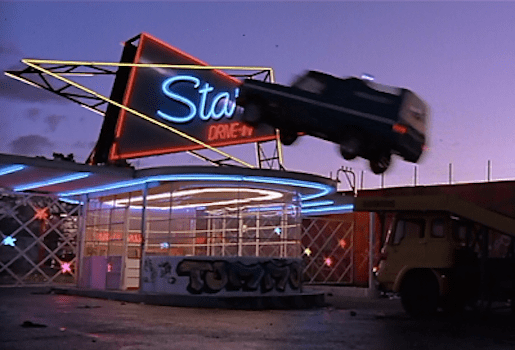
Eventually, all of this social commentary has to give way to the inevitable.
The truck jumps.
The climactic stunt remains one of the film’s great moments because it encapsulates Trenchard-Smith’s entire filmmaking philosophy. The film has spent all this time talking about captivity, consumerism, social control and the collapse of Australian society, and then suddenly a vehicle is flying through the air.
There is something almost philosophically perfect about that.
The truck is not merely escaping the Star.
It is escaping the limitations of the film itself.
After all the political anxiety, the satire and the symbolism, Trenchard-Smith simply says: enough.
Make it bigger.
Make it faster.
Make it fly.
That is not a failure of seriousness.
It is Trenchard-Smith’s definition of seriousness.
OZPLOITATION WITH A BRAIN
This is perhaps the mistake people make when discussing Australian exploitation cinema. They assume a film must either be trash or a masterpiece.
Dead-End Drive-In is both.
It is trashy.
It is intelligent.
It is adolescent.
It is politically loaded.
It is visually sophisticated.
It is exploitative.
It is genuinely interested in Australian society.
The contradiction is precisely what makes it work.
Trenchard-Smith understands that audiences might come for the cars, the punk costumes, the violence and the dystopian spectacle. So he gives them all of it.
Then he hides the political argument inside the popcorn.
A FILM THAT ARRIVED TOO EARLY
Perhaps Dead-End Drive-In was simply released at the wrong moment.
Australian audiences were still being encouraged to think of Australian genre cinema as something inferior to Hollywood. A film this strange, this aggressively Australian and this unwilling to behave itself was never going to fit comfortably into the mainstream.
Its initial commercial failure is therefore one of cinema’s more satisfying ironies.
The film depicts a society that has failed to recognise the value of its own discarded population.
Australian cinema subsequently spent years doing something similar to Dead-End Drive-In itself.
It was sitting there.
Covered in graffiti.
Surrounded by wrecked cars.
Waiting for someone to realise what they were looking at.
Eventually, the audience arrived.
THE GREAT AUSTRALIAN ANARCHIST
Forty years later, perhaps the best way to celebrate Dead-End Drive-In is not to pretend that it is perfect.
It isn’t.
Some of its politics are uncomfortable. Some of its ideas are more fully developed than others. Its aesthetic is unmistakably tied to the decade that produced it.
But perfection would almost miss the point.
Brian Trenchard-Smith has never been a filmmaker of polite surfaces. His cinema is physical. It is interested in impact, movement and spectacle. The machinery matters. The bodies matter. The stunt matters.
His films want you to feel the physicality of cinema.
The car hits the barrier.
The engine screams.
The body flies.
The gate electrifies.
The world collapses.
And Dead-End Drive-In might be his purest expression of that sensibility.
It is a dystopian science-fiction film, a punk film, a car movie, a prison movie, a social satire, a romance, an exploitation picture and an Australian nightmare.
And somehow, against all reason, it is also enormous fun.
THE PRICE OF ADMISSION
The title is perfect.
Dead-End Drive-In is not merely a description of the place in which Jimmy finds himself trapped. It is a description of the society surrounding him.
Everyone has arrived at the end of the road.
There is no future.
So consume.
There is no meaningful employment.
So entertain yourself.
There is no escape.
So decorate the prison.
There is no hope.
So turn the music up.
And if anyone complains, give them another cheeseburger.
That is the genius of Trenchard-Smith’s dystopia. It is not controlled by some grand totalitarian mastermind. It is maintained by administrative indifference and the quiet acceptance of everyone who has decided that resistance is too much trouble.
The system does not need to explain itself.
It simply keeps operating.
People disappear into the Star.
The movies continue playing.
The food keeps coming.
The cars keep burning.
And outside the fence, everybody else carries on.
FORTY YEARS IN THE REAR-VIEW MIRROR
Forty years later, Dead-End Drive-In feels less like a relic than a warning that has become increasingly difficult to ignore.
Its anxieties about unemployment, consumerism, youth alienation, social exclusion and institutional neglect remain remarkably potent. Its punk aesthetic has become retro. Its cars have become objects of affection. Its drive-in has disappeared.
Its future, meanwhile, has arrived in fragments.
Perhaps that is why the film has endured.
It never really predicted Australia.
It exaggerated Australia.
It took existing anxieties and turned the volume knob until the speakers exploded.
That is what Brian Trenchard-Smith does.
He does not whisper.
He does not gently suggest.
He kicks the door in, sets the car on fire, throws the television through the window and then asks whether you’ve noticed what is happening.
THE GATES ARE STILL CLOSED
There is a moment in Dead-End Drive-In when the absurdity finally becomes clear. The prison isn’t simply the electrified fence. It isn’t the guards. It isn’t the government. It isn’t even the Star.
The prison is the idea that there is nowhere else to go.
That is why Jimmy has to escape. Not simply because he wants freedom, but because he still believes freedom exists.
And perhaps that is the film’s most enduring act of rebellion.
In a genre packed with nihilism, Dead-End Drive-In still believes that someone can look at the wreckage and say no. No, I don’t want this. No, I don’t accept this. No, this isn’t the future.
I’m getting in the car.
I’m hitting the accelerator.
I’m going through the fence.
And if Brian Trenchard-Smith is directing, there will probably be a truck flying overhead when you do it.
That is Dead-End Drive-In at 40: a film about a country staring into the abyss and deciding to install a snack bar; a film about capitalism, captivity and consumption disguised as a car chase; a film about a generation being told that the future has already been cancelled.
And a filmmaker who responded to that bleak proposition with the only reasonable answer he could think of.
Make it louder.
Make it stranger.
Make it faster.
And, for God’s sake, make the truck jump.
- Saul Muerte

