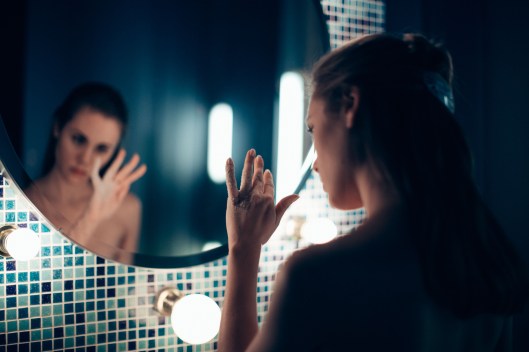
Or a more accurate description would be ‘Just barely brimming above the surface’, as this movie never really dives any new depths in Shark horror films.
It would appear that this is a tough task to take on, as many souls have ventured into the big blue to tackle one of humankind’s greatest predators. However, since Spielberg’s classic Jaws invented the term ‘blockbuster’ back in 1975, those pretenders have been left drifting with no sense of direction at all.
While director Johannes Roberts (F, The Other Side of the Door) does his best to weave through the tension surrounding two sisters who attempt a cage dive for the first time, only to plummet to the ocean floor.
As there oxygen runs low, they must brave the shark infested water in order to survive.
Australian Claire Holt cuts a fine performance as the fearless Kate and one can see her career escalating beyond The Vampire Diaries from which she became a household name.
Where as Mandy Moore’s Lisa grates, and as twee as she may appear to be, by the end of the movie you’re wishing that she would become shark bait so that we don’t have to endure her shrill voice in every panic-driven scene.
On a lighter note, it was refreshing to see Matthew Modine back despite little screen time.
His role as the boats captain has a subtlety to it that only an actor of his expertise can pull off whilst still being believe able. His presence is a welcome relief during the scenes when the girls are submerged, albeit in the occasionally voice across the comms system.
The diagnosis:
With the promise of a sequel in the works titled 48 Meters Down, it must be doing something right, and whilst it is watchable, this hardly blows you out of the water.
Best advice would be to get tanked and watch with some mates.
At least then you can rely on the good company.
Steven Kastrissios takes us deep into modern Albania for his sophomore outing in the director’s chair.
Paving his way into the horror scene, Kastrissios turned heads with his debut feature, The Horseman, partly for hits ‘extreme violence’ but also for his ability to not shy away from the harsh society that is infused throughout the films narrative.
With Bloodlands, the subject of vengeance is once again at the forefront of Kastrissios storytelling, a subject that seems close to his heart.
In this instance, we are faced with a family struggling to make ends meet and with conflicting interests pulling at their innermost desires. It is only when confronted with a blood feud set by a witch and her mysterious clan that the family must unite and stand together against a common enemy in a brutal fight for survival.
Recently Bloodlands took out 3 awards at A Night of Horror Film Festival for Best Foreign Language Film; Best Australian Film; and Best Australian Director, and one can see why as it this tale of mythology and highly tense drama is a refreshing sight against the anarchy and gore that has been presented of late on our screens.
Cinematographer, Leander Ljarja beautifully captures the Albanian landscape, and Kastrissios slow burn direction allows the tension to build steadily to keep the viewer gripped to its gritty conclusion.
It just feels a shame that the characters feel so two-dimensional in places and this makes the strong concept and themes lost in what would have been thoroughly engaging piece had more care and attention centred on this area.
As such, there are no real shock moments, and the path becomes a predictable one as a result.
The Diagnosis:
A slow-burn horror that is reminiscent of The Hills Have Eyes in tone, but is embedded with Albanian culture, which adds a new flavour to the horror scene. A rewarding watch despite some character flaws.
Lanthimos, the Greek director of Dogtooth (2009) and The Lobster (2015), gifts us with yet another glimpse into his weird and wonderful imagination in this psychological horror film. The Killing of a Sacred Deer is based on the Greek myth of King Agamemnon, his daughter Iphigenia, the goddess Artemis and, as per the film’s title, one dead deer. Go forth and Google.
Colin Farrell, star of The Lobster and the director’s deadpan muse, is in the best form of his career.
He plays Dr. Steven Murphy, a successful cardiothoracic surgeon, with a beautiful wife played by the icily perfect Nicole Kidman, two beautiful kids (Kim and Bob) and a beautiful home.
Other than a strange bedroom ritual (I won’t divulge more here but it does kind of involve general anaesthesia), his life appears to be perfect. Until everything goes to shite.
When he first meets with the teenage Martin (the excellent newcomer, Barry Keoghan), you immediately think “Hmmmm.” Martin immediately comes off as odd and unnerving. Their meetings appear to be quite suspect especially when Steven gifts him an expensive watch and lies to a colleague about who he is when he unexpectedly visits him at his hospital.
When Steven invites him home to meet his family, it appears that the relationship between the boy and the surgeon is innocent. The viewer goes from suspecting Steven is up to no good to suspecting Martin himself. It soon becomes evident that Steven has a stalker on his hands…
Half way through the film, and after a building sense of dread, the film suddenly veers from Fatal Attraction to Sophie’s Choice. To give any more away would be to deprive you of the thrill of watching the film with no idea what’s going on or what’s going to happen next.
Diagnosis:
The Killing of a Sacred Deer is definitely a Yorgos Lanthimos film yet it doesn’t feel like the carbon copy of a successful formula (ahem, Wes Anderson). If you are a fan of the director, you will definitely enjoy the film and if you are new to his work, it may just make you want to watch his earlier films.
Sydney, Australia, December 6, 2017 – The winners of the 2017 A Night of Horror Film Festival and Fantastic Planet Film Festival are announced.
Presented by Deadhouse Films, the 11th annual A Night of Horror International Film Festival and Fantastic Planet, Sydney Sci-Fi and Fantasy Film Festival showcased a stunning array of the latest and greatest horror, sci-fi, thriller and fantasy films from around the globe. Here are the winning films from the 2017 event:
Norbet Keil’s gorgeously gruesome body horror REPLACE took A Night of Horror’s “Best Film” award.
While Brazilian filmmaker Samuel Galli captured “Best Director” for his confronting serial killer / supernatural chiller OUR EVIL.
That film’s mesmerising lead actor, Ademir Esteves, won the award for “Best Male Performance”.
And the “Best Female Performance” award was given to Dafna Kronental for her stunning performance in the beautifully lensed and terrifying Australian outback nightmare THE MARSHES.
Listen to our podcast with director Roger Scott here.
A Night of Horror’s “Independent Spirit Award” for a feature film was captured by the riotous Ozploitation flick MUSCLECAR.
Listen to our podcast with director Dwayne Labbe and producer Aaran Creece here.
But the biggest winner of the festival was the mesmerising Australian/Albanian co-production BLOODLANDS. The haunting film focuses upon a traditional Albanian family, coming to terms with modernity. But their domestic problems seem insignificant when the family find themselves drawn into a horrific blood feud with a witch and her kin. BLOODLANDS took out three of the fest’s major awards: “Best Foreign Language Film”, “Best Australian Film”, and “Best Australian Director” for Steven Kastrissios.
Fantastic Planet Film Festival’s top honour, “Best Film”, was won by the terrifying yet deeply moving post-apocalyptic thriller HOSTILE. The film’s French director, Mathieu Turi also won the award for “Best Director”, which, in a split jury decision, was shared with Uganda’s Nabwana I.G.G., director of the hilarious action adventure, and international festival hit BAD BLACK. While the fest’s “Independent Spirit Award” was captured by the high-octane thrill-ride SIXTY MINUTES TO MIDNIGHT. Robert Nolan, the film’s lead, and one of the brightest lights in Canada’s vibrant acting scene, took the “Best Male Performance” award in a unanimous jury decision.
A Night of Horror’s “Best Short Film” was awarded to the pulse-charging survival horror LEVEL. The festival’s “Best Animated Short Film” award was won by the brutal French anime FIERCE. While atmospheric and masterful SOUND FROM THE DEEP from Finland won “Best Lovecraft Short Film”. The audience choice award for “Best Australian Short Film” went to the chill-inducing I’M SORRY MUMMY. And “Best Music Video” was awarded to the twisted MUUY BIIEN – MORAL COMPASS from director Benjamin Roberds. The festival’s inaugural “Best Web or TV Content” was taken by the nightmarish US short STEREOSCOPE. And the fest’s “Independent Spirit Award” for a short film went to the shocking and bloody Canadian short STUDDED NIGHTMARE.
Fantastic Planet’s “Best Short Film” was taken by the Spanish techno-terror thriller iMEDIUM. While “Best Animated Short Film” was won by the enchanting CORKY from the USA. Audience choice award for “Best Australian Short Film” went to the hilarious social satire DIRT TIN. The winner of “Best Music Video” was director Kim Pommel’s visually captivating A LOVE LIKE PI – JACK AND THE GIANT. The Finnish time-spanning sci-fi web series END UNSUNG won “Best Web or TV Content”. And Fantastic Planet’s “Independent Spirit Award” for a short film was awarded to the twisting sci-fi thriller REM from New Zealand’s April Phillips.
Both festivals also host screenplay competitions. The winner of A Night of Horror’s feature screenplay competition was FRIDAY NIGHT FRENZY by Richard Stringham. The competition’s 1st runner-up was Neil Chase’s DEAD STRAYS. The 2nd runner-up was CLARITY by Ariana Kenny. A Night of Horror’s short screenplay winner was LOST MAN by Guy Harvey. That competition’s 1st runner-up was Noah Pfister’s ROADKILL. And the second runner-up was CANNIBAL MOTHER by Jacob Schefer.
The winner of Fantastic Planet’s feature screenplay competition was TRANSCARLET by James Ross. The 1st runner-up was STORMCATCHERS by Mike Donald. Ana Ziegle Loes’ F7/F2 captured the 2nd-runner up spot. Fantastic Planet’s short screenplay competition was won by Daniel Earney and Dio Traverso’s JACK RABBIT. While AN IRON SHELL OF RITUAL by Jeff Racho took the competitions 1st runner-up spot. And the competition’s 2nd runner-up was THE INFINITE AND THE DIVINE by Krystyna Łoboda and Derek Weissbein.
And congratulations to Dee Wallace for winning “Best Female Performance” at Fantastic Planet Film Festival for her role in AYLA.
Declared as ‘The most haunted house in England’, by Harry Price, who happened to be one of the earlier pioneers in paranormal research and along with that statement, The Borley Rectory has been embedded in the psyche of anyone with an interest in things that go bump in the night.
Question marks have been raised about the authenticity of Mr Price proclamation and certain suggestions have been raised about his character with some even suggesting that he was a charlatan, out for profit. Especially when he penned a series of books on the subject.
Questions aside, the history of The Borley Rectory is certainly a strange one and one can only study its background and discover that it’s an odd place where curious and unexplainable things have occurred.
So it’s little wonder that no one has really documented the history before.
Well thankfully director Ashley Thorpe had that curiosity and passion to explore the stories that have decorated The Borley Rectory over the years and transformed it into what can only be described as a masterpiece of filmmaking.
Thorpe is able to transform the mystery and suspense and present the viewer with a unique style of documentary using his own blend of animation.
The style and manner of the film not only flows with ease but could also craft a new and exciting way to present historical documentaries for the digital generation.
Guiding us along the way is the delicate tones of Julian Sands who narrates the tales and characters journeys throughout the film.
The ensemble cast too are simply amazing and deftly underplay their roles to perfection.
Nods especially go out to Jonathan Rigby as Harry Price, Reece Shearsmith (The League of Gentlemen) as V.C. Wall, and Nicholas Vince (Hellraiser) ad Rev. Smith.
The Diagnosis:
With Borley Rectory, Thorpe captures the eeriness whilst also staying informative and engaging. At times the screen feels like it is breathing with a life of its own and lifts the viewer from scene with a sense of unease.
It’s the holiday season in suburban America; snow blankets the streets, lights adorn every home, and a troublesome boy is left in the care of his babysitter while his parents step out for the night.
Sounds a bit like Home Alone, right? Well, this is Home Alone with blood, lots of blood.
Better Watch Out is a surprising addition to the horror-comedy genre from Canadian-Australian director Chris Peckover.
Despite its US setting, the film was shot in Sydney with three Australian actors in the lead, all of whom did an impressive job with a difficult script.
What starts as a home invasion thriller ends in completely different territory. Luke (Levi Miller) has a crush on his teenage babysitter Ashley (Olivia DeJonge – The Visit) and uses their time alone at home together to make his move.
Before things can get too awkward however, the phonelines are cut, a brick is thrown through a window, and a shadow lingers outside.
Rarely does a film manage to hide its secret from an audience until the big reveal, but Better Watch Out did just that.
The plot twists and turns worked a Christmas treat, and the bloodletting was just plain fun. But some of the scenes failed to pack much of a punch, and the whole thing felt like it was trying too hard to be weird.
The Diagnosis:
You’ll walk away feeling mildly uncomfortable, but it probably won’t keep you awake on Christmas night.
Musclecar is a rampage of mayhem that shifts through the gears to a new level of cult Ozploitation.
It’s an Aussie oddball film and one not to be missed if you like a bit of a laugh.
Alrighty, let me paint the picture for you. B grade film maker Bambi (Jacinta Stapleton, Neighbours) spends her last 10k on her dream car before finding out the grant for her new film has been cancelled… dun DUN DUNN.
She’s left with a shiny new big red car and no money to run it. With the help of an admirer, Randy, Bambi resorts to murdering drunken men before using their blood to run her car… an obvious alternative to picking up a few extra shifts at Coles and hitting up her local SHELL.
The film has you on edge from the get go. Perhaps it’s the inherent objectaphillia, or Bambi’s revved up ringtone, or maybe even the way she hooks up a human heart to the engine of the car… hmm.
Nevertheless, Dwayne Labbé has creepy down pat. The insanity builds throughout the 75- minute saga enough to wrap up the film with a satisfying bang.
Murderers who just kill their victims and don’t do anything weird with them is sooo last Wednesday.
Musclecar’s main fuel is the animated comic-book style panels that are used to separate or punctuate scenes. It makes me think that it could have been as effective, if not more so, if the entire film were animated.
The art really accentuates the genre and really sells its comedic layer. The absurd plot could not have survived if it didn’t stand by its funnies.
The Diagnosis:
Musclecar won’t intrinsically change you, or make you wish that your car came to life, but it makes for an entertaining hour and a bit…
The perfect fuel for a night in to drain your mind and feed your soul.
Alternate Title: I Watched This So You Don’t Have To
Amazing performances from a diverse and talented cast.
A thrilling storyline.
Terrifying creatures, made all the scarier by almost never fully seeing them.
I refer of course to the 2007 film adaptation of Stephen King’s classic horror tale about a large group of terrified townspeople trapped in a grocery store by a strange, otherworldly mist. (I never tire of watching this film and in fact watched it a few times to rid myself of the bitter taste of mediocrity that was left in my mouth after watching the series.)
The 2017 television series was one of the worst things that these orbs in my face have been forced to look upon.
Lacklustre performances from an unmemorable and largely average cast (with the notable exception of Frances Conroy (the matriarch from Six Feet Under) who is tremendous despite her character being fairly annoying
Confusing and meandering plotlines, most of which go nowhere and serve no real purpose.
A mixed bag of monsters, most of which aim for Hannibal-esque special effects (I refer of course to the television series with Mads Mikkelsen and not the film), but lack their elegance, grotesque beauty and creativity.
To sum up the plot (if it can even be called much of one), the story centres around a family whose teenage daughter has been the victim of a heinous crime.
While dealing with the aftermath, they are separated from each other when an eerie mist suddenly descends upon their small Maine town.
They must deal with some not so fantastic neighbours (and the deadly mist of course which is the most likeable character in the series.)
Unlike the film which showed the good and the bad that come out in people while facing a crisis, the show only portrays seriously unlikeable characters who repeatedly do horrible, horrible things to one another.
Which brings me to the subject of the series finale (because this series was blessedly cancelled after the first season!)
I never watched Lost but I remember hearing people complaining that they had been loyal viewers for years and then were massively let down by the ending.
This was less of a letdown for me because I didn’t care about any of the characters but I still wanted some kind of payoff in terms of answers.
We dedicated ten hours of our lives to the show so the ending – abrupt and nonsensical – left me with my mouth fully agape for ten minutes. I could not believe that they chose to end the series – let alone a season – so poorly. I have never felt so cheated by a finale. I can’t say that I have fully recovered from it.
The Diagnosis:
Get you a man or woman who will endure 10 hours of terrible television to keep you company (and without complaint!) My gentleman companion earned himself so many gold stars for sitting with me to watch this series in its entirety that he gets a kidney from me if he ever needs one.
This TV series was that bad.
Straight from the offset, director Roger Scott lures you into his feature length directorial debut, The Marshes with an unsettling feeling deep within unfamiliar territory.
It’s a fantastic achievement as Scott’s attention to detail breathes new life onto the screen and in doing so awakens a fear that may have lay dormant in us all.
His ability to infuse a sense of Australian mythology and mysticism, and weave it into a thoroughly modern world allows the audience to fall deeper into a labyrinth of despair and confusion.
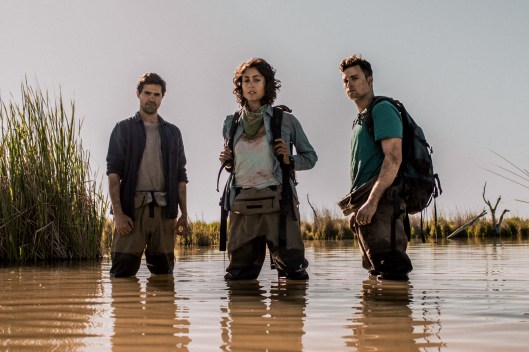
3 biologists who represent this ‘modern Australia’, venture out into the land, which I’m pretty sure has never been captured on screen before. A place deep inland, but instead of dry, red, desert, we are faced with lush vegetation as our setting.
But don’t get too comfortable, as something lurks within that will ensnare you and pull you apart.
The beauty of this Australian horror film is that Scott plays with your senses, clouding the characters thoughts and yours along with it, so that the very question of reality is thrown into the equation.
Speaking of characters, the cast involved, primarily the afore-mentioned biologists, allow for the atmosphere to appear more intimate and intense. Chief among them is Dafna Kronental who plays Dr Pria Ana, a woman that finds herself initially fighting for her place in the University, fighting for The Marshes, and ultimately fighting to stay alive. Kronental is incredibly believable as she goes through the motions and the tension ratchets up.
By the end of the movie, the sense of claustrophobia engulfs the viewer and your striving for the characters to find their freedom and survive their ordeal.
The Diagnosis:
With its unique vision and frightening consequences, The Marshes could well be a modern horror classic.
Back in the 90’s there were four TV series you could argue were the flagship shows of that decade.
One was an animated cartoon that (at the time of writing) is still going (although not for much longer if rumours are to be believed). Another two were 4-walled sitcoms set in New York that shared a universe via a 3rd sitcom called Mad About You.
But the 4th was something else. It was about two FBI agents “banished” to a basement chapter of the Bureau called the X-Files. In one of the episodes the male lead talks to the female lead about a real-life case called The Mad Bomber.
Long story short – from 1940 to 1956 George Metesky blew up shit at random locations in New York using homemade bombs. Catching him was next to impossible using traditional forensic techniques, so as a hail-mary cops consulted a criminal psychiatrist.
After analysing the crime scene photos and the taunting letters Metesky had sent to the authorities, the psychiatrist painted a detailed portrait of the sort of man the “Mad Bomber” was.
It encompassed his personality traits, his age, build, even his nationality. It even went so far as to say Metesky was likely a virgin, had an Oedipus complex and should they catch him: “He’ll be wearing a double-breasted suit, buttoned”.
What this psychiatrist had done was create one of the world’s first criminal profiles. And yes, it did eventually lead to Metesky’s arrest. Legend has it he answered the door in his P.J.’s, but when the cops told him to get dressed, guess what kind of outfit he put on…?
So, what does this all have to do with Netflix’s Mindhunter?
Well in the mid 90’s I found myself wandering through a bookstore on George Street when, for some reason, this thick paperback leaped out at me. It was black with silver lettering and it was titled Mindhunter: Inside the FBI’s Elite Serial Crime Unit. I still have it. It was about a relatively new investigative technique called forensic profiling – developed throughout the late 70’s and 80’s. Only now it was about to hit the zeitgeist, and reading about it seemed a great way to load up on what (at the very least) would be an awesome dinner party conversation starter. (This was pre-Wikipedia don’t forget).
So, I bought the book and devoured it cover-to-cover. It cites the story of Metesky and his capture (so it wasn’t just a flight of fancy from Mulder…) before detailing the career of former real-life FBI agent John E. Douglas, and his partner Robert Ressler.
In the 70’s they hit upon the idea to interview notorious and incarcerated serial killers back when the term serial killer had yet to be coined. Initially it was to try and get a sense of the senseless nature of their crimes, but in doing so they found they were unearthing patterns and “reasons of logic” that lay within the world of psychological motivation (as opposed to traditional motivation – eg: I need money, this person has money, I’m going to kill this person to get their money).
This new investigative tool was the stuff of Hollywood dreams. To be able to predict what sort of car a vicious killer drives? What sort of house he lives in? What type of watch he wears and on what wrist? It was Sherlock Holmes but sexier – more mysterious, because it was the “psychic TV detective” come to life!
And I knew about this miraculous thing before all my friends. That is…until about a year or so later when Hollywood (not for the last time) shat on my parade by releasing Millennium and Profiler – two TV series that centred around, you guessed it, a criminal profiler.
My book had gone mainstream. Nowadays the lexicon of profiling is so common, you can’t throw a letter at the various NCIS, CSI’s and SVU’s without it being raised with the general assumption that EVERYONE in the audience knows what you’re talking about.
But back then, it was magic. And the magic of Mindhunter the TV series is that it takes place at a time when profiling can be sexy again. Ie: The time of its birth.
For it is a very dramatized recreation of my black & silver book. Set in the 70’s it follows a young Special Agent Holden Ford (effectively Douglas in this universe) and an older pro Bill Tench (Ressler) as they go about conducting their earliest interviews. They do this very much on their own time amid scepticism & resistance from their fellow agents.
As a series it dips into real life cases & characters when it needs to – it’s portrayal of their very first interviewee Edmund Kemper is both chilling and chillingly accurate in regards to the person I had painted inside my head. To see Ed “come to life” after all these years is a sensation I can’t begin to describe.
Yet other elements – usually to do with the home lives of the two leads – are the stuff of typical TV drama. As a series its rhythm is hard to describe. It’s not a serial killer-of-the-week cop show by any stretch, yet it’s not a straight up dramatization of “real-life events” with all the oblique plotlines that can go with such a story.
What it certainly is, is compelling. Well set up for a 2nd season, you will be skipping the end credits big time to get to the next episode.
As a Douglas avatar, Ford – played by Jonathan Groff – will go through an interesting evolution in subsequent years (should the series go beyond 2) mainly because when profiling entered the world of popular media both Douglas and Ressler (by all accounts) had a huge falling out over credit.
Undoubtedly Mindhunter the book is a biography that very much downplays Ressler’s involvement, as it’s told through Douglas’s eyes. And by all accounts Douglas himself has no problem being Hollywood-ised in multiple ways – eg: he has been cited as the inspiration behind Silence of the Lamb’s Jack Crawford, as well as Criminals Minds’ Jason Gideon AND David Rossi.
Yet in the land of the internet – passionate advocates for both men often fall in the “either/or” category. Very much like how a lot of young Australian kids fell into “You’re either a Ford man or a Holden man. You can’t be both. One car is shit, the other is the real deal”.
It is this duality in fact that caused the producers to name Douglas’s character Holden Ford.
The series is also co-produced by Charlize Theron and David Fincher.
Also, I completely made up that bit about Holden’s name. I have no idea why they chose it.
Prognosis:
Series 2 will be just as good if not better than series 1. But it’ll jump the shark by series 3.