
The Devil Gets a Digital Upgrade
Twenty years later, The Omen remake remains a fascinating example of Hollywood’s obsession with recreating perfection.
Some films are remade because there is something new to say. Others are remade because technology has advanced. And then there are films like The Omen, a production that seemed to exist because someone looked at one of the greatest horror films ever made and wondered what it would look like with a larger budget, digital polish, and a release date perfectly aligned with the Number of the Beast.
June 6, 2006.
6/6/06.
From a marketing perspective, it was genius. From a creative perspective, the results were considerably more complicated.
Released exactly thirty years after The Omen, director John Moore‘s remake arrived during a period when Hollywood was aggressively resurrecting horror properties. The early 2000s had become the age of remakes. Studios sought recognisable brands, established audiences, and proven concepts. Originality increasingly took a backseat to familiarity. Yet few films presented a greater challenge than The Omen. After all, how do you improve upon prophecy?
Remaking the Antichrist
The original Omen succeeded because it balanced supernatural terror with emotional authenticity. At its heart was not a story about Satan. It was a story about doubt. Gregory Peck‘s Robert Thorn was a man slowly watching certainty erode beneath his feet. Every revelation chipped away at his rational worldview until he could no longer deny the impossible. The horror emerged from belief.The remake understands this structure and follows it almost religiously. Perhaps too religiously.
Screenwriter David Seltzer, returning from the original film, essentially recreates his own script. Dialogue, set pieces, character beats, and narrative progression remain remarkably faithful. The result is less reinterpretation than replication. This is not a film interested in reinventing Damien Thorn. It is interested in introducing him to a new generation.
The Curse of Fidelity
Faithfulness is often treated as a virtue when discussing remakes. Yet fidelity can become its own creative trap. The 2006 version recreates numerous iconic moments with admirable precision. The nanny’s suicide. The cemetery sequence. The horrifying discoveries surrounding Damien’s origins. The infamous glass decapitation. Everything is present and accounted for. Yet something essential feels missing.
The original film possessed a sense of uncertainty. Audiences were invited to question whether prophecy, coincidence, or paranoia might explain unfolding events. That ambiguity created tension. The remake arrives carrying thirty years of cultural baggage. Everyone already knows who Damien is. Everyone knows where the story is going. The mystery has vanished. What remains is execution. And execution alone can only carry a horror film so far.
Liev Schreiber’s Burden
Stepping into the shoes of Gregory Peck was always going to be an impossible task. To his credit, Liev Schreiber wisely avoids imitation.
His Robert Thorn is colder, more reserved, and considerably more contemporary. He projects the confidence of a modern political operator, a man accustomed to controlling outcomes and shaping narratives. This interpretation works surprisingly well. Where Peck conveyed moral certainty gradually collapsing, Schreiber presents professional certainty under siege. His descent becomes less tragic and more existential. The performance anchors the film whenever spectacle threatens to overwhelm substance. Schreiber understands the assignment. The problem is that he is trapped inside a story many viewers already know by heart.
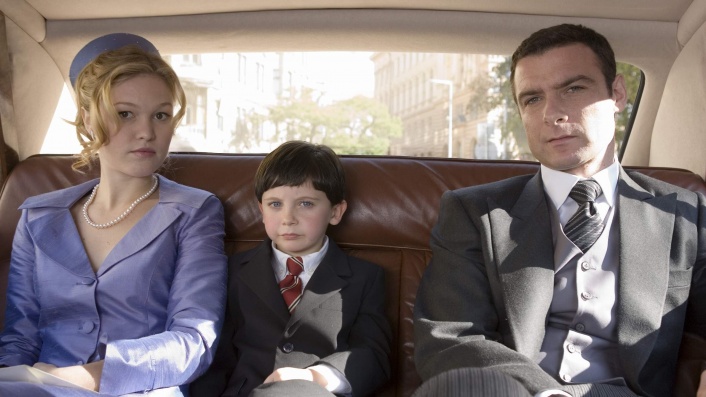
Julia Stiles and the Shadow of Lee Remick
If Schreiber largely succeeds, Julia Stiles faces an even more difficult challenge. Lee Remick delivered one of horror’s most emotionally devastating performances in the original, capturing a mother’s growing terror with heartbreaking vulnerability. Stiles brings intelligence and conviction to Katherine Thorn, but the screenplay affords her fewer opportunities to fully explore the character’s psychological collapse. As a result, some of the emotional devastation feels compressed. The tragedy remains intact. The humanity becomes slightly muted.
Digital Dread
One area where the remake inevitably differs is visual presentation. The original film emerged from an era of practical filmmaking and naturalistic cinematography. Its horrors unfolded within recognisable spaces that felt grounded and tangible.
The 2006 version embraces a more stylised aesthetic. Storm clouds gather with apocalyptic grandeur. Visions arrive with digital enhancement. Biblical imagery receives a modern blockbuster sheen. At times this works beautifully. Certain sequences achieve a painterly quality reminiscent of religious artwork brought violently to life. At other moments, the polish works against the material. The Antichrist is most frightening when he feels plausible. The more elaborate the presentation becomes, the further the film drifts from the unsettling realism that made the original so effective.
A Product of Post-9/11 Anxiety
Viewed twenty years later, the remake functions as an intriguing time capsule of its era. The early twenty-first century was marked by growing uncertainty. Political instability, religious extremism, global conflict, and apocalyptic rhetoric dominated public discourse. Questions surrounding faith and power once again occupied cultural conversation. In that context, The Omen felt strangely relevant.
The idea that evil might infiltrate institutions rather than attack from outside resonated with contemporary anxieties. Damien remained frightening because he represented corruption hidden behind respectability. A child destined not simply to destroy society. But to inherit it. The remake perhaps never fully capitalises on these themes, yet their presence lingers beneath the surface.
Living in the Shadow of Greatness
Perhaps the greatest challenge facing The Omen was that it arrived burdened by comparison. This is not a bad film. Far from it. The performances are strong. The craftsmanship is professional. The atmosphere remains effective. The source material is inherently compelling. Its real crime is being measured against perfection. Richard Donner’s original transformed religious horror. John Moore’s remake preserves it. There is honour in that achievement, even if preservation ultimately proves less exciting than innovation.
The Prognosis:
Twenty years after its release, The Omen remains one of the more respectable horror remakes of the 2000s. Anchored by committed performances from Liev Schreiber and Julia Stiles, it successfully introduces Damien Thorn’s terrifying mythology to a new generation while maintaining considerable reverence for its source material.
Yet reverence alone cannot recreate dread.
The film faithfully reconstructs the architecture of a masterpiece without fully capturing the unease that once haunted its corridors.
The devil received a digital upgrade.
But some nightmares remain impossible to improve.
- Saul Muerte

