There is a peculiar pleasure in watching a cinematic disaster being taken seriously. Not excused, exactly, but examined with enough curiosity to discover what might have been buried beneath the wreckage.
Few films arrive with quite the baggage of Exorcist II: The Heretic. John Boorman’s 1977 follow-up to William Friedkin’s The Exorcist has spent decades occupying that strange territory reserved for movies that are discussed almost as much for their failure as for their contents. A notorious sequel. A critical punching bag. A cinematic oddity. A film so frequently invoked as an example of Hollywood hubris that its actual ambitions can become almost incidental.
David Kittredge’s Boorman and the Devil is interested in those ambitions.
Rather than constructing another gleeful autopsy of one of cinema’s most infamous misfires, Kittredge approaches The Heretic with something considerably more valuable: curiosity. The result is a documentary about a much-maligned horror sequel that gradually reveals itself to be less interested in proving that everyone was wrong than in asking why anyone would attempt something so strange in the first place.
On paper, the sequel looked almost impossibly well positioned. Boorman arrived having already established himself as a filmmaker of considerable ambition, while The Exorcist had become a cultural phenomenon. Yet instead of attempting to reproduce Friedkin’s approach, Boorman took the material somewhere considerably more abstract.
And that, perhaps, was the original sin.
The Exorcist II: The Heretic isn’t particularly interested in being The Exorcist II in the conventional sense. It is stranger, more metaphysical and more concerned with ideas than the straightforward continuation audiences might reasonably have expected. The result is a film that can feel less like a conventional horror sequel than a fever dream constructed from fragments of mythology, psychology and spiritual inquiry.
Kittredge understands that contradiction is precisely where the story becomes interesting.
The documentary’s greatest strength is its refusal to reduce The Heretic to either of the two easiest interpretations: misunderstood masterpiece or unmitigated disaster. Instead, Boorman and the Devil allows both possibilities to coexist.
There is plenty here to remind us why the film was so violently rejected. The production was troubled, the tonal shifts were substantial and the distance between what audiences expected and what Boorman attempted was enormous. Yet alongside those failures sits an extraordinary amount of artistic ambition.
That ambition is what Kittredge wants us to reconsider.
The documentary benefits enormously from access to Boorman himself. His presence gives the film an immediacy that no amount of archival reconstruction could quite replicate. Alongside him are recollections from Linda Blair and Louise Fletcher, while contemporary filmmakers including Mike Flanagan and Karyn Kusama offer their own perspectives on the film’s peculiar legacy.
What emerges is less a conventional making-of documentary than a meditation on artistic risk.
That distinction matters.
There is something increasingly unusual about the idea of a major studio giving an established filmmaker the resources to make something genuinely eccentric. Contemporary filmmaking is hardly devoid of experimentation, but the scale at which The Heretic was allowed to pursue its particular vision feels increasingly alien.
Kittredge consequently finds something unexpectedly contemporary in a film that was once dismissed as an embarrassing relic.
Boorman and the Devil asks us to consider whether failure itself has become too threatening to contemporary filmmaking. A film that takes no risks can be competent, polished and entirely forgettable. A film that takes enormous risks can collapse spectacularly — but it can also produce images, ideas and artistic possibilities that would never have existed had everyone involved simply played it safe.
That makes The Heretic a fascinating subject not merely because it failed, but because it failed while attempting something.
And there is a difference.
Kittredge’s documentary is at its most compelling when it recognises that the history of cinema is littered with films whose reputations have changed because the cultural conversation around them changed. Sometimes reassessment reveals a genuine masterpiece. Sometimes it merely makes a fascinating failure more fascinating.
Boorman and the Devil doesn’t necessarily need to convince you that The Exorcist II: The Heretic is secretly a great film.
It only needs to make you curious enough to watch it again.
That is a considerably more interesting proposition.
For horror audiences, there is another reason the documentary resonates. Genre cinema has always been particularly susceptible to critical dismissal when it refuses to behave according to expectation. The horror sequel is expected to deliver familiar pleasures with familiar machinery. Boorman instead delivered something dreamlike, philosophical and formally eccentric.
The question isn’t whether that decision worked.
The question is whether we still value filmmakers enough to allow them to make that decision.
In an era increasingly dominated by intellectual property, established formulas and the gravitational pull of audience expectation, Boorman and the Devil becomes an accidental argument for artistic recklessness. Not recklessness without consequence, but the kind that accepts that failure is occasionally the admission price for originality.
There is something rather fitting about a documentary examining one of Hollywood’s great cinematic disasters arriving at that conclusion.
Perhaps The Heretic wasn’t a failure because John Boorman reached too far.
Perhaps its real failure was that audiences weren’t prepared for where he reached.
Boorman and the Devil doesn’t erase the film’s flaws, nor should it. Instead, it digs through the wreckage and finds something considerably more valuable than a verdict: the evidence of ambition.
And sometimes that is enough reason to look again.
SUFF #20
Boorman and the Devil screens Friday 11 September at 7:45pm as part of the 20th Sydney Underground Film Festival at Factory Theatre.
Sleep is supposed to be the great surrender. We close our eyes, relinquish control and allow consciousness to dissolve into whatever strange machinery waits on the other side. Horror has long understood the vulnerability of that state, from the nightmare logic of A Nightmare on Elm Street to the psychological labyrinths of contemporary supernatural cinema. Parasomnia takes that familiar anxiety and gives it a promising contemporary framework: what happens when the thing haunting your dreams stops respecting the border between sleep and waking life?
Directed by James Ross II, the Shudder Original places Jasmine Mathews’ Riley at the centre of a story shaped by night terrors, unresolved trauma and disappearance. When her best friend becomes the latest person to vanish, Riley begins to suspect that the demonic presence stalking her dreams may have found a way into the waking world. It is an immediately attractive premise, one that offers the possibility of psychological horror, supernatural mystery and nightmare imagery existing simultaneously, with Riley’s own fractured perception leaving us uncertain about where one state ends and another begins.
Unfortunately, Parasomnia never quite manages to turn that intriguing foundation into the film it initially promises to be.
There is plenty here to admire. The central concept has genuine potential, particularly in the way it connects Riley’s trauma with the supernatural threat. Rather than simply introducing a demon and allowing it to run amok, the film attempts to make the creature part of a larger psychological landscape. Riley’s night terrors are not merely convenient vehicles for scares; they are connected to grief, memory and the unresolved events that have shaped her life. That gives the supernatural elements an emotional foundation, even if the eventual story struggles to build upon it.
Jasmine Mathews is particularly strong in the lead. Riley could easily have become a conventional horror protagonist — traumatised, frightened and increasingly convinced that nobody believes her — but Mathews gives the character a more complicated interior life. There is a convincing fragility to her performance, but also a determination that prevents Riley from becoming passive. She carries the film through some of its weaker narrative stretches, grounding the more fantastical material in recognisable human emotion.
That becomes increasingly important as the storyline begins to show its limitations.
The problem with a horror film built around dreams is that the possibilities are virtually limitless. Once the audience understands that reality itself may be unreliable, the filmmaker has access to a wonderfully unstable cinematic space. A bedroom can become a trap. A familiar face can become threatening. A mundane location can suddenly acquire the logic of a nightmare. The rules of reality can be stretched, distorted or discarded entirely.
Parasomnia occasionally understands this, but too often it seems reluctant to fully embrace the possibilities of its own premise.
The film’s strongest moments are those in which uncertainty takes precedence over explanation. When Riley is caught between sleep and waking, the question isn’t necessarily whether what she is experiencing is real, but whether reality still provides a useful distinction. Those sequences possess an unnerving ambiguity, allowing the horror to operate somewhere between psychological breakdown and supernatural intrusion.
Yet the more the film attempts to explain its mythology, the less compelling that ambiguity becomes.
This is a recurring problem with supernatural horror. The unknown is often considerably more frightening than the known, particularly when the unknown exists inside something as personal and uncontrollable as a nightmare. Once the film begins establishing the mechanics behind its demonic presence, some of the mystery starts to evaporate. The audience is no longer trapped inside Riley’s uncertainty; we are increasingly being given the answers.
And unfortunately, those answers aren’t always particularly satisfying.
The storyline feels serviceable rather than revelatory. There are ideas here that could have produced something considerably more psychologically intricate, particularly around trauma and the persistence of grief, but the screenplay frequently settles for conventional supernatural-horror machinery. Characters move towards revelations because the narrative requires them to, discoveries arrive with an increasingly familiar rhythm and the mystery ultimately feels less substantial than the concept that initially introduced it.
This is where Parasomnia becomes frustrating rather than outright disappointing.
Because there is clearly a better film lurking inside it.
The concept is strong. The performances are strong. The atmosphere is often effective. There are moments where the film creates precisely the kind of disorientation it needs, leaving Riley — and the audience — uncertain about whether they are experiencing a nightmare or something considerably more tangible.
But those ingredients don’t quite coalesce into a satisfying whole.
The supernatural entity itself is another example of this imbalance. As an idea, a demonic figure capable of moving between dreams and reality is an excellent horror proposition. It weaponises one of humanity’s most universal vulnerabilities: sleep. There is something deeply unsettling about the possibility that closing your eyes doesn’t protect you from the monster, but actually gives it access to you.
Yet the creature ultimately feels more effective as an idea than as a fully realised antagonist.
The film is strongest when the demon remains at the periphery of Riley’s experience, when its presence is suggested through fragments and disturbances rather than presented as something that needs to be completely understood. Once it becomes a more conventional supernatural threat, Parasomnia loses some of the psychological unease that made its premise so attractive.
There is also a noticeable tension between the film’s ambitions and its storytelling. It wants to explore trauma, grief, friendship and the lingering consequences of tragedy while simultaneously delivering supernatural thrills. Those elements are not incompatible — horror has been doing exactly that for decades — but they require a narrative capable of allowing the emotional and genre components to reinforce one another.
Here, they sometimes feel like separate tracks running alongside each other.
Riley’s emotional history gives the horror meaning, but the horror doesn’t always deepen our understanding of Riley.
That distinction matters.
The best psychological horror makes the monster inseparable from the character confronting it. The supernatural threat becomes an external expression of something internal, allowing every encounter with the creature to reveal something about the protagonist. Parasomnia gestures towards that territory without quite committing to it.
As a result, the film’s emotional material can feel somewhat underdeveloped just when it should be reaching its greatest intensity.
That is particularly evident in the final act.
Without venturing into spoilers, the conclusion struggles to deliver the catharsis that the preceding story seems to be building towards. The film has established a compelling relationship between Riley’s trauma and the supernatural threat, but the eventual resolution doesn’t quite capitalise on that connection. Instead of transforming the earlier ideas into something thematically resonant, the ending largely feels like the narrative arriving at its required destination.
It isn’t disastrous.
It simply isn’t enough.
And that distinction is important because Parasomnia is never a bad film. It is an intermittently effective one that repeatedly demonstrates what it could have been. There are enough strong ideas and performances here to make the experience worthwhile, but also enough conventional storytelling to prevent it from becoming the psychologically disquieting nightmare its premise suggests.
Mathews remains the film’s greatest asset. Her performance gives Riley emotional credibility even when the screenplay becomes predictable, and she brings enough vulnerability and resolve to make the character worth following. The supporting performances similarly help maintain the film’s human dimension, preventing the supernatural material from becoming entirely detached from the people experiencing it.
Ultimately, however, Parasomnia is caught between two versions of itself.
One is a strange, unsettling psychological horror about trauma invading dreams and nightmares crossing into reality. That film is genuinely intriguing. It understands that the most frightening aspect of sleep is not necessarily what we dream about, but the surrender of control that makes dreaming possible in the first place.
The other is a more conventional supernatural thriller that needs to explain its mythology, organise its scares and eventually provide answers.
The first film is considerably more interesting than the second.
When Parasomnia embraces uncertainty, it works. When it allows Riley’s perception to become unstable and makes us question whether the nightmare has crossed over or whether Riley is simply losing her grip on reality, the film finds its unsettling centre. But whenever it retreats into familiar supernatural storytelling, the tension dissipates.
There is a good horror movie buried somewhere within Parasomnia. At times, you can almost see it clawing its way to the surface.
What ultimately holds it back is not a lack of ideas, atmosphere or talent. It is that the story doesn’t quite know what to do with all three.
The Prognosis:
Parasomnia is a film with a genuinely strong horror concept and committed performances, particularly from Jasmine Mathews, but its mediocre storyline prevents the material from reaching its full potential. It is worth entering the nightmare for the atmosphere and ideas; just don’t expect the waking world to provide quite the payoff you’re hoping for.
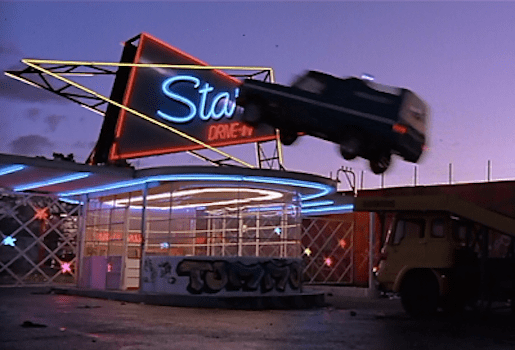
There are Australian films that attempt to explain Australia. There are Australian films that attempt to romanticise it. Then there is Dead-End Drive-In, Brian Trenchard-Smith’s magnificent, deranged vision of a country that has looked at its own future, shrugged, and decided the best thing to do is throw everyone into a drive-in, feed them cheeseburgers, give them drugs and make sure they never leave.
Forty years on, Dead-End Drive-In remains one of the strangest and most exhilarating films to emerge from the great Australian exploitation boom. Released in 1986, it is ostensibly a dystopian science-fiction thriller, but that description hardly begins to contain the thing. It is a car movie, a punk movie, a prison movie, a satire of consumer culture, a portrait of youth alienation, a social nightmare and, inevitably for a Brian Trenchard-Smith film, an excuse to launch increasingly large pieces of machinery through the air.
It is also one of those rare films that becomes more interesting the more seriously you take it.
Because beneath the outrageous costumes, the spectacular stunt work, the burnt-out cars and the general sensation that someone has spiked the national cinema with amphetamines, Dead-End Drive-In is asking an unnervingly serious question: what happens when a society decides that its unwanted people are easier to contain than to help?
The answer, according to Trenchard-Smith, is apparently to build a prison that looks exactly like a Saturday night at the movies.
THE MAN WHO NEVER KNEW HOW TO BEHAVE
To understand Dead-End Drive-In, you have to understand Brian Trenchard-Smith. Not because the film is some carefully controlled expression of auteurist intent, but because his career represents almost the exact opposite of the respectable model of Australian filmmaking. Trenchard-Smith has always seemed happiest when genre conventions are being thrown into the air and collided together at considerable velocity.
He could make martial-arts exploitation, horror, science fiction, children’s adventure, action cinema and television, often with the same gleeful disregard for the boundaries separating them. The Man from Hong Kong, Turkey Shoot, BMX Bandits and Dead-End Drive-In may appear to belong to entirely different cinematic universes, yet they share an unmistakable physicality. Trenchard-Smith likes movement. He likes spectacle. He likes bodies being thrown around spaces. He likes machinery being pushed beyond its sensible limits. Most importantly, he understands that exploitation cinema does not have to choose between being entertaining and being about something.
Dead-End Drive-In might be the clearest expression of that philosophy.
It is ridiculous, but it is not stupid. It is politically charged without ever becoming a lecture. It is visually extravagant despite its relatively modest resources. It is adolescent, lurid and occasionally uncomfortable, but beneath all that noise is a remarkably clear understanding of the social anxieties of the Australia that produced it.
Trenchard-Smith simply refuses to deliver those ideas politely.
He gives them a chainsaw.
WELCOME TO THE STAR
The premise is brutally simple. Jimmy “Crabs” Rossini and his girlfriend Carmen arrive at the Star Drive-In after suffering car trouble. They expect an evening at the movies. Instead, they discover that the drive-in has effectively become a detention centre for unemployed and socially unwanted young people.
The government does not need to execute them. It does not even need to rehabilitate them. It simply needs to remove them from the functioning parts of society and make their confinement sufficiently comfortable that they stop asking questions.
The Star provides food, entertainment, drugs and companionship. It becomes a world within a world, a brightly illuminated enclosure where the inmates are encouraged to consume themselves into submission.
This is where Dead-End Drive-In becomes considerably more sophisticated than its lurid surface suggests. The prison does not look like a prison. There are no obvious dungeon walls or endless corridors of concrete. There is a snack bar. There are cars. There is music. There are movies playing on a huge screen.
The inmates are not simply denied freedom. They are given enough distractions that freedom begins to seem unnecessary.
THE PERFECT PRISON IS ONE YOU DON’T WANT TO ESCAPE
That remains the film’s most disturbing idea.
The authorities have not created a traditional authoritarian nightmare. They have created a lifestyle. The inmates are surrounded by the very things that a consumer society tells them should make them happy. Food, television, entertainment, drugs, sex and material possessions become substitutes for employment, purpose and political agency.
The genius of the Star is that it doesn’t have to convince its inhabitants that they are free. It only has to convince them that freedom is inconvenient.
Why leave when there is food?
Why work when there is television?
Why build a future when the present is entertaining?
Why protest when you can get high?
The film’s dystopia therefore operates through distraction as much as repression. The system has discovered that the easiest way to control a population is not necessarily to terrify it, but to keep it occupied.
That makes Dead-End Drive-In feel remarkably prescient. Its junk food, consumerism and endless entertainment are not simply background details. They are the architecture of the prison.
THE DRIVE-IN AS AUSTRALIA
The choice of the drive-in is particularly inspired because the drive-in was itself such a recognisable part of Australian popular culture. It was a place associated with freedom, leisure, adolescence and the ability to temporarily escape the routines of everyday life.
Trenchard-Smith takes that cultural memory and turns it inside out.
The drive-in is no longer somewhere you visit to escape society.
It is somewhere society sends you when it has decided that you are no longer useful.
That reversal gives the film’s central location a strange melancholy. The Star feels simultaneously futuristic and nostalgic, like a discarded piece of Australian culture that has been repurposed as a holding pen for the future.
The cars remain. The screen remains. The food remains. The entertainment continues.
Only the audience has become the prisoner.
AND THEN THERE ARE THE CARS
Of course, this is Brian Trenchard-Smith, so the automobile cannot merely be symbolic.
The car in Dead-End Drive-In is a status symbol, a shelter, a weapon, an object of desire and, most importantly, an expression of mobility. Yet the film takes particular pleasure in turning that symbolism against itself. Cars are everywhere, but nobody is actually going anywhere.
The inhabitants of the Star sleep in their vehicles. They decorate them. They identify with them. They use them to establish status within the enclosed society. The automobile, traditionally one of the great symbols of freedom, has become another part of the prison.
That contradiction is everywhere in the film. The people have cars but no roads to freedom. They have entertainment but no meaningful future. They have food but no purpose. They have choices, provided those choices remain within the boundaries established for them.
The whole film can almost be understood as a gigantic metaphor for having the accelerator pressed firmly against the floor while the vehicle remains stationary.
Naturally, Trenchard-Smith eventually decides that the metaphor requires an actual vehicle to fly through the air.
THE GONZO AUSTRALIA OF BRIAN TRENCHARD-SMITH
There is something gloriously Australian about the film’s refusal to be subtle. Economic collapse becomes a wasteland of burnt-out vehicles. Youth alienation becomes a sea of punk costumes and leather. Government oppression becomes an electrified fence around a drive-in. Consumerism becomes junk food and television. Social exclusion becomes a population of young people deliberately abandoned inside a recreational complex.
The apocalypse is not presented as some distant future catastrophe.
It is the present turned up to eleven.
This is one of Trenchard-Smith’s great gifts. He understands that exploitation cinema can exaggerate reality until the exaggeration becomes a form of truth. Dead-End Drive-In does not seriously attempt to predict what Australia will look like. Instead, it takes the anxieties already present in Australian society and magnifies them until they become almost absurd.
The result is a kind of gonzo social realism.
Everything is too loud. Everything is too colourful. Everyone is slightly too grotesque. The cars are too damaged. The violence is too spectacular. The costumes are too outrageous.
And yet you can recognise the world underneath it.
That is where the satire bites.
A WORLD BUILT FROM JUNK
The Star itself looks as though civilisation has been put through a meat grinder and then handed over to a gang of teenagers with a spray can. Burnt-out cars, graffiti, concrete, rubbish, punk fashion and industrial decay transform the location into a junkyard version of the future.
The film’s production design is crucial because Trenchard-Smith does not need to build some enormous futuristic metropolis. He can find the apocalypse in the Australian landscape that already exists.
The apocalypse is a car park.
The apocalypse is a takeaway counter.
The apocalypse is an abandoned industrial space.
The apocalypse is a generation of young people who have been told that there is no future and have consequently stopped behaving as though one exists.
Most disturbingly, the apocalypse is brightly lit.
THE UNCOMFORTABLE POLITICS OF THE STAR
It would be easy to celebrate Dead-End Drive-In entirely on the basis of its aesthetic pleasures, but doing so would ignore some of the film’s more uncomfortable dimensions.
Its treatment of race, immigration and Australian identity deserves scrutiny. The film emerges from a period when anxieties surrounding immigration, economic decline and the changing nature of Australian society were deeply embedded in political and popular culture. Those anxieties find their way into the Star, where displaced populations are effectively contained and removed from the mainstream.
This is one of the reasons Dead-End Drive-In is more interesting than simply being an anarchic Ozploitation spectacle. The film does not merely show us a dystopian Australia. It shows us what that Australia is afraid of.
It is afraid of unemployment.
It is afraid of youth.
It is afraid of social disorder.
It is afraid of outsiders.
It is afraid of economic collapse.
It is afraid that the institutions supposedly responsible for maintaining order might themselves be incapable of solving the problems they have created.
Those fears do not necessarily make the film politically progressive. Some of its imagery remains troubling. But that does not make it irrelevant. Quite the opposite. The discomfort is part of what makes the film worth revisiting.
Dystopian cinema can reveal a culture’s anxieties as clearly as it reveals its aspirations.
JIMMY CRABS AND THE REFUSAL TO STAY PUT
Ned Manning’s Jimmy is therefore crucial because he refuses the bargain.
Everyone else has adapted to the Star. Jimmy hasn’t.
His rebellion is not particularly intellectual. He doesn’t deliver great political speeches. He simply refuses to accept that this is all there is.
That makes him strangely radical.
In a world where the system has convinced people to accept captivity as comfort, the simple desire to leave becomes an act of resistance.
Jimmy still believes that there is something beyond the fence.
That belief is the most dangerous thing about him.
CARMEN AND THE HORROR OF ADAPTATION
Natalie McCurry’s Carmen complicates the film’s simplistic notion of resistance. She begins to adapt to the Star, and that adaptation is both understandable and disturbing.
Because people do adapt.
They adapt to poverty. They adapt to confinement. They adapt to political instability. They adapt to bad conditions. They adapt because sometimes adaptation is the only available survival mechanism.
The Star does not need everyone to love it.
It simply needs people to stop imagining anything else.
Jimmy wants to escape.
Carmen learns how to survive inside.
Neither response is entirely comfortable.
THE MOVIES WITHIN THE MOVIE
The films being screened inside the Star provide another layer to Trenchard-Smith’s satire. The inmates watch exploitation movies while simultaneously living inside one.
Violence is entertainment.
Violence is fantasy.
Violence is spectacle.
Then violence spills beyond the screen.
The audience watches people watching movies, and those people are themselves watching images that reflect the world they inhabit. It creates an endless feedback loop between screen violence and social violence.
Trenchard-Smith’s answer to this complicated observation is, naturally, not to stop making violent movies.
He makes the violence bigger.
That is part of the joke.
Dead-End Drive-In is itself an exploitation movie critiquing a culture of exploitation.
It knows exactly what it is doing.
THE TRUCK JUMP
Eventually, all of this social commentary has to give way to the inevitable.
The truck jumps.
The climactic stunt remains one of the film’s great moments because it encapsulates Trenchard-Smith’s entire filmmaking philosophy. The film has spent all this time talking about captivity, consumerism, social control and the collapse of Australian society, and then suddenly a vehicle is flying through the air.
There is something almost philosophically perfect about that.
The truck is not merely escaping the Star.
It is escaping the limitations of the film itself.
After all the political anxiety, the satire and the symbolism, Trenchard-Smith simply says: enough.
Make it bigger.
Make it faster.
Make it fly.
That is not a failure of seriousness.
It is Trenchard-Smith’s definition of seriousness.
OZPLOITATION WITH A BRAIN
This is perhaps the mistake people make when discussing Australian exploitation cinema. They assume a film must either be trash or a masterpiece.
Dead-End Drive-In is both.
It is trashy.
It is intelligent.
It is adolescent.
It is politically loaded.
It is visually sophisticated.
It is exploitative.
It is genuinely interested in Australian society.
The contradiction is precisely what makes it work.
Trenchard-Smith understands that audiences might come for the cars, the punk costumes, the violence and the dystopian spectacle. So he gives them all of it.
Then he hides the political argument inside the popcorn.
A FILM THAT ARRIVED TOO EARLY
Perhaps Dead-End Drive-In was simply released at the wrong moment.
Australian audiences were still being encouraged to think of Australian genre cinema as something inferior to Hollywood. A film this strange, this aggressively Australian and this unwilling to behave itself was never going to fit comfortably into the mainstream.
Its initial commercial failure is therefore one of cinema’s more satisfying ironies.
The film depicts a society that has failed to recognise the value of its own discarded population.
Australian cinema subsequently spent years doing something similar to Dead-End Drive-In itself.
It was sitting there.
Covered in graffiti.
Surrounded by wrecked cars.
Waiting for someone to realise what they were looking at.
Eventually, the audience arrived.
THE GREAT AUSTRALIAN ANARCHIST
Forty years later, perhaps the best way to celebrate Dead-End Drive-In is not to pretend that it is perfect.
It isn’t.
Some of its politics are uncomfortable. Some of its ideas are more fully developed than others. Its aesthetic is unmistakably tied to the decade that produced it.
But perfection would almost miss the point.
Brian Trenchard-Smith has never been a filmmaker of polite surfaces. His cinema is physical. It is interested in impact, movement and spectacle. The machinery matters. The bodies matter. The stunt matters.
His films want you to feel the physicality of cinema.
The car hits the barrier.
The engine screams.
The body flies.
The gate electrifies.
The world collapses.
And Dead-End Drive-In might be his purest expression of that sensibility.
It is a dystopian science-fiction film, a punk film, a car movie, a prison movie, a social satire, a romance, an exploitation picture and an Australian nightmare.
And somehow, against all reason, it is also enormous fun.
THE PRICE OF ADMISSION
The title is perfect.
Dead-End Drive-In is not merely a description of the place in which Jimmy finds himself trapped. It is a description of the society surrounding him.
Everyone has arrived at the end of the road.
There is no future.
So consume.
There is no meaningful employment.
So entertain yourself.
There is no escape.
So decorate the prison.
There is no hope.
So turn the music up.
And if anyone complains, give them another cheeseburger.
That is the genius of Trenchard-Smith’s dystopia. It is not controlled by some grand totalitarian mastermind. It is maintained by administrative indifference and the quiet acceptance of everyone who has decided that resistance is too much trouble.
The system does not need to explain itself.
It simply keeps operating.
People disappear into the Star.
The movies continue playing.
The food keeps coming.
The cars keep burning.
And outside the fence, everybody else carries on.
FORTY YEARS IN THE REAR-VIEW MIRROR
Forty years later, Dead-End Drive-In feels less like a relic than a warning that has become increasingly difficult to ignore.
Its anxieties about unemployment, consumerism, youth alienation, social exclusion and institutional neglect remain remarkably potent. Its punk aesthetic has become retro. Its cars have become objects of affection. Its drive-in has disappeared.
Its future, meanwhile, has arrived in fragments.
Perhaps that is why the film has endured.
It never really predicted Australia.
It exaggerated Australia.
It took existing anxieties and turned the volume knob until the speakers exploded.
That is what Brian Trenchard-Smith does.
He does not whisper.
He does not gently suggest.
He kicks the door in, sets the car on fire, throws the television through the window and then asks whether you’ve noticed what is happening.
THE GATES ARE STILL CLOSED
There is a moment in Dead-End Drive-In when the absurdity finally becomes clear. The prison isn’t simply the electrified fence. It isn’t the guards. It isn’t the government. It isn’t even the Star.
The prison is the idea that there is nowhere else to go.
That is why Jimmy has to escape. Not simply because he wants freedom, but because he still believes freedom exists.
And perhaps that is the film’s most enduring act of rebellion.
In a genre packed with nihilism, Dead-End Drive-In still believes that someone can look at the wreckage and say no. No, I don’t want this. No, I don’t accept this. No, this isn’t the future.
I’m getting in the car.
I’m hitting the accelerator.
I’m going through the fence.
And if Brian Trenchard-Smith is directing, there will probably be a truck flying overhead when you do it.
That is Dead-End Drive-In at 40: a film about a country staring into the abyss and deciding to install a snack bar; a film about capitalism, captivity and consumption disguised as a car chase; a film about a generation being told that the future has already been cancelled.
And a filmmaker who responded to that bleak proposition with the only reasonable answer he could think of.
The body has always been one of horror’s most reliable battlegrounds. We fear what can enter it, what can escape from it and, perhaps most disturbingly, what it might become when it is no longer entirely under our control. With Saccharine, Australian filmmaker Natalie Erika James takes that anxiety and feeds it through one of contemporary culture’s most persistent obsessions: the desire to change the body into something supposedly better.
Hana is a medical student consumed by dissatisfaction with her weight and appearance. When she encounters an obscure weight-loss craze promising extraordinary results, the temptation proves impossible to resist. The secret ingredient, however, is not some miracle pharmaceutical. It is human ash. And when Hana begins consuming it, she discovers that the dead aren’t necessarily prepared to become part of somebody else’s pursuit of perfection.
What begins as a grotesque diet-culture satire gradually develops into something stranger: a ghost story, a psychological horror film and a piece of body horror that asks how much of ourselves we are prepared to destroy in the pursuit of becoming somebody else.
It is an ambitious premise, and James is an ambitious filmmaker. The result doesn’t always manage to reconcile all of its ideas, but when Saccharine sinks its teeth into its central concerns, it demonstrates exactly why James has become such an interesting voice in Australian horror.
The James Body
Viewed alongside Relic, Saccharine begins to reveal something particularly fascinating about Natalie Erika James as a filmmaker.
These are very different horror films, dealing with very different forms of suffering, yet they are connected by an increasingly recognisable preoccupation: what happens when an internal experience becomes impossible to contain inside the mind and begins to manifest upon the body.
In Relic, that experience is dementia. Edna’s cognitive deterioration becomes increasingly physical, with the house itself seeming to absorb and reproduce the decay taking place within her. Mould spreads across the walls and eventually across Edna’s body, turning the invisible horror of neurological decline into something tangible.
Saccharine takes that same principle and turns it inward.
Hana isn’t losing control of her body because disease has taken it from her. She is attempting to take control of it herself. The horror emerges from the space between those two impulses. She wants to improve herself, to become thinner, more desirable and more acceptable, but the pursuit of that ideal gradually becomes an act of self-erasure.
James has described Saccharine as exploring the thin line between self-improvement and self-erasure, and that distinction provides perhaps the most useful key to understanding her cinema.
Her characters aren’t necessarily confronted by monsters that exist independently of their emotional lives. Instead, horror gives physical form to something they are already carrying.
In Relic, grief, ageing and the terror of watching a loved one disappear become an environment that literally decays around the characters. In Saccharine, shame, hunger and the desire to alter one’s body become a presence that enters Hana from within and gradually assumes control.
The monster is therefore never entirely external.
It is an expression.
From Decay to Self-Erasure
The connection between Relic and Saccharine becomes particularly striking when we consider their attitudes towards the body.
Edna’s body is betraying her.
Hana believes her body is betraying her.
The distinction is enormous, but James approaches both characters with the same fundamental empathy. Neither woman is simply a vessel for a horror metaphor. The supernatural allows James to explore experiences that are difficult to represent literally, while the human being remains at the centre of the film.
That is why the body horror in both films feels more tragic than sensational.
In Relic, the horror lies in the inevitability of deterioration and the helplessness of those watching it happen. In Saccharine, the horror lies in the possibility that the desire to escape dissatisfaction can become another form of destruction.
One woman cannot stop her body changing.
The other cannot stop trying to change hers.
Both are trapped by an increasingly hostile relationship with the physical self.
And in both cases, James makes that psychological imprisonment literal.
The House and the Body
There is also a fascinating architectural connection between the two films.
Relic is inseparable from its house. The building becomes an extension of Edna’s deteriorating mind, with rooms, corridors and walls transforming into expressions of confusion, entrapment and decay. The physical environment becomes a manifestation of the psychological experience.
Saccharine moves that idea into the body.
Hana’s environment still matters, but the primary architecture is now physical. Her body becomes the space through which the horror operates. The film’s medical settings are particularly appropriate because they turn the human form into something that can be examined, measured, dissected and categorised.
That is precisely what Hana is doing to herself.
She has internalised the idea that her body can be treated as a problem to solve.
James simply turns that idea into horror.
The result is a continuation of the spatial thinking that made Relic so effective. In both films, characters are trapped inside environments that increasingly reflect their psychological states. The difference is that Relic makes the house feel like a body, while Saccharine makes the body feel like a haunted house.
An Australian Body-Horror Tradition
This makes Saccharine part of a particularly interesting moment in Australian horror.
Australian genre cinema has long had an appetite for the grotesque, but recent years have seen filmmakers increasingly combine physical horror with sophisticated psychological and social themes. The Babadook, Relic, Sissy and Talk to Me are very different films, but each demonstrates the capacity of Australian horror to transform intimate anxieties into something monstrous.
Saccharine comfortably belongs within that tradition.
The horror doesn’t simply arrive from outside.
It grows from something recognisably human.
Hana’s obsession with her body is not an abstract concept. It is connected to the pressures surrounding beauty, desirability, self-worth and the seemingly endless cultural demand to improve ourselves.
James simply pushes those pressures to their most grotesque conclusion.
What if the shortcut actually worked?
What if you could consume something and become thinner almost immediately?
And what if the price of that transformation was another human being?
What Are We Willing to Consume?
The film’s weight-loss substance, Gray, is one of its most inspired concepts.
Initially, it appears almost miraculous. Users lose weight at an extraordinary rate, turning the fantasy of effortless transformation into reality.
But Hana is a medical student.
She investigates.
And what she discovers is horrifying.
The substance is human ash.
At that moment, Saccharine reveals its most deliciously perverse idea. The modern miracle cure isn’t some futuristic invention. It is simply death repackaged as a consumer product.
The body that society has taught Hana to despise can apparently be transformed through the consumption of another body.
It is cannibalism disguised as wellness.
And the more Hana understands about Gray, the further she is prepared to go to continue using it.
James is at her strongest when she allows this idea to speak for itself. She doesn’t need to explain the metaphor because the metaphor is already horrifying.
We have simply taken the language of dieting and pushed it into nightmare territory.
The Dead Fight Back
The film’s second major idea arrives when Hana begins to realise that the human remains she is consuming belonged to someone.
That someone does not necessarily appreciate what has happened.
The resulting ghost story gives Saccharine another layer of unease. Hana isn’t merely haunted because she has violated some supernatural rule. She is being confronted by the humanity she has tried to reduce to an ingredient.
The ghost becomes a physical manifestation of the moral consequence of Hana’s obsession.
The dead woman is no longer simply a body.
She is a person.
That distinction becomes increasingly important.
The more Hana becomes obsessed with changing herself, the more she begins to lose sight of the humanity of other people. The haunting therefore isn’t simply punishment.
It is confrontation.
Midori Francis’ Hana
Midori Francis carries much of the film’s emotional weight.
Hana could easily have become an unpleasant protagonist. Her decisions become increasingly disturbing, and her obsession leads her into ethically appalling territory. Yet Francis gives her enough vulnerability to make those choices comprehensible without excusing them.
There is desperation beneath the vanity.
There is loneliness beneath the obsession.
And there is an almost tragic belief that if Hana can simply fix her body, the rest of her life will somehow fall into place.
Francis understands that contradiction.
Hana knows that what she is doing is wrong.
She continues anyway.
That is much more interesting than a protagonist who simply doesn’t understand the consequences of her actions.
Her intelligence becomes part of the tragedy. She has enough medical knowledge to understand exactly what is happening, but knowledge cannot overcome obsession.
The Anatomy of Horror
James’ visual confidence is particularly evident in the way she treats the human body.
The medical environment provides an appropriately clinical backdrop. Bodies are dissected, examined and categorised. Human remains become objects of scientific study.
Then the film gradually turns those same bodies into objects of desire and consumption.
The clinical becomes corporeal.
The corporeal becomes edible.
The edible becomes supernatural.
James repeatedly finds ways of making the human body appear simultaneously fascinating and disgusting. Flesh, organs and food begin to occupy the same visual territory.
This is where Saccharine demonstrates some of its greatest confidence.
Body horror doesn’t necessarily require mutilation.
Sometimes the most disturbing image is something completely ordinary presented from the wrong perspective.
A meal becomes grotesque.
A body becomes food.
Food becomes flesh.
And the distinction between nourishment and destruction begins to disappear.
The Beautiful and the Grotesque
James’ visual evolution between Relic and Saccharine is equally revealing.
Relic is dominated by oppressive darkness, Gothic architecture, mould, shadow and gradual decay. Saccharine initially appears almost to reject that visual language. Its colours are brighter, its surfaces more artificial and its imagery more tactile.
But the underlying philosophy is remarkably similar.
James has spoken about wanting Saccharine to occupy a space between “candy and grime” — the artificial sweetness of pleasure alongside the physical rot underneath it.
That tension is central to her work.
The beautiful and the grotesque are never entirely separate.
In Relic, the family home contains both memories of love and the horror of deterioration. In Saccharine, the promise of beauty and self-improvement contains the possibility of self-destruction.
James seems instinctively drawn to the point where attraction becomes repulsion.
Something is beautiful because we desire it.
Something is horrifying because we understand what that desire can cost.
That is a sophisticated foundation for body horror.
A Ghost Story Inside a Body-Horror Film
The film’s most interesting structural decision is also one of its weaknesses.
James is essentially making two horror films at once.
One is a body-horror story about eating, weight loss and the desire to transform the physical self.
The other is a supernatural ghost story about a dead woman whose body has been violated and whose presence begins to haunt the person responsible.
Individually, both ideas are compelling.
Together, they don’t always fit comfortably.
The ghost story occasionally threatens to pull the film away from its strongest material. Just as the body-horror metaphor begins to bite, the narrative shifts towards more conventional supernatural mechanics.
This doesn’t make those sequences ineffective, but they are less distinctive.
James is at her best when the supernatural and physical become indistinguishable — when we aren’t quite sure whether Hana is being haunted by a ghost, by her own guilt or by the increasingly distorted relationship she has with her body.
The more conventional the haunting becomes, the less interesting the film feels.
When the Metaphor Starts Showing
There is no great subtlety to Saccharine.
That isn’t necessarily a criticism. Horror has always been capable of taking social anxieties and turning them into grotesque literalism.
James understands that the metaphor becomes more powerful when it becomes physically impossible to ignore.
But there are moments when the film explains what its imagery has already communicated.
We understand what Hana is experiencing.
We understand why she wants to change.
We understand the destructive nature of the culture surrounding her.
The film occasionally continues explaining after the horror has already made the point.
This becomes more noticeable as the narrative progresses. The film’s second half doesn’t always maintain the intensity established by its opening sections.
The irony is that the repetition has a thematic logic.
Obsession is repetitive.
The same thought returns.
The same ritual is repeated.
The same dissatisfaction resurfaces.
But what works psychologically doesn’t always work dramatically.
The Horror of Wanting More
One of the film’s strongest ideas is that Hana never reaches a point at which enough is enough.
The first transformation isn’t sufficient.
The next one isn’t sufficient.
The goal moves.
The body changes.
The dissatisfaction remains.
This is perhaps the most disturbing aspect of Saccharine because it doesn’t require a supernatural explanation.
The promise of perfection is inherently unstable.
There is always another flaw.
Another kilogram.
Another improvement.
Another version of ourselves waiting to be manufactured.
Hana’s horror comes from discovering that the thing she believes will finally make her happy has no finish line.
The body can always be changed.
The appetite can always return.
The obsession can always demand more.
The Horror of Self-Erasure
This is where Saccharine most clearly extends the ideas of Relic.
Edna’s body is being taken away from her.
Hana is voluntarily giving hers away.
The first is a horror of inevitable deterioration. The second is a horror of chosen transformation.
Yet both films ultimately arrive at a similar question:
What happens when the body ceases to feel like home?
James doesn’t provide an easy answer because neither film is really interested in easy answers.
Instead, she uses horror to make psychological experiences physical.
In Relic, decay becomes architecture.
In Saccharine, insecurity becomes consumption.
In both films, the body becomes the place where emotional and psychological damage can no longer remain invisible.
That may ultimately be the defining characteristic of James’ cinema.
She doesn’t use horror to escape reality.
She uses horror to make reality impossible to ignore.
The Australian Body-Horror Renaissance
There is something particularly encouraging about Saccharine existing within the current Australian horror landscape.
The country has always produced filmmakers willing to confront the grotesque, but there is now a remarkable confidence in Australian genre cinema’s ability to explore serious emotional and social issues through horror.
Saccharine doesn’t merely want us to recoil.
It wants the recoil to mean something.
The body becomes the battleground where social pressure, personal insecurity, desire, grief and guilt collide.
That makes James’ work part of a broader Australian horror tradition that treats genre as a means of examining the things we might otherwise find difficult to discuss directly.
And James is clearly developing a visual language of her own.
There is a confidence here that goes beyond the script’s occasional structural uncertainty.
A Film That Bites, But Doesn’t Always Chew
The frustrating thing about Saccharine is that its best ideas are genuinely excellent.
The concept of a weight-loss drug made from human ashes is inspired.
The collision of body horror and ghost story is fertile territory.
The Australian setting gives it a distinct identity.
Midori Francis is compelling.
And James has an instinct for visual horror that remains impressive.
But the film sometimes feels like it is carrying too many ideas at once.
The social commentary wants to be sharp.
The ghost story wants to be frightening.
The body horror wants to be disgusting.
The character drama wants to be emotional.
The romantic material wants to give Hana something to desire.
And the family material wants to explain where her relationship with her body originated.
Some of these elements complement one another beautifully.
Others simply compete for attention.
The result is a film that is frequently fascinating without always being completely satisfying.
The Prognosis:
Saccharine is an ambitious Australian horror film that deserves credit for taking a genuinely grotesque premise and using it to interrogate something far more familiar: our complicated relationship with our own bodies.
Natalie Erika James remains an assured visual filmmaker, and Saccharine confirms that the concerns emerging from Relic were not simply the product of a singular premise. There is a developing body of work here, one increasingly concerned with the physical manifestation of internal suffering.
Relic asked us to confront the horror of watching a body and mind deteriorate.
Saccharine asks us to confront the horror of desperately trying to prevent that body from being what it is.
One woman cannot stop herself changing.
The other cannot stop trying to change herself.
Both become trapped inside bodies that no longer feel like their own.
That continuity makes Saccharine more interesting than its individual successes and shortcomings might suggest. It establishes James as a filmmaker fascinated by the point at which psychological suffering crosses the threshold into physical horror.
The film doesn’t always achieve the devastating impact its premise promises. Its supernatural elements occasionally feel more conventional than its body-horror ideas, and its thematic commentary can sometimes become too explicit.
But there is enough ambition, imagination and outright grotesquerie here to make the film worthwhile.
James has created a horror story in which appetite becomes addiction, transformation becomes self-destruction and the dead refuse to remain reduced to ingredients.
It doesn’t always digest its ideas cleanly.
But when Saccharine sinks its teeth into its subject, it does so with considerable force.
And in an Australian horror landscape increasingly willing to make the body its canvas, that is something worth celebrating.
Relic made the house feel like a body.
Saccharine makes the body feel like a haunted house.
The next question is what James will choose to haunt.
Australian genre cinema has never needed to look overseas for its nightmares. They have always been here: in the bush, in the suburbs, on isolated roads and beneath the seemingly endless glare of the Australian sun. From the brutal social realism of Wake in Fright through the post-apocalyptic ferocity of Mad Max, the unsettling suburban nightmares of Next of Kin and the blackly comic violence of 100 Bloody Acres, Australian filmmakers have repeatedly demonstrated an ability to turn familiar landscapes into places of profound unease.
Mia’Kate Russell’s Penny Lane Is Dead belongs comfortably within that tradition.
What makes the film particularly exciting, however, is that it doesn’t feel like an exercise in Australian genre nostalgia. Russell’s feature directorial debut has the confidence to understand the visual and thematic vocabulary of the films that came before it while still attempting to establish a voice of its own. Set during the blistering Australian summer of 1986, it takes the familiar ingredients of the holiday-house thriller—friendship, isolation, youthful recklessness, secrets and escalating violence—and turns them into something considerably darker.
The result is not without its imperfections. At times, the film’s ambition exceeds the precision of its execution, and some of its genre mechanisms are more familiar than revolutionary. But those shortcomings are considerably less interesting than what Russell gets right. Penny Lane Is Dead announces the arrival of a director with a remarkably assured understanding of atmosphere, performance and the particular unease that can emerge when Australian sunlight becomes almost as oppressive as darkness.
At the centre of it all is Kat, played by Sophia Wright Mendelsohn in a performance of extraordinary complexity.
The premise is deceptively straightforward. During a scorching summer in 1986, three best friends gather at a summer house to celebrate, only for a prank to spiral catastrophically out of control. What begins as youthful mischief rapidly becomes a fight for survival, and the familiar rhythms of friendship are replaced by suspicion, fear and bloodshed.
Yet Penny Lane Is Dead is less interested in the mechanics of the prank than in what happens when the social bonds holding these characters together begin to disintegrate.
Russell understands that the most effective horror frequently emerges from relationships rather than monsters. The threat isn’t simply something invading the house from outside. It develops within the group itself, exposing resentments and anxieties that were already present beneath the surface. The summer house consequently becomes less a refuge than a pressure chamber, with the oppressive heat amplifying every argument, every secret and every moment of uncertainty.
That Australian summer is crucial to the film’s identity.
There is an almost tactile quality to the heat. Russell understands the visual contradiction of the Australian landscape: the brightness, openness and apparent freedom of the coast can coexist with profound isolation. The relentless sunlight offers nowhere to hide, while the house becomes increasingly claustrophobic despite its connection to the vast landscape outside.
It is a distinctly Australian form of unease.
The film’s 1986 setting could easily have become an exercise in retro decoration, but Russell largely avoids allowing nostalgia to overwhelm the story. The period is present without becoming the point. Instead, the analogue world reinforces the film’s sense of isolation. These characters cannot simply reach for a smartphone and summon assistance. Information travels differently. Secrets remain secrets for longer. Physical proximity matters.
The result is a setting that feels authentically lived in rather than manufactured for aesthetic effect.
But Russell’s greatest achievement is her command of tone.
Penny Lane Is Dead moves between youthful energy, dark humour and genuine brutality without entirely settling into any one register. That instability works in the film’s favour. The characters are young, impulsive and capable of making spectacularly bad decisions, yet the consequences are never treated as weightless genre entertainment.
When the prank goes wrong, the film changes.
The laughter becomes uncomfortable.
The summer atmosphere becomes oppressive.
Friendship becomes liability.
And the question shifts from what happened to what these people are capable of doing now that survival is at stake.
That tonal transition is where Russell demonstrates the greatest promise as a filmmaker. She understands that violence is most effective when it alters the emotional temperature of a scene rather than simply providing spectacle. The blood matters because something has changed between the characters.
And then there is Kat.
Sophia Wright Mendelsohn gives the film an extraordinary centre of gravity. Kat could easily have been written as an archetype—the troubled friend, the survivor, the unpredictable one—but Mendelsohn refuses to allow her to settle into any convenient category.
Instead, Kat remains elusive.
Her motivations are not always immediately transparent. Her emotional responses can be contradictory. She can be sympathetic in one moment and deeply troubling in the next. There are flashes of vulnerability alongside moments of apparent calculation, and Mendelsohn never signals too clearly which version of Kat we are supposed to believe.
That ambiguity is enormously important.
The performance asks the audience to keep reassessing Kat rather than simply deciding whether she is “good” or “bad”. She exists somewhere in the uncomfortable territory between those definitions, where trauma, fear, loyalty and self-preservation begin to overlap.
Mendelsohn’s work is particularly impressive because so much of Kat’s complexity exists in what she doesn’t say. A look can alter the meaning of an entire exchange. A pause can suggest resentment, fear or calculation without definitively confirming any of them. She gives Kat an interiority that extends beyond what the screenplay explicitly tells us.
As the situation deteriorates, that interior world becomes increasingly difficult to read.
And that is precisely what makes her so compelling.
Kat isn’t simply someone trying to survive the horror.
She becomes part of the horror’s moral problem.
Russell and Mendelsohn understand that survival can be an ugly proposition. The genre has traditionally rewarded characters who demonstrate courage, loyalty and resourcefulness, but Penny Lane Is Dead is considerably more interested in what survival does to those qualities when the pressure becomes unbearable.
What would you sacrifice?
Who would you betray?
How much of yourself are you willing to abandon if doing so means seeing another sunrise?
Kat becomes the embodiment of those questions.
This is also where the film’s friendship dynamics become particularly effective. The three central characters aren’t simply interchangeable genre victims. Their histories and emotional connections matter, and the escalating violence forces those relationships into uncomfortable territory. The film understands that the destruction of friendship can be every bit as disturbing as physical violence.
There is a particular sadness to watching people who once knew each other intimately become strangers.
Russell captures that fracture with an increasingly grim confidence.
The film isn’t perfect. Some of its narrative turns feel familiar, and there are moments when the screenplay reaches for a psychological complexity that the plotting doesn’t entirely support. The pacing can also feel uneven as the film transitions between its more character-driven passages and its escalating genre violence.
At times, the film’s influences are visible.
But influence is not the same thing as imitation.
The important thing is that Russell demonstrates an understanding of why Australian genre cinema has historically been so effective. The landscape matters. The heat matters. Isolation matters. Humour matters. Violence matters. Most importantly, the characters matter.
There is a distinctly Australian understanding of menace at work here: the recognition that the environment doesn’t need to become unfamiliar to become threatening. The house, the summer and the friendships are all recognisable. Russell simply applies enough pressure until their familiarity becomes uncomfortable.
That is an exciting foundation for a filmmaking career.
The Prognosis:
Penny Lane Is Dead is not a flawless film, but perfection is not what makes Russell’s debut exciting. What matters is the confidence behind the camera and the sense that a filmmaker has arrived with a genuine understanding of the genre she wants to inhabit.
Mia’Kate Russell demonstrates a strong visual sensibility, an assured command of atmosphere and, most importantly, an instinct for character-driven horror. She understands that Australian genre cinema works best when its horrors emerge from recognisable places and recognisable people rather than being imposed upon them.
And Sophia Wright Mendelsohn’s Kat gives the film its beating psychological heart.
It is a beautifully complex performance, one that refuses to simplify a character who becomes increasingly difficult to understand. Mendelsohn trusts the audience to sit with uncertainty, and the film is considerably stronger for it. Kat isn’t merely someone caught inside the nightmare. She becomes the question the nightmare is asking.
For all its rough edges, Penny Lane Is Dead feels like the kind of debut that deserves attention beyond its immediate genre pleasures. It belongs to an Australian tradition of dark, uncompromising genre filmmaking while suggesting that tradition still has plenty of life left in it.
If this is where Mia’Kate Russell begins, it will be fascinating to see where she goes next.
There is a curious contradiction at the heart of Lucio Fulci’s Zombi 2 (1979).
It is remembered as one of horror cinema’s most visceral experiences. Audiences recall the infamous splinter-in-the-eye sequence, waterlogged corpses clawing their way from forgotten graves, and perhaps the most improbable confrontation ever committed to film—a zombie wrestling a shark beneath Caribbean waters.
Yet these images, extraordinary though they are, tell only half the story.
Remove Fabio Frizzi’s score and Zombi 2 becomes a very different film. The gore remains. The atmosphere largely evaporates.
That is because Frizzi understood something fundamental about horror: terror is rarely created by images alone. It is born in the uneasy dialogue between what we see and what we hear.
His music does not merely accompany Fulci’s vision.
It becomes the invisible force animating it.
Death That Refuses to Hurry
Most horror scores are built around surprise.
Sharp orchestral stings announce the arrival of danger, while crescendos prepare audiences for moments of violence. The music acts as punctuation, directing emotional responses from scene to scene.
Frizzi rejects this language almost entirely.
Instead, Zombi 2 unfolds through repetition.
Hypnotic bass lines pulse like a slowing heartbeat. Melancholic keyboard melodies drift through the soundtrack with an almost mournful resignation. Percussion rarely accelerates toward excitement, preferring instead to march with patient inevitability.
The result is remarkable.
The score does not frighten because something terrible might happen.
It frightens because it convinces us something terrible has already begun.
The zombies are not predators.
They are destiny.
Paradise in Decay
One of the score’s most fascinating qualities is its embrace of Caribbean musical textures.
Reggae-inflected rhythms and relaxed grooves should evoke warmth, freedom and idyllic island life. Within another film, they might underscore postcard images of turquoise waters and sun-drenched beaches.
Fulci offers precisely those images.
Frizzi, however, quietly corrupts them.
Rather than allowing the music to reinforce paradise, he places those familiar rhythms alongside decomposition, disease and death. The juxtaposition is profoundly unsettling. The audience is left suspended between two incompatible emotional registers.
Beauty and decay.
Life and death.
Holiday and nightmare.
It is as though the island itself has become infected.
This collision of musical expectation and horrific imagery becomes one of Zombi 2‘s defining artistic achievements.
Music as Memory
Equally distinctive is Frizzi’s incorporation of dialogue fragments and sonic echoes from the film itself.
These moments dissolve the conventional boundary between soundtrack and sound design.
Instead of existing outside the narrative, the score begins to feel haunted by it.
Voices emerge like distant memories. Brief sonic fragments surface and disappear before the listener has time to grasp them fully. The soundtrack becomes less a collection of musical compositions than an echo chamber in which images and sounds continue reverberating long after the film has ended.
It is this quality that explains why so many horror fans continue listening to the soundtrack independently.
The music is no longer simply recalling the film.
The film is being reconstructed inside the listener’s imagination.
The Beautiful Melancholy of the Undead
There is another reason Frizzi’s work continues to endure.
Unlike many zombie scores, Zombi 2 is unexpectedly melancholic.
The music rarely celebrates violence.
Nor does it revel in chaos.
Instead, it mourns.
Its melodies carry an unmistakable sadness, suggesting not simply death but loss. This emotional register elevates Fulci’s film beyond exploitation.
His zombies are horrifying not because they are monstrous, but because they are tragic.
They are remnants.
Echoes of humanity stripped of memory and identity.
Frizzi’s score recognises this sadness and gives it voice.
A Defining Partnership
Zombi 2 marked the beginning of one of horror cinema’s greatest creative partnerships.
Fabio Frizzi and Lucio Fulci would continue refining this musical language throughout City of the Living Dead, The Beyond and The House by the Cemetery, producing scores that remain among the most celebrated in European genre cinema.
Listening to Zombi 2 today, however, one can already hear the blueprint.
The progressive rock sensibilities.
The electronic experimentation.
The hypnotic repetition.
The willingness to privilege atmosphere over melody.
The conviction that horror is not simply seen.
It is heard.
Continue the Conversation
Fabio Frizzi’s score for Zombi 2 rewards repeated listening. Every revisit reveals another subtle detail—a mournful melody that previously slipped by, an unexpected reggae rhythm beneath the dread, or a dialogue fragment that blurs the line between soundtrack and memory. It is a composition that invites not only appreciation, but discussion.
In the latest episode of Sounds of Horror, I delve deeper into the music of Zombi 2, exploring individual tracks, Frizzi’s creative partnership with Lucio Fulci, and why this remains one of my favourite horror soundtracks of all time. If this article has sparked your curiosity, I’d love for you to join me as we continue the conversation in the accompanying episode.
Final Thoughts
There are horror soundtracks that enhance great films.
Then there are those rare scores that become inseparable from them.
Fabio Frizzi’s work on Zombi 2 belongs to the latter category.
More than four decades after its release, its influence can still be heard in contemporary horror composition, while its haunting themes continue to captivate listeners far beyond the confines of Fulci’s film.
For me, it remains one of horror cinema’s greatest musical achievements—not because it demands attention, but because it quietly seeps into the subconscious.
Like Fulci’s undead, it moves patiently.
Relentlessly.
And once it has taken hold, it never truly leaves.
There are few fears more primal than the uncertainty of new parenthood.
The sleepless nights, the anxiety, the overwhelming sense of responsibility and the quiet terror that something might be wrong. Horror has long recognised the emotional potency of this vulnerability, from Rosemary’s Baby and The Babadook to more recent explorations of maternal dread. Nightborn enters this lineage with an intriguing premise and an evocative Finnish setting, but despite moments of genuine unease, it struggles to nurture its strongest ideas into something truly memorable.
Set deep within the forests of Finland, the film follows Saga (Seidi Haarla) and her husband Jon (Rupert Grint) as they return to Saga’s childhood home in the hope of beginning a new chapter. Following the birth of their son, however, Saga becomes convinced that something is deeply wrong with the child. Her growing paranoia places increasing strain on her marriage, leaving Jon caught between concern for his wife and disbelief in her increasingly desperate claims.
The film’s greatest strength lies in its atmosphere.
The Finnish wilderness provides an appropriately isolated backdrop, with dense forests and remote homesteads creating an ever-present sense of unease. Nature itself seems to watch the characters, quietly reinforcing the feeling that they have wandered into a place governed by older, darker traditions. The cinematography frequently favours silence over spectacle, allowing tension to accumulate rather than relying on conventional jump scares.
Seidi Haarla delivers a committed performance as Saga, convincingly balancing maternal instinct with psychological uncertainty. The audience is never entirely sure whether her fears stem from post-partum trauma or something genuinely supernatural, and Haarla handles this ambiguity with impressive restraint.
Rupert Grint, meanwhile, provides a grounded counterbalance. His Jon is less a sceptic than a man desperately trying to support his wife while struggling to understand what is happening around him. It’s a quietly sympathetic performance, even if the screenplay doesn’t always give him enough depth beyond that role.
Unfortunately, Nightborn never fully commits to the questions it raises.
The film repeatedly hints at fascinating ideas surrounding motherhood, inherited trauma, folklore and the fear of passing unseen burdens from one generation to the next. Yet rather than exploring these themes with confidence, it often retreats into familiar horror conventions. The psychological tension that proves so compelling in the opening act gradually gives way to narrative choices that feel more predictable than revelatory.
This uncertainty extends to the film’s identity.
At various points it wants to be folk horror, domestic drama, psychological thriller and supernatural mystery. Each approach contains promise, but they never quite coalesce into a satisfying whole. Rather than enriching one another, the competing tones dilute the impact of the central story.
There are moments where Nightborn genuinely unsettles. Its strongest sequences exploit the universal anxieties surrounding new parenthood with sensitivity and restraint, reminding us that horror needn’t always rely on monsters when fear already exists within the everyday experience of raising a child.
Ironically, those grounded moments prove more effective than the film’s supernatural ambitions.
As the mystery unfolds, many of the early ambiguities are exchanged for explanations that feel less compelling than the questions themselves. The result is a conclusion that lacks the emotional punch the opening acts seemed to promise.
That isn’t to say Nightborn is without merit. Its atmosphere remains consistently impressive, Haarla anchors the film with a compelling lead performance, and the Finnish landscape lends the production a distinctive visual identity rarely seen in contemporary horror. But strong atmosphere alone cannot compensate for a narrative that struggles to decide exactly what kind of horror story it wishes to tell.
The Prognosis:
Nightborn contains the ingredients for an unsettling exploration of maternal fear, grief and inherited darkness, yet never quite brings them together into a cohesive whole. While its performances and atmospheric setting provide plenty to admire, the film ultimately feels caught between psychological subtlety and supernatural convention, never fully embracing either.
Like the forests that surround its characters, Nightborn is rich with mystery and promise. It simply loses its way before reaching its destination.
Some actors become horror icons because they wear the mask.
Others become icons because they become the monster.
Sam Neill achieved something far rarer.
He became the audience.
Throughout a career spanning more than five decades, Neill possessed an extraordinary ability to ground the unbelievable. He rarely played action heroes or larger-than-life figures. Instead, he portrayed ordinary men confronted by extraordinary horrors, inviting audiences to experience fear through his eyes. It was this gift—his effortless humanity—that made him one of horror cinema’s most quietly indispensable performers.
News of his passing at the age of 78 marks the loss of one of the screen’s most versatile actors. While mainstream audiences will forever remember him as Dr. Alan Grant in Jurassic Park, horror fans recognise a very different legacy—one built upon psychological collapse, cosmic terror, religious apocalypse and existential dread.
Few actors travelled through as many corners of the genre with such conviction.
The Face of the Antichrist
When Neill inherited the role of Damien Thorn in Omen III: The Final Conflict (1981), he faced an impossible challenge.
How do you follow one of horror’s greatest child villains?
Rather than attempting to imitate what had come before, Neill transformed Damien into something altogether more unsettling. Calm, articulate and utterly convinced of his divine purpose, his Antichrist never relied on theatrical villainy. Evil, in Neill’s hands, became sophisticated.
It was less frightening because of what Damien did.
It was frightening because of how completely he believed he was right.
Descending into Madness
If one performance defines Sam Neill’s relationship with horror, it is undoubtedly Possession (1981).
Opposite Isabelle Adjani’s astonishing portrayal of emotional disintegration, Neill charts an equally devastating psychological descent. Jealousy gives way to paranoia. Paranoia mutates into obsession. Eventually, reality itself begins to fracture.
Few actors have depicted emotional collapse with such raw vulnerability.
The horror of Possession lies not only in its infamous imagery but in Neill’s willingness to expose every insecurity, every fear and every contradiction within his character.
It remains one of cinema’s bravest performances.
The Horror of Knowing
By the time John Carpenter cast Neill in In the Mouth of Madness (1994), the actor had become uniquely suited to a particular kind of horror.
The horror of comprehension.
As insurance investigator John Trent, Neill doesn’t simply encounter cosmic terror.
He gradually understands it.
His performance captures the devastating realisation that knowledge itself can become a curse, echoing the works of H.P. Lovecraft where the greatest danger is not death but the collapse of certainty.
It remains one of the finest cinematic expressions of cosmic horror ever committed to film.
Beyond the Shadows
Even outside traditional horror, Neill continually found himself drawn towards stories exploring fear and survival.
The psychological tension of Dead Calm.
The hellish nightmare of Event Horizon.
Even Jurassic Park, at its heart, is a monster movie dressed as an adventure.
Across genres, Neill displayed remarkable consistency.
He never mocked the material.
He believed in it.
And because he believed…
We believed.
The Humanity of Fear
Perhaps that is Sam Neill’s greatest contribution to horror.
He reminded us that courage is rarely loud.
His characters were frightened.
They doubted themselves.
They made mistakes.
They suffered.
Yet they continued forward nonetheless.
In a genre often populated by heroes and monsters, Neill specialised in portraying people.
Real people.
That humanity transformed extraordinary horrors into deeply personal experiences.
A Lasting Legacy
There will undoubtedly be tributes celebrating Sam Neill’s extraordinary career.
They will speak of awards, acclaimed performances and blockbuster successes.
They should.
He earned every accolade.
But here at Surgeons of Horror, he will also be remembered as one of the genre’s great ambassadors.
An actor who never treated horror as a stepping stone.
An actor who understood that fear could reveal as much about the human condition as any drama.
An actor whose quiet sincerity elevated every nightmare he entered.
The monsters may have belonged to the stories.
But the humanity…
That always belonged to Sam Neill.
Rest in peace, Sam Neill (1948–2026)
Thank you for showing us that the most unforgettable performances are not always those of the hero or the villain, but of the person caught between them, trying to make sense of a world that suddenly no longer does.
The daily commute. The same corridors. The same conversations. The same routines that slowly blur one day into the next until time itself begins to feel meaningless. It is a concept that philosophers, writers and filmmakers have explored for centuries, perhaps most famously through the Greek myth of Sisyphus, condemned by the gods to endlessly push a boulder uphill only for it to roll back down again.
In many ways, Exit 8 feels like a modern horror interpretation of that ancient tale.
Directed by Genki Kawamura, this adaptation of the cult video game takes a deceptively simple premise and transforms it into a tense psychological puzzle box. A lone man finds himself trapped within an endless sterile subway passageway. The rules appear straightforward: continue walking if nothing seems unusual, turn back if you discover an anomaly, and eventually find Exit 8. Fail to spot even the smallest irregularity and you are sent back to the beginning.
Simple.
At least in theory.
What unfolds is an increasingly unnerving descent into paranoia, where the audience becomes just as invested in spotting the abnormalities as the protagonist himself.
The Horror of Observation
One of the film’s greatest strengths is its ability to weaponise the mundane.
The subway corridor is almost aggressively ordinary. Fluorescent lighting illuminates spotless walls. Posters line the passageway. Commuters occasionally pass by. Nothing screams horror.
Yet that normality becomes the film’s greatest source of tension.
Every frame invites scrutiny.
Did that sign move?
Was that man always standing there?
Has the corridor become slightly longer?
Kawamura understands that true suspense often emerges not from what is present but from what feels subtly wrong. The audience quickly finds themselves scanning every inch of the screen, searching for details that might reveal the next anomaly.
The experience becomes strangely interactive.
Like the protagonist, viewers are trapped inside an endless game of observation.
The Curse of Repetition
The film’s strongest thematic thread lies in its exploration of repetition itself.
Like Sisyphus eternally rolling his boulder uphill, the protagonist repeatedly finds himself returned to the beginning despite making apparent progress. The endless corridor becomes a metaphor for routine, anxiety and the human desire to find meaning within seemingly endless cycles.
There is a distinctly existential quality to the narrative.
The further the protagonist travels, the more uncertain both he and the audience become regarding whether escape is even possible. The goal remains visible, yet perpetually out of reach.
It is a simple concept executed with surprising depth.
Breaking the Cycle
To its credit, Exit 8 recognises the dangers of becoming trapped by its own premise.
The film occasionally suffers from the very repetition it seeks to explore. There are stretches where the narrative momentum slows and the structure risks becoming predictable. Audiences may find themselves wondering whether the concept has enough substance to sustain its running time.
Fortunately, Kawamura repeatedly finds ways to reinvigorate the experience.
Particularly effective are the moments where the film shifts perspective and broadens its focus beyond the central character. These narrative pivots arrive at precisely the right moments, offering fresh emotional context while preventing the film from becoming trapped within a single repetitive rhythm.
Each shift subtly alters the audience’s understanding of what is happening and why, transforming what could have become a one-note exercise into something considerably richer.
Minimalism as a Strength
Much like films such as Cube, The Platform or Vivarium, Exit 8 demonstrates how a limited setting can become a fertile playground for ideas.
The minimalist approach forces attention onto performance, atmosphere and concept rather than spectacle. Kawamura never relies on elaborate visual effects or excessive scares. Instead, he allows uncertainty and anticipation to do the heavy lifting.
Not because of shocking imagery, but because it taps into something universally relatable: the fear of being trapped within a system whose rules we only partially understand.
The Prognosis:
Exit 8 is a clever, unsettling and surprisingly philosophical piece of genre filmmaking that transforms a deceptively simple premise into an absorbing exploration of repetition, observation and existential dread.
While the narrative occasionally slows under the weight of its cyclical structure, Genki Kawamura consistently finds inventive ways to pull audiences back into the mystery through clever shifts in perspective and an ever-present sense of uncertainty.
Like Sisyphus pushing his boulder uphill, the protagonist’s journey may appear repetitive on the surface, but each attempt reveals something new about the nature of the labyrinth he inhabits—and perhaps about ourselves as well.
Tense, thought-provoking and quietly haunting, Exit 8 proves that sometimes the most terrifying journeys are the ones that never seem to end.
Saul Muerte
Home Entertainment Release: Australian audiences can experience Exit 8 at home through Umbrella Entertainment’s Collector’s Edition release, available here:
Curses passed from parent to child. Sins revisited across generations. Ancient evils clawing their way into the present through bloodlines unable to escape the past. Yet for all the genre’s fascination with ancestry and buried trauma, relatively few Australian horror films have explored those ideas through an authentically First Nations lens.
That is where It Will Find You finds its greatest strength.
Directed by Chris Broadbent and Enzo Tedeschi, this independent supernatural horror may operate within familiar genre frameworks, but it distinguishes itself through cultural specificity, emotional sincerity and a willingness to foreground Aboriginal storytelling rather than simply use it as aesthetic dressing.
The result is a film that occasionally shows the limitations of its budget yet consistently punches above its weight through atmosphere, mythology and heart.
The Horror of Inheritance
The story follows Emily, a young woman whose decision to move out of home inadvertently awakens a generational curse dormant for twenty-five years. As those around her begin dismissing her experiences as paranoia or psychological instability, Emily is forced to reconnect with her ancestry and confront the vengeful “giniirr” — a supernatural force demanding repayment for ancestral sins.
The premise itself is not radically new. Horror cinema has explored family curses countless times before. Yet It Will Find You succeeds because it roots those familiar ideas within cultural identity and intergenerational memory.
This is not simply a monster story.
It is a story about disconnection.
About fractured lineage.
About the danger of severing oneself from history and community.
The supernatural threat becomes inseparable from cultural trauma, giving the film emotional resonance beyond its scares.
A Powerful First Nations Voice
Perhaps the most refreshing aspect of It Will Find You is the way it foregrounds Aboriginal mythology without reducing it to exotic spectacle.
Too often genre cinema approaches Indigenous spirituality from the outside looking in, transforming sacred traditions into mysterious background texture for predominantly non-Indigenous narratives. Here, the mythology feels integrated into the emotional fabric of the story itself.
The film understands that horror works best when the supernatural carries symbolic weight.
The “giniirr” is frightening not merely because it stalks or kills, but because it represents unresolved history returning to demand acknowledgement. The curse operates almost as a manifestation of generational pain — something inherited, suppressed and ultimately impossible to ignore.
That thematic undercurrent gives the film surprising depth.
Kylah Day Holds the Centre
At the heart of the film is a compelling performance from Kylah Day.
Day carries much of the film’s emotional burden, grounding the supernatural chaos with vulnerability and determination. Emily’s fear feels genuine precisely because the performance never drifts into exaggerated horror theatrics. Instead, Day plays the role with an emotional realism that keeps the audience tethered to her experience even when the narrative veers into more familiar genre territory.
There is also something quietly powerful in the way the character’s journey mirrors the film’s broader thematic concerns. Emily is not merely fighting a monster; she is attempting to reclaim understanding of who she is and where she comes from.
That search for identity becomes the film’s true emotional engine.
Atmosphere Over Excess
Working with a clearly limited budget, Broadbent and Tedeschi wisely avoid overreaching.
Rather than relying heavily on visual effects spectacle, It Will Find You leans into atmosphere, tension and suggestion. Shadows linger longer than expected. Silence carries weight. The Australian landscape itself becomes part of the unease, simultaneously beautiful and isolating.
There are moments where the film’s ambitions visibly stretch against its financial constraints, particularly in some of the larger supernatural sequences. Yet there is also a sincerity to the filmmaking that compensates for those rough edges.
The directors understand mood.
More importantly, they understand restraint.
The horror often works best not when the film explains everything, but when it allows uncertainty and folklore to bleed together.
A Familiar Framework with a Distinct Identity
There are undeniably moments where It Will Find You falls into recognisable supernatural horror rhythms. Audiences familiar with modern possession and curse narratives may anticipate certain narrative turns before they arrive.
Yet dismissing the film on those grounds would overlook what makes it noteworthy.
Its identity.
Its perspective.
Its voice.
The film does not reinvent supernatural horror, but it does enrich it by telling a story rarely explored within mainstream Australian genre cinema. That alone gives it significance.
And when the emotional sincerity, strong central performance and cultural depth align, the film becomes genuinely affecting.
The Prognosis:
It Will Find You may not possess the polish or scale of larger studio horror productions, but its strengths lie elsewhere. Through committed performances, effective atmosphere and a powerful engagement with First Nations storytelling, the film transforms familiar supernatural ingredients into something culturally resonant and emotionally grounded.
A horror film shaped not simply by ghosts and curses, but by ancestry, memory and the lingering scars of inherited trauma.
Even when uneven, it remains compelling.
And in a genre landscape increasingly hungry for fresh voices and perspectives, that matters.