The shadows are calling again. The screen is no longer a safe window to peer through but a chasm, hungry and alive, waiting to swallow you whole. Strap in, Sydney — Dark Nights Film Fest Vol. 2 has crawled out of the grave and into the Ritz, and this time it’s not here to play nice.
This isn’t cinema for the faint, the casual, or the polite. This is cinema that stalks you through the back alleys of your subconscious, cinema that rips the floorboards off your cozy illusions and drags you headfirst into a pit of worms. Just when you thought the blood had dried and the screams had faded, festival director Bryn Tilly has cranked open the gates again, ushering in a delirious parade of maniacs, monsters, and midnight visions.
Nine Australian premieres. One unholy cult resurrection. Twenty-two short, sharp shocks from across the globe. It’s a full-course banquet of nightmares, each dish steaming with dread and dripping with the strange juices of cinema’s dark heart.
Opening night doesn’t just raise a curtain — it tears open the roof with Hell House LLC: Lineage, an unhinged carnival of terror where haunted basements and clown-faced demons set the tone for what’s to come: fear without safety nets. From there the fest descends into Germany’s tangled woods with Bark, drags you through the neon purgatory of America in A Desert, and burns you alive with the Serbian one-two punch of A Serbian Documentary and Karmadonna — films that don’t just push buttons, they rip them out and swallow them whole.
But the crown jewel of delirium? Peter Jackson’s Braindead in screaming 4K glory. Thirty years since its last Australian theatrical run, and the pus-filled carnage hasn’t aged a day. This isn’t a screening — it’s an exorcism of sanity, an orgy of undead slapstick that makes every Marvel movie look like a children’s nap-time.
And just when your skull’s about to split, along comes Necromorphosis, burrowing into your flesh like a cockroach in heat, and Sun, a fever-dream hybrid of movement and madness that dances straight into the abyss. By the time the anthology Adorable Humans rolls around, Hans Christian Andersen will be spinning in his grave fast enough to power a small Danish village.
Closing night locks the doors and swallows the keys with The School Duel, a dystopian grenade lobbed at society’s fragile bones — ferocious, timely, and cruelly relevant.
This isn’t just a festival. It’s a séance. A bacchanal of blood, dread, and midnight delirium. Between the Aussie and international shorts, the Movie Boutique of VHS relics and arcane treasures, and filmmakers dropping truth bombs about low-budget survival, Dark Nights is where the monsters come to play.
Forget safe cinema. Forget the plush multiplex glow. The Ritz is where the shadows come alive, and the screen bites back.
Dark Nights Film Fest Vol. 2 — October 9–12, Ritz Cinemas, Randwick. Bring your nerves, bring your nightmares, and leave your soul at the door.
When Zach Cregger entered the horror feature scene, he didn’t tiptoe — he detonated expectations. Barbarianwas less a debut than an ambush: a grimy, surprising, and brutally effective tale that revealed the monstrous rot beneath the airbrushed façade of Airbnb America. Its impact was seismic enough to place Cregger alongside names like Ari Aster and Jordan Peele — auteurs reshaping horror into the cultural mirror it was always meant to be. So when Weapons, his sophomore effort, sparked a bidding war (with Peele among the contenders), it was more than a surprise — it was a coronation in waiting.
Needless to say, Cregger won that war — and what he’s delivered is not Barbarian 2.0, but something stranger, more ambitious, and arguably more fractured. Weapons is a moody mosaic of trauma and silence, a sinister Rubik’s Cube where every rotation deepens the dread.
The premise? Devastatingly simple: seventeen children vanish in a single night from a third-grade classroom, leaving behind one silent survivor. From this incomprehensible event, the narrative spirals outward — or perhaps downward — following a grieving parent, a guilt-ridden teacher (Julia Garner in one of her finest, most haunted performances), a cop on the edge, and a child forever changed. But where other films would tighten their grip around whodunit logic, Weapons unspools into something looser, more hypnotic, and more unsettling.
Like Magnolia if directed by a sleep-deprived David Lynch with a grudge against PTA meetings, Weapons stitches together fractured timelines and parallel points of view. What emerges is not a thriller in any traditional sense, but a psychological pressure-cooker about grief, complicity, and the invisible rot hiding beneath the manicured lawns of America’s suburbs.
This underworld — literal and figurative — is fast becoming Cregger’s signature terrain. In Barbarian, it was the basement: that dread-soaked labyrinth of generational abuse buried beneath a “perfect” Detroit neighborhood. In Weapons, there is no single basement, but many — emotional caverns, buried truths, suburban crypts dressed as cul-de-sacs. The “what lies beneath” motif returns, only now it’s diffused across an entire town, each household its own cracked mask.
Cregger’s knack for dissonant tonal shifts — likely honed during his time with the absurdist comedy troupe The Whitest Kids U’ Know — is used here not just for comic relief, but as a narrative landmine. Just as you settle into one emotional register, he flips it: tragedy becomes absurdity, horror becomes farce, and laughter curdles into a scream. The comedy doesn’t soften the horror — it accentuates it, like a smile too wide on a corpse.
Though Weapons doesn’t carry the shocking immediacy of Barbarian, it proves Cregger isn’t a one-trick provocateur. He’s a filmmaker drawn to structure — and its collapse. He’s fascinated by what people repress, and what happens when that repression becomes radioactive. What makes this second feature particularly resonant is its willingness to linger, to disorient, and to drag its audience down into the darkness without the promise of catharsis.
Josh Brolin, as a grizzled, emotionally feral father, grounds the film with a gut-punch performance that crackles with grief and rage. And Garner’s turn as Justine Gandy — a character navigating guilt, authority, and maternal ambivalence — is quietly devastating. Their presence not only adds gravitas, but signals that Weapons is aiming beyond the horror niche. It wants to haunt, not just horrify.
Yes, Weapons will divide. It lacks the clean arc of a traditional mystery. It demands attention, patience, and a willingness to fall into its emotional sinkholes. But for those attuned to its wavelength, it’s a rewarding descent — a fever dream that lingers in the bones.
The Prognosis:
Cregger has once again shown that he isn’t just interested in jump scares or gore. He wants to excavate — to dig through the ruins of modern life and see what festers beneath. With Weapons, he’s pulled up something malformed, tragic, and oddly beautiful.
The question isn’t whether he’ll push boundaries in future films. It’s whether we’ll be ready for where he takes us next — or what lies buried when we get there.
Quarxx’s All the Gods in the Sky (Tous les dieux du ciel) is not easily categorised, and that’s entirely the point. Sitting somewhere between psychological horror, arthouse drama, and cosmic nightmare, this French genre-bender takes its time and isn’t afraid to make its audience uncomfortable—both emotionally and philosophically.
At the centre of this bruising tale is Simon, a deeply troubled factory worker played with quiet intensity by Jean-Luc Couchard. Isolated on a decaying farmhouse in the French countryside, Simon devotes his life to caring for his sister Estelle (Melanie Gaydos), who was left severely disabled due to a tragic accident during their childhood. The pair exist in a shared purgatory of guilt, silence, and unresolved trauma.
Quarxx delivers a slow punch of a film—one that creeps under your skin not with conventional jump scares, but with mood, decay, and despair. It builds its atmosphere with surgical precision, weaving in splinters of sci-fi, existential dread, and surrealism. Simon’s fixation with extraterrestrial salvation offers a disturbing mirror into his desperation—a hope that something beyond this earth might rescue them from their irreversible reality.
While not all of its experimental swings land perfectly, the film is bolstered by weighty performances and a haunting visual style. The bleak, moldy interiors and ghostly farm exterior evoke a tactile sense of rot, both physical and spiritual. Quarxx makes no effort to handhold the viewer, instead demanding that we wade through the same confusion and torment as Simon himself.
All the Gods in the Sky is certainly not a film for everyone. Its pacing is deliberate, its emotional resonance often brutal, and its genre elements veer from subtle to grotesque. But for those willing to embrace its unsettling tones, there’s something strangely transcendent at its core—a meditation on guilt, disability, and the yearning for escape, whether divine or alien.
The Prognosis:
Though it never fully ascends into the upper tier of arthouse horror, it remains a distinct and memorable piece—an otherworldly prayer whispered from the darkest corners of human suffering.
Saul Muerte
All The Gods in the Sky premieres on Shudder and AMC+ Monday 4 August
Trans horror’s fiercest voice returns with her most personal and spellbinding film yet
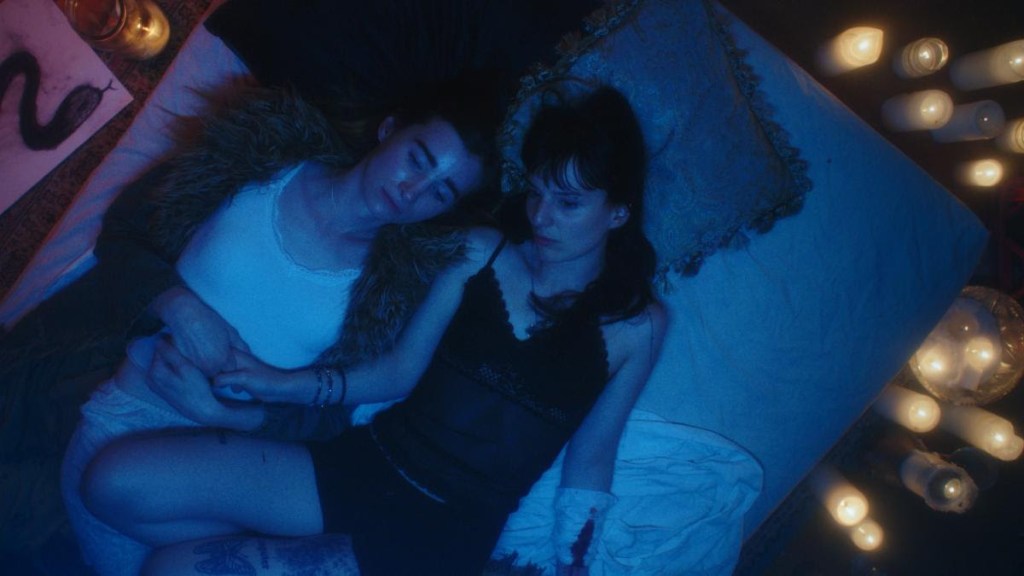
Australian filmmaker Alice Maio Mackay returns to the Fantasia International Film Festivalwith the Canadian premiere of her latest genre-defying feature, The Serpent’s Skin, screening July 23 and 25. Already hailed as her most emotionally resonant and stylistically bold film to date, The Serpent’s Skin fuses supernatural romance with visceral horror, balancing the grotesque and the intimate in true Mackay fashion.
With nods to The Craft, Buffy the Vampire Slayer, and Charmed, Mackay’s newest film conjures millennial teen nostalgia while grounding its witchy terror in the urgent realities of Gen-Z identity, trans survival, and queer resilience. The Serpent’s Skin follows Anna, a trans girl who escapes her stifling, bigoted hometown only to find both romance and horror in a new city—where she falls for goth tattoo artist Gen and accidentally unleashes a demon that begins feeding on their chosen family. What follows is a chilling exploration of trust, self-doubt, and love under supernatural pressure.
Mackay’s voice is unmistakable—raw, punk, defiantly queer—and in The Serpent’s Skin, she harnesses everything she’s learned across her rising career.
From her debut So Vam (2021), Mackay immediately caught the attention of the indie horror world. Described as “a perfect metaphor for transitions and change” and “crafted with a learned voice,” the film positioned Mackay as a filmmaker to watch. Her follow-up, Bad Girl Boogey (2023), was no less impactful—“gritty and raw,” it revealed a sharpened focus and a stronger command of message-driven horror, showing that Mackay could “resonate” beyond just subculture circles.
With T-Blockers (2024), she made perhaps her most personal statement yet. Reviewers called it “fresh,” “unifying,” and “awakening,” applauding how Mackay used her own lived experience to channel communal anger and hope, all while clearly “having a ball” pushing genre boundaries. Her rapid creative output continued with Satranic Panic, another bold and timely entry praised for placing “real characters dealing with real issues in surreal circumstances.”
Produced by Dark Star Pictures, the company that has stood behind each of Mackay’s last five films, The Serpent’s Skin stars Alexandra McVicker (Vice Principals), Scott Major (Heartbreak High), Charlotte Chimes (Neighbours), and Jordan Dulieu (Before Dawn). It also features Fantasia alumni cameos from Avalon Fast (Honeycomb), Joe Lynch (Suitable Flesh), and Betsey Brown (Assholes), with Emmy-nominated Vera Drew (The People’s Joker) returning as editor and Louise Weard (Castration Movie) joining as producer.
Premiering earlier this year at Frameline and heading next to FrightFest this August, The Serpent’s Skin is more than just a new chapter in Mackay’s filmography—it’s a culmination of her growth as a director, writer, and creative force. She’s built a canon that pulses with identity, rage, humour, and style, always speaking directly to those who need it most.
As she returns to Fantasia—a festival that helped champion her earliest work—it’s clear Alice Maio Mackay is no longer just a promising talent. She’s a defining voice in trans cinema and genre storytelling. And with The Serpent’s Skin, she reminds us that transformation, no matter how painful, can be power.
The sequel we all knew was coming. And yes, we will be referring to our checklist of what makes a good sequel, but that aside, is this outing any good, and was it necessary?
From memory the last movie (reviewed and podcasted by me and Chris Dawes) was definitely ripe for franchising. So straight away we’re not in Matrix territory where the question “Why!? Just why!??” isn’t screaming in your head every few minutes.
In 2.0 we pick up two years after the last movie, where Megan’s creator – Gemma (Allison Williams) and her niece Cady (her name is Cady!?? The whole time you swear they’re calling her “Katie!) played by Violet McGraw – are continuing their lives as the only family each one of them has. Except now Gemma is a staunch and vocal advocate for AI regulation due to her knee-jerk reaction to being almost killed by a robot AI (of her own making, it should be said) and Cady (in turn) is following in her aunts’ footsteps (of sorts) by being a computer science nerd.
In an overcompensating effort by Gemma, she ensures Cady takes Akido lessons so she can defend herself. Unfortunately Cady takes those lessons to an unwanted extreme by regarding Steven Segal as a martial arts poster boy, and one beaten up school bully later, Cady gets in trouble; Gemma is at her wits end, and we soon realise life between them is full of tension. For Gemma still punishes herself for putting Cady in harm’s (Megan’s) way, and Cady hates on Gemma for… reasons. She’s a teenager now, so it’s Hollywood lore she be a little bitch to any authority figure in her life. To be honest, you kinda zone out when you go through their motivations ‘cause you’re keen for the Megan goodness to begin.
And that gets kick started by the presence of another killer robot named Ameila (played by NOT Olsen sister, Ivanna Sakhno). However, unlike Megan, Ameila is very lifelike in face and body, as she is constructed NOT to be a faux babysitter for kids, but as a turbo charged infiltration assassin for the CIA.
How she came into existence is the McGuffin that drives the Main Plot of this film, as we simultaneously find out that (shock surprise) Megan is still “alive”, in an online only sort of way. So when Amelia goes rogue (because of course she does) and comes after Gemma and Cady (for reasons you’ll have to watch to understand) Megan’s primary directive to protect Cady at all costs comes to the surface as she demands Gemma build her a new body to literally kung fu fight Amelia (robato robato).
So with our pieces on the board, let’s get into the nuts ‘n’ bolts of M3gan 2.0.
And for a more detailed description of that, as with our last analysis of the first movie, here’s Chris
Dawes with his half of this review.
Dude – I didn’t see it! You went to the premiere without me!
Chris Dawes
Thanks Chris!
Anyway – some highlights worth mentioning is the existence of another Chekov’s Gun in the form of a cybernetic exo-skeleton that makes people super strong (although its application is at least a little funnier/cooler than you’d think).
We also have a new Megan dance number. For those of you who don’t remember, the main (and some would argue, only) reason the first movie did so well, was because of Megan’s hip-hop/ballet moves she pulls before killing Ronnie Cheng. It was a perfectly bite sized Tik Tok moment which gave the film it’s viral boost as countless people imitated it along the lines of Deadpools *Nsync number.
However, Megan’s effort this round – whilst certainly cool – is less memorable due to the fact it doesn’t have any unique & easy-to-copy dance move(s). In the first instalment it was a simple twist of the hips and a rubbery swing of the arms mixed with a sideways head-duck. But for 2.0 she does the Robot (very generic and a bit on the nose) with a 360-degree head spin (which is impossible to replicate). Although in its defence, it’s still entertaining to watch…
Kiwi legend Jermaine Clement guest stars as Alton Appleton, a tech billionaire who serves as both plot device and comedy device.
Another nice (re)addition is the return of Gemma’s two co-workers from the last film Cole (Brian Jordan Alvarez) and Tess (Jen Vann Epps) giving us some nice continuity for 2 characters (and actors) who really don’t need to be there.
And speaking of returning cast – the 2 most important also come back, despite the fact that, had they not, a lot of people wouldn’t have noticed. And they are Amie Donald and Jenna Davis. For they are Megan. More specifically her body and voice respectively.
As Megan was meant to be a pre-teen to match Cady in the first film, the immediate problem they were always facing was, IF they were going to recreate her as before, they would have to recast. But the film-makers clearly appreciate one of the reasons Megan works, is because Donald and Davis clearly work.
And so – with Donald going through the typical growth spurt that comes with puberty – Megan finds herself a foot taller when given her new body, and leaning into this means that the franchise is trying to give the impression each instalment will be a continuation of Megan’s evolution; both in body and in sentience.
And that alone implies this film series will be less Chucky and more Terminator. In more ways than one, as tonally there is a clear shift in Megan’s role from being the Big Bad, to the thing that fights the Big Bad (just like Arnie did in T2)
The Prognosis:
The film-makers have put careful thought into this sequel by analysing the first film’s success, identifying what worked, and leaning into those markers.
So checklist time:
1. Is it a clone of the original? NO
2. Is it a clone of the original but simply more and just bigger? NO
3. Does it expand the universe/lore of the original? YES
4. Is it a good standalone film without relying too heavily on the original? YES
5. (Optional) Does it have a cool new gimmick or element that’s not in the original film, but sits well within the universe of the first film? (Eg: Think Yoda and his ground breaking puppetry in The Empire Strikes Back. Or the CGI T-1000 in T2). NO
6. Does it identify the SPIRIT of the original, and duplicate it? YES definitely.
Because the biggest thing the film-makers have wisely clocked is that Megan ISN’T a horror film, but a fun film. Camp fun. And that’s what makes this movie an upgrade from the original.
Directed by The Motorcycle Diaries‘ Walter Salles and boasting a stellar cast led by Jennifer Connelly, Dark Water (2005) had all the ingredients for a compelling psychological horror. But despite its prestigious pedigree and the eerie bones of its Japanese source material, the film never quite rises above a slow, soggy trudge through grief, isolation, and leaky ceilings.
Connelly plays Dahlia, a mother in the throes of a bitter divorce who relocates with her daughter to a dilapidated apartment on Roosevelt Island. From the outset, the mood is steeped in melancholy—a constant downpour, peeling wallpaper, and a black stain that won’t stop bleeding through the ceiling. It’s all metaphor, of course, for abandonment, trauma, and emotional erosion. And while Connelly commits fully, offering a deeply felt, restrained performance, even her best efforts struggle to keep the film from sinking under its own dreariness.
There’s strong support from the likes of John C. Reilly, Tim Roth, Dougray Scott, and Pete Postlethwaite, each adding gravitas in small doses. But the ensemble feels wasted on a script that paces like a dirge and spends too long building atmosphere at the expense of real suspense. Where Hideo Nakata’s 2002 original (Honogurai mizu no soko kara) balanced its ghost story with quiet dread and a haunting emotional core, this remake feels bloated by comparison—drawn out and uncertain of where to land its final blow.
Salles, though an accomplished filmmaker, seems misaligned with the genre here. The horror elements never hit hard enough, the tension evaporates rather than builds, and even the film’s climactic revelations arrive without the sting they need. There is a tragic weight at the story’s centre—a meditation on motherhood, abandonment, and sacrifice—but it’s bogged down by the film’s sluggish rhythm and predictability.
The Prognosis:
Dark Water isn’t without merit. It’s beautifully shot and well-acted, and at its heart lies a poignant idea about the things we carry and the past we cannot rinse away. But ultimately, this is a film that, despite all the polish and pedigree, feels like a remake with little new to say—trailing in the shadow of its superior original.
Soaked in mood but lacking menace, Dark Water leaves only a damp impression.
How dark are you willing to go? For David Cronenberg, The Shrouds marks another step into the abyss—one not of body horror, but of soul-rattling grief. This is arguably his most intimate and meditative work in decades, stitched together from threads of personal mourning, speculative technology, and the philosophical weight of death’s final curtain.
At the centre is Karsh (played with measured intensity by Vincent Cassel), a widower and tech entrepreneur who creates a radical new device: one that allows the living to peer into the graves of their deceased loved ones via digitally monitored “shrouds.” This deeply invasive (yet oddly spiritual) concept is classic Cronenberg—scientific progress colliding with deeply human frailty. But when a series of graves, including that of Karsh’s wife, are mysteriously desecrated, the film pivots into a sombre, noir-like mystery driven more by obsession than resolution.
From the turn of the century, Cronenberg’s work—Spider, A History of Violence, Cosmopolis, and Crimes of the Future—has leaned away from his earlier grotesque sensibilities and toward psychological excavation. The Shrouds is a continuation of that journey, and perhaps his most self-reflective piece since The Fly. With the recent passing of his wife, the film becomes a stark act of cinematic mourning—less a story than a eulogy.
The concept of the shroud here operates on multiple levels: biblically, as the linen of death and resurrection; metaphorically, as the veil between life and death; and narratively, as the enigma that cloaks Karsh’s unraveling. There’s also the ever-present shroud of mystery that clouds the truth—not only of the graveyard desecrations, but of Karsh himself. As the film progresses, Karsh becomes more opaque, his motives murkier, and his grief increasingly pathological. These twists are fascinating but also frustrating, leading the narrative into a fog of unanswered questions that might leave some viewers cold.
Yet Cronenberg surrounds Cassel with a stellar cast that brings warmth and depth. Diane Kruger and Guy Pearce, both enigmatic and grounded, help anchor the film in emotional reality even as it drifts into cerebral territory. Their performances are subtle yet compelling, with Pearce offering a particularly nuanced turn.
The Prognosis:
The Shrouds isn’t easy to love—but then again, grief rarely is. What it offers is a look into one man’s private hell, filtered through the lens of a director who has never shied away from uncomfortable truths. If its philosophical weight sometimes outweighs its dramatic clarity, it remains a compelling, mournful meditation from one of cinema’s most fearless auteurs.
Saul Muerte
The Shrouds will be screening in cinemas nationwide from Thu 3rd July.
Directed by Jeff Wolfe, Outbreak promises psychological dread and emotional turmoil against the backdrop of a creeping viral catastrophe—but ends up delivering little more than a tepid, trauma-soaked shuffle through familiar terrain.
The film follows a State Park Ranger (Billy Burke) and his wife (Alyshia Ochse) as they navigate the emotional wreckage of their teenage son’s disappearance, only to be confronted by a mysterious outbreak that further destabilises their world. As the infection spreads, so too does the sense of despair—but unfortunately, not much tension.
Billy Burke anchors the film with an earnest and committed performance, his weathered presence lending weight to otherwise limp material. Wolfe allows plenty of room for grief to dominate the narrative, but the pacing is sluggish, and the dramatic beats soon feel repetitive. Rather than building momentum, Outbreak spirals into melodrama, with a script that too often leans on genre clichés and a plot that telegraphs its twists from miles away.
There are a few flashes of atmosphere—some moody cinematography and eerie silences—but the film’s tonal heaviness overshadows its horror ambitions. The virus metaphor is serviceable, and by the time the film reaches its climax, the emotional payoff feels muted and overly familiar.
Despite its promising premise and a solid cast including Raoul Max Trujillo, Taylor Handley, and Jessica Frances Dukes, Outbreak plays it safe when it desperately needed to take risks. Watchable, sure—but only for the curious or the committed fans of the cast. For most, this is a slow trudge through thematic terrain that’s already been better navigated by others.
Outbreak will be available to rent or buy on DVD & Digital across Apple TV, Prime Video, Google TV, YouTube, and Fetch (AU) from July 2nd.
Director Christopher Smith (Triangle, Severance, Creep) has long walked the fine line between genre smarts and psychological thrills. With Consecration, he returns to familiar territory: isolation, trauma, and the gnawing sense that reality is unspooling by divine design—or perhaps something darker. Unfortunately, despite a stellar cast and evocative visuals, this theological thriller never quite delivers the clarity or momentum it promises.
At the centre of the story is Grace, played with icy restraint and wounded conviction by Jena Malone, who travels to a remote convent in the Scottish Highlands after the supposed suicide of her priest brother. It’s no spoiler to say she doesn’t buy the Church’s official line. What follows is a grim unpicking of spiritual rot, ancient rites, and personal demons—literal and otherwise.
Malone is a reliably magnetic presence, giving Grace a cold, coiled intensity. She’s in nearly every frame and carries the film with a quiet sense of fury, even when the script leaves her wandering in narrative fog. Danny Huston, meanwhile, brings a slippery, unsettling charm to his role as Father Romero—a man whose calm demeanour suggests he’s either a holy man or something far more manipulative. Their scenes together crackle with tension, even if the broader story never quite catches fire.
Visually, Consecration is arresting. Robert Adams’ cinematography makes the windswept cliffs and ancient stone interiors of the convent feel appropriately ominous and otherworldly. There’s a chilling stillness to the imagery, as though the land itself has been cursed. Smith knows how to set a mood, and he does so beautifully here, evoking The Ninth Configuration by way of The Nun.
But for all its atmosphere, Consecration stumbles under the weight of its convoluted plot. Flashbacks, hallucinations, religious visions, and a not-so-linear structure make for an increasingly confusing experience. Smith is no stranger to twisty storytelling—Triangle remains a standout in that regard—but here the puzzle-box elements feel murky rather than mind-bending. The story moves slowly, and its pacing often saps the tension that the setting and premise so deftly establish.
By the time the “revelations” arrive, they’re less shocking than they are baffling, tipping the film into a kind of Doctor Who-style timey-wimey terrain that doesn’t mesh with the grounded horror of its opening acts. It’s a tonal mismatch, and one that ultimately dulls the emotional impact of the finale.
Still, there’s something admirable about the ambition on display. Consecration isn’t content to offer up surface-level scares. It aims for spiritual unease and existential horror, and when it clicks, it’s genuinely unsettling. But in the end, the execution can’t match the ambition.
The Prognosis:
A gorgeous, well-acted descent into faith and madness—but one that loses its way somewhere along the sacred path.
Saul Muerte
Consecration will be available on UK Digital Platforms from 16th June.
Beneath its softly lit salons and the hushed intimacy of late-night haircuts, The Stylist carves out something far more unsettling: a psychological portrait of aching loneliness, identity collapse, and the monstrous lengths some will go to feel like they belong. Directed with eerie precision by Jill Gevargizian, this feature-length adaptation of her acclaimed short film offers a muted but effective horror tale that leans more into sadness than shocks.
Claire (Najarra Townsend) is a woman adrift—quiet, awkward, desperate to connect—but with a hunger that’s gone grotesquely unmet. She doesn’t just cut hair. She scalps. Each kill is not about violence for its own sake, but a tragic, chilling attempt to wear someone else’s life. And that’s where The Stylist cuts deepest—not in the gore, but in its exploration of identity as a fragile performance, and what happens when someone can no longer locate their own sense of self.
Enter Olivia (Brea Grant), an affable, outgoing bride-to-be who naively invites Claire deeper into her world. From there, the spiral is slow and agonising. What starts as admiration curdles into obsession. Claire’s need to be Olivia isn’t just jealousy—it’s pathological yearning. Her scalping isn’t about trophies in the serial killer sense. It’s about transference. Taking the one thing a person can’t fake: their presence, their social ease, their confidence. Claire doesn’t want to destroy—she wants to inhabit.
Townsend delivers a superb, painfully internal performance. Her Claire is meek but never blank—each nervous twitch and downward glance revealing someone quietly screaming behind her skin. She doesn’t play the killer as a monster, but as a woman in mourning—for connection, for warmth, for identity. It’s a performance that sticks with you. Brea Grant, meanwhile, plays Olivia with a brightness that never tips into caricature, making her slow realisation all the more tragic.
Stylistically, the film is polished, with an elegant aesthetic that contrasts beautifully with its macabre subject matter. There are echoes of Maniac, May, even Single White Female, but The Stylist stands on its own, particularly in how grounded its emotional horror remains. The mood is heavy, sometimes to a fault, with pacing that occasionally feels listless rather than deliberate. Still, the thematic undercurrents—how we mask our emptiness, how we covet others’ confidence like currency—are deeply resonant.
The Prognosis:
There’s a sadness in the scissors. In the need to be seen. In the horror of invisibility. The Stylist doesn’t reinvent the horror genre, but it delivers something more haunting than expected: a quiet eulogy for those who never quite found their place, and the darkness that fills the void.

 Surgeons of Horror