George Pavlou’s Transmutations (also known as Underworld) occupies an awkward, largely forgotten corner in the canon of Clive Barker–related cinema—a curiosity rather than a cornerstone, a footnote rather than a foundation. Released two years before Hellraiser would redefine Barker’s place in the genre, this early attempt at translating his sensibilities to the screen delivers more frustration than fascination, offering only faint glimmers of the nightmarish imagination that would soon reshape horror.
The premise holds the embryonic outline of Barker’s obsessions: flesh in flux, identity undone, desire twisted into mutation. A missing sex worker, a wealthy puppet master, a mercenary ex-lover, and a secret colony of chemically altered outcasts living beneath the city—on paper, it’s unmistakably Barker. But while the ingredients are present, the alchemy is not. Pavlou’s direction lacks the atmosphere and transgressive conviction needed to bring Barker’s script to life, resulting instead in a confused stew of sci-fi noir, body horror, and crime thriller clichés.
What should feel mythic and grotesquely operatic instead feels oddly anaemic. The underground mutants—conceptually ripe territory for Barker’s fascination with monstrous otherness—never rise above rubber-suit awkwardness. Their tragedy is undercut by clumsy execution, their menace diluted by incoherent world-building. Even the film’s central hallucinogenic powder, a classic Barker motif of transcendence through sensation, slips through the story like an undeveloped idea.
For Barker admirers, the film is primarily interesting as a “before the storm” artifact: a glimpse of themes and images he’d later refine with far more confidence, from the eroticised metamorphoses of Hellraiser to the urban-myth underworlds of Nightbreed. Transmutations hints toward these futures but never manages to articulate its own identity. It’s a film caught between genres, visions, and expectations—ultimately satisfying none.
As a mid-1980s horror oddity, it has its moments of charm: a grubby London atmosphere, a handful of practical effects that almost work, and a pulpy energy that occasionally threatens to spark to life. But as part of the Barker cinematic legacy, Transmutations remains a minor and often misguided experiment—one that underscores how vital Barker’s own directorial control would become in shaping the stories he imagined for the screen.
The Prognosis:
A relic for completists, a curiosity for scholars of Barker’s filmography—but for most viewers, it’s easy to see why this particular mutation never evolved.
By the year 2000, the Hellraiser franchise had drifted far from its grisly, surreal origins under Clive Barker. What had once been a baroque tale of desire, pain, and cosmic horror had, by its fifth entry, morphed into something altogether more familiar: a standard-issue psychological thriller with the faintest whiff of Cenobite leather stitched across it. Scott Derrickson’s Hellraiser: Inferno epitomises this era of crowbarring unrelated stories into the franchise, taking what could have stood alone as a grim detective noir and grafting Pinhead and his puzzle box onto its framework.
The film follows Detective Joseph Thorne (Craig Sheffer), a morally compromised cop whose corruption and addictions lead him down a spiralling rabbit hole of violence, betrayal, and surreal torment. Along the way, he encounters the infamous Lament Configuration, unleashing the Cenobites. Or at least, in theory. In practice, Doug Bradley’s Pinhead barely registers, appearing only in fleeting, spectral cameos as though contractually obligated. It’s a curious bait-and-switch: marketed as a Hellraiser sequel, but functioning more as a hallucinatory morality play about guilt and punishment.
Craig Sheffer delivers a performance that is both strange and strangely compelling. His Thorne is less a hardened detective than a man visibly unraveling from frame one, his paranoia and sweaty desperation walking a fine line between over-the-top and hypnotic. His odd choices give the film its only real personality, even when the script veers into derivative territory.
For Scott Derrickson, Inferno marked his feature debut, and in hindsight, it reads like an intriguing blueprint. The seeds of his fascination with morality, spirituality, and personal damnation—later explored more successfully in The Exorcism of Emily Rose and Sinister—are all present here, though buried under the constraints of direct-to-video horror branding. His direction adds a layer of polish and atmosphere to what otherwise could have been disposable.
The Prognosis:
In the end, Hellraiser: Inferno is less a Hellraiser film than a late-night cable thriller wearing Cenobite skin. It embodies the era when Dimension Films would shoehorn iconic franchises into unrelated scripts, keeping names alive while draining them of identity. As such, it’s both frustrating and oddly fascinating—a film that feels at once forgettable and, in retrospect, a small but notable stepping stone for Derrickson.
“Magic is just illusion seen through the eyes of fear.” That line might sum up Lord of Illusions, but it also eerily reflects the creative struggles of its director, Clive Barker, an artist trapped between his immense imagination and the brutal limitations of mainstream filmmaking. Now, thirty years on, Lord of Illusions remains a compelling—if uneven—entry in 1990s horror cinema. It’s also the swan song of a visionary director who made only three films, all defined by their refusal to play safe, and all marred by battles behind the scenes.
Based on Barker’s own short story The Last Illusion, the film blends horror, noir, and supernatural thriller elements into a curious cocktail. At the centre is private investigator Harry D’Amour (Scott Bakula, doing his best trenchcoat-wearing Bogart impression), who stumbles into the orbit of Nix—an apocalyptic cult leader and black magician brought to life with chilling intensity by Daniel von Bargen. It’s a film that questions the nature of belief, the cult of personality, and the illusion of control, but one that often finds itself constrained by the very genre conventions Barker had always tried to defy.
In many ways, Lord of Illusions is the most accessible of Barker’s three directorial efforts, though that’s not necessarily a compliment. After the gonzo body-horror of Hellraiser (1987) and the mythic, misunderstood Nightbreed (1990), Illusions plays more like a compromise. Barker once described filmmaking in Hollywood as being forced to “paint with the wrong colours,” and this film feels like one created with a limited palette. The original cut was famously toned down by the studio, stripping away much of its esoteric layering and graphic imagery in favour of a neater, more digestible detective-horror hybrid.
That said, Barker’s fingerprints are still everywhere—particularly in the rich, occult mythology. Nix is a villain who could have stepped straight out of a Gnostic nightmare or Barker’s own Books of Blood. The grotesque magic sequences, from mind-bending illusions to viscera-soaked resurrections, are pure Barker: sensual, terrifying, and drenched in symbolic horror. The Los Angeles setting adds an appropriately seedy sheen, suggesting that Hollywood itself may be the greatest illusion of them all.
The cast holds up well, even when the material doesn’t always serve them. Bakula grounds the madness with a solid performance, while Famke Janssen smoulders in one of her earliest roles, though her character is sadly underwritten. Kevin J. O’Connor provides another eccentric Barker-alum turn as illusionist Philip Swann, a man both haunted and doomed by his involvement with the occult.
Yet even as Lord of Illusions showed Barker still had stories to tell, it would also be the end of the road for him as a director. After suffering through studio interference on Nightbreed—a film whose director’s cut wouldn’t see daylight for over two decades—and dealing with similar frustrations here, Barker effectively stepped away from filmmaking. He returned to literature, theatre, and painting—forms where his unfiltered creativity could finally roam free.
Looking back on his three films together—Hellraiser with its S&M-tinged metaphysics, Nightbreed with its monstrous allegories, and Lord of Illusions with its descent into spiritual corruption—each reveals a piece of Barker’s cinematic lens: one that sought to fuse body and soul, religion and sex, horror and beauty. But Hollywood was never ready for such an unshackled vision, and Barker himself was never willing to dull the blade.
The Prognosis:
Lord of Illusions stands as an intriguing, if flawed, finale. It may lack the razor-edged impact of Hellraiser or the operatic heart of Nightbreed, but it remains a fascinating coda to Barker’s filmic voice—a magician’s final act before stepping off the stage, disgusted with the applause.
And in that way, maybe Nix was right after all: “I was born to murder the world.” Only for Barker, it was never the world he wanted to kill—just the illusion of what it could have been.
The box is still open—but by 2005, the horrors inside had lost their teeth.
As the Hellraiser franchise entered its straight-to-video era in the early 2000s, fans had already weathered a series of diminishing returns. But 2005’s double blow of Hellraiser: Deader and Hellraiser: Hellworld, both directed by Rick Bota and released within months of each other, marked a significant point of no return. Celebrating (or lamenting) their 20th anniversary in 2025, these two entries are less remembered for expanding Clive Barker’s mythos and more for highlighting how far the series had drifted from its grim, sensual origins.
Hellraiser: Deader
Of the two, Deader fares slightly better—not because it’s a faithful addition to the Hellraiser canon, but because it begins life as something else entirely. Originally a standalone supernatural thriller script, it was retrofitted to include the Cenobites and the Lament Configuration, resulting in a stitched-together film that almost works in spite of itself.
Kari Wuhrer leads the story as a hard-nosed journalist chasing down an underground death cult in Romania. The film flirts with themes of trauma, addiction, and blurred reality—concepts that Hellraiser once handled with provocative boldness—but here, they’re dulled by a by-the-numbers execution. Still, the moody Eastern European backdrop and committed turns from Wuhrer, Marc Warren, and Paul Rhys give it some atmosphere, and the central premise—of a cult obsessed with conquering death—does echo Hellraiser’s fascination with pushing bodily and spiritual limits.
But despite flashes of creativity, Deader never shakes its identity crisis. The Cenobites are barely relevant to the narrative, and Pinhead’s presence feels perfunctory. It’s not a Hellraiser movie so much as a middling thriller that happens to feature a few familiar hooks.
Hellraiser: Hellworld
If Deader is diluted, then Hellworld is downright disposable. Set in a pseudo-Internet-era gaming world, Hellworld attempts to be meta and modern, pitting a group of teens against a Hellraiser-themed online game. The resulting film feels like Scream meets House on Haunted Hill—but without the tension, intelligence, or atmosphere of either.
Despite the presence of genre legend Lance Henriksen and a young Henry Cavill (long before the cape), the cast is wasted in a script that relies on techno-jargon, faux-twists, and a painfully forced attempt at self-awareness. Doug Bradley’s Pinhead appears for his final time here, but his screen time is minimal, his dialogue rote, and his menace utterly defanged.
The film ends with a ridiculous twist that robs it of even the shallow pleasures of a bad slasher flick. For many fans, Hellworld marks the lowest point in the franchise—and it’s hard to argue with that sentiment.
Doug Bradley: The Final Configuration
If Hellworld is a disappointing swan song, it’s also the end of an era for Doug Bradley, who portrayed Pinhead across eight Hellraiser films from 1987 to 2005. With his commanding presence and Shakespearean delivery, Bradley transformed what could have been a gimmicky monster into a tragic, philosophical figure—a dark priest of pain and pleasure who lingered long after the credits rolled.
Bradley’s contributions to the franchise can’t be overstated. In Hellbound and Hell on Earth, he explored the remnants of humanity in Pinhead’s psyche; in later films like Inferno and Deader, he still managed to bring gravitas even when the writing failed him. His final appearance in Hellworld may be a muted farewell, but his legacy remains stitched into the flesh of the genre.
The Prognosis:
Twenty years on, Deader and Hellworld stand as cautionary tales about franchise fatigue and the dangers of branding over storytelling. What began with Clive Barker’s twisted poetry and existential dread had, by 2005, become little more than window dressing. Still, Deader holds a flicker of creativity, and even in the depths of Hellworld, Bradley’s shadow looms large—a final, ghostly reminder of what Hellraiser once dared to be.
There have been a number of re-imaginings or reboots of significant horror films of late. Be it Scream (2022),Texas Chainsaw Massacre (2022), or Goodnight Mommy (2022). Now comes the turn of Hellraiser, Clive Barker’s vision of a realm that delicately balances the line of pleasure and pain from the novella, The Hellbound Heart. Initially brought to the screen by Barker himself back in 1987, the franchise has seen eleven instalments including this latest venture.
Charged with bringing this to light is Director David Bruckner, who has already proved his worth with solid features, The Ritualand The Night House. The focus in steering this before a new generation horror aficionados is the lament configuration, a puzzle box that opens the portal into another realm where extra dimensional beings known as cenobites lurk in the hopes of luring souls into exploring the outer reaches of sensualness through pain, suffering and satisfaction.
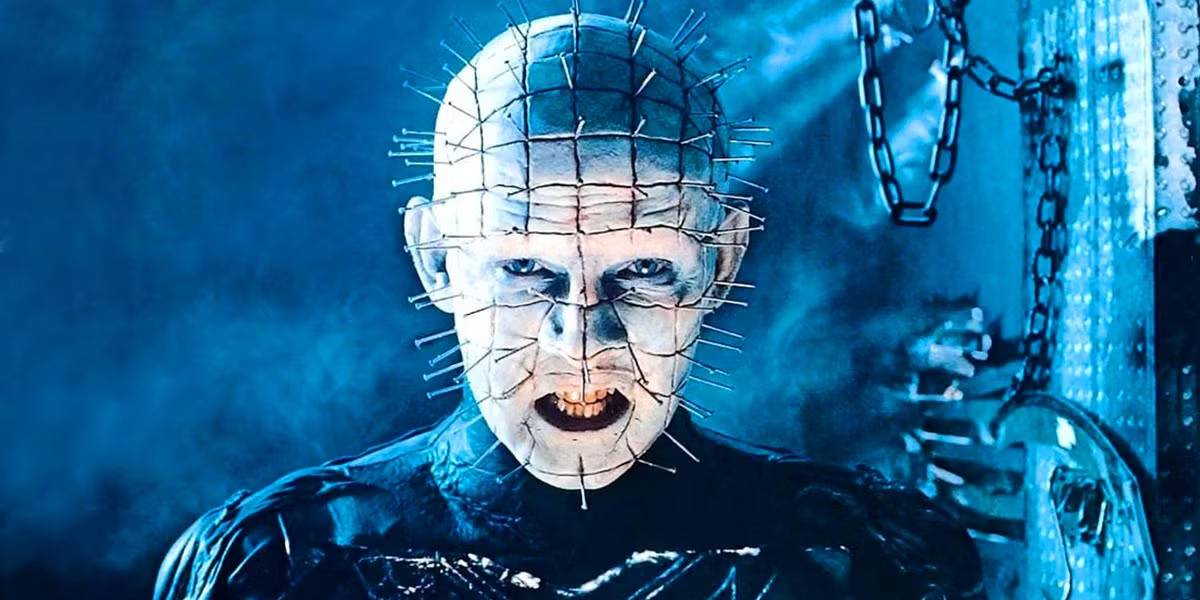
The Cenobites are led by The Hell Priest known as Pinhead, most notably portrayed by Doug Bradley in the past, but has seen Stephen Smith Collins and Paul T. Taylor also takes on the role which now falls into the hands of Jamie Clayton to add a more gender fluid adaptation. This allows Pinhead to weave a more sexual and sinister enticement into the realm beyond and one that Clayton captures successfully.
Hellraiser(2022) needs to find its modern voice too and does so by centring on a sibling relationship, bound by blood but torn apart by one’s vices. Riley (Odessa A’zion) is a recovering drug addict who is constantly being bailed out of dire situations by her brother Matt (Brandon Flynn). This relationship however is strained one last time when Riley is lured in by her boyfriend Trevor (Drew Starkey), to break into an abandoned warehouse to steal some goods, only to encounter the lament configuration. This discovery leads them down a path of no return, where those they are closest to will be drawn down with them.
Will Riley claw her way to survival or find a way to bargain with ‘The Surgeons’ and the Leviathan; the king of hell?
All the while another piece of the puzzle is at play with a hedonistic millionaire, Roland Voight (Goran Višnjić) who is trying to equally pull the strings of those who encounter the lament configuration in an effort to fulfil his own twisted desires. Whoever will find the right combination and reap their rewards will be pushed to the final scenes, but the cost of the victor may or may not be as expected.
The prognosis:
I have always respected the art and vision of Clive Barker, and while it’s hard to top the original vision (One that Barker helmed himself), it’s great to see the world of cenobites, Pinhead and The Hellbound Heart brought before a modern audience.
Director Bruckner once again proves he can adapt mythology and mystery with a troubled heart and its centre through a well-constructed narrative.
My one criticism is how polished it feels at times which takes away from the dark and twisted viscera that runs through Barker’s world.
Sleepwalkers was one of those movies that has immersed itself in my mind and I’m pretty sure formed part of my horror film makeup. It’s probably not surprising really if I divulge a little of my personal journey through horror films. I would have been around 14 years old at the time of its release and already had sunk my impressionable mind into the works of Stephen King and knowing his name was attached to the writing credits for what would have been his first not to be based on any of his pre-existing works (Not that I knew this at the time). It also starred Madchen Amick, hot off the David Lynch hit tv series Twin Peaks. Lynch was also integral to forming my cinephilia and with Amick’s involvement, I was already hooked. It would also be directed by Mick Garris who has since carved a name for himself in the name of horror on-screen and often using King’s work as source material. Later, I would understand the importance that Aice Krige would play in movies having already carved a name through Chariots of Fire, Ghost Story, and Barfly. This would be my first encounter with Krige however and it’s fair to say that her role of the matriarchal shapeshifter Mary, a shapeshifting energy vampire, sets the tone for the whole movie.
Along with her son Charles Brady (Brian Krause) feeds off the lifeforce of virgin women and can transform into werecats to feed on their prey, whilst also using their powers of telekinesis and illusion to manipulate those with whom they encounter. Their only weakness are domestic cats, who are resistant to the sleepwalkers magic and can cause fatal wounds.
Madchen Amick takes on the role of Charles’ virginal interest Tanya, who is lured in by his magnanimous charm. Before long, Tanya realises that there is more to Charles than meets the eye and must fight tooth and nail to survive.
Looking back at the film now, it still holds some allure despite some clearly aged creature effects, and the moment when Charles transforms for the first time is a great counterweight to our first impressions of his character. Throw into the mix a blink and you’ll miss Ron Perlman as Captain Soames and horror maestros Clive Barker, Joe Dante, John Landis, Tobe Hooper and even King himself cropping up at notable points, and you’ve got a lot to get your teeth into. Oh and Mark Hamill also makes an uncredited appearance which brings a smile to this cinema lover’s face.
It is Krige however as mentioned who really comes to life as Mary and the lead antagonist of the film, with her incestous needs and devilish desires lights up every scene that she is in. For this, Sleepwalkers is well worth a revisit.
100 years ago the Roaring Twenties came into effect with a social and economic boom that pushed the boundaries of experimentation and exploration dubbing it the crazy years.
Cinema has evolved greatly during this time and spawned Robert Miene’s silent horror in German Expressionism, which is still considered a classic among some critics.
While the tides have shifted and the boundaries of what is classified as horror has twisted through the years, moving numerous debates and discussions along the way, we come to a time when originality can be hard to come by, or perhaps the audience has become too critical and our perceptions have changed.
Can the films of today cause a deeper development in the genre that we’ve come to love and like the films that were born a century ago stir the insanity again and break new ground in the process?
Let’s look at what 2020 has in store and see if indeed it will deliver.
This film has led some early reports to compare it to Alien but in the ocean deep instead of the far reaches of space. It does boast Kristen Stewart in the cast who may divide audiences and has been a bit hit and miss of late in her film choices but she is supported in this instance by Vincent Cassel, who is known for choosing experimental films. Does this then mean that this team of underwater researchers will uncover not only a few beasties but also break new ground in the process?
Prediction: Neither sink or swim. A drifter that will entertain some but not cast anything new into the cinematic landscape.
Jan 24 – The Turning
Based on Henry James novel, The Turn of the Screw and produced by Steven Spielberg, it stars Mackenzie Davis (Terminator: Dark Fate) and Finn “Can my hair grow any longer?” Wolfhard (Stranger Things) and bears close scrutiny as director Mike Flanagan (Doctor Sleep) is set to release an interpretation of the novel in Netflix series, The Haunting of Bly Manor, his follow up to the successful The Haunting of Hill House.
Prediction: Director Floria Sigismondi will no doubt bring some artistic visual flair that is evidence from her music videos, but could possibly fall foul of “popcorn syndrome” – Light, fluffy with a bit of crunch and serves the masses, but ultimately has no substance.
Initially I was really excited about this release, being a fan of the Ju On franchise, plus Nicolas Pesce’s work with The Eyes of My Mother, and Piercing. Both movies have pushed the boundaries of comfort and shot in stylistic fashion that I was keen to see where Pesce would take The Grudge. Early reports haven’t been favourable however, so it could be another disappointment in the first month of the new decade.
Prediction: Could be another franchise instalment too many. The name alone will pull in the numbers, yet may not hit the mark on the scare front.
Jan 31 – Gretel and Hansel
It’s been over 200 years since The Brothers Grimm fashioned the fairy tale about a cannibalistic witch that kidnaps two children roaming in the woods. The fact that it is still resonates today is a testament to the strength of the storytelling and it will be interesting to see the story told from the perspective of Gretel played by Sophia Lillis (IT) who has already proved compelling as the young Beverly Marsh.
Prediction: Better than your average fair without necessarily offering anything new or compelling with the horror genre.
Some may argue its place in this list, but it is billed as a psychological horror and director Robert Eggers has already made a name for himself in the artistic expressionism world within the genre with his debut feature, The VVitch, a film that also divided audiences. American audiences have already seen the movie too as it was released there last year, but as yet Australian audiences are still to see Eggers’ sophomore outing which pits Willem Defoe and Robert Pattinson against one another in a battle of wills and sanity in a remote and confined island.
Prediction: Will wow audiences looking for the alternative and alienate those more into the mainstream. Either way, both audiences will applaud the performances and Eggers and cinematographer Jarin Blaschke will paint a stunningly beautiful canvas.
Feb 13 – Fantasy Island
Blumhouse Productions are about to shake things up again by breathing new life into a cult 70s tv series. With a star-studded cast – Michael Pena (Crash), Maggie Q (Nikita), Lucy Hale (Pretty Little Liars), and Michael Rooker (Henry: Portrait of a Serial Killer). On an island where your fantasies come true, only to turn into nightmares and the guests must figure out its mystery in order to survive.
Prediction: Another success for Jason Blum and the team which will connect with the cinema-going public. If it’s played right, it could offer a fresh take using a blend of fantasy and horror that could also spark a franchise
Feb 21 – Brahms: The Boy ll
This one is a bit of an oddity. Whilst its predecessor was a middle of the road affair and proved to be better than expected. It did feel like a one-off movie that didn’t necessarily warrant any further journey into the world of Brahms. A sequel is here though and will pick up with the doll being discovered by another family.
Prediction: A flop that will fall by the wayside and may not even make a blip on the radar.
Feb 27 – The Invisible Man
Another Blumhouse movie, this time in collaboration with Universal to resurrect their monsters franchise after the abysmal Tom Cruise vehicle from a few years ago. In what is potentially a ripe and current topic being explored in domestic violence as its central theme The Invisible Man boasts a cracking cast with Elisabeth Moss taking lead duties. It’s also in great hands with director Leigh Whannel steering the ship following his successful movie Upgrade from last year, plus Whannel is a storyteller, so expect a decent script to boot.
Prediction: The first big success of the year bringing the Universal monsters franchise back on track and paving the way for future projects with The Bride, Renfeld, The Invisible Woman, and Frankenstein.
Mar 20 – A Quiet Place Part 2
The question is whether director John Krasiniski can repeat the winning formula from the first movie. This War of the Worlds style feature with an audio twist is more sci-fi than horror, but with the family in plight scenario held a strong connection with the audience. How will this translate now that there is an absent father?
Prediction: Cillian Murphy will provide some much needed gravitas to the narrative which will be strong enough to lift the audience through with some decent ups and downs to wrench up the tension.
Apr 3 – The New Mutants
Since Disney took over Marvel operations, The New Mutants has been stuck in production, deemed a little dark for the House of Mouse questioning how to distribute it. The feature comes across as The Dream Warriors crossed with the X-Men and centres on 5 young mutants held in a secret facility against their will. It also boasts a cracking cast with Maisie Williams (Game of Thrones), Anya Taylor-Joy (The VVitch, Split), and Charlie Heaton (Stranger Things).
Prediction: Despite several delays I feel that this film is gonna connect in a big way and pull in a lot of people. It just depends on how dark Disney are willing to go with it.
Apr 17 – Antlers
Little is known about this movie other than it is based on a short story by Nick Antosca the creative mind behind the Channel Zero anthology series. The screenplay must have some potential to have caught the eye of Guillermo Del Toro and put his name down as producer.
Prediction: With Keri Russell in the cast to provide the fantasy elements in reality, this could well be the surprise hit of the year.
May 15 – Saw reboot
Currently titled The Organ Donor starring Chris Rock, Samuel L. Jackson and Max Minghella this reboot of the Saw franchise will see the return of the Jigsaw Killer, but without Tobin Bell… I think? With director Darren Lynn Bousman at the helm once more following his turn overseeing parts 2-4, he is no stranger to the world.
Prediction: Will put bums on seats for the shock gore factor alone, but will the buddy cop drama approach pay off? Time will tell.
Jun 11 – Candyman
This is gonna be a tough one to watch for me as I am such a huge fan of the original movie and like Freddy, Candyman would haunt my dreams for a long time after viewing. A lot of that has to do with the strength of Clive Barker’s short story coupled with Tony Todd’s personification of the titular character. Part of me is willing for this to be a success though as I can see room for the movie to be delivered to a modern audience using folklore and mythology at its core, and the storyline itself can transcend easily through the ages. It will be interesting to see a female perspective in director Nia DaCosta to follow Helen’s journalistic investigations.
Prediction: Jordan Peele has attached his name to this project and is clearly passionate about the story, but one can’t help but feel this is one step too far in rekindling the old flame that resides within the Candyman story.
Jul 2 – Ghostbuster: Afterlife
I know it’s technically not a horror film, but I’m including this in the mix for its nostalgic value in me the original movie paved the love of horror that I have and opened the door to many more glorious visions in the genre ever since. The original team will return in some shape or form, but primarily the film centres around a mother and her two children who set up on a farm only to discover something paranormal lurking in the town.
Prediction: Another film that will be resting on the merits of the first film, and while it’s great to see Jason Reitman take on the franchise following in his father’s footsteps, one can only hope that there will be enough comedy, horror and sci-fi to capture that old magic, but I think it will just be a glimmer rather than that sparkle.
Jul 10 – The Purge 5
Supposedly returning for the final instalment the 12 hour no holds-barred, crimefest ignited something in the movie-going audience. It has seen five feature length instalments and 2 seasons.
Prediction: More of the same, so if you’re a fan of the series, you’ll love it. I for one think the films are fun and enjoyable and it will be interesting to see how James DiMonaco will conclude things.
Jul 30 – Morbius
Sony has promised to take the Marvel universe into dark territory before with Venom and here they intend to do so again with Morbius, the Living Vampire. Jared Leto will no doubt bring the goods for the titular role and is in good company with Matt Smith, Jared Leto, and Tyrese Gibson.
Prediction: Director Daniel Espinosa provides great entertaining and solid movies, such as Safe House and Life, and I see no change here to his formula, but still question if they can go dark enough to make it compelling for horror fans.
Sep 11 – The Conjuring 3 aka The Conjuring: The Devil Made Me Do It
The Conjuring universe has progressed in leaps and bounds since its initial release in 2013. There has been the odd blips, but essentially the films continue to entertain and scare audiences. This latest film will once again see the Warrens at the centre of proceedings, this time with one of their most publicised cases that bore witness to Arne Cheyenne Johnson claiming that he was possessed when he murdered.
Prediction: Solid acting, tight storyline, but may fall down with its delivery and exposition. Unfortunately Director Michael Chaves didn’t deliver with The Curse of La Llorona, so I fear that this may end up in a similar way, but am still willing to give it a chance.
Sep 17 – Last Night In Soho
Not much known about this one, but Edgar Wright has a knack for tapping the pulse of classic films and adapting their essence for a modern audience. This time around the psychological horror is inspired by Don’t Look Now and Polanski’s Repulsion both high in my all-time favourite lists
Prediction: A killer cast in Anya Taylor-Joy, Matt Smith, Diana Rigg, and Terence Stamp, this could be the ‘big hit’ of the year.
Oct 15 – Halloween Kills
In 2018, David Gordon Green, Danny McBride and Jason Blum attempted the impossible, the resurrection of Michael Myers that would connect both fans of the original and connect with a new audience. By delving into the subject of trauma and the impact that this has on its victims, Myers became both topical and harrowing. His sheer brutality and the force in which he attacks his victims made his carnage all the more disturbing.
Prediction: The name and sheer presence of Myers will bring the audience to the screens, but can they still make him relevant? They can’t rest on the nostalgic nods this time around. It’s a fine line to walk on, for if they get it wrong, they could find their final instalment, Halloween Ends a tricky sell.
TBC – Army of the Dead
For sheer shits and giggles, and action-pumped mayhem from visual storyteller Zack Snyder, about a group of mercenaries who decide to rob a casino during a zombie outbreak, this film concludes our list.
Prediction: Starring Dave Bautista, Army of the Dead will be entertaining if nothing else. A perfect answer for those just wanting to get their kicks and not have to think too deeply.
Before we even begin to dissect the latest outing from the Hellraiser franchise, we must first look to its writer and director, Gary J Tunnicliffe.
If ever there was a guy completely immersed in the world of Pinhead and his fellow cenobites it’s Tunnicliffe.
Having provided the make up effects for all the Hellraiser films since Hellraiser III: Hell on Earth, Tunnicliffe has also written the previous instalment, written and directed the surprisingly decent short, No More Souls: One Last Slice of Sensation. Hell, he’s even played a cenobite in one of the movies.
Now he turns his attention to the director’s chair, which may have horror enthusiasts a little concerned due to the fact that he’s only really dealt with kid friendly films outside of Hellraiser.
But the very fact that he has been so integral to the look and feel of this world, would lead you to believe that he could very well be the man for the job…
However, as much as Judgement is his movie and the look and feel of it is actually quite beautiful and gloriously bloody in places, it never manages to lift itself from the straight-to-video Budget that we find ourselves.
Ignoring, (if at all possible) that Doug Bradley once again has been left in the darkest recesses of the Leviathan’s domain, never to be Pinhead again.
Instead, we’re left with Paul T. Taylor to take on the notorious role, and although he does an ample enough job, it just never feels right, and you’re left hungry for more as a result.
We are treated to a mere 15 seconds or so of Heather Langenkamp playing the landlady of one of the victims, but her presence is soon forgotten as we forced back into the somewhat rickety plot line.
Speaking of which, here is my main grief about this picture.
We’re treated to a fairly decent beginning, introduced to a character called The Auditor, (played by Tunnicliffe) as he goes around reaping the world of demented souls through a fairly grotesque and torturous process, much to the delight of fans no doubt.
The Auditor soon becomes secondary as we follow two brother detectives and a third female detective as they try and uncover who this serial killer is.
The more we deviate away from the sexual, violent, and depraved world of The Auditor, the cheaper and less authentic the film becomes.
Ever since we were introduced to Craig Sheffer’s Detective Joseph Thorne in Hellraiser: Inferno, it feels like filmmakers are compelled to include some downtrodden and beaten detective into the fold, as they try to uncover clues into the hidden world.
This feels to me like it’s completely missing the point of Clive Barker’s original creation.
Detailing people’s obsession with searching for the ultimate in satisfaction and pleasure; pushing themselves beyond the state of ecstasy into a world of no return.
It is this compulsive, addictive personality that is sadly lacking in these later films, and because of this, Pinhead feels more like a voyeur in his own land, and unable to enact the sheer desolation that sent chills to the bone from the original movie.
The Diagnosis:
It’s a brave attempt to lure people back into the world we came to love, but Tunnicliffe’s vision starts with a good pulse, but whimpers out and dies as he drowns in the history of previous outings.
As a result, we’re forever shackled to the walls without ever feeling like we’ve had our souls torn apart.
Instead, like Pinhead throughout this movie, we’re left wallowing and yearning for the days of yore.

 Surgeons of Horror