Tags
clive barker, hellraiser, library of the oocult, rawhead rex, Sounds of Horror, the damnation game
How the man who turned desire, flesh and forbidden knowledge into horror changed the genre
There are writers who frighten us by showing us what we fear. Clive Barker has always been more interested in showing us what we want. That distinction is crucial. Horror has traditionally understood desire as a vulnerability. We desire wealth, immortality, sex, knowledge, revenge, transcendence; something monstrous waits at the other end of that desire and punishes us for reaching toward it. The forbidden door should remain closed. The mysterious box should remain unopened. The ancient bargain should never be made. Barker’s fiction repeatedly asks a more uncomfortable question: what if we open the door because we genuinely want to know what is on the other side?
And what if, when the door opens, what waits beyond it is not simply monstrous? What if it is beautiful? What if it is seductive? What if it offers exactly what we asked for? That is the territory Barker has occupied for more than four decades. From Books of Blood through The Damnation Game, The Hellbound Heart, Hellraiser, Rawhead Rex, Cabal, Nightbreed, Weaveworld, Imajica and beyond, Barker has repeatedly returned to the same fundamental proposition: the boundary between what we desire and what we fear is far less stable than we would like to believe.
That makes the current moment an unusually appropriate time to revisit his work. The Damnation Game has recently returned to the operating table through Occult Echoes. Hellraiser is about to receive its own examination through Sounds of Horror. And with Rawhead Rex reaching forty, one of Barker’s most uncompromising creations is once again forcing its way out from beneath the cultural soil. Three works, three monsters and three very different expressions of the same imagination provide a particularly useful route into an artist whose career is considerably broader than any single creation.
THE WRITER WHO WANTED TO OPEN THE DOOR
When Books of Blood appeared in the mid-1980s, Barker did not arrive in horror simply as somebody trying to reinvent gore. The blood was the most visible part of what he was doing, but it was hardly the whole story. His real innovation was imaginative. Barker understood that the human body could be simultaneously disgusting and magnificent; that sexuality could be frightening without being morally condemned; that monsters could possess their own forms of beauty; and that the supernatural did not necessarily exist to restore order but could instead expose how fragile our assumptions about order had always been.
His horror is therefore rarely satisfied with a simple opposition between human and monster. The monster may desire. The human may be monstrous. The beautiful may be dangerous. The grotesque may be liberating. And the thing that looks like damnation may, under the right circumstances, resemble salvation. That instability is one of the reasons Barker’s work has proved so durable. He doesn’t simply place a monster inside the story. He changes the rules by which we understand what the monster is.
THE BODY AS A THRESHOLD
For Barker, the body is never merely a body. It is a threshold. Something can enter it. Something can emerge from it. It can decay, regenerate, mutate, transform, open, split, heal, rupture or become something that no longer resembles the person who originally inhabited it.
This is one of the great continuities between Barker’s apparently disparate works. The horror isn’t necessarily that the body can be destroyed. The horror is that the body can change. And transformation is rarely presented as purely negative. Barker is fascinated by metamorphosis because metamorphosis contains possibility. To become something else is terrifying. It is also tempting.
That duality gives his work a peculiar emotional charge. The reader isn’t always standing safely outside the nightmare looking in. Sometimes the nightmare is extending an invitation.
THE DAMNATION GAME: THE PRICE OF DESIRE
The Damnation Game is an ideal place to begin because it contains so much of the Barker philosophy in embryonic form. At its centre is a Faustian proposition involving immortality, power, debt, corruption and the terrible consequences of making an agreement whose terms are not fully understood. But Barker’s interest isn’t simply in the mechanics of the bargain. It is in why someone would make it.
A supernatural bargain only works dramatically if the person accepting it genuinely wants what is being offered. Otherwise the Devil—or whatever occupies the Devil’s position—has very little leverage. Barker understands this instinctively. The supernatural doesn’t have to force the door. It waits for us to open it. That makes The Damnation Game part of a much older literary tradition, one that stretches through Marlowe and Goethe and into the modern horror novel. But Barker’s version is particularly physical. The consequences of desire don’t remain abstract philosophical propositions. They manifest in flesh, violence, decay and corruption.
The bargain becomes a machine that converts desire into consequence. And that is one of Barker’s great themes: we may get exactly what we wanted and discover that this is considerably worse than not getting it at all.
FROM THE LIBRARY TO THE OCCULT ECHOES
This is also where the recent Occult Echoes episode on The Damnation Game becomes a natural companion to this retrospective. That episode allows us to approach Barker from the literary side, examining the novel not simply as an early example of extreme horror but as a story about bargains, immortality, corruption and the human appetite for forbidden experience. Where this retrospective is concerned with Barker’s larger artistic preoccupations, Occult Echoes gives The Damnation Game the opportunity to stand on its own as a novel and to examine the particular occult machinery Barker constructs around desire and consequence. Together, the two pieces reveal how much more is happening beneath the novel’s grotesque surface than a simple battle between good and evil.
THE DEVIL DOESN’T HAVE TO LIE
This idea connects Barker to the Faustian tradition, but it also distinguishes him from more conventional morality tales. The traditional Devil lies. Barker’s supernatural figures can be more disturbing because they don’t necessarily have to. They can tell the truth. They can fulfil the contract. They can give you the experience you wanted. They can open the door. The horror comes afterwards.
That is a much more sophisticated conception of damnation because it makes the victim complicit in their own destruction. The monster isn’t merely an external force. The monster is the answer to a question the protagonist was desperate enough to ask.
FROM THE PAGE TO THE FLESH
Barker’s early fiction also demonstrates something that would become increasingly important when he moved into filmmaking. He thinks visually, not merely descriptively but architecturally. His worlds are constructed out of images: flesh and machinery, blood and stone, angels and demons, wounds and openings, labyrinths and thresholds.
That helps explain why his work has always seemed unusually adaptable to visual media. But it also creates a problem. How do you film an imagination that refuses to remain inside ordinary reality?
Barker’s answer, eventually, was to direct the film himself.
HELLRAISER: THE DOOR OPENS
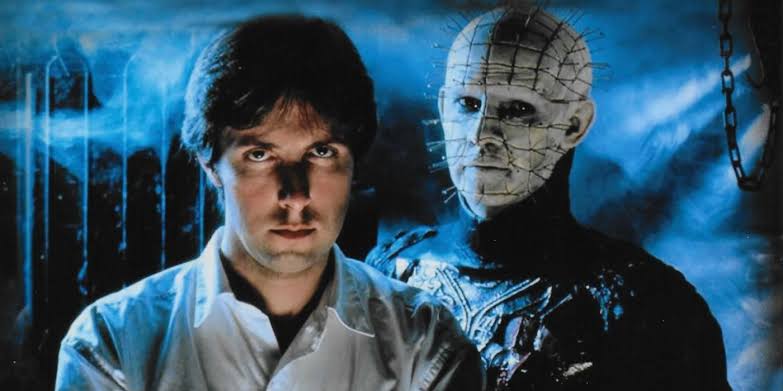
Hellraiser is often reduced to Pinhead. That is understandable. It is also a mistake. Pinhead became one of horror cinema’s most recognisable figures, but he is only the most visible component of Barker’s larger conception. The true protagonist of Hellraiser is desire.
Frank Cotton has exhausted the experiences available to him and believes there must be something beyond them. The Lament Configuration provides the mechanism. He opens it. The Cenobites arrive. And the universe responds.
What makes this so powerful is that Barker doesn’t construct the Cenobites as conventional monsters who simply invade a human world. They are something stranger. They are explorers of sensation. They exist somewhere beyond the conventional distinction between pleasure and pain. Frank doesn’t accidentally stumble into Hell. He goes looking for an experience beyond the limits of ordinary human existence. And he finds it.
PLEASURE AND PAIN
This is where Barker’s treatment of sexuality becomes particularly important. The sexual imagery surrounding Hellraiser is not simply there to shock. It is connected to the film’s entire conception of transcendence. Frank wants more: more sensation, more experience, more intensity. The Cenobites offer more. The problem is that “more” is not necessarily the same thing as “better.”
That distinction is the engine of Barker’s horror. Human beings are extraordinarily good at believing that the next experience will complete them—the next relationship, the next drug, the next sexual encounter, the next acquisition, the next revelation, the next forbidden door. Barker’s horror asks what happens when that appetite becomes metaphysical. What happens when there really is another level? And what happens when we discover that our bodies and minds were never designed to survive it?
THE CENOBITES AND THE BEAUTY OF THE MONSTROUS
The Cenobites also demonstrate Barker’s refusal to make ugliness simple. They are horrifying, but they are designed. Their costumes, wounds, modifications and ritualistic appearance create an aesthetic system. They are grotesque, but they are not random. That distinction matters because Barker is an artist before he is a provocateur.
The image matters. Texture matters. Composition matters. The wound itself becomes an artistic object. The body becomes sculpture. Pain becomes ritual. The monster becomes iconography. This is one reason Hellraiser remains so visually distinctive decades after its release. Barker didn’t merely create monsters. He created images that seemed to belong to a mythology that had existed before the audience arrived.
FROM THE SOUNDS OF HORROR
That visual and sonic dimension is precisely what makes Hellraiser such a natural subject for Sounds of Horror. The forthcoming episode approaches Barker’s cinema through one of its most crucial but sometimes overlooked components: the way Christopher Young’s score transforms Barker’s imagery into atmosphere, ritual and emotional architecture. If The Damnation Game allows us to examine Barker’s literary fascination with forbidden bargains, Hellraiser allows us to hear how those same concerns become cinematic—how desire, dread, sensuality and damnation can be expressed not only through image and performance but through sound itself. The Sounds of Horror episode therefore becomes another facet of the same Barker examination: the novel gives us the imagination, the film gives us the image, and the score gives that image its pulse.
RAWHEAD REX: WHEN THE OLD WORLD COMES BACK
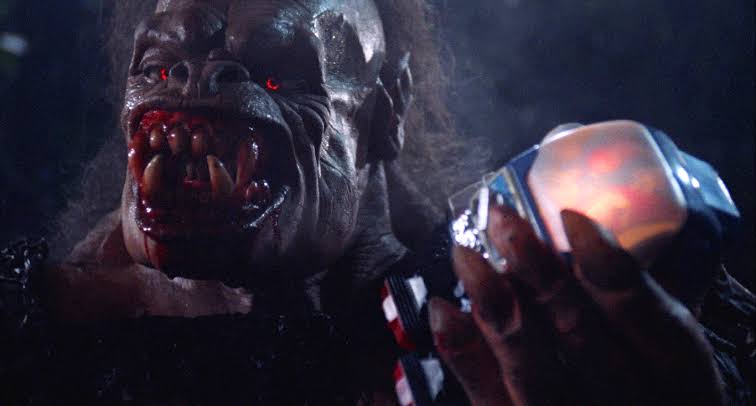
If The Damnation Game represents Barker’s fascination with bargains, and Hellraiser represents his fascination with sensation, Rawhead Rex represents something more primitive. Here the door doesn’t need to be opened. It has already been buried. And somebody has disturbed the earth.
Rawhead is not a sophisticated metaphysical negotiator. He is appetite. He is violence. He is an ancient presence erupting into a modern landscape. That makes Rawhead Rex an important counterpoint to Hellraiser. The Cenobites emerge from a puzzle; Rawhead emerges from the ground. The Cenobites possess a strange ceremonial elegance; Rawhead is a desecration of civilisation. The Cenobites represent what happens when humanity deliberately searches beyond its boundaries; Rawhead represents what happens when we discover that those boundaries were never as secure as we thought.
THE MONSTER BENEATH BRITAIN
There is something particularly potent about Rawhead’s relationship with the landscape. Barker takes the familiar countryside and turns it into a place of latent pagan violence. The modern world has paved over its older gods. It has built roads, houses and churches. It has convinced itself that the old mythology is dead. Then Rawhead gets out.
The effect is almost archaeological. Horror is no longer arriving from another dimension. It is emerging from underneath the one we already occupy. That is one of Barker’s most enduring tricks: making the familiar reveal the existence of an older reality beneath it.
THE SACRED AND THE PROFANE
Barker’s work is saturated with religious imagery, but he is rarely interested in conventional religious horror. He is interested in religion as a language for transformation. Angels, demons, martyrs, resurrections, Hell, Paradise, sacrifice, sin and redemption aren’t simply decorative elements. They provide Barker with a vocabulary for discussing experiences that ordinary language struggles to contain.
But Barker repeatedly corrupts that vocabulary. Angels can be grotesque. Demons can possess codes of their own. Hell can be beautiful. Paradise can conceal monstrosity. The body can become a site of revelation. The profane can become sacred. The sacred can become horrifying. And somewhere in the middle stands the human being, trying desperately to determine which is which.
THE QUEERNESS OF THE MONSTROUS
It is also impossible to discuss Barker without acknowledging the significance of desire that exists outside conventional horror’s heterosexual and moral frameworks. Barker’s work emerged at a time when mainstream horror was often deeply uncomfortable with sexuality unless sexuality could be punished. Barker’s imagination was different.
Desire wasn’t necessarily something to be corrected. It was something to be explored. That doesn’t make his work uncomplicated or automatically progressive in every respect. Barker can be excessive, grotesque, provocative and deliberately uncomfortable. But his monsters frequently exist beyond the categories that conventional horror uses to establish normality. The result is a horror in which transformation can become liberation as well as destruction.
That ambiguity is central to Barker’s imagination. The monster doesn’t always represent the thing we must remain. Sometimes it represents the thing we might become.
BARKER THE ARTIST
This is also why it is important not to treat Barker solely as a writer who happened to make films. He is an artist whose mediums happen to include writing. Painting, photography, theatre, cinema, comics and games all became extensions of the same imaginative territory.
The common denominator isn’t medium. It is imagination. Barker wants to construct worlds. And those worlds tend to have doors. You can open them. You can cross them. You can sometimes return. But you are unlikely to return unchanged.
THE FAILURE OF CONTAINMENT
Perhaps this is Barker’s greatest contribution to modern horror. He doesn’t trust containment.
The haunted house is supposed to contain the ghost. The asylum contains madness. The coffin contains the vampire. The grave contains the dead. The body contains the self. Civilisation contains barbarism. Religion contains the sacred. Reality contains fantasy.
Barker keeps breaking those containers.
His horror emerges precisely at the point where one category leaks into another. That is why his imagery is so often concerned with wounds and openings. The wound is an opening in the body. The box is an opening in reality. The door is an opening between worlds. The bargain is an opening between desire and consequence. The monster is an opening between human and inhuman.
Everything in Barker seems to be capable of becoming a threshold.
FROM HORROR TO DARK FANTASY
One of the most interesting things about Barker’s career is what happened after he became famous as a horror writer. He didn’t simply keep writing Hellraiser variations. He expanded into Weaveworld, The Great and Secret Show, Imajica, Everville, The Thief of Always, Abarat and numerous other projects.
The movement into fantasy shouldn’t be understood as Barker abandoning horror. It is arguably Barker following his imagination to its logical conclusion. Once you believe that the world contains hidden realms, impossible creatures and alternate forms of existence, horror and fantasy become neighbours. The difference is often one of perspective.
A door into another world can be an invitation. It can also be a trap. Barker understands both possibilities.
THE FILMMAKER WHO WANTED CONTROL OF THE IMAGE
Barker’s decision to direct Hellraiser is particularly revealing. Earlier experiences with screenwriting had convinced him that there was a gap between the images he imagined and the images cinema eventually produced. Rawhead Rex is especially important here, because Barker’s dissatisfaction with the film helped motivate his determination to direct his own work.
Hellraiser therefore becomes more than another adaptation. It is an artistic intervention. Barker wasn’t merely adapting his own story. He was attempting to protect the imagination that produced it.
WHAT BARKER ACTUALLY CHANGED
So what did Barker change? Not simply the amount of blood horror could contain. Not simply the amount of sexuality. Not simply the grotesque. Those are the surface effects.
The deeper change was conceptual. Barker made it increasingly difficult to assume that horror had to operate according to a moral binary. The monster didn’t necessarily have to be evil. The victim didn’t necessarily have to be innocent. The forbidden didn’t necessarily have to be wrong. The beautiful didn’t necessarily have to be safe. The grotesque didn’t necessarily have to be repulsive. And desire didn’t necessarily have to be punished.
Sometimes desire was the doorway through which revelation entered. Sometimes it was the doorway through which damnation entered. Often it was both.
THE THREE BARKERS
That brings us back to the three works currently circling the Surgeons of Horror operating theatre.
The Damnation Game gives us Barker the occultist: a man makes a bargain because he wants something beyond the limits of ordinary existence. Hellraiser gives us Barker the metaphysician: a man opens a box because ordinary sensation is no longer enough. Rawhead Rex gives us Barker the folklorist: an ancient force erupts into the modern world and reminds humanity that civilisation is not the same thing as control.
Three stories, three thresholds, three different forms of transgression. And beneath them all is the same question: what are you willing to risk in order to experience something beyond the limits of the life you already have?
THE HORROR OF GETTING WHAT YOU WANT
That may ultimately be Barker’s defining contribution to horror. He understood that the most frightening supernatural stories aren’t necessarily about being denied. They are about being granted.
The Devil keeps his bargain. The box opens. The monster awakens. The dead return. The body transforms. The hidden world reveals itself. The fantasy becomes real.
And suddenly the character discovers that the impossible thing they wanted was attached to consequences they never bothered to imagine.
This is why Barker’s horror remains so potent. It isn’t fundamentally conservative. It doesn’t simply tell us to stay away from the forbidden. It understands why we approach it. And that makes the resulting horror considerably more complicated.
The monster doesn’t always have to chase us.
Sometimes it only has to offer us something.
THE LEGACY OF THE DOOR
Forty years after Rawhead first began tearing his way into popular culture, and decades after the Cenobites became some of horror cinema’s most recognisable figures, it is tempting to reduce Barker to iconography: the pins, the box, the chains, the flesh, the blood, the monsters.
But the imagery survives because there was an idea beneath it.
Barker understood that horror becomes more powerful when it stops being a simple opposition between ourselves and something else. The monster can be inside us. The forbidden can be desirable. The beautiful can be grotesque. The grotesque can be beautiful. The supernatural can fulfil its promises. And the person who crosses the threshold may not necessarily want to come back.
That is Barker’s great gift to horror. He made the door irresistible.
CLIVE BARKER AND THE FUTURE OF HORROR
Perhaps the most revealing thing about Barker’s work is how difficult it is to contain inside the word “horror.” He has written horror, fantasy, dark fantasy and children’s fiction; poetry and screenplays; comics and other forms of visual storytelling. He has painted monsters and angels, landscapes and nightmares. He has created worlds that are frightening precisely because they are larger than the genre that introduced them.
That may be why his most enduring creations still feel strangely alive. Pinhead isn’t simply a horror villain. Rawhead isn’t simply a monster. The worlds of Imajica and Weaveworld aren’t simply fantasy landscapes. They are manifestations of an imagination that refuses to accept the borders placed around it.
And perhaps that is the best way to understand Clive Barker: not as the man who made horror more extreme, not as the man who created Pinhead, and not even simply as one of the most important horror writers of his generation, but as an artist who looked at the boundaries between flesh and spirit, pleasure and pain, beauty and ugliness, fantasy and reality, sacred and profane—and decided that they were far too interesting to leave intact.
THE LAST DOOR
The great horror writers frighten us by showing us the darkness. Barker does something slightly different. He shows us the door into the darkness. Then he gives us a reason to open it.
That is why The Damnation Game, Hellraiser and Rawhead Rex continue to speak to one another across different forms and decades. One offers a bargain. One offers a box. One offers an ancient monster beneath the earth. But each is ultimately asking the same question: how badly do you want to know what is on the other side?
And that may be the most Barkeresque question of all. Because in his universe, the frightening part isn’t necessarily that something terrible is waiting behind the door. It is the possibility that, once you open it, you might discover something you have been searching for your entire life.
And by the time you realise what it costs, the door may already be closing behind you.
The Prognosis:
Clive Barker’s legacy isn’t simply one of gore, monsters or shock. It is a legacy of transformation. He took horror’s traditional boundaries and treated them as invitations rather than rules. He made flesh into landscape, desire into danger, monsters into icons, fantasy into another form of horror and horror into another form of wonder.
The deepest Barker nightmare isn’t that the world is full of monsters. It is that the world may be much stranger, more beautiful and more terrible than we have allowed ourselves to imagine.
And somewhere in the dark there is a door.
You already know what it looks like.
The only question is whether you have the courage—or the stupidity—to open it.
- Saul Muerte