Tags
Twenty years after genetically engineered killer sheep first terrorised audiences, New Zealand filmmaker Jonathan King returns to his blood-spattered paddocks. We talk practical effects, cult cinema, horror-comedy and why sometimes the best way to overcome a limited budget is to embrace an idea that is completely, gloriously unhinged.
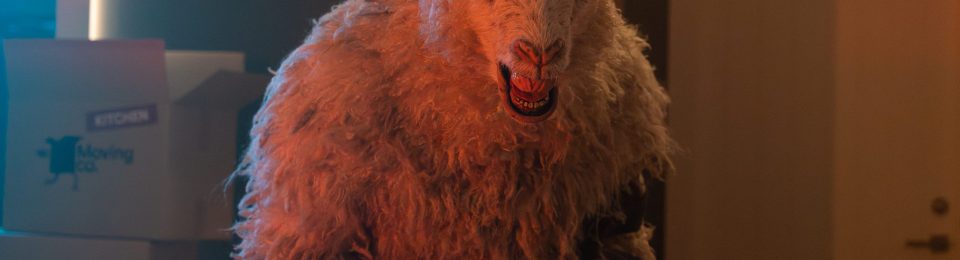
There are few horror premises as beautifully ridiculous as genetically engineered sheep developing a taste for human flesh. Yet when New Zealand filmmaker Jonathan King unleashed Black Sheep upon the world in 2006, the absurdity was precisely the point. Beneath its blood-soaked pastoral nightmare was a film that understood an essential principle of horror-comedy: commit completely to the madness, and the audience will follow.
Two decades later, King is returning to that peculiar corner of New Zealand horror with Black Sheeps, a sequel that revisits the original film’s world while refusing to settle for a simple repeat of its woolly carnage.
“I’d always low-key dreamed of returning to this world,” King tells Surgeons of Horror. The possibility became more tangible when a succession of producers began asking when he would make another film, including Monster Fest’s Grant Hardie. Once the prospect became real, King discovered an unexpected privilege in revisiting a mythology of his own creation.
“The luxury of ‘owning’ a story world and horror mythology of my own felt like an enormous privilege and a thrilling opportunity to play.”
For a filmmaker whose signature creation involves livestock transformed into instruments of slaughter, that opportunity sounds rather more entertaining than pastoral.
A different flock, a different nightmare
The challenge with any sequel to a cult film is negotiating the tension between familiarity and reinvention. Audiences want the pleasures of the original, but repetition risks turning an inspired aberration into a commercial exercise.
King was determined that Black Sheeps would not become a cover version of its predecessor. Time has passed within the story’s world, and the sequel introduces a young female scientist whose investigation into a dangerous pathogen leads her back to her hometown and the quarantined farmland known as the Zone. Meanwhile, Nathan Meister returns as Henry Oldfield, the original film’s sheep-phobic protagonist, now transformed into a more weathered and formidable figure.
King describes his conception of Henry as something approaching a “grizzled, mythic, Road Warrior-type persona”.
The passage of time has given the sequel a different emotional foundation. Henry’s responsibility for the events unfolding on his farm has weighed heavily upon him, driving a single-minded determination to contain the threat. As King sees it, that burden has also damaged his relationships, giving the character an arc that extends beyond the original film’s immediate events.
“I was always going to bring Henry back,” King explains. “He’s certainly the character I’m most closely connected to.”
Meister, he adds, helped fill in the gaps between the two films, giving Henry a renewed emotional dimension and “a lovely arc back to humanity”.
The sequel’s expanded mythology also reflects a world that has changed considerably since 2006. King points to the experience of COVID-19 and the fragmentation of public understanding around information and truth as unexpected gifts for a storyteller. He was not interested in forcing an explicit allegory upon the film, but the notion of a forgotten health crisis returning to threaten a community offered fertile narrative ground.
What happens when a catastrophe supposedly contained becomes dangerous again? What happens when people discover that the past was never quite as safely buried as they believed?
In Black Sheeps, such questions provide a framework for another outbreak of grotesque absurdity.
The comedy of taking monsters seriously
The original Black Sheep succeeded because it treated an outrageous premise with an almost stubborn sincerity. Its humour emerged from the collision between the ridiculousness of its creatures and the seriousness with which its characters confronted them.
For King, that tonal balance remains the guiding principle.
“The tone of the first one was very much our guiding principle for the new one: very silly things played straight.”
Performance, presentation and music work together to establish what King calls a “tonal envelope” in which almost anything becomes possible, provided the filmmakers commit to it completely.
That commitment is essential to the effectiveness of horror-comedy. A filmmaker who constantly signals that the audience should laugh risks undermining the very tension that makes the joke work. Conversely, a film that refuses to recognise its own absurdity can become ponderous. The sweet spot lies somewhere between the two: a world whose inhabitants take their predicament seriously, even when the audience can scarcely believe what it is watching.
Sheep, King admits, proved particularly useful in this regard.
Seen from a distance, they are clumsy, docile balls of fluff. Viewed up close, their physical characteristics can be considerably less comforting.
“Up close, they genuinely are frightening – black, bulbous eyes, sprayed lower teeth, hard bony skulls, bony hooves…”
The contradiction between the sheep’s innocuous public image and their unsettling physical reality became a source of inspiration. King says he did not consciously plan the discovery, but the creature’s potential was there to be exploited.
That tension between the familiar and the monstrous is one of horror’s most enduring tricks. Black Sheeps simply finds an especially mischievous way of applying it.
Practical effects and the pleasure of the impossible
The return of Wētā Workshop to the franchise is particularly significant. The effects house once again helps bring the film’s creatures to life, reconnecting the sequel with one of the original’s defining pleasures: the tangible, physical presence of its monsters.
For King, practical effects offer more than nostalgia for an earlier era of filmmaking. They change the relationship between the creature, the performer, the camera and the audience.
Real objects interact with real light. Shadows fall across physical surfaces. Actors can respond to something occupying the same space rather than imagining a creature that will be added during post-production.
“I think there’s no question that practical effects are hugely useful for all aspects of production,” King says. “We’re looking at light and shadow hitting real, incredibly lifelike, objects, and actors are playing off what they can see.”
There is also value in the imperfections of physical effects. Rather than diminishing the illusion, King believes they invite the audience to participate in it.
“Imperfect physical effects invite collaboration from the audience,” he explains, describing the experience as a shared act of making the moment happen. The viewer is not simply observing an effect but bringing something of their own imagination to its completion.
That philosophy does not mean Black Sheeps rejects digital effects. King reveals that the new film contains more than 400 visual effects, but says they were all based on photographing real objects and creatures in situ.
The guiding principle, established by visual-effects supervisor Charlie Tait, was straightforward: “Shoot it for real first; shoot it on set or on location.”
It is an approach that recognises how practical and digital techniques can complement each other. Technology becomes most effective when it extends the physical world rather than replacing the need to create one.
For creature horror, where the audience must believe in something that should not exist, that distinction matters.
Returning to the landscape
New Zealand’s landscapes have long offered genre filmmakers a striking combination of beauty and menace. Yet King is reluctant to claim a conscious allegiance to the idea of “New Zealand Gothic”, despite the term’s obvious relevance to stories in which familiar rural environments become places of unease.
“There’s definitely a fine line between landscapes that are breathtakingly beautiful… and eerily menacing,” he says, while acknowledging that New Zealand has no monopoly on the effect.
The more significant opportunity with Black Sheeps was the chance to revisit the locations used in the original film. The same hills, roads and corners of the landscape remain recognisable, but time has altered their context.
“There is the same will shared, many of the same hilltops, some of the same corners in the road to the farm as we use in the first film.”
The physical continuity lends the sequel’s world a particular authenticity. These are not merely locations selected to resemble an earlier film; they are places that genuinely persist, weathered by the intervening years.
For a sequel concerned with the return of a threat that was supposedly contained, that continuity becomes more than a production advantage. The landscape itself carries a sense of history.
The past is still there. So, apparently, are the sheep.
The anatomy of a cult film
Could King have predicted that Black Sheep would sustain an audience for twenty years and eventually inspire a sequel?
“ I definitely could not have planned or hoped for the first film to have such a long life,” he admits.
Part of its durability, he suggests, comes from its relative timelessness. Aside from a few incidental details, little about the original firmly anchors it to 2006. Its premise is audacious but simple, and its commitment to the central idea remains undiminished.
“I think we commit so hard to ‘the bit’ that I think it delights audiences whenever they encounter the film.”
There is a lesson here for cult cinema. A film cannot manufacture affection simply by being eccentric, nor can it guarantee longevity by trying to anticipate every future audience. Sometimes a strong concept, executed with conviction, gives a film a life its makers could never have planned.
King’s own confidence has certainly grown. Black Sheeps is his fourth film as a director rather than his first, and he describes having a much greater command of the director’s toolkit. That experience allowed him to worry less about certain practical concerns and create a production environment that was more playful, inventive and responsive.
The result, he suggests, was a film in which the creative possibilities could remain open.
That spirit also connects Black Sheeps to the broader New Zealand tradition of irreverent genre filmmaking. King cites Peter Jackson’s Bad Taste and Braindead as direct influences on the original Black Sheep, and recognises the significance of Wētā Workshop’s origins in Jackson’s filmmaking world.
For smaller national industries, originality can be more than an artistic preference. It can be a means of making an impression internationally.
“If you’re going to notice a film from New Zealand it has to be doing something other than genre staples,” King says. “Budget will always be a limitation and genuinely fresh or freaky ideas our best hope to overcome that.”
It is a succinct argument for the value of distinctive genre cinema: when resources are limited, imagination becomes a form of production capital.
One final incision
For all the grotesque comedy and creature-feature excess, King has a clear idea of what he would remove from horror if given the opportunity.
Asked the signature Under the Scalpel question — what would he cut from the genre forever? — his answer is not a monster, a trope or a particular filmmaking technique.
“I think it would be meanness, torture porn.”
King is not arguing that horror should abandon cruelty, shock or disgust. Rather, he believes those elements should serve something beyond themselves.
“There’s no question there’s a lot of cruelty in the world; horror should be a place we can get scared, shocked, grossed out even, while exploring some kind of moral through line.”
For King, the uncertainty surrounding that moral line can be part of the experience. Horror can unsettle us precisely because we do not always know where our sympathies should lie, or how far a film will push its characters and audience.
But the filmmaker remains responsible for the work he puts into the world.
“Don’t be mean.”
It’s a surprisingly elegant conclusion from the director of a film franchise built around murderous livestock. Beneath the blood, the practical monstrosities and the sheer absurdity of the premise lies a belief that horror can be outrageous without becoming cruel for cruelty’s sake.
Two decades after the original flock first ran amok, Jonathan King is returning to the paddock with a new generation of creatures, a changed world and the confidence to push the premise further. If Black Sheeps proves anything, it is that a truly distinctive horror idea need not become less strange with age.
Sometimes, given enough time, the sheep simply get meaner.
CATCH BLACK SHEEPS AT MONSTER FEST
Jonathan King’s Black Sheeps screens as part of the travelling Monster Fest 2026 program this coming weekend, fresh from its world premiere at Sitges and marking its Australian premiere.
- Perth: Event Cinemas Innaloo — Sunday 1 November, 5:00pm
- Sydney: Event Cinemas Burwood — Sunday 1 November, 7:00pm
- Adelaide: Event Cinemas Marion — Sunday 1 November, 7:00pm
- Brisbane: Event Cinemas Indooroopilly — Sunday 1 November, 7:00pm
The film is rated MA15+ and runs for 103 minutes.
Tickets and full session details: Monster Fest — Black Sheeps
Under the Scalpel is Surgeons of Horror’s ongoing conversation with the filmmakers and creatives operating inside the darker corners of cinema.
- Saul Muerte

