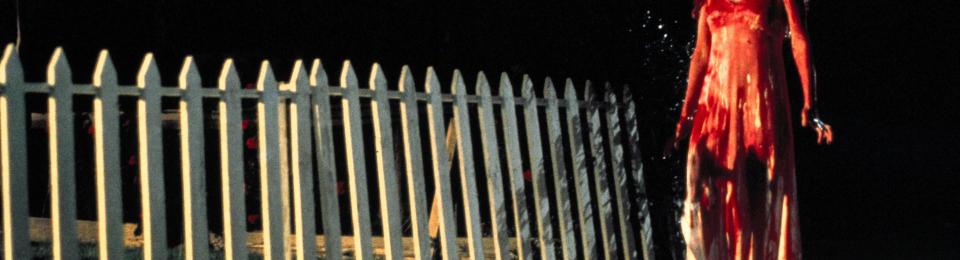
What connects Stephen King’s blood-soaked teenage nightmare with Isaac Bonewits’s attempt to formulate a theory of magic? From the supernatural power of Carrie White to the occult principles explored in Real Magic, we examine the fascination with mind over matter, the boundaries between belief and evidence, and the enduring desire to discover what lies beyond our understanding of reality.
A bucket of pig’s blood. A school gymnasium. A teenage girl standing beneath the wreckage of her dreams.
When Carrie White finally unleashes her telekinetic abilities in Stephen King’s Carrie, the consequences are catastrophic. Objects move without being touched, machinery becomes a weapon, and a community that has spent years humiliating a vulnerable young woman discovers that she possesses a power it cannot control.
For horror audiences, telekinesis is an instantly recognisable supernatural device. It transforms invisible intention into physical consequence, allowing a character’s thoughts to reach beyond the limits of the body. In Carrie’s hands, that power becomes an instrument of terror, but it also raises a more fundamental question: what if the mind could exert a direct influence over the material world?
It is a question that belongs to a much wider history of occult speculation, paranormal investigation and philosophical inquiry. Long before Carrie became one of horror’s most recognisable figures, human beings were searching for explanations for experiences they could not readily understand. From religious ritual and folk magic to the developing field of parapsychology, the possibility that consciousness might influence events beyond ordinary physical interaction has occupied a persistent place in our cultural imagination.
That brings us to Isaac Bonewits’s Real Magic: An Introductory Treatise on the Basic Principles of Yellow Magic, the subject of an earlier episode of Library of the Occult. Published in 1971, the book attempts to establish a theoretical framework for magical phenomena, drawing connections between occult traditions, psychology, religion, anthropology and parapsychology.
Bonewits does not provide a scientific demonstration that Carrie’s extraordinary abilities could exist. Nor does his work establish telekinesis as a verified human capacity. What it offers is a starting point for a different kind of inquiry: how do we define magic, how might claims of paranormal phenomena be investigated, and why do we continue to imagine that human consciousness might possess powers extending beyond the familiar limits of the body?
By placing Carrie alongside Real Magic, we can examine the cultural appeal of telekinesis without confusing supernatural fiction with scientific evidence. More importantly, we can explore why the power to move objects with the mind has become such a potent expression of human frustration, ambition and the desire to exert control over an otherwise indifferent world.
The Impossible Made Tangible
Telekinesis is, at its simplest, the supposed ability to move or manipulate physical objects through mental power alone. The term has become firmly embedded in popular culture, particularly within science fiction, fantasy and horror, where it provides a convenient way to turn thought into action.
Yet its appeal extends beyond spectacle. Telekinesis offers an answer to one of humanity’s oldest frustrations: the gap between what we want to happen and what we can actually make happen.
Our minds are capable of imagining extraordinary transformations, but our bodies remain subject to physical limitations. We cannot move a mountain simply by wishing it elsewhere. We cannot stop a falling object through concentration alone. We may influence the world through speech, physical action, technology and cooperation, but those processes require some form of material interaction.
Telekinesis imagines a way around those restrictions. The mind becomes an instrument capable of reaching directly into the external world, bypassing the usual mechanisms through which intention becomes action.
In fiction, this creates immediate dramatic possibilities. A character can manipulate objects without touching them, defend themselves against an unseen threat or turn an ordinary environment into a weapon. The familiar becomes unstable because the rules governing it have apparently changed.
In Carrie, however, the power has a more intimate function.
Carrie White begins her story as a young woman with very little control over her own existence. Her religiously oppressive mother regulates her behaviour and teaches her to regard her body as a source of shame. At school, her classmates make her an object of ridicule, exploiting her isolation and inexperience for their own amusement. Even the institutions that should protect her fail to provide the support she needs.
Her telekinesis presents a radical reversal of this powerlessness. The girl who cannot prevent others from humiliating her can eventually make the world itself respond to her will.
The transformation is not simply from weakness to strength. It is from a life in which Carrie’s agency is repeatedly denied to one in which her intentions can produce immediate, devastating consequences. The power that once seemed impossible becomes terrifyingly effective.
This is one reason telekinesis works so well in horror. It makes invisible emotions visible. Anger becomes movement; fear becomes destruction; psychological pressure acquires a physical form.
The supernatural ability might be fictional, but the emotional conditions it expresses are recognisable. Carrie’s telekinesis gives extraordinary form to the ordinary human desire to regain control after a lifetime of powerlessness.
Isaac Bonewits and the Question of Real Magic
In the sixteenth episode of Library of the Occult, I explored Isaac Bonewits’s Real Magic, a distinctive volume within Dennis Wheatley’s collection because it moves away from supernatural fiction and towards the theoretical study of magical phenomena.
Bonewits, an influential figure in modern Paganism and Neo-Druidry, was interested in the relationship between magical traditions and the systems through which people interpret experience. Rather than treating magic exclusively as a matter of folklore, religious belief or imaginative storytelling, he attempted to formulate principles that might help explain how magical practices were understood and why they appeared across different cultures.
The book examines a broad range of subjects, including extrasensory perception, ritual, psychic claims and the proposed laws of magic. Its ambition is considerable: to construct a framework through which phenomena traditionally associated with the occult might be classified, examined and discussed.
The important word here is framework.
Bonewits’s approach is not equivalent to a modern scientific consensus that supernatural forces exist. His proposed explanations and interpretations must be assessed on their own merits, and the presence of a theoretical system does not itself establish that the phenomena it describes are real.
Nevertheless, Real Magic is a useful companion to Carrie because it encourages us to look beyond the dramatic image of a supernatural power and consider the assumptions that make such a power meaningful.
What do we mean when we describe something as magic? Are we referring to a religious or ritual practice, a subjective experience, an unexplained event or a claim that a person can influence physical reality through means not currently understood?
These are not interchangeable categories. A ritual may produce a profound psychological experience without demonstrating a supernatural mechanism. A person may sincerely report an unusual event without that report establishing its cause. And a fictional representation of telekinesis can communicate something meaningful about human psychology without offering evidence that telekinesis is possible.
Bonewits’s book invites us to examine the ways these categories have historically overlapped. That makes it a valuable starting point for exploring Carrie’s powers, provided we distinguish the questions the book raises from the conclusions science can support.
Rather than asking whether Bonewits proves Carrie could exist, we can ask what his approach reveals about the desire to understand magical phenomena — and why the possibility of mind over matter remains so compelling.
Telekinesis and Psychokinesis: Mind Over Matter
The terms telekinesis and psychokinesis are frequently used interchangeably, although their emphasis can differ.
Telekinesis is the familiar term in popular fiction for the apparent ability to move objects at a distance through mental power. Psychokinesis, often abbreviated to PK, is commonly used in parapsychology for alleged mental influence on physical systems. Some research in this field has examined whether human intention might correlate with changes in random-number generators, rather than attempting to demonstrate the dramatic movement of large objects seen in films.
The distinction matters because the popular image of telekinesis is considerably more spectacular than the phenomena investigated in most experimental research. Carrie can move objects, manipulate machinery and wreak destruction on a scale that would be impossible to mistake for ordinary physical interaction. Experimental studies of alleged psychokinesis have generally focused on much smaller effects and have produced contested interpretations.
A 2006 meta-analysis examined 380 studies investigating whether human intention correlated with random-number-generator output. The researchers reported a very small overall effect, alongside substantial variation between studies, with the relationship between effect size and sample size raising the possibility that publication bias could explain the results. The findings therefore did not establish a robust, unambiguous demonstration of psychokinesis. https://pubmed.ncbi.nlm.nih.gov/16822162/
Later reviews have continued to discuss experimental claims and unresolved methodological questions. The existence of research into a phenomenon, however, should not be confused with proof that the phenomenon has been established.
At present, there is no robust, reproducible scientific evidence demonstrating that people can move ordinary objects through mental intention alone, as Carrie does.
That qualification need not end the discussion. It simply establishes the boundary between a fascinating claim and a demonstrated ability.
The distinction also helps clarify why telekinesis remains such an effective fictional device. Horror does not need to demonstrate that a supernatural power is scientifically possible. It needs to establish a world in which the power feels emotionally and dramatically convincing.
Carrie’s telekinesis works because the audience understands the consequences of being able to impose her will upon a world that has denied her agency. Its emotional logic is far more important to the story than any hypothetical scientific explanation of how the objects move.
What Does Magic Mean to Us?
One of the most interesting themes in Real Magic is the relationship between belief, experience and interpretation. Human beings have developed countless systems for understanding events that seem unusual, inexplicable or beyond ordinary control. Religious traditions, folklore, ritual practices and paranormal theories all provide different ways of interpreting the world.
Bonewits attempts to identify principles that might help explain magical practices across these different contexts. Whether or not one accepts his proposed framework, the broader question is worth considering: why do people continue to seek hidden connections between intention and events?
Part of the answer lies in our need to make sense of experience. We look for patterns, search for causes and construct explanations for things that surprise us. When an event appears to defy our expectations, we may respond by revising our understanding, questioning the evidence or turning to a framework that offers a different explanation.
This is not unique to the occult. It is part of ordinary human reasoning. The challenge is distinguishing between an explanation that feels meaningful and one that has been adequately supported.
Belief can influence perception, behaviour and emotional experience. Rituals may provide structure, comfort, communal identity or a sense of agency. Expectations can shape how people interpret ambiguous events. These effects are worthy of study in their own right, even when they do not require supernatural explanations.
The difficulty arises when the psychological or cultural significance of an experience is treated as proof of an extraordinary physical mechanism.
A person may experience a ritual as transformative without demonstrating that it has altered external reality through supernatural means. Equally, a fictional story can express a profound truth about human suffering without providing evidence for the literal existence of its supernatural premise.
This is where Real Magic and Carrie intersect most productively. Bonewits’s project asks how magical claims might be understood and organised into a coherent framework. King’s novel asks what happens when a young woman possesses a power that her surrounding community cannot comprehend or control.
The two works approach the unknown from different directions. One attempts to construct a theory; the other imagines the human consequences of an extraordinary ability.
Neither needs to be mistaken for the other.
Carrie White: Power as a Response to Powerlessness
Carrie’s telekinesis has attracted literary and cultural interpretations that go well beyond the mechanics of supernatural horror. One particularly compelling reading treats the ability as a symbolic expression of suppressed agency: the power to manipulate the external world becomes a response to the restrictions imposed upon Carrie’s body, behaviour and social identity.
In an essay published by Ball State University’s Digital Literature Review, Leah Heim examines Carrie’s telekinesis through the concept of the abject, drawing upon feminist theory to explore the relationship between the female body, social repression and supernatural power. Other critical approaches have similarly connected Carrie’s abilities with the institutional and interpersonal forces that deny her a meaningful place within her community. https://blogs.bsu.edu/dlr/2017/04/10/telekinesis-as-the-female-abject-in-stephen-kings-carrie/
These readings help explain why Carrie’s powers are so closely tied to her experiences of adolescence and humiliation.
Her first period is a moment of profound vulnerability. She has not been given the knowledge needed to understand her own body, and her classmates turn that vulnerability into public entertainment. The incident is not simply an example of bullying; it establishes a pattern in which Carrie’s lack of control becomes a source of pleasure for others.
The telekinesis offers the opposite possibility. Through it, Carrie can affect the world without requiring anyone’s permission. Objects respond to her intentions, and the boundaries between her inner life and the external environment begin to dissolve.
Yet power does not automatically bring freedom.
Carrie’s abilities do not provide her with the emotional understanding she has been denied. They do not teach her how to navigate relationships, resolve conflict or distinguish between genuine affection and manipulation. Nor can they repair the damage caused by years of abuse.
Instead, her power develops alongside the pressures bearing down upon her. The more intolerable her circumstances become, the more catastrophic the consequences of its release.
The prom sequence brings this contradiction to its horrifying conclusion. Carrie is briefly allowed to imagine that she might belong. When that hope is destroyed, her telekinesis turns the gymnasium into an extension of her anguish.
The power is real within the fiction, but its deeper significance lies in what it represents. Carrie can control objects, yet she cannot recover the innocence of her childhood or undo the humiliation she has suffered. Her ability to impose her will upon the physical world cannot restore the relationships and security that have been denied to her.
This is what makes the story tragic rather than simply triumphant. The fantasy of absolute control becomes inseparable from the recognition that some forms of suffering cannot be repaired through power alone.
If Telekinesis Were Real, What Would It Mean?
Imagining telekinesis as a genuine human ability immediately raises questions that extend beyond the occult. How would such a capacity be demonstrated? Under what conditions would it operate? Could it be measured, reproduced and distinguished from ordinary physical causes, deception or experimental error?
These are the kinds of questions that any claim of an extraordinary physical ability would need to withstand.
If a person could reliably move objects through mental intention alone under appropriately controlled conditions, the result would warrant serious scientific investigation. Researchers would need to establish the effect, rule out alternative explanations and determine whether independent teams could reproduce the findings.
That is a very different proposition from assuming that an unexplained event must be supernatural simply because its cause is not immediately apparent.
The distinction is central to an intellectually responsible approach to the occult. Curiosity is valuable, but curiosity is not confirmation. An open mind does not require the suspension of critical judgement; indeed, the more extraordinary a claim, the more important it becomes to examine the evidence carefully.
Bonewits’s ambition to formulate a theoretical framework for magic makes Real Magic a useful historical document in this discussion. It reflects an attempt to bring order to a subject often divided between traditional belief, personal testimony and sceptical dismissal. His work can be studied for the questions it raises, the categories it proposes and the way it reflects the occult intellectual climate of its time, without assuming that all of its theories have been validated.
The same distinction applies to Carrie.
We can investigate the cultural history of telekinesis, examine claims of psychokinesis and explore the philosophical questions surrounding consciousness without needing to believe that Carrie White’s abilities could exist in the real world.
Fiction gives us the freedom to imagine the consequences of possibilities that remain unproven. Its value is not diminished by the absence of scientific confirmation. Sometimes, the impossible premise allows a story to illuminate something that is entirely real.
Why Horror Needs the Impossible
Horror frequently gives physical form to experiences that are otherwise difficult to represent. Fear becomes a creature in the darkness. Guilt becomes a haunting. Repression becomes a monstrous transformation. The supernatural allows internal conflicts to escape the mind and enter the shared world of the story.
Telekinesis is particularly suited to this process because it transforms intention into visible action. A character’s emotional state can change the environment without the usual physical mechanisms that separate thought from consequence.
In Carrie’s case, the effect is both empowering and terrifying. The ability that gives her an unprecedented degree of control also becomes the instrument through which her anguish destroys the possibility of a future.
This relationship between power and consequence is what separates Carrie from a straightforward fantasy of supernatural wish fulfilment. Her abilities do not provide a clean escape from vulnerability. Instead, they magnify the conflict between what she wants, what she has suffered and what she ultimately does.
The story asks us to recognise the cruelty inflicted upon Carrie without pretending that her retaliation repairs it. Her suffering deserves empathy, but the destruction that follows remains horrifying. Telekinesis makes that contradiction spectacular, turning a private history of humiliation into a public catastrophe.
Seen through the lens of Real Magic, Carrie also becomes a useful reminder of the different meanings the word magic can carry. In Bonewits’s book, magic is the subject of an attempted theoretical investigation. In King’s novel, it is a supernatural premise through which human conflict is dramatised. In popular culture, it is an image of power that seems to transcend ordinary limitations.
These meanings can illuminate one another, but they should not be collapsed into a single claim.
The fictional power does not prove the occult theory. The occult theory does not establish the scientific reality of telekinesis. Yet the relationship between them opens a worthwhile conversation about belief, agency and the human fascination with the possibility of influencing a world that often seems beyond our control.
The Prognosis: The Power to Move More Than Objects
Telekinesis remains one of horror’s most enduring supernatural concepts because it gives visible form to an invisible force: intention. It allows the mind to reach beyond the body, transforming thought into action and vulnerability into power.
In Carrie, that transformation is inseparable from tragedy. The young woman who has spent her life being controlled by others discovers an ability that makes the external world answer to her. But the power cannot provide the love, knowledge or security she has been denied. It can destroy the structures around her, yet it cannot undo the circumstances that brought her to the brink.
Isaac Bonewits’s Real Magic offers a different route into the question of supernatural power. Rather than telling a story about telekinesis, it attempts to construct a framework for understanding magical phenomena and the beliefs surrounding them. Its theories deserve to be considered in their historical and intellectual context, while extraordinary claims must remain subject to careful examination.
Bringing these works together does not require us to choose between unquestioning belief and dismissive scepticism. It invites us to distinguish between what we can demonstrate, what we can meaningfully interpret and what we continue to imagine.
Perhaps that is the most productive connection between occult inquiry and horror fiction. Both are drawn to the possibility that the familiar world might conceal something we have yet to understand. One asks how such possibilities might be investigated; the other explores what they might mean for us.
Carrie White’s telekinesis may remain firmly within the realm of fiction. Its emotional truth, however, is far more immediate. We understand the desire to exert control when life has made us powerless, the temptation to answer humiliation with retaliation, and the danger of confusing the ability to command the world with the ability to heal ourselves.
The real question is not whether we can move objects with our minds.
It is what we would do if we could.
And whether, like Carrie, we would discover that power alone cannot save us from the damage we carry within.
- Saul Muerte

