Why Horror Fears Its Own Future
A child is both a promise and a prophecy.
Few figures in horror cinema are more unsettling than the child. Not the masked killer. Not the vampire. Not the ghost. The child.
For generations, horror filmmakers have returned again and again to images of corrupted innocence, murderous offspring, prophetic youths, and children who seem somehow disconnected from humanity itself. They stare with knowing eyes. They speak with borrowed wisdom. They smile at moments they should cry. And they often possess a terrifying understanding of the world that adults can neither comprehend nor control.
This recurring archetype has produced some of the genre’s most enduring nightmares. Yet beneath the scares lies something more profound than simple shock value. The evil child is not merely a monster. It is a manifestation of our collective anxieties about the future. Because unlike every other horror icon, children eventually inherit the world.
The Corruption of Innocence
The horror genre has always understood the power of contradiction. A church becomes a site of blasphemy. A home becomes a prison. A parent becomes a threat. Likewise, the child becomes frightening precisely because society instinctively associates childhood with purity. Children represent possibility, hope, continuity, and renewal. They are symbols of what comes next. When horror twists those expectations, the results become uniquely disturbing.
This tension was explored with chilling effectiveness in The Bad Seed, one of the earliest and most influential examples of the evil child narrative. Young Rhoda Penmark appears polite, intelligent, and charming. Beneath that perfect exterior, however, lurks a calculating sociopath capable of manipulation and murder. The film’s horror emerges not from what Rhoda does. It emerges from what she represents. The possibility that evil may be innate. That monstrosity might not be created. It might simply be born.
Children of a New World
By the 1960s, horror’s fascination with corrupted youth began reflecting broader cultural anxieties. The post-war generation was witnessing unprecedented social change. Traditional structures of authority were increasingly challenged. Scientific advancement accelerated at a dizzying pace. The future felt uncertain. Into this atmosphere arrived Village of the Damned.
Its platinum-haired children remain among horror’s most iconic images. Possessing telepathic powers and collective intelligence, these youngsters appear detached from ordinary human emotion. They are calm, rational, and utterly alien. Unlike previous monsters, they cannot be understood through conventional morality. They represent evolution itself. The next generation made flesh. The adults of Midwich are not confronting evil. They are confronting obsolescence. It is a fear that resonates far beyond science fiction. Every generation eventually confronts the unsettling reality that the future belongs to someone else.
Damien Thorn and the Birth of Destiny
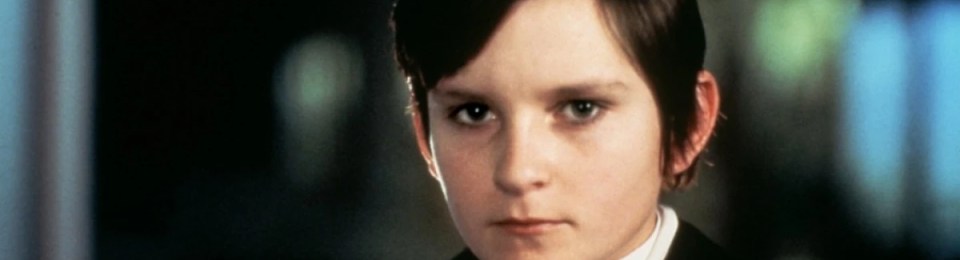
Few characters embody this idea more completely than Damien Thorn. When The Omen arrived during the height of religious horror, it transformed the evil child archetype forever. Damien was not simply dangerous. He was prophetic.
The Antichrist.
A child whose existence carried apocalyptic implications. What distinguished Damien from many of his predecessors was inevitability. Rhoda Penmark might be stopped. The Midwich children might be destroyed. Damien represented something far more terrifying. Destiny.
The adults surrounding him are not merely fighting for survival. They are attempting to prevent history itself. In doing so, The Omen crystallised a recurring theme that would echo throughout countless films that followed:
Children are frightening because they embody the future we cannot control.
Revolution Through Childhood
The 1970s and 1980s saw the archetype expand further. Nowhere is this more evident than in Children of the Corn, adapted from the short story by Stephen King. Unlike Damien, Isaac and his followers are not supernatural aristocrats destined to rule nations. They are religious extremists who have overthrown the adult world entirely. Parents are slaughtered. Authority collapses.
Children establish their own society governed by violent dogma. Viewed through a cultural lens, the film taps into fears surrounding generational rebellion and ideological radicalisation. Adults become powerless spectators while the next generation constructs a future founded upon values they neither recognise nor understand. The cornfields conceal more than monsters. They conceal the possibility of replacement.
The Impossible Moral Question
Perhaps no film interrogates this theme more directly than Who Can Kill a Child?. Released the same year as The Omen, Chicho Ibáñez Serrador‘s masterpiece strips away supernatural explanations and forces audiences into an ethical nightmare. The title itself becomes the challenge.
Who can kill a child?
The film weaponises one of humanity’s most deeply ingrained moral instincts. Children are traditionally viewed as victims. They are protected, nurtured, and shielded from harm. When they become the aggressors, our ethical framework begins to fracture. The horror emerges not from violence itself but from hesitation. The inability to reconcile innocence with threat. Even today, few horror films pose a more uncomfortable question.
The Child as Reflection
As horror evolved into the 1990s and beyond, the evil child continued to adapt. The Good Son presented evil as domestic and intimate. Orphan manipulated assumptions surrounding childhood itself. Japanese horror introduced spectral children whose grief transcended death in films such as Ringu and Dark Water. These works differ dramatically in style and execution, yet they share a common thread. The child becomes a mirror. A reflection of adult fears, failures, and uncertainties. Whether supernatural, psychological, or symbolic, these figures reveal anxieties that society struggles to articulate openly.
Fear of losing influence.
Fear of social change.
Fear of inherited trauma.
Fear of what awaits beyond the horizon.
Why the Archetype Endures
The continued popularity of evil child narratives suggests these fears remain deeply embedded within the human experience. Every generation imagines itself uniquely positioned at the edge of transformation. Political upheaval, technological advancement, environmental uncertainty, and cultural evolution create recurring questions about what kind of world will emerge next. Children naturally become the embodiment of those questions. They are the future made visible. Hope and uncertainty intertwined. The horror genre simply explores what happens when uncertainty wins.
When the future arrives wearing a smile.
When innocence conceals something unknowable.
When tomorrow no longer belongs to us.
The Prognosis:
From The Bad Seed and Village of the Damned to The Omen, Who Can Kill a Child?, and Children of the Corn, horror’s fascination with corrupted youth has never been about children alone.
It is about what children represent. The unknown future. The next generation. The possibility that the world they inherit may no longer resemble the one we understand. The monster under the bed eventually disappears. The child standing beside it grows up. And one day, inherits everything.
Further Exploration: Children of the Apocalypse
The evil child remains one of horror’s most enduring figures because it attacks one of humanity’s most fundamental beliefs: that children represent hope for the future. Whether they arrive as prophetic harbingers, supernatural vessels, cult leaders, or simply reflections of our deepest societal anxieties, these young monsters force us to confront uncomfortable questions about innocence, inheritance, faith and destiny.
From Village of the Damned and The Omen to Children of the Corn, The Good Son, and modern successors such as Hereditary, horror has repeatedly returned to the unsettling notion that the next generation may not save us—they may be our undoing.
For a deeper dive into the history, symbolism and evolution of evil children in horror cinema, be sure to check out Resurrected Horrors Episode 5: Children of the Apocalypse on the Surgeons of Horror YouTube channel. The episode explores how filmmakers across decades have transformed childhood innocence into one of the genre’s most potent nightmares and examines why these stories continue to resonate with audiences today.
👉 Watch: Resurrected Horrors Ep 5 – Children of the Apocalypse
Because in horror, the most frightening monsters are often the ones we are supposed to protect.
- Saul Muerte

