Why Harry Bromley Davenport’s Experimental Score Deserves a Place Among Horror’s Most Unsettling Soundtracks
Horror fans often remember films through images. The shark emerging from the depths. The masked killer standing silently in a doorway. The child staring blankly into the distance. Yet cinema is not merely a visual medium. Some of the most effective horror films linger in our memories not because of what we saw, but because of what we heard.
The shrieking strings of Psycho. The infernal chanting of The Omen. The electronic dread of Halloween. Music has always been one of horror’s most potent weapons. It invades the audience in ways images cannot. It bypasses logic and heads directly for the subconscious, creating unease long before the monster appears. It is this relationship between sound and fear that forms the basis of Sounds of Horror, a new Surgeons of Horror web series exploring the music that has shaped some of the genre’s most unforgettable nightmares. And for our inaugural episode, there could be no better subject than one of horror’s strangest cult classics.
XTRO.
The Film That Arrived from Another World
Released in 1983, XTRO remains one of the most peculiar science-fiction horror films of its era.
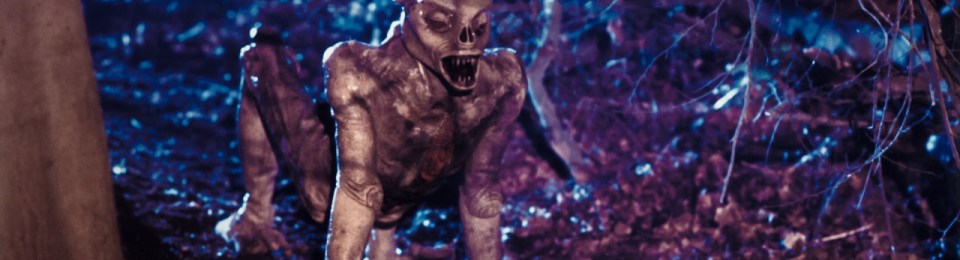
Written and directed by Harry Bromley Davenport, the film tells the story of a father abducted by extraterrestrials who returns years later transformed into something profoundly alien. What follows is a surreal blend of body horror, psychological nightmare and cosmic absurdity that feels entirely disconnected from the mainstream science-fiction cinema of the early 1980s.
Where many alien invasion films sought wonder or adventure, XTRO embraced discomfort. The film’s notorious practical effects, grotesque transformations and dreamlike imagery have earned it a devoted cult following over the decades. Yet discussions of the film often overlook one of its most important components.
Its soundtrack.
Music as Contamination
What makes Davenport’s score so unusual is its refusal to behave like a traditional horror soundtrack. There are no grand orchestral swells announcing danger. No comforting musical motifs guiding the audience through the narrative. Instead, the score functions like an intrusion. An infection. A signal from somewhere beyond human comprehension.
The synthesizers drift between melody and noise. Familiar structures emerge only to collapse moments later into strange electronic textures and unsettling tonal shifts. Rather than supporting the film’s images, the music often appears to challenge them. The result is deeply disorienting.
Listeners are denied the emotional reassurance that conventional film scores typically provide. The soundtrack creates the sensation that something is fundamentally wrong, even during moments when the screen appears relatively calm. It mirrors the central premise of the film itself. An alien presence infiltrating everyday life.
The Sound of Body Horror
One of the most fascinating aspects of XTRO is the way its music complements the film’s body horror themes. Body horror is often discussed in visual terms. Mutations. Transformations. Flesh reshaped into something unfamiliar. Yet these physical changes become significantly more disturbing when paired with sound. Davenport understands this instinctively.
His score frequently feels organic and mechanical at the same time. Electronic pulses mimic biological rhythms. Strange textures evoke the sensation of flesh becoming unstable. Sounds appear to mutate alongside the characters themselves. The audience is not simply watching transformation. They are hearing it.
This creates a uniquely immersive experience in which music becomes an extension of the horror rather than merely an accompaniment to it.
An Alien Transmission from the 1980s
Viewed through a contemporary lens, XTRO’s soundtrack feels remarkably ahead of its time. Many modern horror scores favour atmospheric sound design over traditional melody. Films increasingly blur the line between music and environmental noise, creating immersive sonic landscapes designed to provoke unease. In many respects, Davenport was already experimenting with these ideas decades earlier.
The soundtrack often resembles an alien broadcast breaking through a radio signal. It is fragmented, unstable and frequently difficult to categorise. This refusal to conform may explain why the score remains so effective more than forty years after its release. It never sounds comfortable. It never sounds familiar. It never sounds entirely human.
Why XTRO Still Matters
Part of XTRO’s enduring appeal lies in its willingness to embrace the bizarre. The film refuses easy categorisation. It is science fiction. It is horror. It is surrealist fantasy. It is body horror. It is all of these things simultaneously. The soundtrack reflects that same creative fearlessness.
Rather than imitate the popular horror scores of its era, Davenport crafted something deeply personal and utterly strange. It may not possess the immediate recognisability of a John Carpenter theme or the orchestral grandeur of Jerry Goldsmith, but it achieves something equally valuable. It creates its own language. A language of discomfort. A language of intrusion. A language of alienation.
Listen Carefully…
As Sounds of Horror begins its journey through horror cinema’s rich musical history, XTRO serves as a fitting first destination. It reminds us that fear is not always visual. Sometimes it arrives as a whisper beneath the soundtrack. A distorted synthesizer pulse. A melody that never quite resolves. A sound that feels as though it originated somewhere far beyond our understanding.
More than four decades after its release, Harry Bromley Davenport’s score remains one of horror’s most fascinating overlooked achievements. Perhaps it is finally time we listened.
🎵 Watch Sounds of Horror Episode 1: XTRO (1983) now on the Surgeons of Horror YouTube channel.
In this inaugural episode, Saul Muerte explores the film’s experimental soundtrack, analyses key musical cues and examines how sound helped transform XTRO into one of the most unsettling cult horror films of the 1980s.
- Saul Muerte

