Tags
For decades, horror discourse has treated the 1990s as a wasteland.
A strange cultural dead zone wedged awkwardly between the blood-soaked excess of the 1980s and the postmodern self-awareness ignited by Scream. Conventional wisdom has long suggested the genre lost itself during the early half of the decade — caught between fading slasher formulas, shifting audience tastes, and an industry uncertain how to evolve.
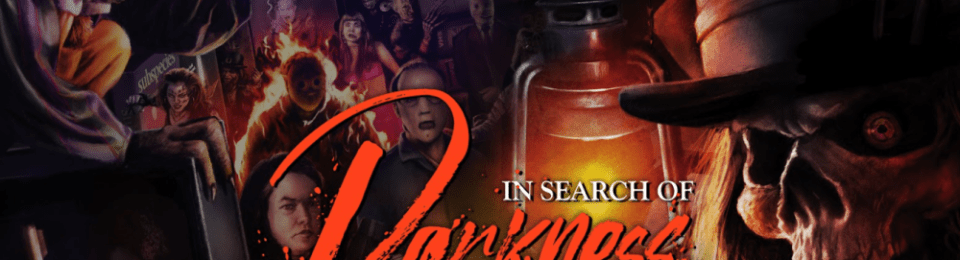
But In Search of Darkness: 1990-1994 arrives not simply to celebrate the era, but to challenge that narrative entirely.
Over the course of its sprawling six-hour runtime, the documentary reframes the early ‘90s not as horror’s creative collapse, but as one of its most fascinating transitional periods — a fragmented, experimental stretch where filmmakers pushed the genre inward, toward psychology, existentialism, body horror, and metafiction.
This was not horror dying.
It was horror mutating.
Horror Between Two Worlds
The early ‘90s existed in the shadow of exhaustion. The slasher boom had burnt itself out, practical effects-driven creature features were becoming financially risky, and mainstream studios increasingly struggled to market horror outside familiar formulas.
What emerged instead was something stranger and more intimate.
The films explored throughout In Search of Darkness: 1990-1994 reveal a genre wrestling with identity itself. Many of these works are steeped in paranoia, decay, and fractured realities — reflecting both the cultural anxieties of the era and horror cinema’s own uncertainty about its future.
And that uncertainty became fertile ground for experimentation.
The Hidden Gems of the Forgotten Era
One of the documentary’s greatest strengths is its excavation of films too often overshadowed by louder genre landmarks.
The Exorcist III emerges as a perfect example — a film long buried beneath the legacy of its predecessor, yet now increasingly recognised as one of the most unnerving studio horrors of its decade. Its procedural structure and existential despair transformed demonic horror into something mournful and deeply human.
Likewise, Nightbreed stands as a fascinating reclamation project. Once misunderstood and butchered by studio interference, Clive Barker’s monster epic now feels radically ahead of its time — a queer-coded dark fantasy about outsiders, persecution, and identity.
The Rise of Psychological and Meta Horror
Perhaps the most fascinating thread running through the documentary is how many early ‘90s horror films became deeply self-reflective.
Wes Craven’s New Nightmare effectively dismantled and reconstructed slasher mythology years before Scream would popularise meta-horror. Meanwhile In the Mouth of Madness saw John Carpenter crafting an apocalyptic vision of fiction infecting reality itself — a cosmic nightmare about media consumption, authorship, and madness.
These were films no longer content with merely scaring audiences.
They wanted to interrogate horror itself.
Even The Dark Half and Body Snatchers channel anxieties surrounding fractured identity, distrust, and societal collapse. Horror had become increasingly psychological, reflecting a world entering the uncertainties of a new decade.
Body Horror, Flesh, and Mutation
Return of the Living Dead 3 transformed zombie horror into tragic body mutilation romance. Body Melt — an especially welcome inclusion given its Australian cult status — weaponised suburban satire through spectacular biological collapse, feeling like a sunburnt cousin to the work of David Cronenberg.
Then there is Cronos, where Guillermo del Toro quietly announced himself as a visionary auteur by transforming vampirism into a meditation on mortality, obsession, and innocence corrupted.
These films understood that horror’s true battleground is often the body itself — unstable, vulnerable, constantly changing.
Anthologies, Gothicism, and Lovecraftian Shadows
Two Evil Eyes united George A. Romero and Dario Argento under the banner of Edgar Allan Poe, while Necronomicon embraced anthology horror through a distinctly Lovecraftian lens.
Meanwhile, films like Dark Waters and Nadja leaned heavily into dreamlike gothic atmosphere, rejecting mainstream accessibility in favour of hypnotic art-horror abstraction.
This willingness to experiment visually and tonally is precisely what makes the period so fascinating in retrospect.
Horror Searching for Its Future
What In Search of Darkness: 1990-1994 ultimately captures so effectively is a genre caught in transition.
The documentary is less about nostalgia than reevaluation. Through interviews with genre icons including Heather Langenkamp, John Carpenter, Frank Henenlotter, Tim Balme, and Michael Gross, the film paints a portrait of horror cinema evolving in real time.
These weren’t safe studio products.
They were risks.
Mutations.
Experiments searching for new language.
And while not every film succeeded commercially, many of them now feel startlingly prophetic.
The Prognosis
In Search of Darkness: 1990-1994 is an absorbing, deeply affectionate reappraisal of one of horror cinema’s most misunderstood eras — a six-hour excavation of forgotten masterpieces, ambitious failures, and genre experimentation hiding in plain sight.
An essential viewing experience for horror devotees, and a powerful reminder that the early ‘90s were never horror’s lost years.
They were simply waiting to be rediscovered.
- Saul Muerte
 Surgeons of Horror
I was excited to see this one drop on Shudder. I’m only about 2/3rds of the way through 1995-1999, though, so this’ll have to wait a little longer!
LikeLike