Sasha Rainbow’s Grafted is an unsettling body horror film that blends themes of identity, beauty standards, and cultural pressure with grotesque yet effective visuals. The film explores the psychological and physical toll of striving for perfection, offering an eerie commentary on how far one might go to fit in.
The story unfolds at a deliberate pace, which can feel sluggish at times, making it difficult to fully connect with the protagonist’s journey. However, the film’s strong pulse comes from its commitment to disturbing imagery and practical effects, which elevate the horror elements. The lead performance is commendable, portraying both vulnerability and a creeping sense of detachment as the character undergoes a grotesque transformation.
Visually, Grafted is striking, utilising cold, sterile environments that contrast with the organic and unsettling nature of the body horror sequences. The cinematography and lighting work to create an almost dreamlike quality, amplifying the protagonist’s descent into obsession. However, the screenplay struggles to maintain a gripping narrative, often losing momentum in its quieter moments.
Despite its flaws, Grafted offers enough unsettling moments to leave an impression. Fans of slow-burning horror with a focus on psychological and body horror will find much to appreciate, even if the film doesn’t fully capitalise on its intriguing premise.
The Prognosis:
A visually striking yet sluggish horror film that explores beauty and obsession through an unsettling lens. While Grafted may not resonate with all audiences, its strong effects and eerie atmosphere make it worth a watch for genre enthusiasts.
Johannes Grenzfurthner’s Solvent is a visceral dive into both the found footage and body horror sub-genres, subverting expectations at every turn. The film introduces us to a team of experts searching for Nazi documents in an isolated Austrian farmhouse, only to uncover a far more sinister secret hidden in the shadows of history. As the team leader becomes obsessed with revealing the truth, his sanity slips away, revealing the true horror that lies beneath—the corrosive force of obsession itself.
What sets Solvent apart from typical found footage films is its refusal to adhere to the genre’s usual tropes. While many found footage films struggle to balance realism with narrative tension, Solvent blends body horror and the obsessive drive for truth, immersing the audience in a descent into madness that feels both surreal and grotesque. Grenzfurthner’s approach to this format is deliberate, calculated, and refreshingly inventive. The faux-documentary style doesn’t just feel like a device to capture jump scares but becomes an integral part of the narrative’s tension, one that slowly unravels with each disturbing discovery.
The film’s brilliance lies in how it explores the toll that the pursuit of truth can take on the human spirit. As the leader of the investigation digs deeper into the farmhouse’s disturbing past, the very act of seeking knowledge becomes a self-destructive obsession. The further he delves, the more he sacrifices his humanity, willingly eroding his moral compass in exchange for answers. This theme is amplified by the body horror elements, where the human form begins to mirror the mental and emotional decay taking place within. It’s a journey through fluid debauchery—one that seeps into every pore of the film, leaving the viewer unsettled and questioning how much one should risk in pursuit of the unknown.
Admittedly, found footage has never been my favorite genre. However, Solvent shifts the direction enough to make it a harrowing and engaging experience. The film hooks you from the very beginning, pulling you deep into its underworld of depravity and insanity. Each moment feels like a gamble with pure evil, and the tension builds to an unbearable crescendo, leaving you wondering whether anyone can truly negotiate with forces so dark and extreme.
Solvent isn’t just a film about unearthing historical horrors; it’s a philosophical exploration of the lengths people will go to when consumed by obsession. Grenzfurthner takes the familiar tropes of body horror and found footage, blends them with a slow-burning narrative, and crafts something perversely unique. It’s a dizzying descent into madness, but for those willing to follow it down the rabbit hole, it’s a ride that will infect you long after the credits roll.
Since Julia Ducournau’s debut feature Raw was released back in 2016 and marked my favourite movie of the year, I’ve been keen to see what she would produce next. Titane has been critically lauded and Ducournau has picked up the Palme d’Or for her thought provoking and confrontational body horror film.
So while this has resonated with a certain audience tailored to a more highbrow concept, how does this relate to the general public?
It’s a film that buries itself deeply into the trauma of its narrative. From this the true horror of human conditioning is on screen and Ducournau never shies away from the impact that this has on not just the central character but also for those that associate with her.
Our lead protagonist Alexia, (played by Agathe Rousselle) has survived a horrific car accident as a child and was fitted with a titanium plate as part of her recovery. The physical surgery scar is often on display as a constant reminder of the burden that this episode has had on Alexia. The result of which leads her on an internal struggle that leads her towards a level of hypersexuality that often eventuate in violent ends. Agatha’s sexual awakening is one born out of depression, anxiety, and oppression that is heavily drawn through a feeling of shame about her own identity and the feelings that she is experiencing that cannot be contained. Instead these emotions spill outward and are often enacted on those she is having a sexual experience with.
After essentially going on a killing spree to mask this oversensualised feelings, she finds salvage in her own automobile, to come full circle with the instrument of her torment and is encapsulated through gratification. This however has its own ramifications as Alexia fall pregnant and appears to be secrete motor oil from her vagina and her bodily transformations suggests that she has fallen pregnant as a result of her automobile encounter. This forces Alexia to go into hiding by masking her own feminity.
The masculisation of her character is an act out of desperation. With no connection to society, Alexia becomes a lonely island who seeks refuge in the only place that will accept her new form, as Adrien, a boy who disappeared 10 years ago. Adrien’s father Vincent (Vincent Lindon) a man healing from his own trauma from losing his son, is only too willing to accept the mirage that has entered back into his fold, and a male dominated world of firefighting. As is often the way it is the broken who can heal one another. Trauma, however can never be masked and no matter how hard you try to mask it, if left untreated the effects will find a way of coming to the surface.
The prognosis:
Director Julia Ducournau has gone on record stating that this film is not a horror movie. And while this may be true in terms of what we consider the horror genre to contain, Titane carries some horrific elements of brandishing the scars that trauma can have.
The journey that Alexia takes is a brutal one that not only sheds light on what trauma can do to a person, but more importantly the extremes that a woman must endure in order to be accepted, in this case to the detriment of her own femininity. A theme that Julia Ducournau explores well and places Titane as one of my contenders for film of the year.
Possession marks one of those unsung movies from the early 80s that oozed its way along the grapevine, causing the occasional ripple among viewers and critics alike across the years. Recently the film celebrated 40 years since its release and is now considered a cult classic among some. Ashamedly, it is a movie that passed me by and I only recently caught the film in time for its anniversary. In a way, it’s not too surprising that I missed out on its initial release as it was criminally shafted into the video nasties group that so many were subject to at the time and perhaps the reason why it has become something of a forgotten gem.
Recently to commemorate this feature, Umbrella Entertainment released a Blu-ray/Dvd edition as part of their Beyond Genres collection and it’s jam-packed with over 4 hours of extra footage which I’ll list at the foot of this article.
So, why does it deserve such recognition?
Possession is a visionary film, where every scene is a spectacle and eviscerates the human soul and exposes every ounce of humanity at its most controlling. All the characters strive for power and control and with every movement, vibrating, convulsing, and straining to reach resolution but bound to repeat the cycle of events all over again. This raw energy stems from Director Andrzej Zulawski who would draw from personal experience to write the screenplay, and the anger and vitriol is part of what we see evicted onto the screen.
Fueling these emotions is an incredible leading cast in Isabelle Adjani in her dual role of Anna, a domestiecised and sexuallay repressed wife, and Helen, a teacher and picture of innocence and virtuosity. Sam Neill also stars as Mark, a spy with a mysterious connection with the political underbelly of Eastern Europe, and a man who is set in his time, expecting that his home life should remain in a certain state and not alter. Threatened by change and a loss of identity, Mark constantly is fighting to remain at the heart of all that surrounds him, tightening his grip, only to watch it slip further from his grasp.
There are many levels that are at play here, which elevates the movie into highbrow territory, none more so than the depiction of a city under political unrest with the physical divide between Berlin’s East and West. The constant threat of destruction in a world hinged on uncertainty. There are a series of doppelgangers at play too with Adjani’s Anna/Helen characters and Neill’s two versions of Mark, where one version symbolises all that is wrong with humanity, and the other, all that seems right, a yin and yang of balance and imbalance. The viewer is placed at the epicentre of the carnage. As the characters fight for their ideological past, they rip apart their very surroundings destroying all that once was. The infamous scene in the underground passage where we bear witness to Adjani’s electrifying performance as Anna experiences a violent miscarriage, is one of the most brutal scenes that I’ve seen on screen. This scene alone is a dark and disturbing depiction of the core being ripped out due to the trauma and conflict that humanity subjects itself to. Infused with cutting edge creature effects that would fit perfectly in any Cronenberg feature, spearheaded by Italian special effects maestro Carlo Rambaldi (Alien, Deep Red).
By the films conclusion as the world seems to be setting itself right again, we’re left with a dubious outcome with Mark and Anna’s son Bob in the wake of turmoil, afraid of both his ‘parents’ and the sounds of war and destruction in the background, a sign that we are all doomed to repeat the same mistakes over and over if we insist on our ridiculous pursuits of perfection; possessed by this ideal and obsessed with fulfilling our desires, unwilling to relinquish control.
For more thoughts and discussions on Possession check out the Surgeons of Horror podcast here:
The first lines spoken in The Soska Sisters latest feature is something of an odd choice seeing that the film itself is a remake of David Cronenberg’s science fiction body horror feature that was released back in 1977, but then the ‘Twisted Twins’ have built a reputation on face-lifts and transformations within their features that it should come as no surprise that should revamp a cult classic. Cronenberg is clearly an inspiration in the Soska Sisters previous features where body horror, mutilation, and the butchering of the beautiful is constantly a running theme through their narrative. From their low-budget debut feature, Dead Hooker In A Truck, they have been willing to their bodies on the line for the sake of their vision and in doing so, continuously look to raise the stakes, but arguably haven’t attained this since their brilliant sophomore outing behind the director’s chair with American Mary.
So, how does this modern transformation of Rabid fair and does it amount to the twin directors’ previous outings?
I have enjoyed watching the Soska Sisters’ journey, even their paint by numbers WWE venture, See No Evil 2, and I found that Rabid had the right pulse to entertain and satiate the gruesome, and bloody fascination with the human aesthetic and its ultimate destruction. We cast ourselves deep in the fashion world, where there is an expected elegance and if you don’t measure up, then you’re cast aside and considered insignificant.
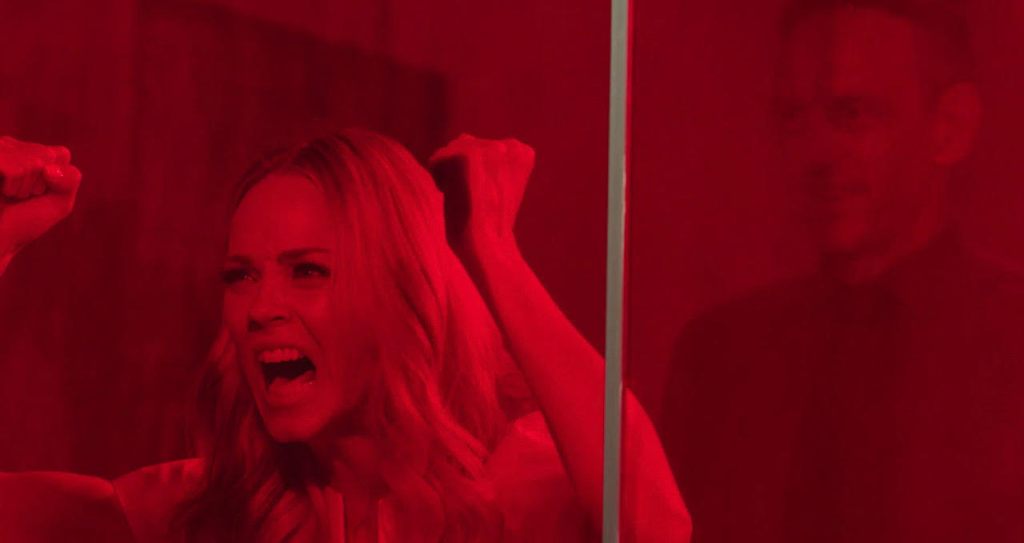
This is where we meet our lead protagonist, Rose (Laura Vandervoot) who works for a fashion designer, Gunther (Mackenzie Gray), but struggles to meet her mark. One night she is invited out by photographer Brad (Ben Hollingsworth) and believes that her luck could potentially be turning, but soon discovers that it’s a pity date, set up by her best friend, Chelsea (Hanneke Talbot). Humiliated, Rose attempts to flee on her bike but is plowed down by an unseen vehicle and rushed to hospital leaving her disfigured and more depressed. It is only when she learns of a scientific breakthrough that could potentially restore her figure that Rose seizes the opportunity to be considered normal. Once again though, trust comes into question as we are only willing to expose the mask we choose to wear with people and only every so often do we allow our true selves be seen. This is a common theme throughout the movie where we should question everyone’s motives and always be suspicious of the characters we encounter, even within the medical profession as hinted by Stephen McHattie’s doctor when he asks his assistant to lend a deformed Rose a mirror, only to contradict himself by saying that Rose should never look at a mirror.
So, Rose undergoes a significant and delicate operation that not only restores her looks but metamorphosed her whole demeanour with mesmerising effect on her persona. Whilst her life suddenly flips for the better, Rose is consumed with lust for blood and meat that sends her into a frenzy and unleashing a creature within that leaves her victims with something that closely resembles rabies, but spreads as quickly as the black plague.
From here on in the action becomes frenetic and just as uncontrollable as the disease, which is obviously a directorial choice, but I can understand some viewers who might find this approach grating.
Stuck between pursuing her dreams of having her own design on the catwalk and recognition of her style, and seeking medical aid, Rose steers closer to self-destruction and chaos.
Prognosis:
The Soska Sisters are back in their domain of stripping the human facade and revealing the tortured soul lurking within in their latest turn in the directors’ chair. Yes, it’s a remake, but there is enough spin on the original and more of the visual style and substance that makes Jen and Sylvia a force to be reckoned with when they are at their best. As always their films are beautifully shot, and manage to infuse some raw energy within the beats, and Rabid continues to project the Soskas into a twisted limelight that feels gnarly and fresh.
Taking out the A Night of Horror’s “Best Film” award from this years festival, Replace doesn’t match this accolade at face value, at least for the first few minutes, but as the layers are slowly pulled back, an intelligent and beautiful movie emerges within.
The reason for this initial reaction, is through the level of confusion that the viewer is faced with and the style that director Norbert Keil has chosen seems off kilter. The acting seems to be similarly stifled too, but all this is a deliberate device to echo the feeling of despair that our lead character, Kira is confronted with.
As she unravels her situation, Kira has to face up to her situation, revealing some unwelcome truths along the way.
The topic of the movie, deals with an age-old dilemma, that seems to be more concentrated over the recent years with women in particular. Especially with the developments in social media and this continuous fascination with beauty and youth that faces our society.
Imagine then the gravity of the situation when you discover that your skin ages rapidly and begins to wither away. The impact that this has is immense and one that Kira lands head on, but when she further discovers that she can replace her skin with another’s with immediate effect, her journey then transcends into a murderous rampage, fuelled by the need to stay youthful.
If this isn’t a measure of our times, I’m not sure what is.
The cinematography on display is both stylised and stunning and Tim Kuhn deserves some of the accolades thrown his way for luring the viewer in through a hypnotic gaze in places.
The score is equally as mesmerising with its rhythmic pulse driving through the films narration.
Further praise should also be bestowed upon Rebecca Forsythe who manages to display Kira’s vulnerability, innocence, rage, and desperation, with delicate transition and believability that belies her age.
The Diagnosis:
This latest entry into the body horror genre is filled with intelligence and beauty. A lethal combination that hits the mark through Norbert Keil’s stunning vision.
The beating heart of writer, director Le Binh Giang’s debut feature, Kfc is laid bare with no holds barred and all guts, no glory.
At least not for the characters portrayed in this gritty, violent, and sadistic world, we find ourselves in.
With a short running time of 69 minutes is certainly not to be scoffed at as Le manages to cram enough twisted, blood-fuckery to warp the mind and melt the soul.
Straight from the off-set, we’re provided with the confronting images of violence and mayhem that will flow through the narrative like a gushing artery, with a guys casually talking with a motionless figure before ripping up a coke can and stabbing them in the neck with it.
Said character is mowed down outside of his abode by a passing vehicle and from here-on-in, we’re sentenced down into a whirlpool of loathing and disgust that leaves the head reeling in response to the grotesque that is on display.
That’s not to mention the necrophilia doctor and his accomplice that deliberately hunt for their victims in their ambulance by smashing into them and dragging their bodies away to be defiled and cut to pieces.
In some ways this film reminds me of Fernando Meirelles’ City of God, minus the beauty of Rio.
There’s no shying away from the brutality of Kfc, but does paint a similar picture of the rough terrain and gang mentality, where only the most deranged will survive.
The films focus is on a trio of sadists, who inflict their cruelty on the world around them without any inflection of emotion, which only adds to the haunting carnage that they leave in their wake.
And it’s only when emotions play a part and brim to the surface with themes of love/lust, anger, and revenge that these three accomplices fall apart.
The energy of the piece propels you forward and there’s enough material to keep you engaged without feeling too violated.
Le Binh Giang manages to craft a cyclical tale with some key observations on how parentage and society can have a serious negative impact on the way we carry out our lives.
Anarchy and chaos will reign but only for a period of time before something or someone else comes along to wipe you off the streets and a new world of pain will begin.
The director apparently wasn’t able to graduate from the University of Ho Chi Minh, due to the extreme violence in Kfc, and although it may not be suited for the faint-hearted, it certainly offers up a fresh take on the body horror genre and could very well propel Le Binh Giang onto greater things as a result.

 Surgeons of Horror