• About
  • podcasts
  • Shop

Surgeons of Horror

~ Dissecting horror films

Surgeons of Horror

Category Archives: Movie review

No Finish Line: The Long Walk Turns Minimalism into Masterpiece

22 Monday Sep 2025

Posted by surgeons of horror in Movie review

≈ 2 Comments

Tags

film, francis lawrence, horror, Horror movies, movies, reviews, Stephen King, the long walk

Sometimes when we get caught up reviewing all these films, it’s easy – all too easy – to forget that
as with a painter staring at a blank canvas; a director, when given their brief, is staring at a multitude
of choices in which to tell the story they have written (or in the case of The Long Walk; been given) .
And this particular story is the brainchild of writing grand master Stephen King. So, no presh.
Also throw in the fact that it involves walking, a ton of it, and you might think this is a film for a
novice (too inexperienced to know that this is an extremely tough assignment) or a black belt
filmmaker. Someone who knows enough to know that a movie that’s about walking in the open air
gives you nowhere to go. No immediate cutaways, no car chases, no love scenes to dictate changes
in pace etc.
Heck even your coverage choices are limited by how stylised (or not) you want to go about filming
men walking. And walking. And walking.
So what do you do? Well, there are a few things this pic leans on, and we’ll talk about those in a bit.
But first – some much-needed context for the 0.08% of you who have clicked on this article not
knowing what this movie is about.
Set in a dystopian alternative reality (around 1970’s ish – although the exact time period is never
stated, so I’m going off the novel, which was written in 1979) you soon realise that The Hunger
Games (and King’s own The Running Man) owe a lot to this idea.
Which is, you get people to WILLINGLY go through a trial of fire to get some nebulous sense of
financial freedom, and freedom from bondage.
In this particular case, you walk. As in you collate at a starting line, get assigned a number and you
walk. There is no finish line. Last man standing (and it is all men in this story. Young men, one from
each State of the U.S. – so 50 in total) wins. And wins big. Both in terms of $ and a wish…
The rule is you DO NOT stop. Evah. If you do for more than a few seconds you are given a warning.
If you fall below 3 miles an hour you are given a warning. More than 3 warnings in an hour and you
are executed there and then by one of the volley of military personnel keeping pace with you.
Water and rudimentary rations are given to the walkers, which prolongs their agony if anything.
Because stopping to relieve yourself or sleeping is counted as a warning/shootable offence. Taking a
pebble out of your shoe, bad weather, incredibly steep inclines…. you’d be surprised just how many
things can impede a good walk when halting is not an option.
And that’s what this review will do right now to get the always insightful Chris Dawes to give his take
on the movie. Over to you Chris!


Ok. So. In my view there are two types of Stephen King adaptations – The genre defining classic (The
Shining, Green Mile, Shawshank) and Dreamcatcher.

The Long Walk is the former.
It’s incredible – they have managed to make a minimalist, mid budget film about a bunch of people
walking through middle America deeply engaging.
Even the moments that you can see coming hit you, and hit you hard.
Everyone in this film is acting the shit out of it in the best possible way – I reckon this will be the
breakout movie for a bunch of the next generations’ Oscar winners.
It’s the kind of film that sits with you when it is over.
And boy howdy, do I love a Mark Hamill heel turn – I genuinely hated his character in a way I have
not often hated a film bad guy. Fucker managed to out-Darth Darth.
Glorious. No notes.
See this movie.


So, as you can see – mixed emotions from Chris there.
I kid.
As he touched upon, the best weapon this movie had at its disposal was casting. One way to get
around a story that has limitations in terms of setting is to make sure your actors are world class for
the roles they have been chosen to play. And for this trek, the filmmakers have nailed it.
When all you have is dialogue interspersed with ratcheting tension with each death, it helps that the
baseline words come from Stephen King. But when those words are delivered by young actors who
themselves are clearly gifted craftsmen, then you have the luxury of letting this movie do all the
heavy lifting for you.
And the tone from the outset is thrown down by the only real female member of the cast – Judy
Greer.
Now well and truly in the mother character phase of her career, her heartbreak as she bids farewell
to her son at the starting line hits a perfect balance. Not over-wrought to put you off the film before
it’s even started, but 100% grounded in a reality you can buy into. Because at this point of the
movie you don’t know the rules of The Walk, but in a great example of show don’t tell, you know it
can’t be good. So from the get-go you are intrigued and a little bit tense – the exact sort of tone you
want at the start of a flick like this.
So. Writing and acting. That’s how you make a dangerously simple premise work. [Allow time for
the world’s biggest d’uh].
But another thing that played in favour of this film was its unapologetic refusal to look away. The
way these men die is graphic, and that’s the point. A bullet does horrendous damage to a human
body. Powered metal explodes through bone and tissue and it doesn’t care how you look
when it does, and this film makes sure you SEE that, in all its factually visceral detail.

And it’s not gratuitous either. But rather, the point. Because why would these men sign up for
something that has a 49 in 50 chance of killing you in a physically painful and undignified way?
Well – why would 12 districts send 2 young people each year to fight to the death for the
amusement of the rich masses?
And by extension… why would SO MANY people in a real-life election vote AGAINST their own best
interest?
Because the illusion those in power sell to those without is tantalising and intoxicating. It’s framed
in rules that THEY set, but if you play the game, you can be ONE OF THEM. One of US!
In this case, chances are 49 to 50 against, but the result is binary. It’s either yes, or it’s no. And most
of us think and feel – deep down – we are the lead character of our own story. And rules don’t apply
to lead characters! Lead characters stand out by going against the mainstream and beating the
odds. Lead characters are special and so are YOU! Despite something immutable as math saying
you’re not.
Plus changing an unfair status quo through revolution seems like a lot of hard work. Work that
mostly benefits those who come after you, as revolts usually kill a lot of instigators. Even successful
ones.
So why not choose a path that could immediately benefit YOU instead? Countless money AND a
wish?
So what if the odds are not in favour? If you want anything in life, anything that’s worth it, you gotta
work for it. Bleed for it.
Walk for it. Die for it.

The Prognosis:

Power is an illusion, but it doesn’t make it not real. And this film makes you feel that every step of
the way.
5 stars.

  • Antony Yee & Chris Dawes

Christensen Sharpens His Blade with Night of the Reaper

15 Monday Sep 2025

Posted by surgeons of horror in Movie review

≈ Leave a comment

Tags

brandon christensen, film, horror, jessica clement, movies, reviews, shudder, shudder australia, slasher

Brandon Christensen’s Night of the Reaper wears its genre lineage proudly, a film whose scaffolding is unmistakably indebted to the slasher cycle of the late 1970s and early ’80s. Yet what distinguishes it from mere pastiche is Christensen’s attempt to infuse the familiar architecture of suburban dread with a contemporary reflexivity. The result is a work that gestures toward both homage and reinvention, though it occasionally falters under the weight of its own ambition.

At its core, the narrative is bifurcated: Deena, a college student reluctantly drawn into the liminal domestic space of babysitting, embodies the archetypal “final girl,” while the sheriff’s scavenger-hunt pursuit of a killer injects a procedural dimension that broadens the scope beyond the living-room crucible. This duality lends the film a structural intrigue, complicating the linear inevitability characteristic of earlier slashers. Christensen’s gambit is to stretch the genre’s grammar toward a more fragmented, almost puzzle-box form, and while not always seamless, it sustains an atmosphere of unease.

Thematically, Night of the Reaper interrogates surveillance, communication, and the transmission of violence—whether through mailed evidence or the uncanny ritual of watching over another’s child. The “babysitter” trope here functions less as a mere setup than as a cultural cipher: the guardian of innocence, rendered vulnerable not only by external threat but by the epistemic instability of what she sees, hears, and knows.

Performances, particularly from Clement, anchor the film in an emotional realism that offsets its occasional excesses of plotting. If the twists sometimes feel calibrated for shock rather than inevitability, they nonetheless affirm Christensen’s willingness to deny the audience easy comfort. The film’s refusal to collapse into nostalgia, even while nodding to Carpenter and Craven, positions it as both homage and critique.

The Prognosis:

Night of the Reaper is less about transcending the slasher than about testing its elasticity—stretching a well-worn form to see what new resonances might emerge. Christensen may reach a little too high, but in doing so he ensures that the film, like its protagonists, never entirely succumbs to the shadow of its predecessors.

  • Saul Muerte

Night of the Reaper is streaming on Shudder from Friday 19th Sept

The Case That Ended It All… and the Love That Carried It.

11 Thursday Sep 2025

Posted by surgeons of horror in Movie review

≈ 1 Comment

Tags

ed and lorraine warren, film, horror, michael chaves, movies, Patrick Wilson, the conjuring, the conjuring universe, Vera Farmiga

There’s a line I keep coming back to when watching The Conjuring: Last Rites: “The case that ended it all.” Not just for Ed and Lorraine Warren, whose final chapter this is meant to be, but for the sprawling universe their names have conjured into existence. Like every haunting, it’s less about the cold spots and whispers in the dark than it is about the people who believed enough to chase them. And at the heart of all this chasing, for over a decade now, have been Patrick Wilson and Vera Farmiga.

If the devil lives in the details, then the soul of this franchise lives in their eyes. Wilson’s steady but haunted Ed, Farmiga’s luminous and fierce Lorraine—they’ve carried us through nun sightings, cursed dolls, crooked men, and endless houses rattling at 3 a.m. What’s remarkable is not that they convinced us to be afraid, but that they convinced us to believe in love. Their bond has been the true connective tissue of the Conjuring Universe, more powerful than holy water or a crucifix.

Michael Chaves, who has already carved his name into the annals of this cinematic scripture (The Curse of La Llorona, The Conjuring: The Devil Made Me Do It, The Nun II), is tasked with the ultimate rite: closing the circle. He doesn’t swing for jump-scares or gore this time. Instead, he stages something quieter, almost tender. Yes, there are entities in shadowy corners, and the Warrens must confront forces that seem beyond human comprehension. But the real confrontation is with time, mortality, and the question of what we leave behind.

Watching Last Rites feels less like entering a haunted house and more like attending a vigil. Each scene reminds us that the Conjuring films were never really about demons—it was about the Warrens looking into the abyss together, hand in hand. And while the scares are muted, the harmony between Wilson and Farmiga remains intact, their chemistry now weathered but stronger, a testament to why audiences kept returning long after the first clap in the dark.

For longtime followers, this is less exorcism and more benediction. Chaves doesn’t so much slam the door shut as pass the candlelight forward. Whether the torch will ignite future stories in this universe, or flicker out with a final prayer, remains unknown. But there’s a sense of closure—like the last page of a well-worn case file, annotated not just with facts and evidence, but with love letters written in the margins.

The Prognosis:

If you came looking for terror, you may leave unsatisfied. But if you came looking for a farewell—an elegy for the haunted hearts who dared to investigate the impossible—then The Conjuring: Last Rites offers exactly that. A requiem, not for the dead, but for a love that kept the darkness at bay.

  • Saul Muerte

Dead Wrong: Snatchers Revives The Body Snatcher with Aussie Dark Humour

30 Saturday Aug 2025

Posted by surgeons of horror in Movie review, Sydney Underground Film Festival

≈ Leave a comment

Tags

Craig Alexander, Hannah McKenzie, Justin Hosking, Shelly Higgs, suff, Sydney Underground Film Festival

Dark comedy has always thrived on uncomfortable juxtapositions, and Snatchers, the Canberra-made debut from directors Craig Alexander and Shelly Higgs, gleefully leans into the clash between the morbid and the mundane. A contemporary riff on Robert Louis Stevenson’s The Body Snatcher, refracted through the lens of Australian gallows humour, it delivers a brisk, twisty tale of desperation, friendship, and the fine line between survival and exploitation.

The set-up is deceptively simple. In a near-dystopian Australia, lifelong friends Mac (Alexander) and Fettes (Justin Hosking) eke out a living as undervalued, underpaid orderlies. When a Jane Doe rolls into their orbit, seemingly a fresh candidate for organ harvesting, the duo sees an opportunity to cash in on their grim surroundings. But when the corpse proves not to be as dead as expected, their plan mutates into a moral and logistical quagmire — a farcical spiral of bad decisions, shifting allegiances, and grim comedy.

What distinguishes Snatchers is not just its premise, but its tonal balancing act. The film operates as a modern Australian take on the Burke and Hare mythos, where grave-robbing becomes a working-class hustle. Yet, instead of solemn Gothic horror, Alexander and Higgs infuse the narrative with a distinctly local irreverence. The humour is dry, the banter unpolished, and the absurdity of the situation constantly undercut by the casual bluntness of its characters. Where a British version might lean into macabre wit, Snatchers feels bracingly Antipodean — equal parts cheeky, grim, and self-deprecating.

Hannah McKenzie, as the not-so-dead Jane Doe, injects a lively volatility into the proceedings, a reminder that the “corpse” has agency of her own and won’t be easily reduced to commodity. The film finds much of its energy in this disruption, forcing Mac and Fettes to navigate not only their friendship but the moral sinkholes of their scheme. The twists come quickly, some predictable, others slyly surprising, but always tethered to the film’s central question: how far will ordinary people bend ethics when the system leaves them with so little to lose?

Though undeniably modest in scale and budget, Snatchers makes a virtue of its scrappy production. Its humour doesn’t always land cleanly, and its narrative leans into familiar beats, but the sheer audacity of its premise — and the willingness to entwine Stevenson’s gothic lineage with Australian socio-economic bite — keeps it engaging. As a festival entry, it embodies the SUFF spirit: resourceful, transgressive, and proudly unpolished, a film that finds life in the margins where mainstream cinema rarely dares to tread.

The Prognosis:

At 80 minutes, Snatchers doesn’t overstay its welcome. Instead, it lingers in the uneasy laughter it provokes — laughter that’s always one step away from horror, one step away from despair.

  • Saul Muerte

SUFF – Snatchers
Unrated 15+
Starts Thursday, September 11, 2025 · Comedy · 1 hr 20 min

Between Dream and Delirium: Julie Pacino’s I Live Here Now Blurs Reality into Madness

30 Saturday Aug 2025

Posted by surgeons of horror in Movie review, Sydney Underground Film Festival

≈ Leave a comment

Tags

cara seymour, julie pacino, lucy fry, madeline brewer, matt rife, sheryl lee, suff, Sydney Underground Film Festival

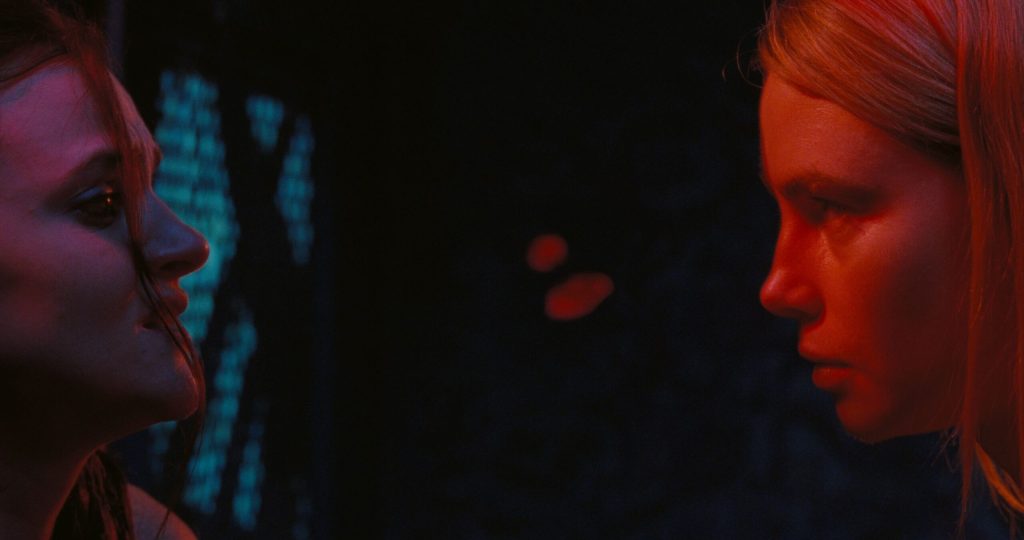
Julie Pacino’s debut feature announces itself less as a narrative than as a hypnotic state of being. With I Live Here Now, she crafts a film that drifts between dream, paranoia, and fractured identity, where each scene feels like a step deeper into a psychological labyrinth. It is a strikingly assured first feature, one that refuses to provide a map, demanding instead that its audience surrender to its vertiginous rhythms.

Lucy Fry, in a career-defining performance, embodies Rose, a young actress who retreats to a remote hotel in Idyllwild, California, in search of respite from her unraveling life. But the more she seeks refuge, the more porous the walls of her reality become. Time loops back on itself, doubles materialise, and memory seeps into performance until the categories lose meaning altogether. Fry is magnetic precisely because she grounds this hallucinatory descent in something tangible: the unease of someone who no longer trusts her own perceptions.

Pacino wears her influences with confidence. Sheryl Lee’s presence inevitably conjures the spectre of Twin Peaks, and David Lynch’s fingerprints are felt in the film’s elastic time, uncanny repetitions, and ominous hum that seems to vibrate through the very air. Yet Pacino’s aesthetic is not mere homage. Her saturated colour palette recalls Argento’s lush operatics, while the film’s elliptical logic suggests Buñuel’s surreal provocations. Layered on top is a contemporary awareness of performance itself — how identity, memory, and desire are all rehearsed roles, prone to fracture under pressure.

Shot on 35mm, the film achieves a tactile, dreamlike fragility. Every frame looks like a half-remembered photograph, poised on the edge of fading. The supporting cast — Madeline Brewer, Cara Seymour, Sheryl Lee, and a gleefully slippery Matt Rife — all slot into the hallucinatory mood, each embodying figures that may be confidantes, doubles, or projections of Rose’s disintegrating psyche. The film offers no clear answers; its power lies in its refusal to resolve whether we are witnessing dream, reality, or a fragmented plurality of selves.

If Tokyo Evil Hotel was SUFF’s splatter assault on the senses, then I Live Here Now is its slow, intoxicating hypnosis. It burrows into the subconscious and gnaws away at the seams of certainty, drawing the viewer into a space where dread and desire cohabit uneasily. As Rose descends, so do we — through layers of paranoia and fractured selfhood, into the uncanny realisation that the mind itself is the ultimate haunted house.

The Prognosis:

I Live Here Now is not a film to be solved. It is a film to be inhabited, to be surrendered to. And in that surrender, Julie Pacino has crafted a debut that is both daringly elusive and deeply resonant — a Lynchian dream refracted through her own distinct lens.

  • Saul Muerte

SUFF – I Live Here Now
Unrated 15+
Starts Thursday, September 11, 2025 · Drama · 1 hr 36 min

Spinning Into Madness: Pater Noster and the Mission of Light Turns Vinyl into a Psychedelic Curse

29 Friday Aug 2025

Posted by surgeons of horror in Movie review, Sydney Underground Film Festival

≈ Leave a comment

Tags

adara starr, christopher bickel, mission of light, suff, Sydney Underground Film Festival

Christopher Bickel is not a filmmaker interested in polish. He is interested in sweat, noise, and the intoxicating dirt that clings to the celluloid ghosts of exploitation cinema. With Pater Noster and the Mission of Light, his latest DIY descent into the grindhouse abyss, Bickel channels the cracked spirit of 1970s cult horror while infusing it with a distinctly contemporary awareness of obsession — musical, spiritual, and cinematic.

The hook is irresistible: Max, a record store clerk chasing the thrill of rare vinyl, stumbles upon an LP from a long-forgotten commune band called Mission of Light. What begins as crate-digging curiosity spirals into something altogether darker, as Max and her friends trace the record’s origins to a secluded cult whose rituals are soaked in both blood and distortion. Before long, the chiming folk harmonies become incantations, the needle-drop becomes a curse, and the grooves themselves seem to open onto a world of psychedelic terror.

Bickel, whose underground reputation was forged on unapologetically abrasive, micro-budget projects, makes no effort to hide the seams. In fact, the seams are the point: a stitched-together tapestry of lurid colour, stroboscopic editing, and gory practical effects that recall the handmade ferocity of vintage splatter cinema. The budget is meager, but the imagination is unruly. When the film tilts fully into ritual bloodletting and cosmic chaos, it achieves the kind of unhinged sensory overload that expensive horror often can’t touch.

What’s most surprising, though, is the music. The filmmakers wrote and recorded a full album in the guise of Mission of Light, and its jangling, upbeat folk tunes — deceptively sunny, unnervingly catchy — weave through the film like a viral infection. Their recurrence creates a peculiar dissonance: the music seems to gnaw at the edges of the viewer’s mind, becoming both a nostalgic echo of 1970s counterculture and a sinister tool of indoctrination. By the time the cult’s rituals are in full swing, the songs are inseparable from the horror, leaving the audience haunted by melodies as much as imagery.

For all its disjointedness — the pacing takes time to find its grip, and some performances verge on pastiche — the film exerts a strange cumulative power. It sneaks up on you, wearing you down with repetition and atmosphere until its final stretches feel like an outright possession. It is less a film you watch than one you are slowly, insidiously absorbed into.

The Prognosis:

Pater Noster and the Mission of Light is not for everyone. Its rough edges are sharp, its indulgence in retro exploitation tropes unapologetic. But within SUFF’s lineup, it is precisely the kind of discovery audiences come to this festival for: a work made with passion, sweat, and delirious creativity, chewing through its limitations to deliver something singular. Bickel has crafted a nightmare that’s equal parts grindhouse revival, cult exposé, and vinyl collector’s hallucination — a low-budget hymn that worms its way into your soul, humming as it feeds.

  • Saul Muerte

SUFF – Pater Noster and the Mission of Light
Unrated 18+
Starts Thursday, September 11, 2025 · Horror · 1 hr 37 min

Neon-Bathed Terror: Nishimura’s Tokyo Evil Hotel Haunts and Horrifies

29 Friday Aug 2025

Posted by surgeons of horror in Movie review, Sydney Underground Film Festival

≈ Leave a comment

Tags

suff, Sydney Underground Film Festival, Yoshihiro Nishimura

SUFF 2025 – Where Cult Cinema, Transgression, and Innovation Collide

In the annals of Japanese horror cinema, Yoshihiro Nishimura occupies a singular, slippery niche — one forged in latex, arterial spray, and an irreverent carnival of grotesquery. From Tokyo Gore Police to Helldriver, his films have thrived on excess, turning the body into a site of anarchic spectacle. With Tokyo Evil Hotel, Nishimura returns to his splatter roots but cloaks the viscera in something more spectral, an unnerving meditation on urban legends and the hidden machinery of Japan’s entertainment underworld.

The premise sounds almost folkloric: a cursed hotel, five suicides in a year, a ghostly figure in a wheelchair propelled by betrayal and heartbreak. But Nishimura, ever the provocateur, is less interested in quiet ghost story chills than in conjuring a fever dream. The film drags the viewer down its neon-lit corridors, where reality and nightmare blur into one another. Images arrive in waves — some baroque in their grotesquerie, others achingly poetic — before dissolving into the next eruption of slime, latex, or digital delirium.

What anchors this onslaught is not narrative cohesion (which Nishimura deliberately unravels) but mood, texture, and metaphor. The hotel itself becomes a nexus of exploitation, its walls absorbing the residue of despair from a culture that glamorises seduction while feeding on vulnerability. Nishimura weaponises the tropes of J-horror — the wrathful woman, the haunted threshold, the cyclical nature of trauma — and splices them into his splatter lineage. If Ring and Ju-On explored the horror of technological contamination, Tokyo Evil Hotel maps the horror of commodified intimacy, where every smile has a price and every fantasy its corroded underbelly.

The cast — Masanori Mimoto and Natsumi Tadano among them — give just enough grounding to keep the delirium tethered to human suffering, though their characters often feel like archetypal vessels swept along by the director’s vision. The real star, as always with Nishimura, is the texture: prosthetic ingenuity, practical gore, and uncanny tableaux that feel equal parts Kabuki and Cronenberg.

Yet the film is not without fracture. The disjointedness — the lurch from social critique to grotesque comedy to lyrical melancholy — sometimes undermines the impact. For some, this instability will feel frustrating; for others, it is precisely Nishimura’s method, a refusal to let the viewer rest. In the context of the Sydney Underground Film Festival, however, Tokyo Evil Hotel feels entirely at home. SUFF thrives on works that assault the senses, destabilise the familiar, and revel in the unruly. Nishimura’s latest is all of that: a cacophony of horror tropes remixed, a lurid nightmare of betrayal and exploitation, and a work that refuses to be neatly filed under ghost story or gorefest.

The Prognosis:

Tokyo Evil Hotel is less about narrative payoff than about immersion — in slime, in sorrow, in spectacle. It is a haunted funhouse mirror of Japan’s social anxieties, one that cackles, weeps, and bleeds in equal measure. Disjointed but unforgettable, it reminds us why Nishimura remains a cult legend: because no one else so gleefully drags horror into the gutter, then refracts it through neon into something unnervingly beautiful.

  • Saul Muerte

SUFF – Tokyo Evil Hotel
Starts Thursday, September 11, 2025 · Horror · 1 hr 30 min

Somnium Finds Terror in the Space Between Sleep and Reality

28 Thursday Aug 2025

Posted by surgeons of horror in Movie review

≈ Leave a comment

Tags

chloe levine, grace van dien, peter vack, rachael cain, will peltz

“Side effects may include hallucinations, paranoia, detachment from reality, and nightmares that never end.”

Racheal Cain’s Somnium invites viewers into the shadowy corridors of an experimental Los Angeles sleep clinic where dreams aren’t just studied—they’re manufactured. At first glance, it plays like another indie horror built around a high-concept premise, but Cain’s film manages to stand out thanks to a tight script, stylish execution, and a willingness to explore the darker veins of Hollywood’s underbelly.

The story follows Gemma (Chloe Levine), a young actress trying to carve her way into the industry, who takes a job at Somnium, an overnight sleep program that promises clients their “dreams come true.” Of course, reality is far more sinister. The longer Gemma spends at the clinic, the more she—and the audience—begin to unravel in a world where hallucination and reality bleed together, paranoia runs high, and dreams become nightmares with teeth.

Levine is perfectly cast as Gemma, balancing youthful ambition with growing unease. She’s backed by a strong ensemble: Will Peltz (Unfriended) as a fellow insomniac with secrets of his own, Peter Vack (The Intern) as one of Somnium’s all-too-charming clinicians, and Grace Van Dien (Stranger Things), whose role underscores the disquieting glamour-versus-decay theme that runs through the film.

Cain, who both wrote and directed, brings a confident hand to the material. Her Los Angeles is a city of surfaces—sleek on the outside, rotting underneath—and the dream sequences, shot with a hazy surrealism, capture that tension beautifully. There are echoes of films like A Nightmare on Elm Street and The Neon Demon here, but Cain filters her influences into something distinctly her own: a slow-burn horror-thriller that lingers in the liminal space between dream logic and urban paranoia.

The Prognosis:

Somnium isn’t flawless—the pacing drags in the middle act, and some of the more abstract sequences might test the patience of viewers craving traditional scares. But when it works, it works surprisingly well. By the time the film plunges headfirst into its unsettling final stretch, Cain makes good on her promise: dreams do come true, though rarely the way you expect.

  • Saul Muerte

Thanks to Lightbulb Film Distribution, Somnium will be available to rent or buy on digital platforms including Apple TV, Prime Video, and Google TV starting September 10th. For those who enjoy psychological horror tinged with surreal menace and a glimpse into the darker corners of Los Angeles life, it’s worth staying awake for.

Corporate Carnage Falls Flat: Night of Violence Opens FrightFest with More Blood Than Bite

21 Thursday Aug 2025

Posted by surgeons of horror in Movie review

≈ Leave a comment

Tags

caitlyn borek, ilya konstantin, john schaub, kit lang, Russ Russo, vince benvenuto

Premiering on the opening night of FrightFest 2025 at the ODEON Luxe Leicester Square, Illya Konstantin’s debut feature Night of Violence arrives with plenty of ambition and a message aimed squarely at the horrors of corporate greed and the opioid crisis. Part workplace-invasion thriller, part satire, it promises to confront real-world issues through the lens of exploitation cinema.

There’s no denying the energy behind Konstantin’s filmmaking. The film is scrappy, bloody, and unapologetically brash, with moments of gore that land effectively and demonstrate a clear enthusiasm for the genre. The central conceit — asking what survival looks like in a profit-driven world — is a timely and resonant one, ensuring that Night of Violence never lacks for thematic ambition.

Unfortunately, where the film falters is in its execution. The script struggles to sustain its weighty ideas, often relying on dialogue that feels blunt rather than biting. Characters come across as two-dimensional archetypes, serving more as mouthpieces for the film’s message than as people the audience can invest in. As a result, the satire feels undercooked, the thrills somewhat hollow, and the film’s bigger questions end up buried under noise rather than sharpened by it.

The Prognosis:

For a debut, Konstantin deserves credit for swinging big and refusing to play it safe — Night of Violence certainly doesn’t lack passion or intent. But with thinly drawn characters and a weak script dragging down its flashes of brutal impact, the film plays more like a promising calling card than a fully realised statement.

  • Saul Muerte

Back in the Slicker: Jennifer Love Hewitt Returns in a Soggy Sequel

21 Thursday Aug 2025

Posted by surgeons of horror in Movie review

≈ 2 Comments

Tags

chase sui wonders, freddie prinze jr, jennifer love hewitt, jonah hauer-king, madelyn cline, sarah michelle gellar, sarah pidgeon, tyriq withers

I Know What You Did Last Summer.  Followed by I STILL Know What You Did Last Summer.  Followed by I’ll Always Know What You Did Last Summer.  Followed by an Indian rip off and a TV Series.

Who knew those last 3 were a thing?!

And now, a Legacy Sequel!  That’s the term apparently!  Which is basically what you call a sequel that happens so long after the last movie you can get away with slapping it with the original title.

Like The Thing and The Thing and Halloween and Halloween and Scream and Scream. 

Or Inside Out and Inside Out and Inside Out and Inside Out and Inside Out.  Although those last 5 had nothing to do with each other – that was just an exercise to show off I can use Google as a search engine.

Now with this film they really should have kept the momentum going with something like “Anyway, Where Were We?  Oh Yeah!  I REALLY Know What You Did Last Summer and Maaaan Are You In Twouble…”

‘Cause why not?

But I digress. When this instalment was announced, it seemed like a blatant cash in on the last Scream release.  Except that film didn’t have its female Party of 5 lead, whereas this movie does.

So apart from Jennifer Love Hewitt returning as Julie James, we have Mr. Sarah Michelle Gellar AKA Freddie Prinze Jr. returning as Ray Bronson and…. Mrs. Sarah Michelle Gellar AKA Sarah Michelle Gellar returning as Helen Shivers.

And yes, for those of you who remember the original, that particular last factoid throws up a question that you can probably answer after thinking about it for half a second.

So – to catch you up on the premise of the original – a bunch of rather well-off white kids kill a stranger whilst driving irresponsibly on a quiet bendy road on the side of a hill.

Realising they can get away with this crime if they just stay schtum, we fast-forward a year later and we find these teenagers are dealing with what they’ve done in different ways – none of them healthy.

And their sitch gets worse when they get a mysterious note delivered to them that says the title of the movie, and a large dark figure dressed like a fisherman in a slicker (apparently that’s what the heavy raincoat look is called) armed with a hook starts stalking and killing them.

BUT with this legacy sequel, a bunch of rather well-off white kids kill a stranger whilst driving irresponsibly on a quiet bendy road on the side of a hill.

Realising they can get away with this crime if they just stay schtum, we fast-forward a year later and we find these teenagers are dealing with what they’ve done in different ways – none of them healthy.

And their sitch gets worse when they get a mysterious note delivered to them that says the title of the movie, and a large dark figure dressed like a fisherman in a slicker (apparently that’s what the heavy raincoat look is called) armed with a hook starts stalking and killing them.

So yeah.  With that I’m pretty much at a loss as to what to say next.  So… with his take on the film – here’s Chris Dawes…

HAHAHAHAHAHAHAHAHAHA

HAAAAAAAA

HAHAHAHAHAHAHAHAHAHAHA

Jesus Christ.

Ok.

So, get someone drunk. Like really drunk. Like “wheelbarrow of vodka and a hose” drunk.

Then, try to get them to recount the plotlines of every prior I Know What You Did movie.

That is this script.

It’s the most hilariously incoherent pastiche of moments from the earlier gear you could possibly spend 50 million dollars to create.

It is an absolutely terrible film. Just soooooo goddamn dire – but it’s the kind of dire that is enjoyed in the company of friends, with whom you will share every inconceivably written plot point and sophomorically acted quotation from now until the end of time.

I loved every fucking second of it, 1000% worth the price of admission.

Also, watch it with as many Zoomer and Alpha influencers who didn’t grow up ensconced in the culture as you can – their bewildered reactions to everything happening made it all the more special.

Thanks Chris!

Well there you have it.  He liked it!

The Prognosis:

Long story short, it’s not very good.  But then again, they’ve always been the poor relation to the SCREAM films.  Although it’s nice to see Jennifer Love Hewitt again.  And oh yeah – spoiler alert – there is a twisty twist that makes you feel… nothing really.  Unless you’re invested in this franchise.  In which case you cheeky little R. Slicker 😉

  • Antony Yee and Chris Dawes
← Older posts
Newer posts →

Subscribe

  • Entries (RSS)
  • Comments (RSS)

Archives

  • February 2026
  • January 2026
  • December 2025
  • November 2025
  • October 2025
  • September 2025
  • August 2025
  • July 2025
  • June 2025
  • May 2025
  • April 2025
  • March 2025
  • February 2025
  • January 2025
  • December 2024
  • November 2024
  • October 2024
  • September 2024
  • August 2024
  • July 2024
  • June 2024
  • May 2024
  • April 2024
  • March 2024
  • February 2024
  • January 2024
  • November 2023
  • October 2023
  • September 2023
  • August 2023
  • July 2023
  • June 2023
  • May 2023
  • April 2023
  • March 2023
  • February 2023
  • January 2023
  • November 2022
  • October 2022
  • September 2022
  • August 2022
  • July 2022
  • June 2022
  • April 2022
  • March 2022
  • February 2022
  • January 2022
  • December 2021
  • November 2021
  • October 2021
  • September 2021
  • August 2021
  • July 2021
  • June 2021
  • May 2021
  • April 2021
  • March 2021
  • February 2021
  • January 2021
  • December 2020
  • November 2020
  • October 2020
  • September 2020
  • August 2020
  • July 2020
  • June 2020
  • May 2020
  • April 2020
  • March 2020
  • February 2020
  • January 2020
  • December 2019
  • November 2019
  • October 2019
  • September 2019
  • July 2019
  • June 2019
  • May 2019
  • April 2019
  • March 2019
  • February 2019
  • January 2019
  • December 2018
  • November 2018
  • October 2018
  • September 2018
  • August 2018
  • July 2018
  • June 2018
  • May 2018
  • April 2018
  • March 2018
  • February 2018
  • January 2018
  • December 2017
  • November 2017
  • October 2017
  • September 2017
  • August 2017
  • July 2017
  • June 2017
  • May 2017
  • April 2017
  • March 2017
  • February 2017
  • January 2017
  • December 2016
  • November 2016
  • October 2016
  • September 2016
  • August 2016
  • July 2016
  • June 2016
  • May 2016

Categories

  • A Night of Horror Film Festival
  • Alien franchise
  • Alliance Francaise French Film Festival
  • Australian Horror
  • Best Movies and Shows
  • Competition
  • dark nights film fest
  • episode review
  • Flashback Fridays
  • Friday the 13th Franchise
  • Full Moon Sessions
  • Halloween franchise
  • In Memorium
  • Interview
  • japanese film festival
  • John Carpenter
  • killer pigs
  • midwest weirdfest
  • MidWest WierdFest
  • MonsterFest
  • movie article
  • movie of the week
  • Movie review
  • New Trailer
  • News article
  • podcast episode
  • podcast review
  • press release
  • retrospective
  • Rialto Distribution
  • Ring Franchise
  • series review
  • Spanish horror
  • sydney film festival
  • Sydney Underground Film Festival
  • The Blair Witch Franchise
  • the conjuring franchise
  • The Exorcist
  • The Howling franchise
  • Top 10 list
  • Top 12 List
  • top 13 films
  • Trash Night Tuesdays on Tubi
  • umbrella entertainment
  • Uncategorized
  • Universal Horror
  • Wes Craven
  • wes craven's the scream years

Meta

  • Create account
  • Log in

Blog at WordPress.com.

  • Subscribe Subscribed
    • Surgeons of Horror
    • Join 228 other subscribers
    • Already have a WordPress.com account? Log in now.
    • Surgeons of Horror
    • Subscribe Subscribed
    • Sign up
    • Log in
    • Report this content
    • View site in Reader
    • Manage subscriptions
    • Collapse this bar
 

Loading Comments...