Fourteen years after The Texas Chain Saw Massacre terrified audiences by making violence feel brutally real, Tobe Hooper returned to Texas and did something that initially appeared almost unthinkable.
He made the nightmare funny.
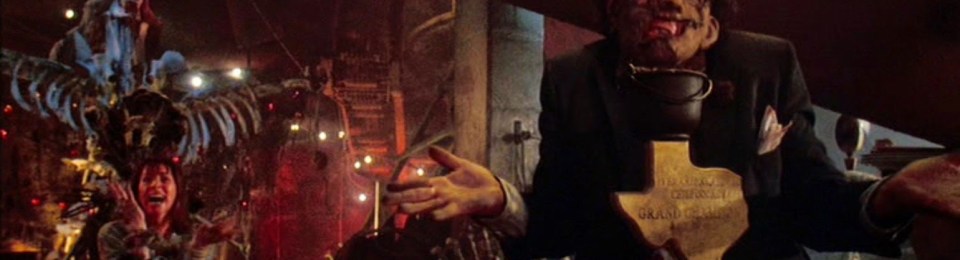
The Texas Chainsaw Massacre 2 is louder, bloodier, brighter and infinitely more ridiculous than its predecessor. Where the original suffocates, the sequel performs. Where Hooper’s 1974 film traps its audience inside a decaying rural nightmare, Texas Chainsaw Massacre 2 opens the doors, turns up the volume and invites us into the circus.
Leatherface now dances.
The family tells jokes.
Victims are mutilated with a level of theatrical excess that borders on cartoon violence.
And the chainsaw, once a terrifying industrial tool, becomes an instrument of performance.
For many viewers, this tonal transformation was a betrayal.
It was also entirely intentional.
The mistake is to assume that Hooper abandoned horror when he introduced comedy. The Texas Chainsaw Massacre 2 is not less horrific because it is funny.
It is funny because the horror has become so grotesque that laughter becomes another way of responding to it.
And that is where the film becomes far more interesting than a conventional horror comedy.
The Nightmare Becomes a Show
The original Texas Chain Saw Massacre was famously dirty.
Its power came from its documentary-like texture: heat, sweat, decay, animal remains and a sense that the camera had stumbled upon something it should never have witnessed. The film feels discovered rather than designed.
The sequel is the opposite.
Everything is exaggerated.
The colours are stronger.
The violence is bigger.
The performances are broader.
Dennis Hopper’s Lieutenant “Lefty” Enright does not merely seek revenge. He enters the film carrying chainsaws as though preparing for a Wagnerian battle. Bill Moseley’s Chop Top is not simply unstable; he is a carnival barker from hell. Drayton Sawyer has transformed from an anxious family patriarch into the manager of a grotesque enterprise built around murder and barbecue.
And Leatherface is no longer just a figure glimpsed in doorways.
He is a star.
This change is fundamental.
The original film makes the audience feel as though it has accidentally entered the Sawyers’ world.
The sequel makes the Sawyers’ world come out to greet us.
The family has become entertainment.
The Chainsaw as Punchline
One of the strangest achievements of Texas Chainsaw Massacre 2 is the way Hooper transforms the chainsaw from an object of pure terror into something approaching a comic instrument.
This does not make it harmless.
Quite the opposite.
The chainsaw remains capable of horrific violence, but its excess becomes part of the joke. When Lefty and Leatherface engage in their infamous chainsaw duel, the scene operates simultaneously as action, horror, parody and absurdist comedy.
Two men are not simply fighting.
They are fencing with chainsaws.
The image is so excessive that the audience has nowhere comfortable to place its reaction.
Should we be thrilled?
Should we recoil?
Should we laugh?
Hooper’s answer appears to be: yes.
That collision of responses is the film’s central achievement.
A traditional horror comedy creates a recognisable rhythm between fear and laughter. A frightening moment is followed by a joke. A comic character enters a dangerous situation. The audience moves between emotional registers.
Texas Chainsaw Massacre 2 is more unstable.
The horror and the comedy often occupy the same image.
That is a very different experience.
The laughter does not arrive after the fear has passed.
It arrives inside it.
The Family Business Goes Public
If The Texas Chain Saw Massacre examined the collapse of a family whose violent labour had become obsolete, the sequel imagines what happens when that family adapts.
The Sawyers become entrepreneurs.
Drayton sells barbecue.
The connection between meat and murder, only implied in the original, becomes a grotesque joke. Capitalism has found a way to absorb the family’s particular talents.
They are no longer merely surviving in isolation.
They have entered the marketplace.
That development makes Texas Chainsaw Massacre 2 a considerably stranger companion to the original than it first appears.
The first film presents the Sawyers as remnants of an abandoned America.
The second suggests that America has found a use for them after all.
Everything can become a product.
Even cannibalism.
Even murder.
Even Leatherface.
The family no longer needs to hide from the world.
The world is now prepared to buy what they are selling.
The Grotesque Family
Hooper’s genius was to understand that the Sawyer family could only remain terrifying for so long if they were treated as a static collection of monsters.
So he allowed them to become ridiculous.
This is not the same as making them sympathetic.
Chop Top remains dangerous. Drayton remains cruel. Leatherface remains capable of appalling violence.
But the film permits us to see their absurdity.
They squabble.
They compete.
They misunderstand one another.
They complain about money and family obligations.
They are monstrous because they are recognisable.
The sequel amplifies this idea until it becomes grotesque theatre.
The family has become a dysfunctional sitcom from hell.
And that phrase matters because the comedy does not diminish the horror. It exposes a different kind of horror: the possibility that atrocity can become ordinary once we become familiar with the people committing it.
The Sawyers are terrifying.
The Sawyers are ridiculous.
Those two statements are never allowed to cancel one another out.
The Birth of Gallows Horror
There is a particular kind of laughter that emerges when horror becomes too grotesque to process in a straightforward way.
It is not laughter because something is safe.
It is laughter because the alternative response has become unbearable.
A joke told at a funeral does not make death less serious. Sometimes it acknowledges the seriousness of death more honestly than solemnity can. It recognises the absurdity of being human in the face of something we cannot control.
The Texas Chainsaw Massacre 2 understands this instinct instinctively.
Its violence becomes so exaggerated, its characters so manic and its situations so absurd that laughter becomes a survival mechanism.
The audience laughs at the abyss because the abyss has become too ridiculous not to.
This is what I call Gallows Horror.
Not simply horror with jokes.
Not simply comedy coated in blood.
Gallows Horror occupies the uncomfortable territory where horror, absurdity and laughter become inseparable. The laughter does not neutralise the horror. It intensifies it. We laugh, then realise that we have laughed at something genuinely appalling.
And that moment of recognition is where the discomfort lives.
Texas Chainsaw Massacre 2 is one of the great expressions of this sensibility.
It asks us to laugh at the Sawyer family while never allowing us to forget what they are.
Leatherface Learns to Dance
Perhaps no character better embodies the sequel’s transformation than Leatherface himself.
In 1974, Leatherface was frightening partly because he was unknowable. His masks, behaviour and panic suggested a person whose identity had been fractured by the demands of the family around him.
In 1986, that fractured identity becomes theatrical.
Leatherface is playful.
He is confused.
He is sexually curious.
He performs.
His interactions with Stretch are uncomfortable precisely because they complicate the traditional monster-and-victim relationship without making it less dangerous. Hooper appears fascinated by the absurdity of masculinity and performance, turning Leatherface’s chainsaw into an instrument of grotesque courtship.
The result is one of the most bizarre sequences in American horror.
It is funny.
It is disturbing.
It is sexual.
It is threatening.
And none of those responses can be cleanly separated from one another.
That is Gallows Horror in miniature.
The audience is invited to laugh at Leatherface’s behaviour even while recognising the profound danger of the situation. The comedy increases the discomfort because it destabilises our moral position.
We should be horrified.
Why are we laughing?
America Gets Louder
The transformation from The Texas Chain Saw Massacre to its sequel also mirrors a broader cultural shift.
The original emerged from a decade of social anxiety and industrial disillusionment. Its nightmare was one of decay.
By the mid-1980s, America had become louder.
Consumer culture was louder.
Television was louder.
Politics was louder.
Violence in popular culture was louder.
The horror sequel belongs to that excess.
It is full of neon, radio broadcasts, advertisements, chainsaws and noise. Even its villains appear to have been turned up beyond any reasonable level.
The Sawyers are no longer the discarded remains of an old America.
They are a product of the new one.
This is why the sequel’s carnival atmosphere matters. The title family has become a travelling sideshow, a grotesque American attraction hidden beneath the highways and amusement parks of modern Texas.
Hooper takes the country’s appetite for spectacle and feeds it back to the audience as human flesh.
Dennis Hopper and the Madness of Escalation
Then there is Dennis Hopper.
Lefty Enright is perhaps the sequel’s most obvious declaration that restraint has been abandoned.
He purchases chainsaws as though arming himself for mythological combat. He storms the family’s underground lair with the intensity of a man entering hell. By the time he begins attacking the walls themselves with a chainsaw, the film has reached a level of absurdity that could only exist inside this particular universe.
And yet Hopper plays the madness with complete conviction.
That commitment is essential.
The film never works if the actors appear to be standing outside the joke. The comedy emerges because everyone treats the insanity as though it matters.
Lefty’s grief is real.
His rage is real.
The chainsaw battle is also completely ridiculous.
Again, the two truths coexist.
Gallows Horror requires that tension.
The absurdity must not erase the stakes.
Laughing at the Abyss
There is a reason The Texas Chainsaw Massacre 2 has aged into something more interesting than its initial reception suggested.
The film was not attempting to repeat the original.
It understood that repetition would have been the real betrayal.
You cannot recreate the feeling of accidentally discovering the unthinkable once the audience already knows what is inside the house.
So Hooper did the next most dangerous thing.
He opened the house wider.
He showed us more.
He made the monsters talk.
He made them dance.
And he made us laugh.
That laughter is not an escape from the horror of the first film. It is what happens when the horror becomes familiar enough to require a new response.
Once the monster becomes an icon, the filmmaker must find another way to make it strange.
Hooper found absurdity.
The Prognosis:
The Texas Chainsaw Massacre 2 is not a failed attempt to recreate The Texas Chain Saw Massacre.
It is a refusal to try.
Tobe Hooper understood that the original had already trapped audiences inside its nightmare. Returning to the same darkness would have meant repeating an experience that could never again be unexpected.
So he transformed the nightmare into a carnival.
The violence became bigger.
The performances became broader.
The family became funnier.
And somehow, through all that grotesque excess, the horror remained.
That is the strange brilliance of Texas Chainsaw Massacre 2. It understands that laughter and terror are not opposites. Sometimes laughter is what emerges when terror has nowhere else to go.
This is Gallows Horror.
The point at which the grotesque becomes absurd, the absurd becomes funny and the laughter itself becomes uncomfortable.
We laugh at Leatherface.
We laugh at Chop Top.
We laugh at Lefty attacking the walls with a chainsaw.
Then, perhaps a moment later, we remember what we are watching.
People are being murdered.
Bodies are being mutilated.
A family is eating human beings.
And we’re still laughing.
That is the abyss Hooper opens beneath Texas Chainsaw Massacre 2.
The joke is that there is no joke.
There is only horror pushed so far beyond reason that the human response begins to break down.
And perhaps that is why the sequel has become increasingly fascinating with age.
The original showed us America as a slaughterhouse.
The sequel showed us the slaughterhouse selling tickets.
Welcome to the carnival.
- Saul Muerte

