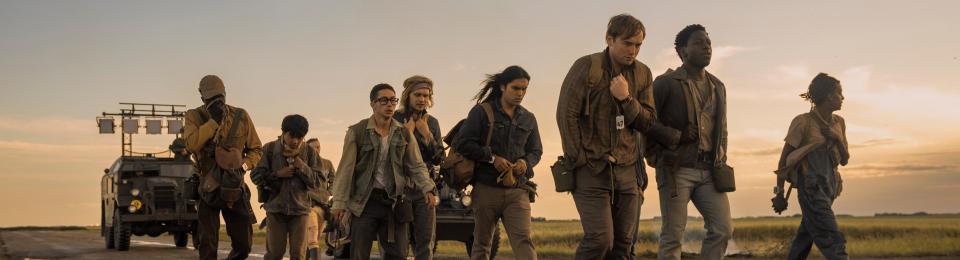
Sometimes when we get caught up reviewing all these films, it’s easy – all too easy – to forget that
as with a painter staring at a blank canvas; a director, when given their brief, is staring at a multitude
of choices in which to tell the story they have written (or in the case of The Long Walk; been given) .
And this particular story is the brainchild of writing grand master Stephen King. So, no presh.
Also throw in the fact that it involves walking, a ton of it, and you might think this is a film for a
novice (too inexperienced to know that this is an extremely tough assignment) or a black belt
filmmaker. Someone who knows enough to know that a movie that’s about walking in the open air
gives you nowhere to go. No immediate cutaways, no car chases, no love scenes to dictate changes
in pace etc.
Heck even your coverage choices are limited by how stylised (or not) you want to go about filming
men walking. And walking. And walking.
So what do you do? Well, there are a few things this pic leans on, and we’ll talk about those in a bit.
But first – some much-needed context for the 0.08% of you who have clicked on this article not
knowing what this movie is about.
Set in a dystopian alternative reality (around 1970’s ish – although the exact time period is never
stated, so I’m going off the novel, which was written in 1979) you soon realise that The Hunger
Games (and King’s own The Running Man) owe a lot to this idea.
Which is, you get people to WILLINGLY go through a trial of fire to get some nebulous sense of
financial freedom, and freedom from bondage.
In this particular case, you walk. As in you collate at a starting line, get assigned a number and you
walk. There is no finish line. Last man standing (and it is all men in this story. Young men, one from
each State of the U.S. – so 50 in total) wins. And wins big. Both in terms of $ and a wish…
The rule is you DO NOT stop. Evah. If you do for more than a few seconds you are given a warning.
If you fall below 3 miles an hour you are given a warning. More than 3 warnings in an hour and you
are executed there and then by one of the volley of military personnel keeping pace with you.
Water and rudimentary rations are given to the walkers, which prolongs their agony if anything.
Because stopping to relieve yourself or sleeping is counted as a warning/shootable offence. Taking a
pebble out of your shoe, bad weather, incredibly steep inclines…. you’d be surprised just how many
things can impede a good walk when halting is not an option.
And that’s what this review will do right now to get the always insightful Chris Dawes to give his take
on the movie. Over to you Chris!
Ok. So. In my view there are two types of Stephen King adaptations – The genre defining classic (The
Shining, Green Mile, Shawshank) and Dreamcatcher.
The Long Walk is the former.
It’s incredible – they have managed to make a minimalist, mid budget film about a bunch of people
walking through middle America deeply engaging.
Even the moments that you can see coming hit you, and hit you hard.
Everyone in this film is acting the shit out of it in the best possible way – I reckon this will be the
breakout movie for a bunch of the next generations’ Oscar winners.
It’s the kind of film that sits with you when it is over.
And boy howdy, do I love a Mark Hamill heel turn – I genuinely hated his character in a way I have
not often hated a film bad guy. Fucker managed to out-Darth Darth.
Glorious. No notes.
See this movie.
So, as you can see – mixed emotions from Chris there.
I kid.
As he touched upon, the best weapon this movie had at its disposal was casting. One way to get
around a story that has limitations in terms of setting is to make sure your actors are world class for
the roles they have been chosen to play. And for this trek, the filmmakers have nailed it.
When all you have is dialogue interspersed with ratcheting tension with each death, it helps that the
baseline words come from Stephen King. But when those words are delivered by young actors who
themselves are clearly gifted craftsmen, then you have the luxury of letting this movie do all the
heavy lifting for you.
And the tone from the outset is thrown down by the only real female member of the cast – Judy
Greer.
Now well and truly in the mother character phase of her career, her heartbreak as she bids farewell
to her son at the starting line hits a perfect balance. Not over-wrought to put you off the film before
it’s even started, but 100% grounded in a reality you can buy into. Because at this point of the
movie you don’t know the rules of The Walk, but in a great example of show don’t tell, you know it
can’t be good. So from the get-go you are intrigued and a little bit tense – the exact sort of tone you
want at the start of a flick like this.
So. Writing and acting. That’s how you make a dangerously simple premise work. [Allow time for
the world’s biggest d’uh].
But another thing that played in favour of this film was its unapologetic refusal to look away. The
way these men die is graphic, and that’s the point. A bullet does horrendous damage to a human
body. Powered metal explodes through bone and tissue and it doesn’t care how you look
when it does, and this film makes sure you SEE that, in all its factually visceral detail.
And it’s not gratuitous either. But rather, the point. Because why would these men sign up for
something that has a 49 in 50 chance of killing you in a physically painful and undignified way?
Well – why would 12 districts send 2 young people each year to fight to the death for the
amusement of the rich masses?
And by extension… why would SO MANY people in a real-life election vote AGAINST their own best
interest?
Because the illusion those in power sell to those without is tantalising and intoxicating. It’s framed
in rules that THEY set, but if you play the game, you can be ONE OF THEM. One of US!
In this case, chances are 49 to 50 against, but the result is binary. It’s either yes, or it’s no. And most
of us think and feel – deep down – we are the lead character of our own story. And rules don’t apply
to lead characters! Lead characters stand out by going against the mainstream and beating the
odds. Lead characters are special and so are YOU! Despite something immutable as math saying
you’re not.
Plus changing an unfair status quo through revolution seems like a lot of hard work. Work that
mostly benefits those who come after you, as revolts usually kill a lot of instigators. Even successful
ones.
So why not choose a path that could immediately benefit YOU instead? Countless money AND a
wish?
So what if the odds are not in favour? If you want anything in life, anything that’s worth it, you gotta
work for it. Bleed for it.
Walk for it. Die for it.
The Prognosis:
Power is an illusion, but it doesn’t make it not real. And this film makes you feel that every step of
the way.
5 stars.
- Antony Yee & Chris Dawes
 Surgeons of Horror
Amen. This was all we’d hoped for. Masterpiece, indeed.
LikeLike
Pingback: Top 13 Killer Films of 2025: Horror, Form, and the Politics of Endurance | Surgeons of Horror