
• About
  • podcasts
  • Shop

Surgeons of Horror

~ Dissecting horror films

Surgeons of Horror

Monthly Archives: June 2025

“Consecration: A Beautifully Shot Descent into a Convoluted Mystery”

14 Saturday Jun 2025

Posted by surgeons of horror in Movie review

≈ Leave a comment

Tags

christopher smith, danny huston, film, horror, jena malone, Movie review, movies, review

Director Christopher Smith (Triangle, Severance, Creep) has long walked the fine line between genre smarts and psychological thrills. With Consecration, he returns to familiar territory: isolation, trauma, and the gnawing sense that reality is unspooling by divine design—or perhaps something darker. Unfortunately, despite a stellar cast and evocative visuals, this theological thriller never quite delivers the clarity or momentum it promises.

At the centre of the story is Grace, played with icy restraint and wounded conviction by Jena Malone, who travels to a remote convent in the Scottish Highlands after the supposed suicide of her priest brother. It’s no spoiler to say she doesn’t buy the Church’s official line. What follows is a grim unpicking of spiritual rot, ancient rites, and personal demons—literal and otherwise.

Malone is a reliably magnetic presence, giving Grace a cold, coiled intensity. She’s in nearly every frame and carries the film with a quiet sense of fury, even when the script leaves her wandering in narrative fog. Danny Huston, meanwhile, brings a slippery, unsettling charm to his role as Father Romero—a man whose calm demeanour suggests he’s either a holy man or something far more manipulative. Their scenes together crackle with tension, even if the broader story never quite catches fire.

Visually, Consecration is arresting. Robert Adams’ cinematography makes the windswept cliffs and ancient stone interiors of the convent feel appropriately ominous and otherworldly. There’s a chilling stillness to the imagery, as though the land itself has been cursed. Smith knows how to set a mood, and he does so beautifully here, evoking The Ninth Configuration by way of The Nun.

But for all its atmosphere, Consecration stumbles under the weight of its convoluted plot. Flashbacks, hallucinations, religious visions, and a not-so-linear structure make for an increasingly confusing experience. Smith is no stranger to twisty storytelling—Triangle remains a standout in that regard—but here the puzzle-box elements feel murky rather than mind-bending. The story moves slowly, and its pacing often saps the tension that the setting and premise so deftly establish.

By the time the “revelations” arrive, they’re less shocking than they are baffling, tipping the film into a kind of Doctor Who-style timey-wimey terrain that doesn’t mesh with the grounded horror of its opening acts. It’s a tonal mismatch, and one that ultimately dulls the emotional impact of the finale.

Still, there’s something admirable about the ambition on display. Consecration isn’t content to offer up surface-level scares. It aims for spiritual unease and existential horror, and when it clicks, it’s genuinely unsettling. But in the end, the execution can’t match the ambition.

The Prognosis:

A gorgeous, well-acted descent into faith and madness—but one that loses its way somewhere along the sacred path.

  • Saul Muerte

Consecration will be available on UK Digital Platforms from 16th June.
“In Her Skin: The Stylist and the High Cost of Belonging”

13 Friday Jun 2025

Posted by surgeons of horror in Movie review

≈ Leave a comment

Tags

brea grant, film, horror, jill gevargizan, movies, najarra townsend, review, reviews

Streaming on Shudder and AMC+ from Monday 16 June

Beneath its softly lit salons and the hushed intimacy of late-night haircuts, The Stylist carves out something far more unsettling: a psychological portrait of aching loneliness, identity collapse, and the monstrous lengths some will go to feel like they belong. Directed with eerie precision by Jill Gevargizian, this feature-length adaptation of her acclaimed short film offers a muted but effective horror tale that leans more into sadness than shocks.

Claire (Najarra Townsend) is a woman adrift—quiet, awkward, desperate to connect—but with a hunger that’s gone grotesquely unmet. She doesn’t just cut hair. She scalps. Each kill is not about violence for its own sake, but a tragic, chilling attempt to wear someone else’s life. And that’s where The Stylist cuts deepest—not in the gore, but in its exploration of identity as a fragile performance, and what happens when someone can no longer locate their own sense of self.

Enter Olivia (Brea Grant), an affable, outgoing bride-to-be who naively invites Claire deeper into her world. From there, the spiral is slow and agonising. What starts as admiration curdles into obsession. Claire’s need to be Olivia isn’t just jealousy—it’s pathological yearning. Her scalping isn’t about trophies in the serial killer sense. It’s about transference. Taking the one thing a person can’t fake: their presence, their social ease, their confidence. Claire doesn’t want to destroy—she wants to inhabit.

Townsend delivers a superb, painfully internal performance. Her Claire is meek but never blank—each nervous twitch and downward glance revealing someone quietly screaming behind her skin. She doesn’t play the killer as a monster, but as a woman in mourning—for connection, for warmth, for identity. It’s a performance that sticks with you. Brea Grant, meanwhile, plays Olivia with a brightness that never tips into caricature, making her slow realisation all the more tragic.

Stylistically, the film is polished, with an elegant aesthetic that contrasts beautifully with its macabre subject matter. There are echoes of Maniac, May, even Single White Female, but The Stylist stands on its own, particularly in how grounded its emotional horror remains. The mood is heavy, sometimes to a fault, with pacing that occasionally feels listless rather than deliberate. Still, the thematic undercurrents—how we mask our emptiness, how we covet others’ confidence like currency—are deeply resonant.

The Prognosis:

There’s a sadness in the scissors. In the need to be seen. In the horror of invisibility. The Stylist doesn’t reinvent the horror genre, but it delivers something more haunting than expected: a quiet eulogy for those who never quite found their place, and the darkness that fills the void.

  • Saul Muerte

Englund, Harris, Moseley—Wasted on a Toothless Slasher

10 Tuesday Jun 2025

Posted by surgeons of horror in Movie review

≈ Leave a comment

Tags

bill moseley, charlotte fountain-jardim, Danielle Harris, dwight h little, robert englund

Trick, no treat: A horror legend trio wasted on a forgettable fright night

Directed by Dwight H. Little, Natty Knocks arrives with a nostalgic promise—one rooted in its genre-savvy casting. With horror icons Bill Moseley, Danielle Harris, and Robert Englund all appearing in the same film, expectations are understandably raised. Unfortunately, what unfolds is a tepid, undercooked Halloween flick that feels more like a missed opportunity than a macabre thrill ride.

Set on Halloween Eve, the story follows Britt (Charlotte Fountain-Jardim), a babysitter tasked with protecting a group of kids from Abner Honeywell, a deranged killer who is also the son of a B-movie scream queen known as “Natty Knocks.” It’s a set-up that might have worked better had the film leaned harder into its retro horror roots, or capitalised on its intriguing central lore. Instead, the narrative plods along with soft suspense and little impact.

Bill Moseley plays it straight but subdued, a far cry from his unhinged roles in House of 1000 Corpses or The Devil’s Rejects. Danielle Harris, often a reliable presence in indie horror, is underused here, while Robert Englund—despite a brief and welcome appearance—feels more like stunt casting than a meaningful addition. The trio’s collective legacy deserves better than what the film ultimately offers.

Technically, the film struggles with uneven pacing and flat direction. There are a few stylistic touches and the occasional attempt at atmosphere, but none of it ever quite gels. The kills are mostly offscreen or uninspired, and the tension rarely rises above a simmer.

The Prognosis:

In the end, Natty Knocks tries to dress up a bare-bones slasher with legacy casting and light folklore, but it doesn’t have the teeth to break through the noise. For fans of Moseley, Harris, or Englund, there’s some fleeting curiosity value. For everyone else, it’s a Halloween story better left untold.

  • Movie Review by Saul Muerte

Natty Knocks is available to rent or buy now.

Fear, Fur, and Fortune: Eye of the Cat Delivers Giallo-Lite Thrills

08 Sunday Jun 2025

Posted by surgeons of horror in retrospective, Uncategorized

≈ Leave a comment

Tags

1960s horror, 1960s retrospective, david lowell, michael sarrazin

Directed by David Lowell Rich, Eye of the Cat claws its way into the tail end of the 1960s with a premise that’s part Hitchcockian suspense, part Gothic melodrama, and part giallo-lite. While it never fully embraces the stylistic excess of its European cousins, there’s just enough tension, sleaze, and visual flair to keep genre fans engaged.

The setup is deliciously pulpy: a man conspires with his lover to rob his wealthy, cat-loving aunt of her fortune. The twist? He suffers from crippling ailurophobia—a fear of cats so intense it borders on the irrational. As the couple manipulates their way into the aunt’s inner circle, it becomes clear that the real threat may not be the clowder of watchful cats, but the secrets and shifting loyalties within the human cast.

While it lacks the razor-sharp elegance of Italian gialli, the film borrows enough of the genre’s staples—suspicious motives, inheritance plots, sudden reversals—to flirt with its spirit. The San Francisco setting provides a breezy, modern contrast to the otherwise old-world paranoia. Stylish cinematography and a few well-executed suspense sequences help elevate what could have been a TV-grade thriller.

Performances are serviceable, if occasionally campy, with Michael Sarrazin giving the lead just the right balance of charm and cowardice. The cats—dozens of them—are effectively used not just as a visual motif but as avatars of retribution. Their calm menace lingers in the corners of every scene, especially as things take a turn for the sinister in the final act.

The Prognosis:

Eye of the Cat may not leave deep scratches, but it’s a fun, semi-decent slice of late-’60s paranoia with just enough bite to justify the watch. For fans of crime thrillers with a twisted core—and anyone who likes their feline horror served with a side of psychological torment—it’s worth a revisit.

  • 1960s Retrospective Review by Saul Muerte

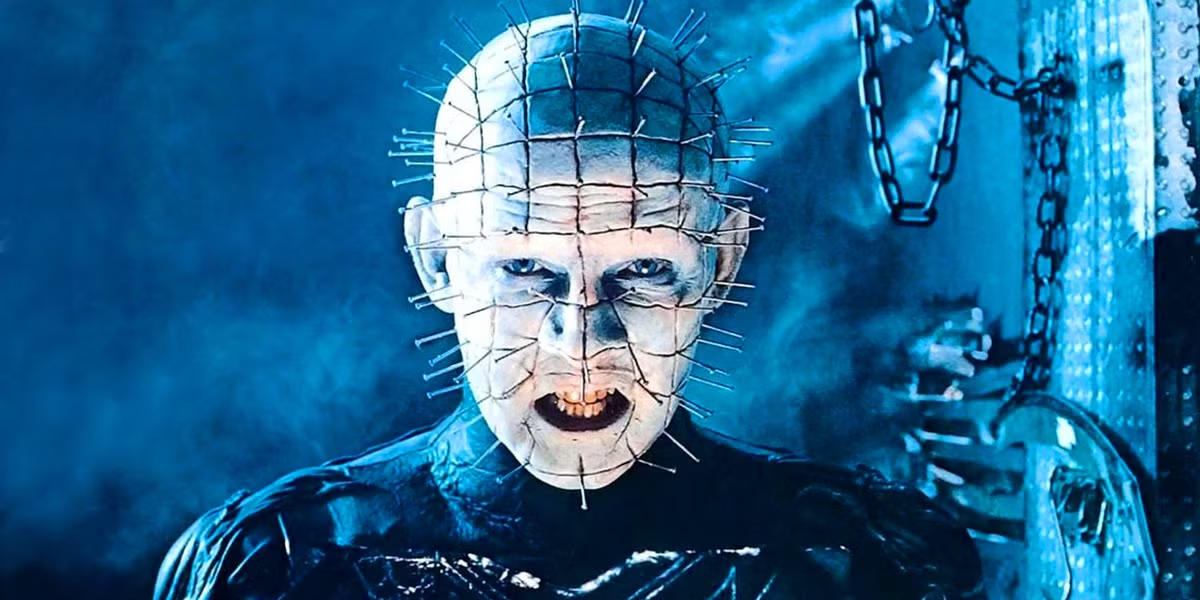
From Chains to Clichés: Revisiting Hellraiser: Deader and Hellworld 20 Years Later

08 Sunday Jun 2025

Posted by surgeons of horror in retrospective

≈ Leave a comment

Tags

clive barker, doug bradley, hellraiser, henry cavill, horror, kari wuhrer, Lance Henriksen, marc warren, movies, paul rhys, pinhead, rick bota

The box is still open—but by 2005, the horrors inside had lost their teeth.

As the Hellraiser franchise entered its straight-to-video era in the early 2000s, fans had already weathered a series of diminishing returns. But 2005’s double blow of Hellraiser: Deader and Hellraiser: Hellworld, both directed by Rick Bota and released within months of each other, marked a significant point of no return. Celebrating (or lamenting) their 20th anniversary in 2025, these two entries are less remembered for expanding Clive Barker’s mythos and more for highlighting how far the series had drifted from its grim, sensual origins.

Hellraiser: Deader 

Of the two, Deader fares slightly better—not because it’s a faithful addition to the Hellraiser canon, but because it begins life as something else entirely. Originally a standalone supernatural thriller script, it was retrofitted to include the Cenobites and the Lament Configuration, resulting in a stitched-together film that almost works in spite of itself.

Kari Wuhrer leads the story as a hard-nosed journalist chasing down an underground death cult in Romania. The film flirts with themes of trauma, addiction, and blurred reality—concepts that Hellraiser once handled with provocative boldness—but here, they’re dulled by a by-the-numbers execution. Still, the moody Eastern European backdrop and committed turns from Wuhrer, Marc Warren, and Paul Rhys give it some atmosphere, and the central premise—of a cult obsessed with conquering death—does echo Hellraiser’s fascination with pushing bodily and spiritual limits.

But despite flashes of creativity, Deader never shakes its identity crisis. The Cenobites are barely relevant to the narrative, and Pinhead’s presence feels perfunctory. It’s not a Hellraiser movie so much as a middling thriller that happens to feature a few familiar hooks.

Hellraiser: Hellworld 

If Deader is diluted, then Hellworld is downright disposable. Set in a pseudo-Internet-era gaming world, Hellworld attempts to be meta and modern, pitting a group of teens against a Hellraiser-themed online game. The resulting film feels like Scream meets House on Haunted Hill—but without the tension, intelligence, or atmosphere of either.

Despite the presence of genre legend Lance Henriksen and a young Henry Cavill (long before the cape), the cast is wasted in a script that relies on techno-jargon, faux-twists, and a painfully forced attempt at self-awareness. Doug Bradley’s Pinhead appears for his final time here, but his screen time is minimal, his dialogue rote, and his menace utterly defanged.

The film ends with a ridiculous twist that robs it of even the shallow pleasures of a bad slasher flick. For many fans, Hellworld marks the lowest point in the franchise—and it’s hard to argue with that sentiment.

Doug Bradley: The Final Configuration

If Hellworld is a disappointing swan song, it’s also the end of an era for Doug Bradley, who portrayed Pinhead across eight Hellraiser films from 1987 to 2005. With his commanding presence and Shakespearean delivery, Bradley transformed what could have been a gimmicky monster into a tragic, philosophical figure—a dark priest of pain and pleasure who lingered long after the credits rolled.

Bradley’s contributions to the franchise can’t be overstated. In Hellbound and Hell on Earth, he explored the remnants of humanity in Pinhead’s psyche; in later films like Inferno and Deader, he still managed to bring gravitas even when the writing failed him. His final appearance in Hellworld may be a muted farewell, but his legacy remains stitched into the flesh of the genre.


The Prognosis:

Twenty years on, Deader and Hellworld stand as cautionary tales about franchise fatigue and the dangers of branding over storytelling. What began with Clive Barker’s twisted poetry and existential dread had, by 2005, become little more than window dressing. Still, Deader holds a flicker of creativity, and even in the depths of Hellworld, Bradley’s shadow looms large—a final, ghostly reminder of what Hellraiser once dared to be.

  • Retrospective by Saul Muerte

Love on the Run Turns to Terror in Queer Horror Road Trip Straight On Till Morning

02 Monday Jun 2025

Posted by surgeons of horror in Movie review, sydney film festival

≈ Leave a comment

Tags

Bonnie Jean Tyer, cooking, Craig Ouellette, homebrew, Kelsey Christian, Maria Olsen, nanowrimo, publishing, SFF, sydney film festival, writing

Freak Me Out delivers another bold, bruising genre gem.

The Freak Me Out program at Sydney Film Festival 2025 has always been a haven for horror misfits, and Straight On Till Morning is a welcome addition to its blood-splattered roster. Directed by Craig Ouellette, this road trip romance-turned-nightmare pits love against extremism, identity against tradition, and outsiders against a force of cruel conformity.

At its heart are Dani and Kaitlin, two queer lovers caught in the euphoric haze of newfound intimacy. Their chemistry is charming, unforced, and grounded in quiet authenticity—a refreshing portrayal that sidesteps overused tropes and instead paints their connection as real and lived-in. But their dreamy road trip through America’s underbelly soon turns into a brutal descent, as they collide with a seemingly God-fearing family whose values are warped by delusion and control.

The film takes its time to find traction, and its deliberate pacing may test some viewers. The first act drifts on the wind of romantic indie minimalism, until a mid-point collision throws everything off the rails and into pure survival horror. From there, it delivers raw tension, visceral violence, and a grim dissection of how love—queer or otherwise—threatens rigid systems built on fear and false righteousness.

What elevates Straight On Till Morning beyond standard genre fare is its refusal to paint anyone with a single brushstroke. The villains are monstrous, yes, but they are never cartoons. Likewise, our protagonists are flawed, unsure, and deeply human. Ouellette doesn’t go for clean lines—this is a film about grey areas. About how outcasts, be they queer lovers or zealots hiding from the modern world, can collide in catastrophic ways.

The Prognosis:

It’s a challenging, sometimes uneven ride, but when it hits its stride, it’s gripping and unrelenting. In a landscape still learning how to do queer horror without pandering or punishing, Straight On Till Morning is a welcome entry—messy, brave, and full of heart.


🎟 Screening Times – Freak Me Out @ Sydney Film Festival 2025

  • Tuesday 10 June, 8:20pm – Dendy Newtown, Cinema 1
  • Friday 13 June, 8:30pm – Event Cinemas George Street, Cinema 9

Dare to fall in love. Stay for the fear.

  • Saul Muerte

I Don’t Want to Be Born (1975) – 50th Anniversary Retrospective

01 Sunday Jun 2025

Posted by surgeons of horror in retrospective

≈ Leave a comment

Tags

caroline munro, Donald Pleasance, eileen atkins, joan collins, peter sasdy, ralph bates

The devil came to the pram—and brought a Hammer cast with him.

Also known by several more sensational titles—The Devil Within Her, Sharon’s Baby, and It’s Growing Inside Her—Peter Sasdy’s I Don’t Want to Be Born is one of the stranger, more uneven horror offerings of 1975. Half supernatural shocker, half demonic soap opera, the film boasts a surprisingly strong cast and a deeply odd premise that has earned it a peculiar kind of cult status over the past fifty years.

Set in a heightened, almost surreal version of London, the film sees Joan Collins’ character give birth to a monstrously violent baby—seemingly possessed by the vengeful spirit of a spurned dwarf lover. What follows is a bizarre series of deaths, each more absurd than the last, all linked by the ominous presence of a pram and its pint-sized occupant.

Though the concept teeters on the edge of parody, Sasdy—who brought genuine Gothic flair to Hammer productions like Taste the Blood of Dracula and Countess Dracula—attempts to play it mostly straight. His direction tries to keep the tone grounded, but the outlandish plot frequently undercuts any attempt at gravitas.

Joan Collins, in full glam-horror mode, commits admirably to the madness. Her co-star Ralph Bates, with whom she previously appeared in Hammer’s Fear in the Night, provides a steadying presence. The cast is stacked with familiar faces from British genre cinema—Donald Pleasance as a soft-spoken doctor, Eileen Atkins as a nun with spiritual insight, and the ever-iconic Caroline Munro in a brief but welcome turn.

Despite its flaws—and they are many—the film’s connections to Hammer’s waning golden age give it an air of familiarity. In many ways, I Don’t Want to Be Born feels like a last gasp of the studio’s supernatural melodrama, though filtered through the grittier, more sensationalistic lens of mid-‘70s exploitation cinema.

The Prognosis:

On its 50th anniversary, it’s fair to say that I Don’t Want to Be Born is more curiosity than classic. But for devotees of Collins, Sasdy, and the weird crossover space between Hammer horror and post-Exorcist hysteria, it’s an oddly compelling footnote in British horror history.

  • Retrospective Review by Saul Muerte

The Ghoul (1975) Tyburn’s house of horrors—where secrets fester in the attic.

01 Sunday Jun 2025

Posted by surgeons of horror in retrospective

≈ Leave a comment

Tags

anthony hinds, freddie francis, john hurt, peter cushing, tyburn films productions, veronica carlson

Half a century on, The Ghoul (1975) stands as one of the more curious entries in the twilight years of British Gothic horror. Directed with solemn precision by Freddie Francis and headlined by the ever-graceful Peter Cushing, the film was a sincere attempt by Tyburn Film Productions Limited to resurrect the moody, atmospheric horrors of the Hammer era—an ambition that resulted in a mixed, but memorable, outing.

Set in 1920s England, the story revolves around a former clergyman (Cushing) who harbours a dark family secret: his cannibalistic son, locked away in the attic of his remote country manor. As uninvited guests and unwitting thrill-seekers stumble upon the estate, the horror quietly unfolds under a heavy blanket of mist, melancholy, and moral decay.

Tyburn—also behind The Legend of the Werewolf—clearly aimed to evoke the bygone days of elegant, character-driven horror. In that spirit, Cushing delivers a beautifully nuanced performance, as always lending depth and humanity to a role steeped in sadness. His scenes carry a weight of personal grief—particularly poignant given the recent loss of his wife at the time of filming.

Director Freddie Francis, returning to familiar Gothic territory, crafts an atmosphere of slow-burn dread, though the pace and plotting may leave some modern viewers wanting. Veronica Carlson—reunited with Cushing from previous Hammer entries—offers a restrained but dignified performance, while a young John Hurt brings a twitchy, unpredictable energy that adds texture to the film’s more traditional framework.

Producer Antony Hinds, a key figure in Hammer’s golden era, worked under the pseudonym John Elder here, contributing to a film that often feels like a swan song to a dying genre. While The Ghoul may not reach the heights of its forebears, its sincerity, craftsmanship, and dedication to classic horror tropes make it worth revisiting.

The Prognosis:

Fifty years later, The Ghoul stands not as a triumph, but as a loving echo—one that reminds us of a genre clinging to its traditions even as the horror world around it began to shift. For admirers of Cushing, Francis, and British Gothic, it remains a thoughtful if flawed gem from a studio that deserved a longer life.

  • Retrospective Review by Saul Muerte

Fog, Flesh, and Fear: The Doll of Satan and the Gothic Roots of Giallo

01 Sunday Jun 2025

Posted by surgeons of horror in retrospective

≈ Leave a comment

Tags

1960s horror, 1960s retrospective, giallo, giallo horror, gothic, gothic horror, italian gothic horror

“Behind every shadow lies a secret. Behind every secret, a scream.”

🗝️ “Behind every shadow lies a secret. Behind every secret, a scream.”

By the time La bambola di Satana (The Doll of Satan) crept into Italian cinemas in 1969, the giallo genre was still sharpening its knives. Mario Bava had lit the fuse with The Girl Who Knew Too Much (1963) and Blood and Black Lace (1964), but it would be another year before Dario Argento’s The Bird with the Crystal Plumage pushed the subgenre into full flight. The Doll of Satan landed at a curious midpoint: a gothic thriller draped in giallo stylings, ripe with misty castles, erotic hallucinations, and a hooded killer lurking in the shadows.

Directed by Ferruccio Casapinta—his only directorial credit—this occult-tinged thriller follows Elisabeth, a young woman returning to her family’s ancestral castle after her uncle’s mysterious death. As the inheritance looms, so do whispers of hauntings, cryptic locals, and ulterior motives. Elisabeth is soon plagued by bizarre, erotically charged visions and finds herself trapped in a web of deceit, culminating in dungeon-bound torture at the hands of a masked figure. Her fiancé, Jack, begins to suspect that the castle’s legend hides a far more human treachery.

While The Doll of Satan never fully commits to the baroque excess or stylish violence that would come to define giallo in the 1970s, it bears several of the genre’s fingerprints: a vulnerable woman in a labyrinthine estate, conspiracies surrounding wealth and inheritance, dreamlike hallucinations, and a killer whose identity is concealed behind cloaks and masks. Yet it’s still deeply tethered to the gothic tradition—with its rain-slicked graveyards, ancestral curses, and fog-choked corridors, the film feels caught in the final breath of the old horror world, even as it reaches toward the future.

There’s an undeniable camp charm in the way the film blends eroticism and suspense, from the exaggerated dream sequences to the near-operatic melodrama. Bruno Nicolai’s score—steeped in mood and menace—adds a ghostly elegance that elevates the film beyond its limited budget and occasionally clunky pacing. Casapinta may not have had the finesse of Bava or the bravado of Argento, but he delivers a stylish, if uneven, curiosity that flirts with the giallo blueprint.

The Prognosis:

The Doll of Satan stands as a minor, though intriguing, footnote in the evolution of Italian horror. It reflects a moment of transformation—when horror cinema in Italy was beginning to trade gothic gloom for lurid thrills, and the supernatural gave way to psychological menace. For giallo enthusiasts and completists, it offers a seductive glimpse into that transitional twilight, where haunted castles began to echo with the sound of switchblades.

  • 1960s Retrospective Review by Saul Muerte

Newer posts →

Subscribe

  • Entries (RSS)
  • Comments (RSS)

Archives

  • January 2026
  • December 2025
  • November 2025
  • October 2025
  • September 2025
  • August 2025
  • July 2025
  • June 2025
  • May 2025
  • April 2025
  • March 2025
  • February 2025
  • January 2025
  • December 2024
  • November 2024
  • October 2024
  • September 2024
  • August 2024
  • July 2024
  • June 2024
  • May 2024
  • April 2024
  • March 2024
  • February 2024
  • January 2024
  • November 2023
  • October 2023
  • September 2023
  • August 2023
  • July 2023
  • June 2023
  • May 2023
  • April 2023
  • March 2023
  • February 2023
  • January 2023
  • November 2022
  • October 2022
  • September 2022
  • August 2022
  • July 2022
  • June 2022
  • April 2022
  • March 2022
  • February 2022
  • January 2022
  • December 2021
  • November 2021
  • October 2021
  • September 2021
  • August 2021
  • July 2021
  • June 2021
  • May 2021
  • April 2021
  • March 2021
  • February 2021
  • January 2021
  • December 2020
  • November 2020
  • October 2020
  • September 2020
  • August 2020
  • July 2020
  • June 2020
  • May 2020
  • April 2020
  • March 2020
  • February 2020
  • January 2020
  • December 2019
  • November 2019
  • October 2019
  • September 2019
  • July 2019
  • June 2019
  • May 2019
  • April 2019
  • March 2019
  • February 2019
  • January 2019
  • December 2018
  • November 2018
  • October 2018
  • September 2018
  • August 2018
  • July 2018
  • June 2018
  • May 2018
  • April 2018
  • March 2018
  • February 2018
  • January 2018
  • December 2017
  • November 2017
  • October 2017
  • September 2017
  • August 2017
  • July 2017
  • June 2017
  • May 2017
  • April 2017
  • March 2017
  • February 2017
  • January 2017
  • December 2016
  • November 2016
  • October 2016
  • September 2016
  • August 2016
  • July 2016
  • June 2016
  • May 2016

Categories

  • A Night of Horror Film Festival
  • Alien franchise
  • Alliance Francaise French Film Festival
  • Australian Horror
  • Best Movies and Shows
  • Competition
  • dark nights film fest
  • episode review
  • Flashback Fridays
  • Friday the 13th Franchise
  • Full Moon Sessions
  • Halloween franchise
  • In Memorium
  • Interview
  • japanese film festival
  • John Carpenter
  • killer pigs
  • midwest weirdfest
  • MidWest WierdFest
  • MonsterFest
  • movie article
  • movie of the week
  • Movie review
  • New Trailer
  • News article
  • podcast episode
  • podcast review
  • press release
  • retrospective
  • Rialto Distribution
  • Ring Franchise
  • series review
  • Spanish horror
  • sydney film festival
  • Sydney Underground Film Festival
  • The Blair Witch Franchise
  • the conjuring franchise
  • The Exorcist
  • The Howling franchise
  • Top 10 list
  • Top 12 List
  • top 13 films
  • Trash Night Tuesdays on Tubi
  • umbrella entertainment
  • Uncategorized
  • Universal Horror
  • Wes Craven
  • wes craven's the scream years

Meta

  • Create account
  • Log in

Blog at WordPress.com.

  • Subscribe Subscribed
    • Surgeons of Horror
    • Join 227 other subscribers
    • Already have a WordPress.com account? Log in now.
    • Surgeons of Horror
    • Subscribe Subscribed
    • Sign up
    • Log in
    • Report this content
    • View site in Reader
    • Manage subscriptions
    • Collapse this bar
 

Loading Comments...