You know the saying: life imitates art. But sometimes art takes a chunk out of life and doesn’t let go. That’s what Jaws did. It didn’t just reshape cinema—it rewrote the cultural script for what a shark was, what the ocean meant, and who we were when we dipped a toe in the surf. Spielberg’s fake shark may have been rubber, but the fallout was all too real.
Because when Jaws hit theatres in 1975, it didn’t just break box office records. It detonated a planet-wide phobia. Rational adults who’d swum in the sea their whole lives suddenly refused to go waist-deep. Boating trips were cancelled. Beaches posted shark patrols like they were expecting Normandy-level invasions. People weren’t afraid of sharks before Jaws. After Jaws, they couldn’t stop picturing themselves inside one.
It’s not hard to understand why. Spielberg’s shark wasn’t just a predator—it was a force of nature, a myth made flesh. It was death from below, unknowable and unstoppable. Williams’ theme didn’t help either—it drilled into your brain like a warning siren. And once the public bought in, they didn’t just flinch at the water. They went hunting.
In the years following the release of Jaws, shark killings skyrocketed. Fishermen organised tournaments with the explicit goal of slaughtering as many as possible. Some sharks were mutilated for sport. Others were left to rot as trophies. The film had awakened an ancient fear and rebranded it as a civic duty. Sharks weren’t just animals anymore. They were villains. And the public wanted revenge.
Peter Benchley, who penned the original novel, would spend the rest of his life trying to undo the damage. He became a staunch conservationist, publicly lamenting how Jaws had fed hysteria. He wrote editorials, gave speeches, funded marine science. But the cultural machine had already chewed through the facts and spat out something far juicier: the monster myth.
And that myth still lingers.
Modern marine biologists have tried for decades to rehabilitate the shark’s image. We now know most species are shy, endangered, and critical to ocean ecosystems. We know attacks are rare—freakish outliers, not targeted carnage. But Jaws set the template. It tattooed an idea onto the global psyche: that beneath the surface lurks something ancient, evil, and waiting.
Here’s the kicker: Spielberg didn’t set out to demonise sharks. The terror came from budget constraints, not bloodlust. Bruce the Shark barely worked, and so the film’s horror became abstract, psychological. But abstraction has consequences. When the threat is offscreen, your brain fills in the blanks—and public imagination filled those blanks with teeth.
Yet maybe there’s something poetic in that. Because Jaws isn’t really about a shark—it’s about fear. Fear of nature, of losing control, of our place on the food chain. It’s about how humans respond when faced with something vast and indifferent. We named it. We hunted it. We called it evil. And the sea just kept rolling in.
Fifty years later, we’re still wrestling with the aftermath. Not just in how we make movies, but in how we treat the planet. The irony of Jaws is that it scared us away from the ocean, when what we really should’ve been afraid of was ourselves.
The scariest thing in Jaws isn’t the shark—it’s the sound of the shark. Two notes. Half a heartbeat. A musical ellipsis that creeps up from the seabed and drills straight into your spine. John Williams didn’t score a monster—he sculpted a presence. One that lurks just outside the frame, gnashing in silence, until your chest tightens and you start checking the shadows under your seat.
In truth, Bruce the Shark barely works on screen. The rubber betrays the realism. It’s stiff, sluggish, and allergic to saltwater. But Spielberg, handcuffed by malfunctioning mechanics and a limited budget, turned to the invisible: sound. And sound became the soul of the film.
Williams’ score is almost mathematical. Minimalist to the point of menace. That primal, pulsing motif—da-dum… da-dum…—doesn’t just suggest the shark is coming. It makes the water itself seem sentient, malevolent. No visuals necessary. Just rhythm. Just dread. Williams said the theme could be interpreted as “relentless, unstoppable,” like fate itself. And he wasn’t wrong. It’s practically aquatic Morse code for you’re screwed.
But the real genius lies in when the sound disappears. The opening attack? No music. Just ambient waves and ragged breathing. Chrissie’s screams. The sound of helplessness. Spielberg and editor Verna Fields trusted the silence—weaponised it, even. They understood that real horror isn’t the monster leaping out, it’s the waiting. The not-knowing. And they cut this film like a time bomb—tick, tick, breath, splash, gone.
Verna Fields deserves sainthood. She didn’t just edit Jaws, she saved it. She built its rhythm with a razor blade and a stopwatch. The cuts are precise, but never sterile. The pacing lets the tension throb, then twist. Her instincts gave Jaws its pulse, and her ear gave it breath. Fields’ decision to linger—on a bobbing raft, on a shark’s-eye view, on a reaction shot just a beat too long—makes the film feel like it’s constantly holding its breath with you.
Sound designer Robert Hoyt and mixer John R. Carter also understood the assignment. The underwater acoustics are muffled, dreamlike, warped—as if you’re already halfway gone. The difference between wet and dry audio isn’t just technical, it’s thematic. The ocean is a place where rules collapse. Where your screams don’t travel. Where your senses betray you.
And then there’s the famous Ben Gardner jump scare—maybe the purest blend of editing, timing, and sonic sabotage ever captured on celluloid. Spielberg throws the entire audience into the ceiling, not with a shark attack, but with a silent, bloated corpse slipping out of a hole in a boat. Fields cut it in her swimming pool. Spielberg added the shriek later. Together, they created a moment that still makes audiences flinch five decades later.
This is the power of Jaws—not just what’s seen, but what’s felt. And feeling is built from rhythm. From restraint. From silence. From two piano keys, repeating like a death mantra.
Other films used gore. Jaws used suggestion. Other films shouted. Jaws whispered.
Amity, as you know, means friendship. That’s the line. The pitch. The myth sold by mayoral pinstripes and anchors in sand. But Jaws is no feel-good postcard. It’s a thinly veiled civics horror story. Underneath the blood and brine is a scathing portrait of a town willing to sacrifice its children for a few more tourist dollars. Sound familiar?
Because Amity is America. Or at least the version of America we don’t like to admit exists—the sun-bleached community where civic pride curdles into denial, where public safety is trumped by profit, and where leadership means smiling through catastrophe with a cigar in hand and blood on your shoes.
Look at Mayor Vaughn, a man so cartoonishly committed to keeping the beaches open he might as well be handing out coupons for half-price limb reattachments. He’s not evil—he’s worse. He’s reasonable. He’s the guy who says “Let’s not overreact” while a shark chews through the local swimming club. His face is everywhere in 2025. He’s every politician downplaying a crisis, spinning a headline, blaming the scientists. Vaughn is the face of inaction, of plausible deniability, of capitalism cloaked in community.
This is the real brilliance of Jaws: it isn’t just a monster movie. It’s a movie about systems. Broken ones. It’s not just the shark that kills Alex Kintner—it’s the chamber of commerce. It’s the vote to keep the beaches open. It’s the hushed phone calls, the shrugged shoulders, the gentle pressure on Brody to “ease up.” The real monster doesn’t have teeth—it has a necktie.
And Brody? He’s not the sheriff, he’s the conscience. The outsider. The guy who moved to town thinking it would be quieter, safer—only to find out that even paradise has politics. His face when he sees that mother waiting for him in black is the face of a man who knows he failed—not because he didn’t try, but because the system didn’t want him to succeed.
It’s all too real. Substitute “shark” for “virus,” “chemical spill,” “gun violence,” “climate change,” take your pick. Jaws is a fable about what happens when truth is inconvenient and accountability is bad for business. A sunny allegory dipped in blood. Amity is the American dream under siege, and the town fathers would rather let it rot than admit something’s wrong.
But Spielberg never shouts. He doesn’t need to. He lets the imagery do the work. The tourist banners flapping in the wind while the ocean turns red. The newspaper headlines are getting smaller. The way Brody’s warnings are always drowned out by local laughter, local logic, and local greed. This isn’t parody—it’s prophecy.
Fifty years on, the shark still scares us—but it’s the town that hits too close to home. Jaws looked at America and asked a brutal question: when danger comes to your doorstep, who gets protected? Who gets ignored? And who gets eaten?
Before the blood, before the teeth, before the fins slicing through sunlit water—Jaws is a story about three men on a boat. Three archetypes stuffed into a floating coffin and set adrift with nothing but a harpoon gun, some beer, and enough resentment to sink a battleship. Forget the shark for a moment—this is the real engine of the film: Brody, the outsider cop with a conscience, Hooper, the rich-boy oceanographer with gadgets and a grudge, and Quint, the seafaring working-class warrior who’d rather spit on authority than answer to it.
It’s Moby Dick meets 12 Angry Men, with blood in the water and resentment in the air.
Let’s start with Brody—our everyman. A New York transplant trying to keep Amity safe, but slowly realising that civic responsibility means nothing when your town’s economy is built on sunburns and fried clams. He’s the man in the middle. Not rich, not poor. Not a sea dog, not a scientist. Just a guy with a badge and a conscience, trapped between two forces louder and more certain than him. Watch him on that boat—swabbing, second-guessing, chain-smoking his stress. He’s the reluctant centre of a tug-of-war between experience and education, brawn and brain.
Then there’s Hooper—young, wired, arrogant. He’s got sonar, flares, and a boat that cost more than your house. He’s used to talking over people, used to being right. But he’s also deeply, emotionally rattled by what’s happening. A kid who loved the sea until it bit back. You can see it in that moment he stares into the opened belly of a tiger shark and realises the real killer is still out there. Hooper’s got money, but no armour. He’s the progressive in a world that doesn’t care about your degrees when the water turns red.
And Quint—ah, Quint. Salt-crusted, sunburnt, drunk on both whiskey and war trauma. He’s the last of a dying breed: the self-made man who doesn’t trust institutions, technology, or rich kids with soft hands. He’s got scars—literal and metaphorical. His monologue about the USS Indianapolis isn’t just a great scene; it’s the soul of the movie. The war shaped him, spat him back, and now he hunts sharks the way some men hunt ghosts. He’s not fighting just a fish—he’s fighting death itself, with a smirk and a machete.
Put these three together on a boat, and what you get isn’t just tension. You get a class war. Old money vs. old trauma. The system vs. the sea. Intellectualism vs. instinct. Spielberg knew exactly what he was doing here—this wasn’t just a monster movie, it was a chamber piece in saltwater. The shark? Just the trigger. The real horror is watching these men unravel—respect each other, resent each other, and finally, get ripped apart by the very thing they were trying to control.
By the time Quint’s blood paints the deck, it’s not just a death—it’s a eulogy for an entire generation of men who thought they could conquer the wild with nothing but grit. Hooper survives, but barely, and only by going under. Brody survives too, but you can see the price in his silence as he paddles away on the wreckage of the Orca. They both live, but the myth of masculinity—stoic, self-reliant, invincible—sinks to the bottom with the shark.
Fifty years on, this triptych of men feels even more vital. Not because it tells us who we should be, but because it shows us what happens when we try to be it all at once. The protector, the thinker, the killer. We saw ourselves in these three. And we watched what the ocean did to them.
Here’s the thing about the shark: it barely worked.
It sank. It stalled. It glitched and groaned and refused to cooperate. Nicknamed “Bruce” on set, the beast spent more time in dry dock than terrorising the screen. Spielberg was 26, sleep-deprived, in over his head, and rapidly learning the only thing scarier than a killer shark was a Universal executive demanding to know why the footage still wasn’t usable.
And somehow, that mechanical failure became a cinematic miracle.
Because what Spielberg did—what Jaws did—was weaponise absence. The shark, originally meant to be front and centre, became a whisper in the dark. A shape beneath the surface. A disturbance in the rhythm of things. You didn’t see it. You sensed it. And that, it turns out, is the oldest, darkest trick in the horror book.
The great lie of movie monsters is that we want to see them. We don’t. Not really. We want to imagine them. The moment you put teeth on screen, you give the audience a sense of control. You label the fear. Spielberg yanked that control away. With John Williams’ pulsing two-note theme doing all the heavy lifting, he transformed absence into dread. The water itself became the monster.
It was Hitchcock’s Psycho shower scene stretched over two hours—and soaked in salt. This wasn’t just an accident. It was an evolution.
The lineage is everywhere. Fast forward to 1999 and you’ve got The Blair Witch Project freaking people out with sticks and sobbing. Paranormal Activity builds its terror from night-vision nothingness. It Follows delivers slow, patient doom from offscreen threats. Even Ari Aster plays coy with his demons, knowing full well that what you don’t see can stick in the brain far longer than anything prosthetic or CGI.
But Jaws did it first—because it had no other choice. And that’s what makes it genius. The ocean becomes a canvas of paranoia. The camera lingers on legs dangling from piers, swimmers bobbing like bait, empty stretches of sea humming with invisible menace. You start scanning the horizon like your life depends on it. Spielberg took a broken prop and turned it into a philosophy: less is fear.
What’s wild is how this “restraint” has been almost entirely misunderstood by Hollywood ever since. In the years that followed, the pendulum swung back to spectacle. Bigger sharks, bigger blood, more teeth, more tech. Sequels gave us full-frontal fish. Other monster movies mistook visibility for effectiveness. But the terror in Jaws came from its limits. The scariest monster in movie history only appears on screen for about four minutes. And that’s all it needed.
Because fear, real fear, comes not from what’s in front of you—but what’s lurking just out of view. It’s the ripple. The shadow. The dark shape sliding silently beneath your feet.
And in that space—between the surface and the scream—Jaws lives on.
The 1970s began with a bang. Or maybe a bottle being smashed in some dingy Manhattan dive bar by a furious auteur screaming about final cut. Either way, it was the era of the director as God: Altman, Coppola, Scorsese, Ashby, Friedkin. Films were messy, political, experimental, personal—shot through with cigarette smoke, New York grime, and the scent of celluloid freedom.
Then came the fin.
Jaws didn’t mean to kill anything. That’s the great irony. Spielberg was a film brat just like the others, trying to make his mark, trying to keep the camera dry and the production afloat. But when Jaws exploded at the box office—wide release, national marketing, TV spots, merchandising—the studios smelled blood in the water. And they didn’t just dip a toe in. They cannonballed.
Suddenly, the auteur was out, and the high-concept was in. You didn’t need a soul, just a hook. Something you could pitch in two words and poster in one: “The Shark.” “The Alien.” “The Ark.” The seismic success of Jaws set the table for Star Wars, Close Encounters, and the age of Event Cinema. The summer blockbuster was born, swaddled in popcorn grease and lit by the flicker of a thousand multiplex screens.
What died? Ambiguity. Risk. The kind of film where a character might sit in silence, drink whiskey, and tell you a story about the USS Indianapolis—without cutting away, without cutting corners, without caring if you were bored. That kind of patient tension would soon be carved up, streamlined, test-screened to death.
And it’s not Spielberg’s fault. He made a damn masterpiece. But he also gave the studios a blueprint: thrill them, brand it, repeat. What was once a wild landscape of rogue visionaries turned into a theme park, complete with merchandising stands and licensing deals. From the moment Jaws hit, the clock was ticking on the Director’s Decade. Within five years, the studios would have their claws back in the tiller, and the artists would be back to hustling for their next passion project on the sidelines.
But the irony’s saltier than the Atlantic: Jaws is a product of the very freedom it helped destroy. You feel it in the sweat on Roy Scheider’s brow, the simmering class tension between Brody, Hooper, and Quint, the silence that builds between John Williams’ stabs of dread. It’s not just spectacle—it’s cinema. Dangerous, uncertain, and tinged with fear. And maybe that’s why it resonates still: because it wasn’t meant to be a product. It just became one.
So yes, Jaws gave us the summer movie. But it also gave us the final act of New Hollywood, played out not in a boardroom, but on the high seas—with one man trying to keep control of a beast too big, too unruly, too monstrous to contain.
A Multi-Angled Retrospective on the Film That Changed Everything
There’s blood in the water, and it never really cleared.
In the summer of 1975, a mechanical shark that barely worked chewed its way through film history, tore apart a sleepy seaside town, and accidentally invented the modern blockbuster. Jaws didn’t just change movies—it devoured them, spat out the bones, and called it summer. Fifty years later, we’re still paddling in its wake, trying to piece together how something this primal, this malfunctioning, this brilliant, took hold of the cultural imagination and refused to let go.
Yes, the stories are legend: Spielberg nearly broke, the shark that wouldn’t cooperate, the endless rewrites, the saltwater editing suite. But we’re not here to just rehash anecdotes. No, this is about mythmaking and myth-breaking. It’s about the movie that killed the decade it was born in. The movie that redefined what fear looked like, sounded like, and sold like. The movie that taught us not just to be afraid of the water—but to buy the T-shirt, the action figure, and the VHS re-release.
This anthology is a series of dispatches from the belly of the beast—cultural, cinematic, economic. Each essay peers down the gullet of Jaws from a different angle, chewing on its legacy with teeth bared. Because 50 years on, the fin may be distant, but the ripple it left on the surface? Still there. Still circling.
As we mark the 40th anniversary of Gremlins, it’s a perfect time to reflect on why this 1984 classic continues to charm and terrify audiences. This film, directed by Joe Dante and produced by Steven Spielberg, is more than just a quirky horror-comedy; it’s a multifaceted narrative that weaves together themes of bullying, satire, and the holiday spirit into a unique cinematic experience.
A Commentary on Bullying
At its core, Gremlins serves as a darkly humorous critique of small-town America and its social dynamics, particularly focusing on the theme of bullying. Billy Peltzer (Zach Galligan), the protagonist, is a kind-hearted but often marginalized young man, working at a job below his potential and dealing with the condescending treatment from authority figures like his boss and the bank’s mean-spirited Mrs. Deagle (Polly Holliday). Billy’s struggles resonate with many who have faced similar social hierarchies and injustices.
The arrival of the adorable Mogwai, Gizmo, who subsequently spawns the malevolent gremlins when fed after midnight, can be seen as a metaphor for the hidden, darker side of human nature that bullying can bring out. The gremlins themselves embody unchecked chaos and rebellion, turning the tables on the town’s bullies and hypocrites, serving them their just desserts in comically exaggerated fashion.
Satirical Humour
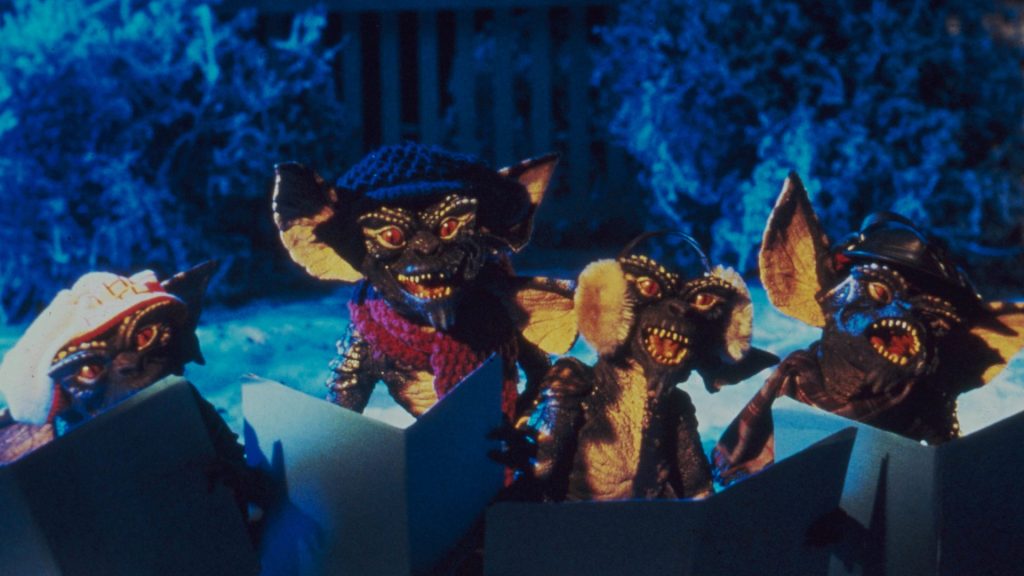
Gremlins masterfully blends horror with satire, using its monstrous antagonists to lampoon a range of cultural and societal norms. The gremlins’ antics, from disrupting Christmas carolers to mimicking iconic scenes from movies, are laced with a sardonic wit that underscores the absurdity of the situations. The film’s dark humour is especially evident in scenes where the gremlins wreak havoc in a local bar, parodying human vices with gleeful abandon.
This satirical edge is a significant reason why Gremlins has endured over the decades. It offers a commentary on consumerism, suburban life, and the veneer of civility that thinly masks our baser instincts. By exaggerating these elements, the film invites viewers to laugh at the absurdity while simultaneously reflecting on the underlying truths.
A Cult Christmas Horror
Despite its summer release, Gremlins has since become a staple of Christmas viewing, carving out a unique niche as a cult holiday horror film. The movie’s setting during the festive season, complete with snowy landscapes and twinkling lights, provides a stark contrast to the chaos unleashed by the gremlins. This juxtaposition heightens the film’s impact, blending the cozy familiarity of Christmas with the unexpected terror of a gremlin invasion.
The festive backdrop also amplifies the film’s themes of family and tradition, albeit through a twisted lens. From the heartwarming relationship between Billy and Gizmo to the darkly comedic mishaps involving Christmas decorations and carolers, Gremlins offers a refreshingly unconventional take on holiday cheer.
The Prognosis:
Four decades on, Gremlins remains a beloved classic, celebrated for its innovative blend of horror, humour, and social commentary. Its enduring appeal lies in its ability to entertain while provoking thought, making us laugh even as we shudder at the chaos on screen. As we revisit this gem on its 40th anniversary, it’s clear that Gremlins is not just a film about mischievous creatures; it’s a timeless observation of human nature, cleverly disguised as a holiday horror-comedy.
There is an inherent fear that we hold deeply of our fellow ‘man’ and the extremes of depravity that we go to away from the confines of urban security. It seems that the further or deeper we go into the backwoods or remote locations, the greater our fear becomes. At the turn of the seventies, now prominent film director Steven Spielberg exposed those fears in the open road, hauling ass from an unknown truck driver across the vast landscape of the US for Duel; John Boorman took the love of adventure and male bonding across the riverways into more dark terrain in Deliverance; and Terence Malik offered up a slice of teenage runaways on a killing spree in South Dakota in Badlands, but it didn’t stop on US soil. In Britain they amped up the fear of folk stories by subjecting its audience to the remote Scottish island of Summerisle in The Wicker Man; and in Australia Peter Weir was serving up some outback disturbance as political commentary for The Cars That Ate Paris. It was a growing trend that was steadily getting darker.
Arguably it was in 1974 that close scrutiny was cast on the unknown and sheltered parts of the country, and a family feasting on travellers to fuel their appetite in The Texas Chain Saw Massacre that would throw turmoil into the mix and slowly craft out the slasher sub-genre. A master of horror, Wes Craven would pick up that agitation baton and run with it for The Hills Have Eyes, casting everyday white American family against a mutant inbred family set in the heart of the Californian desert to really shake us to the core. From here on in, the audience had hillbilly horror to contend with as a new playing field for the genre.
As we etch our way into the late seventies and early 80s, the raw appeal was on show to explore through I Spit On Your Grave; Tourist Trap; and the birth of slasher itself in Friday the 13th. The eighties would then play around with this concept with similar fodder in The Burning; Don’t Go In The Woods; and Just Before Dawn. It wouldn’t be long before the subject would be made lightly and Troma Entertainment didn’t disappoint with the horror comedy, Redneck Zombies to combine this trepidation and mix it with the undead.
The nineties would prove a lonely trail until we would be taken off the road and onto an unbeaten track in 2003’s Wrong Turn, a film that has somehow spawned six follow up features. Now, this may be a contentious point but it still stands strong twenty years on to me for nostalgic purposes and no amount of tree-leaping naysayers can sway me from this opinion. And while part of my reasoning may swiftly be driven by the casting of Eliza Dushka its heroine (still a Faith fan and not in the Buffy camp), but also with a pre-Dexter Desmond Harrington and a post Clueless Jeremy Sisto in its fold. And that’s not to mention a Queens of the Stone Age track in the soundtrack to complete the auditory reckoning, and some of the team from Stan Winston studios to add the gloss and gore. Sure it’s twee horror, but it continued this trend of hillbilly horror, satiating those needs and passing on the baton again for more comedy visions in Tucker and Dale vs Evil, and full out gross horror in the remake of The Hills Have Eyes by Alexandre Aja, bringing us full circle again.
The subject is here to stay as long as our fear remains, and in a post COVID world combined with our isolated lives, surviving or not through cyber connections, surely that fear will only grow stronger and thrust us into a whole new realm of revulsion. Hopefully this will pave way for more creativity to force us on the path of destruction and desolation.
100 years ago the Roaring Twenties came into effect with a social and economic boom that pushed the boundaries of experimentation and exploration dubbing it the crazy years.
Cinema has evolved greatly during this time and spawned Robert Miene’s silent horror in German Expressionism, which is still considered a classic among some critics.
While the tides have shifted and the boundaries of what is classified as horror has twisted through the years, moving numerous debates and discussions along the way, we come to a time when originality can be hard to come by, or perhaps the audience has become too critical and our perceptions have changed.
Can the films of today cause a deeper development in the genre that we’ve come to love and like the films that were born a century ago stir the insanity again and break new ground in the process?
Let’s look at what 2020 has in store and see if indeed it will deliver.
This film has led some early reports to compare it to Alien but in the ocean deep instead of the far reaches of space. It does boast Kristen Stewart in the cast who may divide audiences and has been a bit hit and miss of late in her film choices but she is supported in this instance by Vincent Cassel, who is known for choosing experimental films. Does this then mean that this team of underwater researchers will uncover not only a few beasties but also break new ground in the process?
Prediction: Neither sink or swim. A drifter that will entertain some but not cast anything new into the cinematic landscape.
Jan 24 – The Turning
Based on Henry James novel, The Turn of the Screw and produced by Steven Spielberg, it stars Mackenzie Davis (Terminator: Dark Fate) and Finn “Can my hair grow any longer?” Wolfhard (Stranger Things) and bears close scrutiny as director Mike Flanagan (Doctor Sleep) is set to release an interpretation of the novel in Netflix series, The Haunting of Bly Manor, his follow up to the successful The Haunting of Hill House.
Prediction: Director Floria Sigismondi will no doubt bring some artistic visual flair that is evidence from her music videos, but could possibly fall foul of “popcorn syndrome” – Light, fluffy with a bit of crunch and serves the masses, but ultimately has no substance.
Initially I was really excited about this release, being a fan of the Ju On franchise, plus Nicolas Pesce’s work with The Eyes of My Mother, and Piercing. Both movies have pushed the boundaries of comfort and shot in stylistic fashion that I was keen to see where Pesce would take The Grudge. Early reports haven’t been favourable however, so it could be another disappointment in the first month of the new decade.
Prediction: Could be another franchise instalment too many. The name alone will pull in the numbers, yet may not hit the mark on the scare front.
Jan 31 – Gretel and Hansel
It’s been over 200 years since The Brothers Grimm fashioned the fairy tale about a cannibalistic witch that kidnaps two children roaming in the woods. The fact that it is still resonates today is a testament to the strength of the storytelling and it will be interesting to see the story told from the perspective of Gretel played by Sophia Lillis (IT) who has already proved compelling as the young Beverly Marsh.
Prediction: Better than your average fair without necessarily offering anything new or compelling with the horror genre.
Some may argue its place in this list, but it is billed as a psychological horror and director Robert Eggers has already made a name for himself in the artistic expressionism world within the genre with his debut feature, The VVitch, a film that also divided audiences. American audiences have already seen the movie too as it was released there last year, but as yet Australian audiences are still to see Eggers’ sophomore outing which pits Willem Defoe and Robert Pattinson against one another in a battle of wills and sanity in a remote and confined island.
Prediction: Will wow audiences looking for the alternative and alienate those more into the mainstream. Either way, both audiences will applaud the performances and Eggers and cinematographer Jarin Blaschke will paint a stunningly beautiful canvas.
Feb 13 – Fantasy Island
Blumhouse Productions are about to shake things up again by breathing new life into a cult 70s tv series. With a star-studded cast – Michael Pena (Crash), Maggie Q (Nikita), Lucy Hale (Pretty Little Liars), and Michael Rooker (Henry: Portrait of a Serial Killer). On an island where your fantasies come true, only to turn into nightmares and the guests must figure out its mystery in order to survive.
Prediction: Another success for Jason Blum and the team which will connect with the cinema-going public. If it’s played right, it could offer a fresh take using a blend of fantasy and horror that could also spark a franchise
Feb 21 – Brahms: The Boy ll
This one is a bit of an oddity. Whilst its predecessor was a middle of the road affair and proved to be better than expected. It did feel like a one-off movie that didn’t necessarily warrant any further journey into the world of Brahms. A sequel is here though and will pick up with the doll being discovered by another family.
Prediction: A flop that will fall by the wayside and may not even make a blip on the radar.
Feb 27 – The Invisible Man
Another Blumhouse movie, this time in collaboration with Universal to resurrect their monsters franchise after the abysmal Tom Cruise vehicle from a few years ago. In what is potentially a ripe and current topic being explored in domestic violence as its central theme The Invisible Man boasts a cracking cast with Elisabeth Moss taking lead duties. It’s also in great hands with director Leigh Whannel steering the ship following his successful movie Upgrade from last year, plus Whannel is a storyteller, so expect a decent script to boot.
Prediction: The first big success of the year bringing the Universal monsters franchise back on track and paving the way for future projects with The Bride, Renfeld, The Invisible Woman, and Frankenstein.
Mar 20 – A Quiet Place Part 2
The question is whether director John Krasiniski can repeat the winning formula from the first movie. This War of the Worlds style feature with an audio twist is more sci-fi than horror, but with the family in plight scenario held a strong connection with the audience. How will this translate now that there is an absent father?
Prediction: Cillian Murphy will provide some much needed gravitas to the narrative which will be strong enough to lift the audience through with some decent ups and downs to wrench up the tension.
Apr 3 – The New Mutants
Since Disney took over Marvel operations, The New Mutants has been stuck in production, deemed a little dark for the House of Mouse questioning how to distribute it. The feature comes across as The Dream Warriors crossed with the X-Men and centres on 5 young mutants held in a secret facility against their will. It also boasts a cracking cast with Maisie Williams (Game of Thrones), Anya Taylor-Joy (The VVitch, Split), and Charlie Heaton (Stranger Things).
Prediction: Despite several delays I feel that this film is gonna connect in a big way and pull in a lot of people. It just depends on how dark Disney are willing to go with it.
Apr 17 – Antlers
Little is known about this movie other than it is based on a short story by Nick Antosca the creative mind behind the Channel Zero anthology series. The screenplay must have some potential to have caught the eye of Guillermo Del Toro and put his name down as producer.
Prediction: With Keri Russell in the cast to provide the fantasy elements in reality, this could well be the surprise hit of the year.
May 15 – Saw reboot
Currently titled The Organ Donor starring Chris Rock, Samuel L. Jackson and Max Minghella this reboot of the Saw franchise will see the return of the Jigsaw Killer, but without Tobin Bell… I think? With director Darren Lynn Bousman at the helm once more following his turn overseeing parts 2-4, he is no stranger to the world.
Prediction: Will put bums on seats for the shock gore factor alone, but will the buddy cop drama approach pay off? Time will tell.
Jun 11 – Candyman
This is gonna be a tough one to watch for me as I am such a huge fan of the original movie and like Freddy, Candyman would haunt my dreams for a long time after viewing. A lot of that has to do with the strength of Clive Barker’s short story coupled with Tony Todd’s personification of the titular character. Part of me is willing for this to be a success though as I can see room for the movie to be delivered to a modern audience using folklore and mythology at its core, and the storyline itself can transcend easily through the ages. It will be interesting to see a female perspective in director Nia DaCosta to follow Helen’s journalistic investigations.
Prediction: Jordan Peele has attached his name to this project and is clearly passionate about the story, but one can’t help but feel this is one step too far in rekindling the old flame that resides within the Candyman story.
Jul 2 – Ghostbuster: Afterlife
I know it’s technically not a horror film, but I’m including this in the mix for its nostalgic value in me the original movie paved the love of horror that I have and opened the door to many more glorious visions in the genre ever since. The original team will return in some shape or form, but primarily the film centres around a mother and her two children who set up on a farm only to discover something paranormal lurking in the town.
Prediction: Another film that will be resting on the merits of the first film, and while it’s great to see Jason Reitman take on the franchise following in his father’s footsteps, one can only hope that there will be enough comedy, horror and sci-fi to capture that old magic, but I think it will just be a glimmer rather than that sparkle.
Jul 10 – The Purge 5
Supposedly returning for the final instalment the 12 hour no holds-barred, crimefest ignited something in the movie-going audience. It has seen five feature length instalments and 2 seasons.
Prediction: More of the same, so if you’re a fan of the series, you’ll love it. I for one think the films are fun and enjoyable and it will be interesting to see how James DiMonaco will conclude things.
Jul 30 – Morbius
Sony has promised to take the Marvel universe into dark territory before with Venom and here they intend to do so again with Morbius, the Living Vampire. Jared Leto will no doubt bring the goods for the titular role and is in good company with Matt Smith, Jared Leto, and Tyrese Gibson.
Prediction: Director Daniel Espinosa provides great entertaining and solid movies, such as Safe House and Life, and I see no change here to his formula, but still question if they can go dark enough to make it compelling for horror fans.
Sep 11 – The Conjuring 3 aka The Conjuring: The Devil Made Me Do It
The Conjuring universe has progressed in leaps and bounds since its initial release in 2013. There has been the odd blips, but essentially the films continue to entertain and scare audiences. This latest film will once again see the Warrens at the centre of proceedings, this time with one of their most publicised cases that bore witness to Arne Cheyenne Johnson claiming that he was possessed when he murdered.
Prediction: Solid acting, tight storyline, but may fall down with its delivery and exposition. Unfortunately Director Michael Chaves didn’t deliver with The Curse of La Llorona, so I fear that this may end up in a similar way, but am still willing to give it a chance.
Sep 17 – Last Night In Soho
Not much known about this one, but Edgar Wright has a knack for tapping the pulse of classic films and adapting their essence for a modern audience. This time around the psychological horror is inspired by Don’t Look Now and Polanski’s Repulsion both high in my all-time favourite lists
Prediction: A killer cast in Anya Taylor-Joy, Matt Smith, Diana Rigg, and Terence Stamp, this could be the ‘big hit’ of the year.
Oct 15 – Halloween Kills
In 2018, David Gordon Green, Danny McBride and Jason Blum attempted the impossible, the resurrection of Michael Myers that would connect both fans of the original and connect with a new audience. By delving into the subject of trauma and the impact that this has on its victims, Myers became both topical and harrowing. His sheer brutality and the force in which he attacks his victims made his carnage all the more disturbing.
Prediction: The name and sheer presence of Myers will bring the audience to the screens, but can they still make him relevant? They can’t rest on the nostalgic nods this time around. It’s a fine line to walk on, for if they get it wrong, they could find their final instalment, Halloween Ends a tricky sell.
TBC – Army of the Dead
For sheer shits and giggles, and action-pumped mayhem from visual storyteller Zack Snyder, about a group of mercenaries who decide to rob a casino during a zombie outbreak, this film concludes our list.
Prediction: Starring Dave Bautista, Army of the Dead will be entertaining if nothing else. A perfect answer for those just wanting to get their kicks and not have to think too deeply.








 Surgeons of Horror