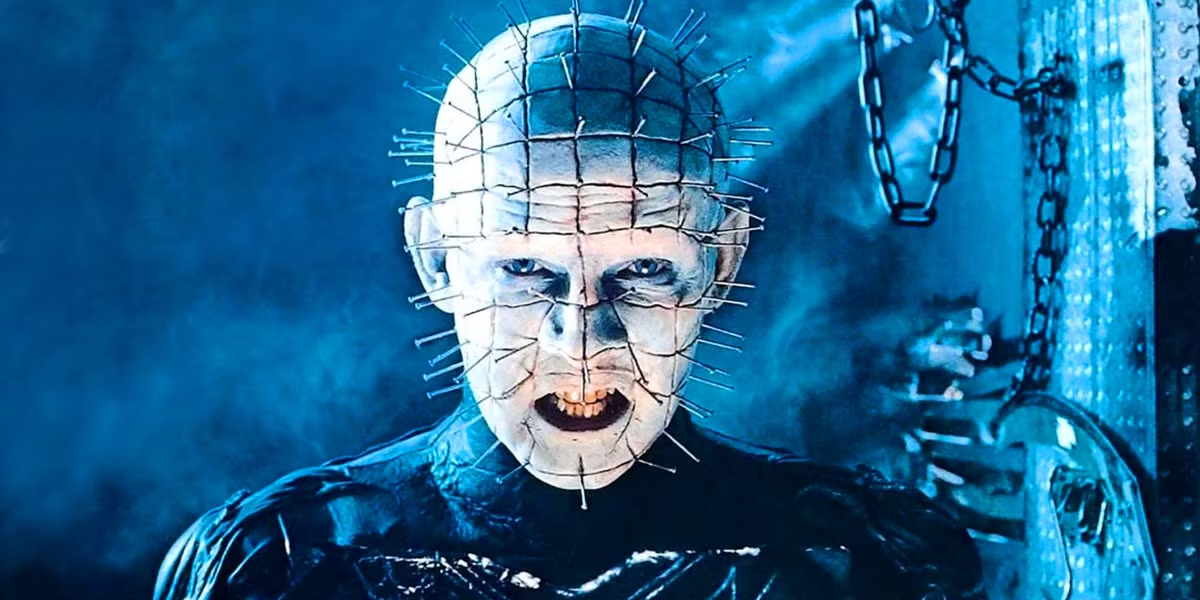
Dead Eyes and Dim Hopes: 30 Years of John Carpenter’s Village of the Damned

Tags

, , , , ,

This cold, contract-bound remake fails to capture the chilling essence of its source — but still boasts moments of eerie charm and unexpected star power.

When Village of the Damned landed in cinemas in 1995, it was already staring down the impossible — updating a revered British sci-fi horror tale (The Midwich Cuckoos by John Wyndham) and stepping into the shoes of the eerie, monochrome classic from 1960. And despite the might of genre legend John Carpenter behind the camera, the result was a forgettable misfire, marked by studio compromise and artistic disinterest.

The story still carries a chilling premise: a mysterious force knocks out a coastal town in California, and shortly afterward, every woman of childbearing age turns up pregnant. The children born from this strange phenomenon are pale, intelligent, and utterly devoid of empathy. It’s fertile ground for psychological horror and social allegory — but this version mostly settles for surface-level spooks and some unfortunately lifeless storytelling.

Christopher Reeve (in what would be his final film role before his tragic accident) brings dignity and gravitas as the town’s conflicted doctor, while Mark Hamill, in an uncharacteristically stern role, plays the local reverend. Seeing Superman and Luke Skywalker in the same frame offers a brief thrill for fans, but even their presence can’t overcome the flat tone and narrative inertia. Lindsay Haun as Mara, the children’s chilling leader, is one of the few bright spots — channeling icy menace with a gaze that deserves better framing.

Carpenter himself later admitted that Village of the Damned was a contractual obligation — and it shows. Absent is the spark of passion or innovation that shaped his earlier masterpieces. Even the usually standout Carpenter score feels half-hearted, composed in collaboration with Dave Davies of The Kinks but largely forgettable. What little levity the film does offer comes in moments of unintentional humour or scenery-chewing camp, rather than any clever writing.

And yet, there’s something strangely watchable about it. Maybe it’s the morbid curiosity of watching a great filmmaker go through the motions, or the way the story’s unnerving core still peeks through the cracks — a disturbing parable about control, conformity, and fear of the unknown. But in the end, this Village feels more like a ghost town.

  • Saul Muerte

Whispers in The Mad Room: A Slow-Burning Descent into Familial Fear

Tags

, , ,

This under-the-radar 1969 thriller simmers with quiet dread and strong performances, even if it never fully embraces its madness.

In the shadow of better-known psychological thrillers of the 1960s, Bernard Girard’s The Mad Room sits in a strange limbo — a Gothic-tinged chamber piece that doesn’t quite unravel as boldly as its premise promises, but nonetheless simmers with intrigue, dread, and the occasional jolt of melodramatic madness.

A reimagining of Ladies in Retirement (1941), the film casts a young Stella Stevens as Ellen Hardy, whose attempt to build a respectable life is threatened by the sudden return of her institutionalised siblings. With a wedding on the horizon and a matriarchal employer (a scene-stealing Shelley Winters) to appease, Ellen’s composure begins to unravel as past horrors threaten to bleed into the present — culminating in a suspicious death and an ever-darkening sense of claustrophobia.

While The Mad Room never fully descends into the psychological chaos it flirts with, it crafts a tense atmosphere within the confines of its limited setting. Girard’s direction is largely restrained, letting the performances do most of the heavy lifting, particularly Stevens, whose nervous energy gives the film a pulse even when the pacing sags.

However, despite its sinister setup and a few genuinely unsettling moments, the film doesn’t push far enough. Its secrets are telegraphed too early, and the final revelations feel like a missed opportunity to truly shock. The film lingers just on the edge of greatness, unwilling to let itself go mad.

For fans of slow-burning, character-driven thrillers with a taste for domestic unease and lingering trauma, The Mad Room offers a slightly underappreciated detour into late-60s psychological horror — flawed, yes, but not without merit.

  • Saul Muerte

Ash (2025): A Sensory Voyage from a Singular Artist

Tags

, , , , , , , , ,

Flying Lotus has never been a filmmaker to colour inside the lines. With Kuso (2017), he exploded onto the scene with a hallucinogenic blend of body horror, surrealism, and sound design that dared viewers to stick with it—or run screaming. With Ash, he reins in the chaos just enough to create what is arguably his most accessible film to date, while still packing it with enough aural and visual flourishes to remain unmistakably his own.

Set on a remote planet and anchored by a creeping sense of cosmic dread, Ash follows a woman (Elza González) who wakes up to find her crew slaughtered and must unravel the mystery before a darker truth consumes her. It’s a premise steeped in sci-fi tradition, but Flying Lotus isn’t here to offer a straightforward space thriller. Instead, he weaves a waking dream of sound and vision—atmospheric, meditative, and disorienting in equal measure.

The real marvel is in the film’s sensory layering. The soundscape—unsurprisingly exquisite—is a collage of ambient dread, industrial echoes, and meditative melodies that feel like transmissions from another dimension. As a musician, Flying Lotus has always been a sound alchemist; here, he pushes that instinct into the very bones of the film.

Elza González gives a committed, emotional performance that grounds the film’s cerebral tendencies. It’s largely her show, and she rises to the occasion with a mix of vulnerability and resolve. Aaron Paul appears in a supporting role that brings both tension and quiet depth, acting as a counterpoint to González’s isolation and inner turmoil.

The film’s Achilles’ heel is its plot. Beneath the rich surface textures and hypnotic editing, Ash tells a story that is familiar, even predictable. But it’s cleverly concealed beneath the stylistic veneer, like a well-worn book with a mesmerising new cover. There’s craft in how Flying Lotus reshapes and recontextualises sci-fi horror tropes, but at times, it feels like style just barely holding up a sagging structure.

There’s no denying Ash is a step forward—a distillation of Flying Lotus’s eccentricities into something more narratively digestible while retaining his unique artistic stamp. For fans of bold sci-fi that dares to flirt with the abstract, Ash may not be the deepest story, but it’s one hell of a ride through an artist’s ever-evolving mind.

Ash is currently streaming on Amazon Prime.

  • Review by Saul Muerte

Sinners (2025) Burns Slow, Strikes Deep: A Southern Gothic Horror for the Soul

Tags

, , , , , , , , , , , ,

Ryan Coogler’s masterful period horror blends haunting performances, rich character work, and a chilling exploration of generational trauma in 1930s Mississippi.

Ryan Coogler’s Sinners is a searing slow-burn period horror that dances with dread and walks hand-in-hand with grief. Set in the Mississippi Delta in 1932, the film follows twin brothers Elijah “Smoke” Moore and Elias “Stack” Moore—both masterfully portrayed by Michael B. Jordan—as they return home to bury their past and sow new beginnings. What they unearth instead is a long-dormant evil that has been waiting, watching, and whispering ever since they left.

The true triumph of Sinners lies in its narrative depth and the emotional complexity that Coogler and his cast mine from every silence, glance, and haunted memory. This isn’t just a horror film—it’s a reckoning. Coogler, whose storytelling instincts have never been sharper, peels back layers of trauma, familial guilt, and the deep-rooted scars of racism, infusing the piece with a quiet fury and poetic sorrow. The horror grows from within, shaped by generations of silence and sorrow, before it ever manifests as something supernatural.

Michael B. Jordan’s dual performance as the Moore brothers is nothing short of riveting. As Smoke, the reformed bootlegger-turned-father haunted by regret, and as Stack, the charming yet damaged twin desperate for purpose, Jordan crafts two fully realised personas that often share the screen but never blur. It’s a feat of nuanced acting that few could carry off with such clarity and emotional intelligence.

Hailee Steinfeld is quietly devastating as Mary, Stack’s ex-lover who embodies both the warmth of a past life and the cold reality of its collapse. Miles Caton delivers a breakout performance as Sammie “Preacher Boy” Moore, a cousin torn between faith and family, while Wunmi Mosaku brings aching humanity to the role of Annie, Smoke’s wife, whose inner strength glows amid the encroaching darkness.

Visually, Sinners is a stunning amalgamation of Southern Gothic decay and modern horror stylings. Coogler references films like The Thing and From Dusk Till Dawn not through mimicry, but through spiritual succession—mood, tension, and a willingness to go where many fear. He weaves these references into the very fabric of 1930s America, evoking a time where the devil wore not just horns, but hoods. The racist undercurrent of the era isn’t just backdrop—it’s part of the horror itself, as oppressive and insidious as any demonic force.

Ludwig Göransson’s score is another masterstroke—an eerie, pulsating blend of Delta blues, spirituals, and ambient dread. It doesn’t just accompany the film; it guides it. The music conjures the Devil at the crossroads, the sorrow of the land, and the weight of sin—historical, personal, and inherited.

Sinners isn’t a film that offers easy scares or tidy conclusions. It’s a powerful, slow-burning descent into a uniquely American hell—one born of blood, legacy, and the terrible things we choose to bury. Coogler has delivered something rare: a horror film with heart, history, and heat. A Southern ghost story for our times—and for all time.

  • Saul Muerte

“The devil don’t wait in the shadows. He walks the road with you.”

Cherry Falls Trips Over Its Own Premise

Tags

, , ,

A provocative twist on slasher tropes can’t save this Scream-inspired misfire, despite strong turns from Brittany Murphy and Michael Biehn.

Cherry Falls arrives on the heels of the late ’90s slasher revival, clearly aiming to ride the wave created by Wes Craven’s Scream, but instead crashes headfirst into its own uneven tone and underwhelming execution. Released in 2000, Geoffrey Wright’s high-concept horror flick flips the slasher trope on its head — targeting virgins rather than the sexually active — yet it ultimately lacks the finesse or wit to carry its premise beyond surface-level shock.

The film is buoyed, in part, by the late Brittany Murphy’s off-kilter, captivating presence as Jody Marken. Her performance injects the film with some much-needed emotional depth and unpredictability. Alongside her, Michael Biehn brings a grounded seriousness as the town sheriff, delivering a performance that feels like it belongs to a more sophisticated script.

However, despite its intriguing central idea and flashes of satirical promise, Cherry Falls struggles with identity — caught between wanting to parody slasher tropes and simultaneously embracing them without the cleverness that made Scream a genre-defining success. Its tonal inconsistency makes it feel more like a pale imitator than a bold reinvention.

By the time the third act rolls around, the film loses what little momentum it had. A rushed and weak resolution undercuts any tension or investment, leaving viewers with more questions than satisfaction. It’s a finale that feels as though the filmmakers ran out of time — or worse, ideas.

Cherry Falls is a curious relic of post-Scream horror, notable more for its cast than its execution. Brittany Murphy’s performance remains its most memorable asset, a haunting reminder of a talent taken too soon. But beyond that, the film fails to leave much of a lasting impression.

  • Saul Muerte

Into the Fog: Fréwaka: Fréamhacha Drifts Through Grief and Myth

Tags

, , , ,

Aislinn Clarke’s hypnotic folk horror enchants the senses, but its symbolic weight and languid pace may leave some viewers lost in the mist.

Aislinn Clarke’s Fréwaka: Fréamhacha is an Irish folk horror steeped in grief, mythology, and atmosphere — a hypnotic, slow-burning tale that seduces the eye even as it keeps the heart at a distance. Cloaked in shadows and silence, the film follows Shoo, a care worker carrying her own unresolved pain, who’s sent to a secluded village to tend to an agoraphobic woman terrified of both her tight-knit neighbours and the Na Sídhe — ancient, otherworldly beings from Irish folklore.

Clarke, previously lauded for her sharp direction in The Devil’s Doorway, leans further into abstraction here. The cinematography is stunning, bathed in misty blues and deep greens, echoing the isolation and fractured psyche of its characters. Symbolism runs thick, and the film often feels like a visual poem mourning lost time and personal trauma.

But where Fréamhacha excels in tone, it falters in engagement. Narrative threads unravel into the ether, characters remain emotionally remote, and the pacing — glacial by design — asks more patience than it rewards. For all its visual allure and thematic ambition, the film’s dreamlike drift can feel aimless, as if lost in the very fog it conjures.

Clarke’s vision remains singular. Fans of folk horror who appreciate the meditative and the metaphorical may find something to latch onto. But for others, Fréamhacha risks becoming a beautiful but intangible whisper — haunting, yes, but fleeting as smoke in the trees.

  • Saul Muerte

The Woman in the Yard: Rooted in Atmosphere, But Lacking in Fear

Tags

, , , , , , ,

Danielle Deadwyler shines in this moody supernatural tale, but Jaume Collet-Serra struggles to fully unearth the horror at its heart.

Twenty years after House of Wax melted into mediocrity, director Jaume Collet-Serra returns to the horror genre with The Woman in the Yard, a moody, slow-burn supernatural tale that teases tension but never quite takes root. There’s a welcome sense of restraint this time around — a desire to craft something more grounded, more psychological — but the final product ends up feeling more undercooked than unnerving.

Danielle Deadwyler is the anchor of the film, delivering a committed and emotionally charged performance as Ramona, a grieving widow attempting to hold her family together after her husband’s sudden death. Deadwyler brings texture and soul to every scene she’s in — her presence commands attention and breathes life into an otherwise uneven script. Whether she’s shielding her children from the unknown or confronting her own internal anguish, she elevates the material with quiet fury and vulnerability.

The premise has potential: a mysterious woman appears on the property — expressionless, enigmatic, and perhaps not entirely human. The creeping dread builds in the first act with genuine intrigue. But instead of snowballing into something harrowing, the film meanders, content to rely on vague symbolism and atmospheric shots without connecting the emotional stakes to the horror elements. The titular woman remains more concept than character — a spectral threat with no real grip on the narrative beyond metaphor.

Collet-Serra shows flickers of maturity here, eschewing the slick gore of his early career for something more intimate and slow-burning. There are shades of The Others and even Relic in the DNA, and a few sequences — particularly a late-night confrontation hint at the film this could have been. But despite these improvements, The Woman in the Yard never fully comes into focus. The tension dissipates rather than crescendoes, and by the final act, the film seems content to whisper instead of scream.

It’s not a disaster — far from it. But with such rich performances and a potent setup, it’s frustrating to watch it all drift into the mist. Ultimately, Collet-Serra has taken a step forward in his genre evolution, but this yard still needs some serious tending.

  • Saul Muerte

Two Undercover Angels (1969): Painted Corpses and Pop Art Piffle

Tags

, ,

Jess Franco’s Two Undercover Angels serves up mod-era sleaze with a wink and a shrug, but its psychedelic style can’t disguise the limp thrills underneath.

As far as Euro pulp oddities go, Two Undercover Angels—aka Rote Lippen, Sadisterotica—might be one of Jess Franco’s more playful deviations. On paper, it’s a mod-era mash-up of pop art, pulp thrills, and soft sleaze: two stylish female detectives from the “Red Lips” agency are on the trail of missing models and dancers. Their investigation leads them to Klaus Thriller, a sinister pop artist with a penchant for painting corpses, and his werewolf-esque henchman, Morpho.

But beneath its colourful veneer, Two Undercover Angels struggles to keep its footing. The plot is both wafer-thin and weirdly convoluted, more concerned with psychedelic set pieces and lounge room flirtations than any real sense of momentum. There’s a certain charm to Franco’s anything-goes attitude, but this one too often feels like a parody without punch, skimming the surface of spy pastiche without offering much intrigue.

Still, there’s no denying the camp value. The film is drenched in candy-coloured lighting, groovy outfits, and suggestive camera work that borders on the absurd. It’s Euro camp through and through—like a budget Bond fantasy filtered through a lava lamp and shot on the run. Lovers of kitsch might find some delight in the film’s unabashed frivolity, but those looking for coherence, or even competent thrills, may walk away bemused.

Franco fans will recognise familiar touches: nonsensical plotting, dreamy eroticism, and the ever-present air of detachment. But even by his standards, this feels like an undercooked entry. The “Red Lips” duo never quite click as compelling protagonists, and while Morpho adds a dose of monster movie weirdness, he’s more curious footnote than actual menace.

Two Undercover Angels is a wild title for a limp romp—cheeky in intent but dull in execution. There’s pop-art potential here, but much like Klaus Thriller’s paintings, its mostly just lifeless models draped in excess.

  • Saul Muerte

“Werewolves (2024) Howls Loud, But Barely Scratches the Surface”

Tags

, , , ,

They will hunt you. Unfortunately, so will cliché.

Steven C. Miller’s Werewolves imagines a dystopia where a supermoon-triggered genetic mutation has turned swathes of the human population into feral beasts. It’s been a year since the initial outbreak wiped out nearly a billion people, but as another supermoon looms, the lycanthropic carnage returns—and so does Frank Grillo, flexing his jawline and gritted-teeth charisma in what amounts to The Purge: Lupine Edition.

Despite a premise with potential for social commentary or even fresh horror spectacle, Werewolves settles for the path of least resistance. What we get is a series of repetitive chase sequences, mid-tier digital werewolf effects, and characters who rarely rise above exposition delivery systems or action-fodder. The plot—two scientists failing to prevent another outbreak, then fleeing to a family home—never truly builds tension or stakes beyond the expected, and the dialogue might as well have been generated by an algorithm trained on testosterone and B-movie one-liners.

Grillo, as always, commits with gravelly intensity, but even he seems to be running on fumes. He does his best to anchor the chaos, but his character is paper-thin, and the emotional beats are forced. It’s the kind of role he’s played better—and with more bite—in other low-budget action-horror hybrids.

Thematically, there’s a whisper of something interesting: a post-apocalyptic world grappling with genetic fate, mob violence, and the loss of humanity. But these ideas are brushed aside in favour of blood-splattered shootouts and tough-guy posturing. The result is a film that never quite decides whether it wants to be a creature feature or a survival thriller—and ends up being neither effectively.

Werewolves isn’t without a pulse. There are moments—mostly during nighttime attacks or glimpses of cities overrun—that hint at a more engaging, visceral film. But they’re quickly buried beneath generic set pieces and uninspired direction. The werewolves themselves, while serviceable in design, are too often relegated to background threats, more like cannon fodder than apex predators.

In the end, Werewolves howls loud but rarely lands a bite.

  • Saul Muerte

Ugly Truths and Unforgettable Performances: Revisiting Poor Pretty Eddie at 50

Tags

, , ,

It’s been 50 years since Poor Pretty Eddie first bled onto grindhouse screens—an exploitation oddity so unrelenting in tone, it still rattles the nerves. Directed by Richard Robinson and David Worth, this backwoods fever dream masquerades as a cautionary tale but plays out more like a cultural endurance test. Yet, even within its murky execution and dubious intent, a pair of unforgettable performances rise above the muck.

Lesley Uggams, cast against type as jazz singer Liz Wetherly, is the emotional core of the film. Her portrayal is both defiant and devastating, as her character is stranded, isolated, and ultimately brutalised in a world thick with racial animosity and patriarchal cruelty. Shelley Winters, meanwhile, leans into grotesque Southern Gothic as Bertha, the deluded former starlet whose fading glamour and bitterness curdle into complicity. Together, these two women anchor the film with performances that are far more compelling than the script deserves.

The story is minimal—a wrong turn leads Liz to an isolated Georgia lodge where Eddie, a preening and dangerous wannabe Elvis (played with jittery menace by Michael Christian), holds sway under Bertha’s unstable watch. What follows is a grim and often exploitative descent into humiliation, abuse, and domination.

At the heart of Poor Pretty Eddie lies a scathing, if poorly handled, examination of systemic white supremacy in the American South. The film doesn’t shy away from making race the centerpiece of its tension—Liz’s every interaction is filtered through the hostile gaze of a white society determined to strip her of autonomy. There’s an ugliness to the way this is handled, and a leering sensationalism that taints the message, but the subtext is undeniably there: this is a tale about a Black woman’s body and spirit being colonised, scrutinised, and fought over in a place that sees her as nothing more than an intruder.

What’s most haunting, perhaps, is that the film’s ugliest behaviors and racist ideologies remain deeply relevant. In its raw depiction of institutional and interpersonal racism—especially how it is normalised, ignored, or celebrated by those in power—Poor Pretty Eddie still finds uncomfortable resonance in 2025.

Unfortunately, the exploitative style undermines much of the film’s thematic potential. The gratuitous nature of the violence, the sleazy tone, and the amateurish editing reduce powerful commentary to provocation. The direction is uneven, and the pacing is meandering, trapping viewers in a murky stew of misogyny and nihilism without offering a satisfying critique or catharsis.

As an artifact of its era, Poor Pretty Eddie is fascinating and infuriating in equal measure. But as a film, it buckles under the weight of its own grotesquery. Still, thanks to Uggams and Winters, the film leaves a mark—even if it’s more bruise than breakthrough.

  • Saul Muerte