• About
  • podcasts
  • Shop

Surgeons of Horror

~ Dissecting horror films

Surgeons of Horror

Category Archives: Universal Horror

Movie review: Dracula (1931) Spanish version

04 Saturday Mar 2017

Posted by surgeons of horror in Universal Horror

≈ Leave a comment

Tags

Carlos Villarías, Lupita Tovar, Pablo Alvarez Rubio, Universal Horror

IN MY IGNORANCE I completely dismissed this movie when I first saw it available as an extra on my DVD.

Basically because I decided to have my snob hat on and thought to myself, “What is the point of watching a movie that is a ‘carbon copy’ of the original?”

It was only when I started to pay more attention that I realised that this movie deserves a lot more recognition.

During the early days of sound in film, Hollywood studios would often film foreign language versions of the movie using the the same sets and costumes as the original version.

In this instance, the Spanish speaking cast and crew would film in the evenings once the English version had wrapped for the day.

But here’s the interesting part.

The crew was allowed to see the daily rushes from the English crew and therefore were able to learn and in some cases improve on the original, purely because they were free to experiment and try new ways to shoot the script.

In some cases, critics have praised the movie and proclaimed that technically speaking, it’s a far superior film.

There are some obvious differences that stand both movies apart.

While some of the shots are bold and adventurous for the time, particularly that of Dracula’s first appearance, coming out from behind a coffin surrounded by smoke simply adds to the mystery of his character.

In some cases though it does feel that some of the shots used are there just for the sake of being different and don’t add to the story.

Unfortunately, it does feel that Carlos Villarías (Dracula) and Eduardo Arozamena (Van Helsing) are lesser than there English counterparts.

Let’s face it, it’s hard to top Lugosi’s signature turn at the titular character.

But Pablo Alvarez Rubio cuts a fine turn as Renfield and gives Dwight Frye a run for his money. 

Choosing a more hysterical performance, his descent into madness is a joy to watch.

Likewise is Lupita Tovar, who could rival the likes of Hollywood’s greatest with her grace, beauty, and intelligence.

She steals most of the scenes that she is in and makes the desperation of her male co-stars to save her soul all the more plausible.

A must-see for fans of the genre.

  • Paul Farrell

LINKS:
Dracula Movies on Hammer Horror Productions

Movie review: Dracula (1931)

03 Friday Mar 2017

Posted by surgeons of horror in Universal Horror

≈ 14 Comments

Tags

Bela Lugosi, Dracula, Tod Browning, Universal Horror, Van Helsing

The thirties would prove to be a truly golden era for Universal Pictures opening the way for greatest horror monsters to grace the silver screen ranging from Frankenstein, The Invisible Man, and The Mummy.

Leading the charge though, was one of THE most iconic characters, Count Dracula.

Based on the novel by Bram Stoker, the creature of the night, the nosferatu who oozes charm would need to have an enigmatic personality to portray him.

And Universal would find their man in Hungarian born Bela Lugosi, who made his name capturing the titular character on stage before winning the role for the film, despite not being the first choice.

Cinematic history would be made though the moment Lugosi saunters across the screen and speaks with his authentic Eastern European tones that sent women swooning.

But it wasn’t just Lugosi’s performance that would captivate and would path the way for Dracula to become a classic in its own right.

Almost stealing the limelight from Lugosi came through the guise of Dwight Frye’s maniacal portrayal of Renfield.

His haunting laugh sends chills to the bone and Frye injects enough erratic energy that it pushes the picture forward with adequate momentum and is a delightful contrast to Lugosi’s slow and decisive movements.

Combine that with Edward Van Sloan’s Van Helsing, a performance that set up a precedence for all those that would follow in his footsteps as Dracula’s key nemesis.

Above all of this though, credit should be bestowed upon the director, Tod Browning.

His career had been carved through his strong career, starting in the silent era back in 1917 with Jim Blumbo.

Browning would go on to form a formidable pairing with actor Lon Chaney in a total of 10 films together, including The Unholy Three, and the awesome movie, The Unknown, which also featured Joan Crawford.

Dracula wouldn’t even be Browning’s first foray into the vampire genre, directing London After Midnight four years prior.

He would also go on to direct cult favourite Freaks…“One of us. One of Us!” a year after Dracula was released.

Interestingly though, Browning’s detailed approach was strangely absent and rumours have circulated since that the production was often in disarray.

Browning even left much of the direction with cinematographer Karl Freund although he would never be officially credited for his involvement.

Despite this, the film was ultimately a success and would spawn a series of gothic horror movies that would stretch a further couple of decades and a further five more sequels.

  • Saul Muerte

LINKS:
Dracula Movies on Hammer Horror Productions

Movie review: The Last Performance (1929)

24 Friday Feb 2017

Posted by surgeons of horror in Universal Horror

≈ Leave a comment

Tags

Conrad Veidt, Universal Horror

THE LAST MOVIE of the 20’s for Universal would also be the last performance from German actor, Conrad Veidt for Hollywood when he would return to his home country.

So the title for the film is quite fitting in this respect.

Veidt had already established himself as an actor of his time and has featured in our previous article on The Man Who Laughs, a movie where his facial make-up would bear a fixed grin.

For The Last Performance, Veidt’s portrayal of the sinister magician, Erik the Great is all delivered through the eyes with numerous close-ups to support this.

It’s a stark contrast to the role he played in the afore-mentioned The Man Who Laughs, which is a testament to Veidt’s acting prowess.

In this role, he is a more dominant and commanding figure on the stage, with a level of authority that has come from his abilities as a magician and the magnitude of his success because of it.

So righteous is he, that it seems only natural for him to hold sway over his beautiful assistant, Julie, aptly played by Mary Philbin (The Phantom of the Opera, The Man Who Laughs).

So when a young guy (Mark) enters the scene, trying to steal from Erik, the magician initially takes pity on him and takes him under his wing.

This enrages Erik’s current apprentice, Buffo, who looks to bring down this new protege by any means possible.

Jealousy, love and deception are the names of the game in this film and despite its short running time, packs a lot into the story to make you feel for all the parties involved.

So when Buffo ends up murdered on stage during a magic trick, all eyes are on the new boy in town.

But true love is emboldened as Julie defends her man, leaving Erik to decide who’s fate he should hold power over.

It’s a gem of a movie, held high because of the performance that Veidt brings to every scene that he is in, which is a shame knowing that this was his last in America.

Well worth a watch for any fans of the silent film genre to witness a true master of his craft at work.


  • Paul Farrell


Movie review: The Last Warning (1929)

17 Friday Feb 2017

Posted by surgeons of horror in Universal Horror

≈ Leave a comment

Tags

Linda La Plante, Paul Leni

PAUL LENI would round out his trio of Universal movies with The Last Warning before his death from blood poisoning.

Laura La Plante would also return for both Director and Universal having received success from her most notable role, The Cat and The Canary.

With The Cat and the Canary, Universal planned to recapture that lightning in a bottle moment by re-teaming Leni and La Plante.

The plotline itself is actually quite an interesting one.

5 years ago, a theatre closes its doors when one of the actors is murdered on stage.

A producer then decides to try and solve this mystery by re-staging the play with the same cast, only to have yet another murder occur.

It’s a great concept, filled with intrigue and menace that could play a deeply unnerving spectacle had it been delivered in the right manner.

As it stands though, Leni was unable to ignite that same level of supernatural element from his previous movie and in doing-so, The Last Warning loses the horror element and merely plays out as a mystery, albeit with a good tale.

Unfortunately some of the scenes have been lost in this movie over time, but it still stands a part of the canon in the lead up to Universal’s golden era of horror.

– Paul Farrell


Movie review: The Man Who Laughs (1928)

10 Friday Feb 2017

Posted by surgeons of horror in Universal Horror

≈ 1 Comment

Tags

Conrad Veidt, Paul Leni, The Man Who Laughs, Universal Horror, Victor Hugo

PAUL LENI RETURNS behind the camera to direct the latest horror movie outing for Universal, following on from The Cat and The Canary, but once again, this movie feels more like a melodrama than an out and out horror.

That’s not to take away from the strength of the story which once again focuses on the plight of its main protagonist, a theme that runs strongly through the Universal movies of this time. 

It’s based on a Victor Hugo novel of the same name. Evidently another inspiration to the producers at Universal and perhaps the reason this movie was greenlit following the success of The Hunchback of Notre Dame.

The protagonist this time around would be Gwynplaine, a man who carries a freak-like grin due to Dr. Hardquannone’s surgery permanently scarring his face.

It is an act that is carried out by the order of King James II and the final result of this permanent smile was said to be the inspiration behind one of Batman’s notorious villains, The Joker.

The Man Who Laughs mainly centred on Gwynplaine’s plight and the torch he carries for the blind Dea, played by Mary Philbin.

By a strange turn of events it is uncovered that Gwynplaine is owed inheritance through his lineage and is urged to marry in order to restore the proper ownership of the estate.

Ultimately though, he would turn his back on his fortune in favour of love.

It’s a beautiful story and you can tell that it was wielded by a master in his field. Conrad Veidt plays Gwynplaine with a certain amount of ease and bodies the pain and torture held within with a simple look or gesture of his eyes.

Veidt himself had made a name for himself 8 years early with the silent horror masterpiece, The Cabinet of Dr Cagliari. He would go on to feature in The Thief of Baghdad and Casablanca before passing away at the age of 50.

His performance in The Man Who Laughs stands strong in the Universal Horror canon and deserves its place alongside the movies that the production company was making at the time and had a significant impact on the movies that would follow.

Significantly this is only 4 years away from Bela Lugosi stepping into Dracula’s shoes and making cinema history.

  • Paul Farrell

Movie review: The Cat and the Canary (1927)

03 Friday Feb 2017

Posted by surgeons of horror in Universal Horror

≈ 3 Comments

Tags

the cat and the canary, Universal Horror

ARGUABLY UNIVERSAL’S next choice for the horror genre would be better delivered 12 years later by rival film company Paramount Pictures.

Certainly it received wider recognition.

Still, in 1927, The Cat and the Canary, based on a play by John Willard would serve up as their fourth outing in what later be labelled as Universal Horror.

Hired for directorial duty would be German Expressionist filmmaker, Paul Leni, who would go on to contribute to Universal for a further 3 movies before passing away at only 44 from an untreated tooth infection.

He is a forgotten master of his craft and one can only ask what would have become of him, had he not been cruelly robbed of this world just as he was starting to hit his stride.

For his debut feature for Universal though, Leni would lend his talents to produce a comedy horror gem and iconic for its time in history.

Centred on the tale of millionaire Cyrus West’s last will and testament, this silent feature unfolds across an evening.

However, a second will appears with suggestions that it were laid there by the ghost of Cyrus West which can only be opened in the event that the details in the first will aren’t carried out.

Essentially, all of his estate is to be bequeathed to his most distant relative, Annabelle, played by iconic silent screen star, Laura La Plante.

She must undergo a medical examination declaring her mentally well, failing to do so enacts the second will.

All relatives eagerly eye of her failure in order to get their hands on the fortune.

Throw into the mix, an escaped lunatic known as The Cat, and you have yourself a fun little romper of a story.

The horror element of this movie can be played loosely but does bare the one creepy moment as played in the clip above, but essentially it’s too light for the true horror enthusiast, but still marks an important entry to the canon as Universal begin to pave a way for what was to come.

  • Paul Farrell


Movie review: The Phantom of the Opera (1925)

27 Friday Jan 2017

Posted by surgeons of horror in Universal Horror

≈ 2 Comments

Tags

Lon Chaney, phantom of the opera, Universal Horror

UNIVERSAL HORROR’S follow up to The Hunchback of Notre Dame would continue to see that success flourish further and continue to explore Gothic Literature as its source, this time with Gaston Leroux’s masterpiece.

Once again Lon Chaney would appear in one of his finest on-screen transformations as the titular Phantom and the film would generate over $2million at the box office despite critics generally calling it an average movie.

It has since found its place and recognition as a significant impact in film history by the Library of Congress.

Personally I feel this movie suffers from the similar lag in pace as its predecessor, a fault that is entirely a subject of its time and place.

It’s also hard to reflect upon when you learn that the original ending was to involve the Phantom dying of a broken heart, instead of the ultimate chase sequence and brutal death at the hands of the mob.

Pacing aside, I still can’t help but marvel at the lengths that Chaney would go to in order to become the monsters on-screen and there’s nothing finer than the make-up reveal when the Phantom’s mask is revealed. It’s a credit to his time, commitment and craftsmanship.

If you’re a keen horror movie fan and would like to take a look at one of the genre’s earliest influences in celluloid history, I would highly recommend giving this a go.

If however, the thought of sitting through a silent, black and white feature as too archaic and far-removed from the modern format with all the blood and gore at its highest depiction, then maybe this ones not for you.

As for me, I love to indulge in the genre, no matter what its form.

We maybe that doesn’t include Uwe Boll’s work.

  • Paul Farrell

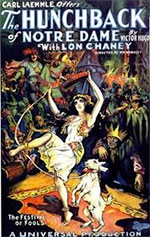
Movie review: The Hunchback of Notre Dame (1923)

20 Friday Jan 2017

Posted by surgeons of horror in Universal Horror

≈ 2 Comments

Tags

Horror movies, Hunchback of Notre Dame, Lon Chaney, Universal Horror, Victor Hugo

hunchback-of-notre-dame

IN 1923 Universal Pictures embarked on a series of horror movies that would stamp their mark on the genre for decades to come.

Their choice of story to launch them into a world of Gothic Horror and literature would be in the guise of Victor Hugo’s 1831 novel, The Hunchback Of Notre Dame. And considering it we’re still talking about a movie in the silent era, the success that the movie received was enormous and understandably would Universal would capitalise on this success.

With every great story though, a great actor would be needed to portray the lead role.

In this instance Universal would score big with “The Man of a thousand faces” Lon Chaney as Quasimodo.

Part of Chaney’s appeal was his devotion to his craft, dedicated to transforming himself physically, particularly with the aid of make up, which helped style his performance of these dark, twisted, and tortured souls.

The movie itself can feel incredibly slow in the first half as Quasimodo is ordered by his master, Johan to kidnap the fair Esmeralda only to be thwarted by the dashing Phoebus, who instantly falls in love with his damsel.

The result leads Quasimodo to be tortured and ridiculed by his captors and the townsfolk.

It’s only in the latter half of the movie when the people start to revolt against the regime and free Esmeralda once again that it really does start to gain enough momentum to keep your interest.

Essentially it’s a tragic tale and if it were not for Chaney’s performance, this would be instantly forgettable.

As such, he carries the movie and his attention to detail and characterisation is a journey worth the wait.

  • Paul Farrell
Newer posts →

Subscribe

  • Entries (RSS)
  • Comments (RSS)

Archives

  • January 2026
  • December 2025
  • November 2025
  • October 2025
  • September 2025
  • August 2025
  • July 2025
  • June 2025
  • May 2025
  • April 2025
  • March 2025
  • February 2025
  • January 2025
  • December 2024
  • November 2024
  • October 2024
  • September 2024
  • August 2024
  • July 2024
  • June 2024
  • May 2024
  • April 2024
  • March 2024
  • February 2024
  • January 2024
  • November 2023
  • October 2023
  • September 2023
  • August 2023
  • July 2023
  • June 2023
  • May 2023
  • April 2023
  • March 2023
  • February 2023
  • January 2023
  • November 2022
  • October 2022
  • September 2022
  • August 2022
  • July 2022
  • June 2022
  • April 2022
  • March 2022
  • February 2022
  • January 2022
  • December 2021
  • November 2021
  • October 2021
  • September 2021
  • August 2021
  • July 2021
  • June 2021
  • May 2021
  • April 2021
  • March 2021
  • February 2021
  • January 2021
  • December 2020
  • November 2020
  • October 2020
  • September 2020
  • August 2020
  • July 2020
  • June 2020
  • May 2020
  • April 2020
  • March 2020
  • February 2020
  • January 2020
  • December 2019
  • November 2019
  • October 2019
  • September 2019
  • July 2019
  • June 2019
  • May 2019
  • April 2019
  • March 2019
  • February 2019
  • January 2019
  • December 2018
  • November 2018
  • October 2018
  • September 2018
  • August 2018
  • July 2018
  • June 2018
  • May 2018
  • April 2018
  • March 2018
  • February 2018
  • January 2018
  • December 2017
  • November 2017
  • October 2017
  • September 2017
  • August 2017
  • July 2017
  • June 2017
  • May 2017
  • April 2017
  • March 2017
  • February 2017
  • January 2017
  • December 2016
  • November 2016
  • October 2016
  • September 2016
  • August 2016
  • July 2016
  • June 2016
  • May 2016

Categories

  • A Night of Horror Film Festival
  • Alien franchise
  • Alliance Francaise French Film Festival
  • Australian Horror
  • Best Movies and Shows
  • Competition
  • dark nights film fest
  • episode review
  • Flashback Fridays
  • Friday the 13th Franchise
  • Full Moon Sessions
  • Halloween franchise
  • In Memorium
  • Interview
  • japanese film festival
  • John Carpenter
  • killer pigs
  • midwest weirdfest
  • MidWest WierdFest
  • MonsterFest
  • movie article
  • movie of the week
  • Movie review
  • New Trailer
  • News article
  • podcast episode
  • podcast review
  • press release
  • retrospective
  • Rialto Distribution
  • Ring Franchise
  • series review
  • Spanish horror
  • sydney film festival
  • Sydney Underground Film Festival
  • The Blair Witch Franchise
  • the conjuring franchise
  • The Exorcist
  • The Howling franchise
  • Top 10 list
  • Top 12 List
  • top 13 films
  • Trash Night Tuesdays on Tubi
  • umbrella entertainment
  • Uncategorized
  • Universal Horror
  • Wes Craven
  • wes craven's the scream years

Meta

  • Create account
  • Log in

Blog at WordPress.com.

  • Subscribe Subscribed
    • Surgeons of Horror
    • Join 227 other subscribers
    • Already have a WordPress.com account? Log in now.
    • Surgeons of Horror
    • Subscribe Subscribed
    • Sign up
    • Log in
    • Report this content
    • View site in Reader
    • Manage subscriptions
    • Collapse this bar
 

Loading Comments...