Since Donald Sutherland pointed his finger and wailed in the closing credits of 1978’s Invasion of the Body Snatchers I’ve loved the whole alien assimilation scene. Currently screening as part of the 2021 Sydney Underground Film Festival comes an Australian voice to the subgenre in An Ideal Host.Channeling that voice is Robert Woods in his directorial feature debut, who fires off on all cylinders with that unique Australian humour, pulling in the words from screenwriter Tyler Jacob Jones and bringing them to life.
Leading what appears to be an idyllic life, Liz (Nadia Collins) and Jackson (Evan Williams)as they set themselves up in a country town with their sweeping views of a serene yet rugged landscape (and cows). There’s a little more going on beneath the surface as Liz seeks to have everything perfect and in place ahead of a dinner party for the close friends, They’ve even rehearsed a wedding proposal to be performed before their guests during the course of the evening. And yet, you constantly question Jackson’s true motives.
All of which comes secondary when an old friend, Daisy (Naomi Brockwell) invites herself along to the occasion with the threat of destroying the tranquility with her wild and unpredictable ways. Daisy would prove to be the last of Liz’s problems however, when further unexpected visitors make their presence known and start to take control of the human bodies and a plan to take over the town and beyond.
What strikes you about this film though besides the comedy beats is the special effects on show, a testament to Woods vision, when the tentacled creatures make their presence felt. The beauty on display though is the way that Woods slowly dials this up through to a carnage-filled conclusion, leaving you grimacing with glee. You can tell that he has honed his craft with an energy that entertains and delights the audience.
The Diagnosis:
Director Robert Woods proves again that Australia has a distinctive voice when it comes to horror. His blend of humour, effects and narrative shine through to the fore. The beats when hit are strong and effective which is orchestrated with precision.
An Ideal Host surprises through the shifts and tones which also proves that Woods can draw you into the narrative before unleashing a gritty, and savagely satisfying end.
Neill Blomkamp is renowned for pushing the boundaries of blending science fiction with modern day storytelling through the lens of cutting edge technology. Having directed some cracking films with District 9, Elysium, and Chappie, Blomkamp’s latest feature, Demonic turns to volumetric capture to tell the narrative is an example of the creative license that he is willing to experiment with.
Our resident Surgeon, Saul Muerte was fortunate enough to catch up with the visionary director to discuss his latest film and how technology has played an important part in molding his storytelling technique for film.
Saul Muerte:
Thanks for taking the time out to talk with us for Surgeons of Horror. I really, really enjoyed the movie and the creative approach that you’ve taken with this one. I just wanted to ask you, um, I mean, I’ve been following your film career for a little while and I’ve noticed that there is this kind of feeling that runs through your movies that’s almost like this infused psychosis, whether it’s alien or humanitarian or mechanoid. And in this case, it’s obviously coming through demonic possession. What is it in your mind that fascinates you about this kind of external manipulation of the human mind in your films?
Neill Blomkamp:
One of the things that is becoming more interesting to me is the idea that there’s like a lying on a psychiatrist’s couch element to directing. I think that these themes, and these ideas become evident to you as the filmmaker over time. So I’m kind of equally curious to try to figure out what that is about. I don’t actually think that I have a conscious onset. I think there’s a bunch of subconscious stuff, maybe. Demonic feels very different to the first two films of mine, and to a lesser degree different to Chappie. It was meant to be something that was much more intimate and smaller scale and kind of living in very close proximity to Carly’s character. And then just going through the process with her. So I think maybe the common theme is some kind of level of redemption, or a sort of cleansing of the soul towards the end of the third act. It’s hard for me to pin down exactly what the similarities are.
Saul:
I do want to touch on the technology aspect that you use with Demonic, because it’s quite a fundamental component. And you’ve been incredibly experimental with your approach to technology over the years. So when you worked with the volumetric capture system in order to realise your vision, what was the greatest challenge that you found using this technology? And what was your biggest learning coming out of it?
Neill:
Well, I mean, this movie is very, very unusual to the way that films are normally made in the sense that there was this gap in time. And there was this thing that I wanted to do, like Paranormal Activity, which was a kind of small self created horror film. And so when you talk about normal films, and the use of technology, it’s usually a case of what would we now use in order to solve this problem? And then you kind of look at it, whatever your options are. This was a case of, I wanted to build something around the idea of using volumetric capture. So the idea of using volumetric capture came before the movie, I also want to do something with these weird Vatican guides that buy up tech companies. So is there a story that can be conjured up so that we can shoot something during the pandemic. I think that if it was a higher budget film, it would have been more difficult to use something as experimental as volumetric capture, because it still looks so glitchy. But if you go forward five years, or definitely 10 years, when that resolution increases to the point that you’re rivalling, you know, traditional film cameras, digital phone cameras, it’ll be omnipresent. There’ll be just every single person who will be using it. It was initially financed by us, I can just do whatever I want and instead of doing another YouTube video, it was like let’s make a longer format piece. And let’s use some of this weird technology and just see how it looks. So I knew pretty much exactly what it would look like because of the resolution constraints which actually came in a bit lower simply because in order to get the resolution higher there would have to be so many cameras close to the action, that it would basically be impossible to really move in any convincing way. So the resolution dies off in a squared fashion exponentially when you move them away, we got the ability to move around and it still has this awesome kind of video game quality to it but resolution dies off is quite quick. So it’s a weird answer, but it’s like the film exists because I felt like using volumetric capture.
Saul:
I think in a way it adds to the character of the piece, so I know you were talking about that kind of glitchy kind of element, but I feel like this adds to the surreal nature that the character of Carly goes through when she’s experiencing that kind of other world factor. Everything kind of ties in really nicely.
I just want to also just go back to District 9 if I may, which was your first feature production. Based on the experience that you’ve picked up over the years, is there anything that you would change with that film? Like, we’re talking about advancements in technology in particular, and stuff that you’ve done along the way. Would you revisit the special effects or the story component and which one of those two weighs heavy in your mind as a creative? What do you think takes precedence? Technology or storytelling?
Neill:
I mean, if you’re doing a high budget film, yeah, well, I mean, pretty much any film it really really should be story first, but it’s kind of like a Venn diagram, it’s like, you’d have to have you have to have a story. And then you also because it’s a visual medium, you also have to have some kind of interesting visual components to it.. And when you overlap, good story with good visuals, you get this kind of matrix sweet spot. Yeah. So that’s kind of how I think of it. But I definitely wouldn’t have arrived at this film, if I was at a higher standard budget level, because it’s just such a different, almost incomparable thing. But I think your question in terms of District 9 is pretty interesting, because I don’t actually think I would change anything. And the other thing that’s interesting is, if I were to shoot another District 9 today, there isn’t any other technological way of doing things that would be radically different, which is super fascinating. So when we shot it, there was this debate where the first way that we were thinking of shooting it was a lot more like how Planet of the Apes did this. And it was kind of revolutionary, where they put motion capture cameras outside of the studio, and they put them in the wild, I think it was actually also in British Columbia. They put them in trees and stuff in the wild, and then they motion captured whoever was playing the apes, and then you know, add the VFX later. So with District 9, we couldn’t afford that approach. And so we ended up doing something that I actually prefer infinitely more, which is a process of growth automation, where you just film your actor, there’s no motion capture dots. There’s like there’s no motion capture cameras, because we couldn’t really afford them. But you just film your actor in a grey lycra outfit. And the benefit is that you get to knock things over in real life and interact with stuff. And then hand animation is done. Almost like classical rotoscope animation, except with a three dimensional rig on top of your character, your human character, your human performer. And then once that skeleton is animated, you put your digital alien on top, and then you have to actually go through this other process which is a cost addition, which is background restoration. So you have to paint out your grey suit guy who’s lying under the alien that now has his, you know, rota mated information embedded within it.
Saul:
Yes, fascinating. I absolutely loved that film. I’ve been kind of following your career since District 9, because I feel like you have this way of cutting through the storyline with this creative, technological aspect that you bring to your films.
Saul:
If we can come back to Demonic, one thing that I found was that the story seems to centre around this idea of trust, and our preconceived ideas of people due to our own kind of misgivings. Is there a message here about going into or letting go of control in order to find ourselves?
Neill:
Yeah, I think one of the concepts that I was interested in was the idea of, like, objective truth. And people coming at topics from different points of view that can sort of be almost equally truthful, depending on the point of view. But there is only one form of truth ultimately. And so I think there’s a sort of subconscious element maybe of those themes kind of bubbling to the surface in the sense that Carla’s sort of overcoming something. I wanted her to be triumphant in a way that she’d overcome the paradigm that was put in place for her, I definitely have some issues with objective truths.,
Saul:
Yeah, that’s kind of my take on it as well. And that’s what I really liked about her journey. And the way there’s obviously this investigative nature, as she’s trying to uncover the truth behind what lay in the past, particularly with her mother. I found it really quite fascinating about Demonic when you come into it, knowing the components that build the film, it kind of makes it a really fascinating journey to watch and see that kind of those elements come into play. And I’m really excited about it. I’m really hoping that it does well for you, Neil. So thank you so much for your time. and talking with us at Surgeons of Horror.
Demonic will be available to stream across all key digital channels from September 15 and on DVD/Blu-ray from 22 September.
Neill Blomkamp is possibly one of the pioneers in modern creative and technological filmmakers and his latest offering Demonic has sought him to look beyond the lockdown restrictions to produce a film that could still test his innovative storytelling techniques through a new medium. His choice of flexing his vision is through volumetric video capture technology.
There are some curious elements that weave together though the narrative which has a mix of grit or raw energy to it and equally the volumetric video capture used is glitchy and unpolished, something that Blomkamp openly admits, but this for me is part of its appeal and gives substance to the film.
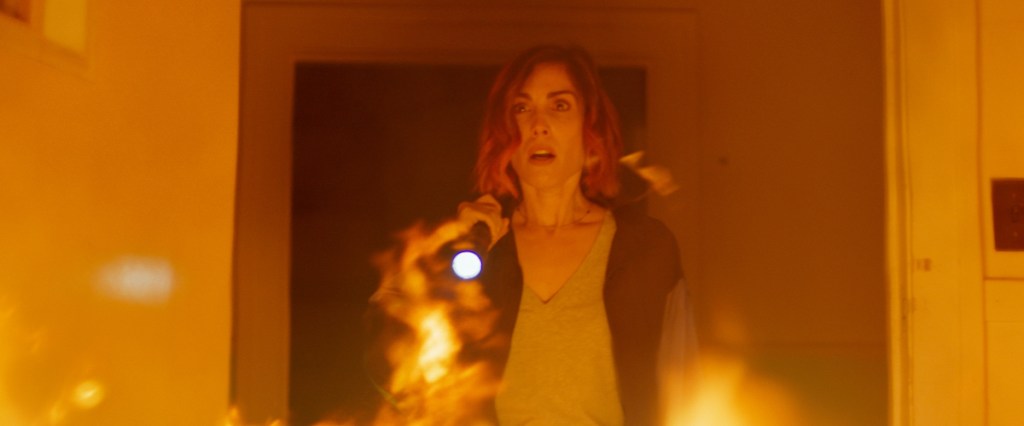
Carly’s (Carly Pope) past has been dormant since the events that happened to her mother Angela (Nathalie Boltt). Events that slowly spill out and reveal themselves in the course of her journey to find the truth, but one that leads her on a path to something sinister lurking in the underworld, waiting to be unleashed.
Sometimes we’re only willing to see things from our own perspectives and not go beyond them to understand the views of others. What becomes apparent to Carly is that her mother didn’t simply lose her way and go mad overnight but something else lured her into its domain and controlled her actions.
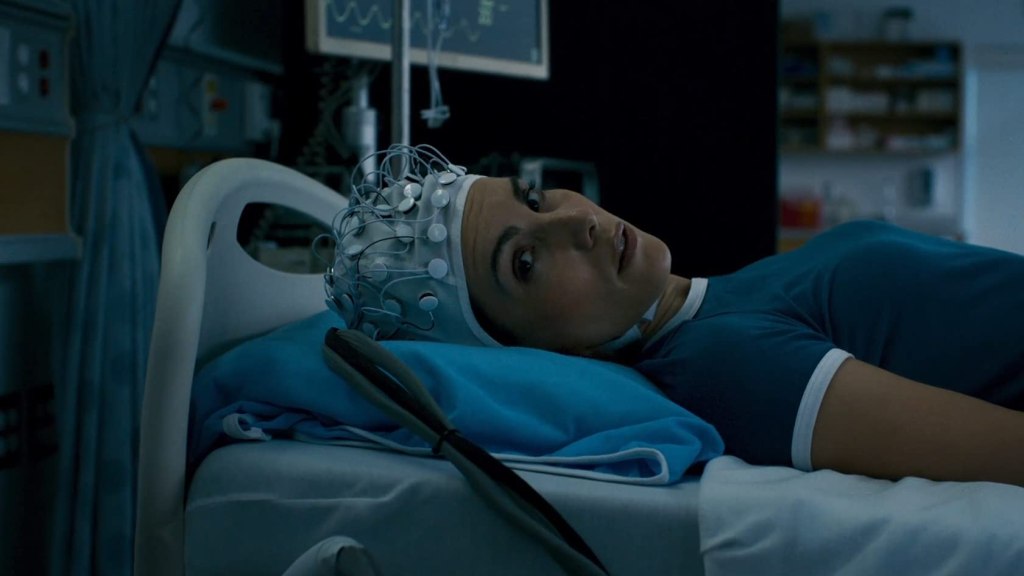
The opportunity to confront her past and her mother comes to Carly in an unusual fashion when she is approached by a physician and his team to visit her mother, (who is now in a coma,) she can enter through a mindscape using new technology. In her mother’s mindscape, Carly tries to find the answers to what tormented her but in doing so, a portal is opened and a bridge formed that allows a demonic force to find a way back into the real world. Carly must team up with her childhood friend Martin (Chris William Martin) to see if they can prevent the demon from inflicting its wrath on all those that stand in its way.
There is a great element that is slightly lacking here though and felt ripe for further opportunity to explore further in a team of religious SWAT members, charged with exorcising demons in a kick-ass military way, but we’re only treated to the aftermath.
The Diagnosis:
Carly’s descent into her past and the investigative way that she goes about finding the reasons for who she is is what holds you to the story and draws you in.
This along with the uncanny valley feel that the volumetric video capturing does to put you off ease, providing that sense of ill-feeling when Carly enters an alternate domain.
The downfall however is that there are moments in the movie that prove a struggle to connect with and feels too disjointed. It’s a catch-22 situation because part of Demonic’s raw appeal is also what makes the film feel incomplete.
I still applaud Blomkamp’s direction and experimental approach but this one didn’t manage to tick all the boxes.
Saul Muerte
Demonic will be available to stream across all key digital channels from September 15 and on DVD/Blu-ray from 22 September.
Dave (Tom Vermeir) is a reluctant caretaker of the titular Hotel Poseidon, which lives and breathes its namesake, through the visuals that ooze and breathe its putridity through the screen and submerges you deep within its sensuous void.
The fact that our hapless protagonist has succumbed to the world around him drifting from one alluring scene to the next, lures the viewer deeper into its dark abyss.
Bequeathed to him by his late father, the aquatic themed hotel embodies the characteristics of the Greek God with its swings of temperament, once providing a mood of destruction and anger in a wake of earth shattering proportions before drifting into a jubilant buoyancy, lifting its occupants into a heightened frenzy before crashing once more into melancholy.
Like our protagonist, some of the emotions become overwhelming and the hotel guests overbearing, smothering the essence of humanity out from between its decaying walls. Dave often has to retreat into a false slumber in order to rest from the fury, but it’s always short lived. His infatuation with some of the guests also bring him to decrepitude; a human shipwreck banked on the ocean floor struggling to breathe. The longer he stays submerged, the higher the stakes that he will become a permanent resident in the watery grave.
Stefan Lernous manages to craft a hypnotic film both with his direction and writing style and works this in harmony with Geert Verstraete’s visuals. It’s clear that Lernous draws from his acting theatrical background to draw the best from his cast allowing each of them to flourish to provide strong performances across the board.
The Diagnosis:
Beautifully shot and drenched in humanities faults to the point of smothering and heightened to the extreme.
It’s a slow beast however, which may not suit all tastes.
And so it comes to pass that one of the Surgeons of Horror’s favourite film festivals rears its beautifully ugly head to shed light on the dark and distrubed side of the celluloid screen.
Opening up the 2021 season of the Sydney Underground Film Festival is an Australian premiere from Kazakhstan that at face value can be poorly judged based on the opening 10 minutes. We’re painted a picture of a guy, Dastan (Daniar Alshinov) who seemingly is trapped in a loveless marriage, which he is forced to endure because of expecting their first child. This tone suddenly shifts however when Dastan suddenly goes on a fishing road trip with his two best friends, one who is trying to tap into his business prospects, the other a district police officer, all of who are bumbling buffoons, well outside of the comfort zone and trying to make the most of their outing.
To damn their characteristics isn’t one that scoffs at their downfall but more so embraces their faults with a humorous response to their ill choices along the way.
I read somewhere about the comparisons to The Coen Brothers movies in style and tone, and for this I can totally picture it, especially some of their earlier movies such as Blood Simple. The similarities see these loveable characters trip and fall over their own blunders in a journey that will question if they will see the end and live to tell the tale.
Along the way our trio fall foul of a quartet of questionable characters from the underbelly of the criminal world, who also come with their own level of ignoramuses. These brothers argue and object to their own decisions, tripping over each other to gain a level of power over one another, much to their own detriment.
In a chance encounter, Dastan and his friends witness the brothers blow the head off of a minion. From her on in, Dastan must strive to last the night and find their way back home without the know-how or intellect to do so. Throw into the mix, other oddities in a one-eyed spiritual kick-ass vigilante hell-bent on the revenge of the death of his dog; an enraptured odd young lady with the aid of her equally strange father, then we’re treated with a unique and funny tale that s a joy to behold.
The Diagnosis:
Let this one absorb you and you will be entertained by the farcical, heightened dark comedy on display. There is a lot of fun on display here, and director Yernar Nurgaliyev manages to dance with the sense of humour aimed at your everyman trio subjected to the ridiculous in order to survive and provide a wake up call to the things that matter to them.
In a similar way to the recent Candymanfeature, Queen of Spades tries to tap into a mythological and sinister presence that channels its energies through mirrors or reflected surfaces. Where the previous movie was strung together through depth and integrity, QoS unfortunately does so through superfluous means and never strikes at the heart as a result.
Both films falter on getting the villain to rise or be invoked to carry out their will, and seem only too happy to just get to the nitty gritty, but without that substance to generate real fear from the entity in question, we left without the grit and just the nit.
So, cue troubled teen Anna (Ava Preston) with her mother, Mary (Kaelen Ohm) who is struggling with the burden of being a single parent. Cue a trio of friends/victims; Katy (Jamie Bloch), Sebastian (Eric Osborne), and Matthew (Nabil Rajo), who form the quartet of invokees, blindly following a path without fully being aware of the repercussions.
Cue the invoked spirit who welcomes the calling so that she can spread her curse and ruin the souls of those she encounters.
Cue the knowledgeable character who bears the weight of understanding and the key to stopping the spirit in her tracks, Smirnov; a man who’s own son fell prey to the Queen of Spades.
Maybe I’m just a bi disheartened by the lack of originality on display. Newcomers to the genre may well get a kick out of it, but the performances aside, all of which are solid, there is nothing to grip onto to shake the kernels and add a little creativity outside of the tracks and into the realms of new ground. Same old stuff on display here.
The Diagnosis:
Despite some fairly decent performances, it’s not enough to shirk off the tired cliches that the film relies upon to keep you engaged.
Despite being released in arguably the biggest year in horror, Hell Night is one of those forgettable films that could easily be buried in the midst of the other dark genre movies of the time had it not boasted The Exorcist’s LindaBlair as its scream queen heroine.
The concept is a fairly simple one, casting four college students who have been drawn the short straw to spend the night in the local mansion, which previously housed the murder/suicide of a man named Raymond Garth, along with his wife and deformed children. Local legend talks of a fourth son, Andrew, who may have survived the ordeal and lurks within the mansion walls. So why stay there at all? Apart from to spark life into the film’s narrative that is. For the four students, it’s to win the right to initiate their pledge into Alpha Sigma Rho.
The four students consist of Marti (Blair), a smart, yet poor girl; Jeff (Peter Barton), a boy of wealthy upbringing; Seth (Vincent Van Patten), a stoner/surfer; and Suki (Denise Dunsmore), the licentious and adventurous member of the group.
There are numerous scares that have been set up by the existing house members, to try and liven up their doomed night and scare them away, but this has a negative impact of ‘the boy who cried wolf’ proportions when the murders begin and the body count begins to rise.
Hell Night had enough ingredients to make this work, and with a strong production team behind it which included Chuck Russell (A Nightmare on Elm Street 3: Dream Warriors) and Frank Darabont (The Mist), but ultimately it struggles to lift itself out of a mediocre plotline, that is essentially a haunted house, boogeyman set up. It has since picked up a cult following which I find a little baffling, but each to their own. Unfortunately Blair also delivers a pretty shoddy performance that garnered her a Razzie nomination for Worst Actress that year.
There are moments in this film that are painfully slow and arborous, which is a shame considering it’s a tale of survival against the odds. And yet, there are moments that are peppered throughout the narrative that give rise to the piece and show signs of promise for Teddy Grennan in his directorial feature debut.
Chief among this is in his lead, Annabelle Dexter-Jones (Under The Silver Lake) delivering a powerful performance as Harper, a nature photographer who witnesses a brutal crime. Stranded in a remote woodland terrain, she is captured and tormented by the culprits. Against the odds, Harper escapes and must use her guile and knowledge of the wild to find her freedom and bring her assailants down.
Her moments of revenge are satisfying on MacGyver style proportions and Harper is truly alone in her fight for survival, as everywhere she turns, she is faced with conspiracy.
There is also a suitably strong performance from Bruce Dern (Silent Running) as a quirky hermit character, and due nods should go to Robert Longstreet (The Haunting of Hill House, and soon to be seen in Midnight Mass, and Halloween Kills) who taps into the darker psyche bringing the alpha villain Ravener the amount of depth needed to make the ordeal more intense.
So far, so middle of the road viewing which neither excites or disappoints, but when the final reel comes around, it is so out of left field and out of keeping with the narrative thus far, that you have to question its placement other than for shock value. The trouble is that it comes across as a misbeat and sours the rest of the film. Not enough character development is put into place to give the shock factor the payoff that the director was aiming for.
The Diagnosis:
It’s a decent enough narrative around survival against the odds, packed with solid performances, but it can’t shake off the mediocrity and then suckerpunches with an incredibly disjointed ending.
Web of the Spider is potentially an example of someone who is obsessed with a vision and is determined to fulfill their satisfaction to keep pushing an idea to make it work. Director Antonio Margheriti (Cannibal Apocalypse) had already tried his hand at the tale of a man challenged to authenticate a story by Edgar Allan Poe by spending a night in a haunted castle and surviving, in 1964 with Castle of Blood starring Barbara Steele. Said film performed poorly at the box office but despite this Margheriti felt compelled to return once more to his source some seven years later, but this time in colour.
There is a part of me that kind of gets this, by having American writer Poe, known for the macabre with a lilt towards romanticism, tired of people judging the authenticity of his work. His claim is that all his fictional stories are based in truth, especially the spiritual or paranormal components. It is equally compelling having the eccentric performer Klaus Kinski take on this magnanimous personality to inject the strange yet driven nature that Poe possesses. In Castle of Blood, Poe was played by Silvano Tranquilli (Black Belly of the Tarantula) who appears this time around playing William Perkins, one of the “spectral” residents of the castle.
This time around, it’s a journalist, Alan Foster (Anthony Franciosca – Tenebrae) who takes up Poe’s bet to spend the dreaded night in the castle, where he meets a number of ghostly spirits of those who have been murdered in the castle walls, and throughout the night play out the moments leading to their deaths. Curiously Foster becomes infatuated with one of the inhabitants, Elisabeth (Michèle Mercier), who equally appears to have fallen for him. As Foster begins to question his sanity and the events that are occurring around him, the big reveal turns out to be that these so-called spirits are in fact vampires, luring him to become their next victim. Foster must now try and fight his way out of the castle before he succumbs to their ways.
Web of the Spider has moments that could genuinely work well but I can’t help but feel that the storyline would serve best as a theatrical presentation where the location and sets can lend weight to the telling of the story using the tricks of the trade. It just doesn’t translate as well in celluloid form and hence why Margheriti falls short of accomplishing his vision for a second time. It would be one that he would openly admit to being a failure and a “stupid to remake it”. I for one am inclined to agree and the less said about the ending the better.
Perhaps this was indicative of my mind not entirely being in tune with this movie at the time I viewed it, but I completely failed to see the vampiric element throughout until I read up about it afterwards. At which point, it thrust the point of the stake firmly into my cognitive mind, along with the inspirations of Joseph Sheridan Le Fanu’s Carmilla. What was more obvious to my mind was stimulus drawn from Robert Wise’s film The Haunting, along with the death of free love and the sixties hippy movement.
The theme of Let’s Scare Jessica To Death is one that seemed to have been prevalent in many movies of its time, tapping into the psychological paranoia embodied by its lead. In this instance, Jessica (Zohra Lampert) is the victim. We learn through discussions among the central characters that Jessica has been through some kind of psychotic episode, and that she has only just returned back into society, albeit in the smallest sense, with her husband Duncan (Barton Heyman); a man who has given up his career as a string bassist for the New York Philharmonic Orchestra to be with her during this time; and their close friend Woody (Kevin O’Connor). The aim is to have a quiet life building up a rundown farmhouse near a lake in Connecticut. They are surprised however to find a drifter, Emily (Mariclare Costello) squatting in their new abode. As this is the era of free spirits and tranquility though, rather than turf her out, the group decide to allow her to stay with them some time. A decision they would come to regret as there is more to Emily than meets the eye.
Throughout the narrative Jessica’s state of mind is always in doubt as she witnesses a strange blond haired lady in the nearby woods, which no one can support her claims, and bears a sparkling resemblance to Abigail, a lady supposedly murdered back in the late 1800’s.
Slowly, all those around Jessica, from the townsfolk, to Emily, and to Woody and Duncan, start to pull away from her, growing distant, or in Emily’s case, trying to attack her by biting her neck. Is this some kind of hallucination or is there something sinister at play?
The atmosphere and dark tension created by Director John Hancock and the Cinematography by Robert M. Baldwin is slowly built up and excellently executed, it’s little wonder that it would generate cult status. This film may not be for everyone, as its style is subjective, but it definitely warrants its place in the horror vault through the eerie narrative and haunting nature that it projects into the celluloid universe.


 Surgeons of Horror