When released in the States back in
September 2018, Hell Fest crashed out
to a poor box office despite what promised to be a great premise with something
that was reminiscent of Tobe Hooper’s The
Funhouse, (a forgotten gem) albeit with a more distinctive teen-slasher
vibe in this instance.
There is a phrase that ‘Monsters don’t
always lurk in the shadows, sometimes they hide in plain sight’, and what
better way to hide and stalk your prey than in a nightmare entertainment theme
park, built to scare and delight its customers.
As the teens enter The Dead Lands, an area
of the theme park where the workers are allowed to physically touch you in
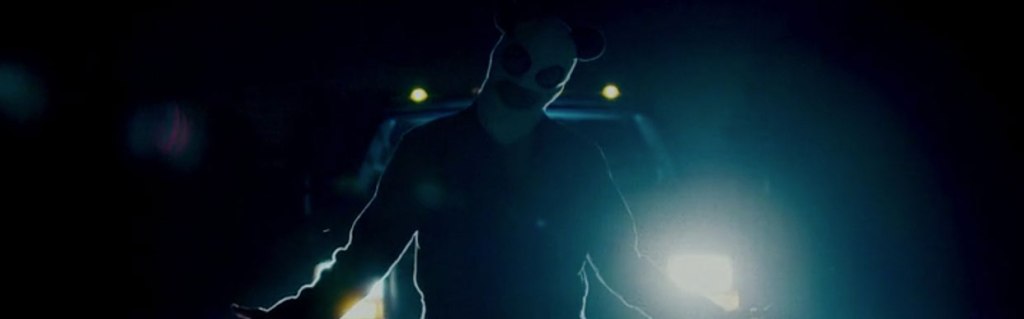
their attempts to up the scare ante, a masked figure known as ‘The Other’
begins to circle and focus on his prey and inevitably picks them off one by
one.
Hell
Fest contains all the hallmarks of what should be a
fun ride which it is including some brutal kills that have you grimacing in
your seat, so why did it bomb and not resonate with its cinema going audience?
Most critics citied its lack of originality
and that it fell to formulaic tropes within the genre with most of the
characters presented as two-dimensional representations of what most horror
fans have seen before. Although I did find Bex Taylor-Klaus’ performance of the
wayward and rebellious Taylor, fun to watch.
I do find it hard to defend Hell Fest
though, as it does appear to tread old ground and you never really feel
connected to the characters. It’s a shame because director Gregory Plotkin’s (Paranormal Activity: Ghost Dimension)
sophomore outing has a great playing field to draw out the horror and offer
some unique approaches to the genre, but fails to deliver.
The Diagnosis:
Whilst Hell Fest is a fun ride, the ride itself becomes all too familiar all too quickly and the thrills whimper out with barely a flicker on the scare-ometer. And hey, it was awesome to see Tony Todd on screen as the theme park’s barker, despite his screen time being way too small.
Now that the paint has dried and a few weeks has passed since Velvet Buzzsaw was unveiled on Netflix, it seems a good time as any for this Surgeon to dissect Dan Gilroy’s third movie from the director’s chair.
Gilroy’s debut, Nightcrawler was a disturbing vision of a violent, voyeuristic underbelly of US society as depicted by the media, so there was much anticipation ahead of his third outing.
Teaming up once again with stars Rene Russo and Jake Gyllenhaal, Velvet Buzzsaw promised to be another dark and twisted journey into the recesses of the art world, both of whom excel in their respective parts; Gyllenhaal as Morf Vandewalt (great name by the way), an art critic who’s mind begins to unravel as the true horror behind Arts latest discovery Vetril Dease unleashes an evil that threatens the fabrication of materialism and expression to its foundations and rip it to shreds; and respected gallery owner Rhodora Haze, who is every shadow of perfection, but has a her own demons lurking within.
Having shuffled off this mortal coil, Dease’s work is discovered by Josephina (who also works for Rhodora, and coincidentally is having an affair with Gyllenhaal’s Morf) in his apartment and seeking a chance to lift her profile, nabs the lot in search of fortune.
And therein lies the rub.
Every character it seems is in search of their own personal glorification and with each stride to ‘perfection’, they fall deeper into the labyrinth of sin and despair. None more so than Toni Collette’s Gretchen, who gets so bitter and twisted as she distorts and manipulates her grounding in order to establish a firm footing within the Artistic community.
Interestingly though, it’s only those that feed off the creative types and promote their material in order to meet their own ends, are the ones that get popped off one by one. Some, in glorious fashion.
The artists themselves are deeply affected by Dease’s paintings but instead of utter destruction, it only empowers them to go and create again. As if to explore their own passions and free their souls to be reborn, or thrive once more.
The only other exception is Coco
(everyone’s assistant) who is basically everyone’s pawn and unfortunately is
the discoverer of most of the victims.
So far so bloody fabulous. Gilroy does a stellar job at tapping into the heart of the savagery embedded in the Art world, and there are hints of Altmanesque style of direction, as he weaves a multi-layered character narrative.
Ultimately though, where Gilroy succeeded with Nightstalker with its transcendence into hell, with Velvet Buzzsaw, he seems to get lost in the vortex of disillusionment. The more Gilroy subjects his characters to the turmoil within their own psyche, the more fantastical and hyper realistic their world becomes, alienating the audience as a result.
The Diagnosis:
Velvet Buzzsaw like most works of art is subjective to the perception of its viewer or audience. Some may find it a stroke of genius that embodies the ugly psyche of the human mind; others will declare it a façade. When you lift the veil on the mania and manufactured lifestyle that the characters lead, all that’s left is circles in the sand… but then again, maybe that was Gilroy’s point.
It’s been a couple of months now that Sandra Bullock’s Netflix vehicle was released and was strong enough among the Surgeons team to elevate it into the Top 5 horror movies of 2018, but not all of us had such a positive attraction to the film.
Until recently, Bird Box had remained on my Must Watch list and embarrassingly kept
being pushed back when I found time to delve into a film. So, why did I keep
doing this? What was propelling me away or not enticing me into the
post-apocalyptic world where supernatural entities lead people to commit
suicide?
Truth be told, I just found the concept
uninteresting and perhaps too dark or deep. So every time I came to watch the
film, I shied away to watch something else more upbeat or stimulating.
It doesn’t bode well to have these thoughts before watching a movie, but I still wanted to clear my mind and come into this fresh, but I was enticed by the fact that it was directed by Susanne Bier, who was behind the awesome The Night Manager.
Our first introduction to Bullock’s
character, Malorie Hayes is a stern and strict one as she gives two children
specific instructions of a troubled journey that lay ahead. It’s an interesting
choice, as it doesn’t allow you to warm to her straight away. It does allow you
to warm to her as you realize that our first window into her soul is a truly
human one. As stark as it maybe it propels you through the narrative with her
and Bullock’s performance on screen is one of the best I’ve seen in a long
time.
In fact all the performances are significantly on point with all support acts given their chance to have “their moment” on screen, but particular nods should go out to Trevante Rhodes (The Predator), Sara Paulson (American Horror Story), John Malkovich who hams it up in a fantastically melancholic role, and Tom Hollander (Taboo).
Bird
Box is also beautifully shot with cinematographer
Salvatore Tottino exploiting ever inch of the canvas to project his vision.
Throw in a cracking score from the
brilliant mind of Trent Reznor and you can fast see why my fellow Surgeons were
chomping at the bit, especially with the split timeline narrative to provide
the lead-up to the ordeal that Malorie faces in her blindfolded attempt to
navigate the river to find sanctuary in a treacherous land that has been torn
apart.
The narrative has to hang together on
Bullock’s character and her performance, which it does… just. She weaves
together a tumultuous tale of survival and eking out every possible emotion
along the way, but ultimately the narrative does plod along and despite
everyone’s best efforts feels strained and a fairly predictable outcome despite
its best efforts to challenge your thoughts and opinions.
The
Diagnosis:
Bird Box has all the ingredients to make an incredibly powerful movie with strong performances all round, especially with Bullock leading the charge. It boasts a director at her pique with a cinematographer who can tweak out the most stunning images, but like the creatures that invoke the fear, it is all fluff and no substance. Whilst the ride is enjoyable, it doesn’t leave you with any strong connection to the movie.
One of the more recent entertainment trends has seen people seeking a higher thrill or adventure in order to stoke the fires of curiosity and challenge their intellects through ‘escape rooms’ designed to fulfil these needs. Often used as a means of office or work related events to boost morale and establish solid foundation for teamwork. For any British readers out there, it’s hard to shake the image of these adventure seekers within The Crystal Maze shouting out, “I’ve got the crystal! I’ve got the crystal!” But I digress. It seems inevitable then that the movie industry would latch onto this craze and string a dark narrative behind them to lure in the cinema-going public. Essentially what is in offer is a film that has similar traits to Saw or more appropriately Cube following a group of six strangers who in this instance sign up for one of these Escape Rooms only to realise that the stakes are high and very real. And so we see them face challenge after challenge in a fight for survival and where humanity is put in the line and deeply questioned.
Initially enticed to the event by a strange looking cube which had this writer instantly thinking of the puzzle box from Hellraiser. Now that would have been interesting to see a group of people in search of the ultimate thrill by luring out the coenobites in a battle of ecstasy that would tear open their souls in order to reach their satisfaction… if only.
Instead, we’re presented with a series of events that feel all too familiar and despite the threat being all too real, never puts the audience on edge. There are moments where we are taken on the ride and witness the characters plight, but it’s hard to emote any sense of empathy towards them as the focus is more on the danger presented in each room rather than on any depth in personality and any attempt to do so is incredibly formulaic.
The one standout set piece was in the drug infused room that leaves its occupants intoxicated with a highly venomous poison that disorientates and fucks with the mind. This scene does a lot to heighten the loss of control that the characters face and the panic that ensues.It was a pleasure to see True Blood’s Jessica (Deborah Ann Woll) on screen again and the lead protagonist (Taylor Russell) holds her own in a rewarding performance too.
The Diagnosis:
Escape Room could easily serve as a companion to Blumhouse’s The Belko Experiment as it equally pits a group of people in a fight for survival. Whilst it offers a few thrills along the way, it never lifts the danger component to an extreme level and as such bobs along without much fanfare. It’s an enjoyable movie but never really challenged my senses enough to connect with the characters plight.
You’d be forgiven for thinking than Aaron
K. Carter’s sophomore outing behind the camera; An Hour To Kill is just another low budget, off-the-wall movie,
with actors who appear to be running off their lines without any connection to
the audience and cinematography that just about scraps the viewing experience
over the line.
But if you look past the cracks and
crevices that are blatant for a movie of its kind, something begins to happen
that lures you in… namely the screenplay. Carter wisely breaks up the narrative
of the film into various sections that are either flashbacks or stories told by
our leads. This change allows the script to shift gears with each section and
push the audience forward, whilst never feeling stagnant or spend too long on
the sparseness of the captured footage. This is definitely a testament to
Carter’s writing and direction to be able to transport the viewer into the
world and not be too distracted by its obvious flaws.
Whilst the opening scene is obviously
influenced by Tarantino, using a blend of peppered dialogue and crime,
especially with rookie hit man, Frankie played remarkably convincingly by
Frankie Pozos. It could be easy to dismiss Frankie’s performance at first, but
as the story unfolds the audience finds themselves integrated into his
character and his interaction with veteran hit man, Gio (Aaron Guerrero).
Guerrero also teamed up with director Carter in his debut feature, Dead Kansas and also seems quite relaxed
in his character on-screen.
The crux of the story is centred on an
ongoing conflict between crime lord Mr. Kinski (Mel Novak – Game of Death) and Arash. When the
former suspects Frankie as a mole, he charges Gio with the task of bumping him
off. Gio asks that he be given the opportunity to do it his way. Kinski agrees
but gives him the ultimatum to enact his deed within the hour. So with an Hour
To Kill, Gio and Frankie exchange stories to pass the time.
Each story that is presented goes from the
bizarre to the downright deranged and sucks you in deeper into the insanity.
The first story, Valkyrie’s Bunker, a typical slasher style short story,
presents a group of girls who drive to a Nazi bunker for a group project only
to find out they are not alone.
The second story actually suits the style
that the movie has been shot in, resulting in numerous pieces to camera
monologues. Assacre focuses on an eating contest that has 5 entrees competing
to eat a fairly substantial burrito. When the reigning champion is defeated, he
teams up with fellow loser to seek revenge and produce a powerful pepper. The
results are more than anticipated and one of the best and hilarious death
scenes in recent times.
The last segment, Hog Hunters is the most
crazed of all when a bowling team goes in search of some entertainment only to
get more than they bargained for. Words cannot do this segment justice, just
sit back and let the wild times unfold.
The Diagnosis:
Yes it’s low budget and it doesn’t hide the flaws, but Carter creates grindhouse-style deliverance in his direction that highlights his writing abilities and the acting credibility of the lead hit men. If you simply allow the story in An Hour To Kill to wash over you, you’ll be pleasantly entertained.
Transport yourself back twenty years and
cast yourself in an auditorium draped with red velvet curtains and matching
carpet where the unwanted popcorn had stuck to the floor and would crunch
beneath your feet.
This is where I found myself ahead of this
massively hyped movie that had allegedly had audiences throwing up in the
aisles.
Was this a reaction to the events in the
movie or from the hand-held cinematography that the filmmakers Daniel Myrick
and Eduardo Sanchez were looking to achieve in order to capture the old
documentary style filming you often saw in news reports etc.? What ever it was,
Myrick and Sanchez had a lightning in the bottle moment that sent the Internet
ablaze while it was still in its infancy, (no other film at this stage had
created such a multimedia sensation) and in the process reawakened the found
footage genre.
The twenty-year-old version of myself was
determined not to buy into the insanity, but as I sat as the lights went down
anticipating an awakening of my own. To be scared, thrilled, and gripped in
fear at the events that would flow before me. This twenty-year-old was also
incredibly stubborn. I beckoned, nay, willed the filmmakers to push my senses
to the limit. Yes, I was disorientated, but not nearly to the degree that I had
been led to believe, and I found my excitement transported to fury at these whining
Americans that were lost in the woods.
To say that I was underwhelmed was a gross
understatement.
And yet, something kept niggling away at me
beneath the surface.
I was aware of the impact that this little
movie had had on the horror industry, an industry that I loved so much. And
numerous friends of mine would often talk about the impact that it had on them
over the years. Was I wrong to have scoffed at the film so readily? Was there
more to this movie than just your average run-of-the-mill found-footage horror?
Films of similar ilk like Paranormal Activity, or Cloverfield would come and go and not
resonate as deeply, with the exception of Jaume
Balagueró’s [Rec]. It was
safe to say that I wasn’t a fan of this sub-genre.
It was only upon a few years back in preparation ahead of Adam Wingard’s sequel Blair Witch that I gathered the team together for a podcast on the franchise. It was during this time that I began to appreciate the making of this movie.
As The Blair Witch Project celebrates its 20th Anniversary, I’ve come to realize that it is a cracking example of experimental horror at its finest. The techniques that Myrick and Sanchez use in both production and marketing were exemplary, and should be applauded.
Whilst some could argue that it feels like
a student film in places, (which let’s face it, it was) the direction would
mark a new approach in film-making moving forward and open the door for similar
stylized films.
With a 32-page screenplay and a trio of
as-yet undiscovered actors (Heather Donahue, Michael C. Williams, and Joshua
Leonard) in their crew, (some having to double-up as camera crew) they ventured
out into the wooded terrain in Maryland to carry out their vision.
The aim was to guide the actors through pre-decided
marks throughout the woods, where they would improvise around the screenplay, whilst
adapting to each action as it was given to them. The effect was a naturalistic
piece of drama, which made the plight of our trio all the more gritty and
realistic.
It essentially became a test of endurance
on the three actors, as they were deprived of food and disorientated by lack of
sleep.
Throw in the shock ending, which was
initially asked to be reshot by Artisan Entertainment for its confusion, only
to end up in the final cut. It’s a good job too, as the ending is both
startling and unsettling leaving the viewer hollow inside. Any movie that can
garner such a reaction from its audience will always be held highly in these
writers’ eyes.
The final mark of brilliance though comes
in the marketing. With so much back-story written, it became an online
producer’s playing field to create and sell the ‘history’ and cement the
believability further. In an age where the scope of the internets online
marketing capability had yet to be explored, and the mythology behind the Blair
Witch was catapulted into the mainstream, coupled with the mockumentary, Curse
of the Blair Witch, and the book, The
Blair Witch Project: A Dossier.
There’s plenty of good reason that The Blair Witch Project should and still be deemed a horror movie classic, and twenty years on, it is a testament to clever filmmaking, marketing, and that special lightning in bottle magic, that only comes around every so often.
Eau Claire, Wisconsin, January 16, 2019 – MidWest WeirdFest announces its first programming wave for 2019 today. The third annual festival – a cinematic celebration of all things fantastic, frightening, offbeat, and just plain weird – takes place March 8-10, 2019 at the Micon Downtown Cinema in Eau Claire, Wisconsin.
“This year’s fest line-up is set to delight fans of cutting edge horror, sci-fi, underground, and documentary cinema”, says festival founder and programming director Dean Bertram. “We’ve put together a heady and eclectic mix of speculative genre offerings, underground strangeness, and paranormal revelations: From a psychedelic Manson Family reimagining and a post-apocalyptic dance-off epic, through tales about a reanimated electrokinetic teenager, haunted stoners, and inept buddy superheroes, to a bonkers lake monster adventure and the most in-depth Bigfoot documentary ever produced. And that’s just from MidWest WeirdFest’s first programming wave of 2019!”
Discounted festival passes are now on sale at: www.midwestweirdfest.com. Individual tickets to each film will go on sale closer to the festival; both on the fest’s website, and directly from the Micon Downtown Cinema in Eau Claire, Wisconsin.
Full program details and filmmaker guests will be revealed in February.
The first seven feature films announced follow:
FP 2: BEATS OF RAGE (director: Jason Trost)
Despite hanging up his boots following the events of the cult classic “THE FP”, JTRO must return to the blood sport of Beat-Beat Revelation one last time. JTRO and KCDC – his mystical hype man – will quest deep into The Wastes, a land decimated by the Beat Wars, to compete in the ancient Beat-Beat tournament, called “Beats of Rage”, face AK-47, and, hopefully, save the world. Imagine a MAD MAX style future, where battles to the death are fought via the video game Dance Dance Revolution, and you might have an inkling of the crazy and hilarious post-apocalyptic world of THE FP.
THE INVISIBLE MOTHER (directors: Matthew Diebler and Jacob Gillman)
When lesbian stoner Marcy returns to her grandparents’ home to help care for her mentally declining grandmother, she discovers they are being terrorized by a malevolent force from a Victorian post-mortem photograph. THE INVISBLE MOTHER is a giallo-styled, terrifying descent into supernatural terror.
LAKE MICHIGAN MONSTER (director: Ryland Tews)
The eccentric Captain Seafield hires a crew of specialists to help him plot revenge against the creature that killed his father. After several failed attempts, Seafield is forced to take matters into his own drunken hands. What began as a simple case of man verses beast, soon turns into a rabbit hole of mysterious unknowns and Lovecraftian hijinks. LAKE MICHIGAN MONSTER — banned in four lakes!
THE LAST OF THE MANSON GIRLS (director: Lonnie Martin)
Convinced there’s more to the Manson murders than meets the public eye, counterculture journalist Paul Krassner embarks on an LSD tinged investigation of the last of Manson’s disciples: Brenda McCann, Sandra Good, and Lynette “Squeaky” Fromme. What he finds could change how the world sees the 60s… if he lives long enough to tell the story. A riveting, speculative, and psychedelic journey into one of the darkest byways of 1960s Americana.
ON THE TRAIL OF BIGFOOT (director: Seth Breedlove)
From Small Town Monsters, and MidWest WeirdFest alumni filmmaker Seth Breedlove (THE MOTHAN OF POINT PLEASANT, THE BRAY ROAD BEAST), comes this enthralling documentary examining the history of the Bigfoot phenomenon. ON THE TRAIL OF BIGFOOT was filmed coast to coast during 2018 and features witnesses and investigators of the elusive creature. Prepare to go deeper into the Bigfoot subject than you’ve ever gone before.
REBORN (director: Julian Richards)
A stillborn baby girl is brought back to life by a morgue attendant using electrokinetic power. On her sixteenth birthday she escapes her captor and sets out to find her birth mother leaving a trail of destruction behind her. Don’t miss this stunning modern twist on 70s and 80s horror classics like CARRIE, FIRESTARTER, and THE FURY. Stars genre legends Barbara Crampton (RE-ANIMATOR, BEYOND THE GATES) and Michael Parle (STREETS OF FIRE, THE PHILADELPHIA EXPERIMENT).
ZEROES (director: Charles Smith)
After leaving a Halloween party dressed as ninjas, Kenneth and Ray – two drunken roommates – thwart a robbery and their heroics go viral. No litterer or public urinator is safe until an actual serial killer begins to ravage the city. Our inept crime-fighting duo, with the help of the enigmatic and insanely wealthy Gary, must catch the killer before Kenneth’s crush Kate becomes the next target. Hilarity abounds in this superhero spoof.
I remember it clearly, the end credits were rolling, the
auditorium lights were fading up when a well-known media personality, that I
won’t name, turned around in his seat in front and said to my friends and I;
“What the fuck was that?”
The year was 2000 and I’d just sat through a preview screening of M. Night Shyamalan’s much-anticipated follow-up to his previous blockbuster ‘The Sixth Sense’, ‘Unbreakable’. My friends and my reaction was the complete polar opposite of said famed personality. We saw the film for what it was, an utter genius take on a superhero origin movie.
‘Unbreakable’ was in
fact a bold experiment by Disney, they’d entrusted their new wunderkind
writer/director to follow up his previous success with another, and he’d gone
and made a superhero movie way before anyone had.
Over the years that followed I re-watched and re-watched its
Special Edition DVD. It was my go-to movie any time I was looking for something
to watch. I devoured its rich story telling, it’s perverse humour, the subtle technique
in reveal and what to not reveal. I loved the raw drama; of a normal couple
toppling over a razors edge, two middle-aged men (Bruce Willis and Samuel L
Jackson) searching for their place in the universe, a son desperately holding
onto that time in your life when your parents are infallible. None of these
were, or are, the standard ingredients of a comic book superhero movie. I
savoured the Special Features on the DVD, particularly the ‘deleted scenes’,
lamenting on their loss to ‘Unbreakable’
considering they were such strong scenes.
I loved the film from back to front…but the critics didn’t.
Reading bad review upon bad review I wondered whether the critics had watched
the same film.
Over the years I’d heard rumours that ‘Unbreakable ‘was to be the first film, the origin film, of a trilogy, but the more and more M Night spiralled into mediocrity with flop after flop, first came ‘The Lady In The Water’ and ‘Avatar The Last Airbender’, etc. etc., only slightly redeeming himself with ‘The Visit’.
So flash forward to 2018 and there I was ‘giving M Night
another go’, I sat in my lounge room watching ‘Split’ because, well…James McAvoy is always bloody amazing and I’d
just watched Anya Taylor-Joy in ‘The
Witch’, so yeah….
And I was really enjoying it a lot. Though the more and more
I watched, more and more something nagged at me – there was something really
familiar at play here. The subtle reveals, the perverse humour, its dark
fantastical reality.
Was McAvoy’s many characters crazy? Hell yeah, he did have
some serious mental defects but the big question, as with David Dunn in ‘Unbreakable’…were his powers real or a
figment of a wild imagination?
Would we see a supernatural being called The Beast or would
it be some delusion fool with a furry fetish?
But it was as I was watching The Beast talk about the
‘broken’ being pure and the ‘unbroken’ were to be punished that things really
started to click. By the time the ‘Unbreakable’
music began to swell as Crumb hid in his escape house and we cut to a
non-descript diner with David Dunn I was literally off the sofa screaming at
the TV.
“IT’S A MOTHER FUCKING UNBREAKABLE SEQUEL!!!”
And so now I have my finale.
‘Glass’ is really
not a movie I can openly discuss with giving too much away, and frankly I’m
still thinking about it several hours after I watched it. However again I sat
in a cinema with an audience that I don’t think quite understood its wit. I
think I was literally the only one laughing at its dark humour.
The cast were amazing, all returned from the previous two
films (except Robin Wright) and why wouldn’t they, this was as much their story
as it was the leading pro/antagonists. M Night (returning as his cameo from ‘Unbreakable’) even managed to include
the deleted scenes from ‘Unbreakable’
as if they were made solely for that purpose.
This is not a conventional film though; ‘Glass’ is really is an act three of a three-film
story. And while both ‘Unbreakable’
and ‘Split’ appear to be origin
stories for the three lead characters Mr Glass, The Beast, and The Overseer,
this transcends the ‘origin’ tale to make it an ‘origin of species’ story.
Already, like Unbreakable,
critics do not like Glass but
filmmakers don’t make films for critics.
The Diagnosis:
‘Glass’ is a fantastic
final chapter to M Night Shyamalan’s daring superhero experiment. It’s
exciting, it’s funny, it’s bloody entertaining and it’s a very well calculated
story from a bold director who maintained the tenacity to play the long game
here to create a three part opus for himself and us.
‘Unbreakable’, ‘Split’ and ‘Glass’… the little superhero films that could and did.
Strip away all the torture devices and wash away all the blood-soaked, gore-infested mayhem that the franchise has become synonymous for and some of you maybe questioning what’s left? But with James Wan and Leigh Whannell’s original film that kick-started the whole Jigsaw frenzy the audience were treated to an exercise in constrained drama, flickered with tense, psychological elements that quite rightly projected the writer and director partnership into the Hollywood limelight as a result.
Part of Saw’s brilliance comes from the low-budget constraints that were placed on the making of the movie. Once the creative duo realised that the cheapest way to shoot a movie would be to have two actors in one room, this germ of an idea developed into the final product and the birth of Jigsaw and his twisted vision of justice.
Apparently the Jigsaw character began when Whannell feared that he had a brain tumour and pondered the notion of what he would do or need to do if he were only to have a year or two to live. This was the leaping point into the dark recesses of Jigsaws’ mind.
It’s this tightly shot, well structured movie that allowed Wan to develop his technique for manipulating lights and shadow to trick and deceive the audiences’ eye. He would harness this skill further with his sophomore film Dead Silence before working on his masterpiece, The Conjuring.
It wasn’t that easy getting budget for the movie though. With no luck gaining interest from their homeland in Australia, Wan and Whannell tried to taut their project in Los Angeles, but even then had to shoot a short feature to provide a proof of concept before getting any decent interest. You have to applaud their bravado to. So intent were they in getting their vision made, they insisted on having both directing and acting duties respectively. In the end it took newly formed production outfit, Twisted Pictures to give them their desires and have been behind every Saw movie since.
So with one half of the acting team already cast in Whannell as the photographer with a complex past, the team needed a decent actor opposite him as Dr. Lawrence Gordon, a Doctor with an equally dubious past. In steps Cary Elwes, normally associated with his comical roles but proved worthwhile in this serious performance, more than holding his own and providing gravitas to the scenario.
The masterstroke comes with the casting of Tobin Bell as Jigsaw aka John Kramer, who simply owns his role and has propelled himself into horror movie history with his performance as the disturbed yet brilliant mind behind the various traps and tortuous devices throughout all the Saw movies.
So with the narrative played out with Adam and Dr. Lawrence wake up in a bathroom, chained to the floor with nothing but a corpse, a revolver, and a tape recorder to guide them on a journey that will test their metal and push them to the very limits of their intellect and perception.
Saw would be released in front of a Sundance audience for its initial premiere where Lionsgate picked up the distribution rights and the rest is history.
Since then, Wan has established a firm career in the director’s chair to the point hat he has been given the chance to give DC movies some decent crowd with Aquaman, and Whannell more recently carved his own success with Upgrade.
So for those who may have been apprehensive about checking out the origins of Jigsaw, before the bloodbath began, I’d recommend going back to the original source as you maybe pleasantly surprised by this outing with a clever, psychological thriller that is an example of how to shoot a low-budget movie with a lot of smarts and a decent narrative to keep the audience hooked.
It still stands strong 15 years on and my bet is that this will still be the case in another 15 years.
We’ve barely a decade of horror under their Universal belts, the powerhouse production company was struggling once more to pull in the numbers at the box office. So it’s with some sense of irony that the movies that started it all in Dracula and Frankenstein would be screened as a double feature and reignite the craze all over again. The stunt would be so successful that Universal Pictures would look to producing another instalment of their beloved monster franchise with Son of Frankenstein, in what would be the third of the series.
In Frankenstein and Bride of Frankenstein, Universal had created two classic features, thanks to the direction of James Whale, where some have argued that the latter outweighed its predecessor. Whatever your views on the matter, it would be a touch act to follow and into the directors shoes steps Rowland V. Lee (The Count of Monte Cristo, The Three Musketeers) to try and accomplish this task.
The result is one that is worthy of the
Frankenstein name, despite it bordering on silliness and camp on occasion. (A
sign of the direction that Universal would fall into down the track.)
With grand plans to shoot the film in
colour using Technicolor only to be disbanded due to artistic and budgetary
reasons, Son of Frankenstein would be
presented to the audience in black and white and reunite the horror icons, Bela
Lugosi and Boris Karloff. In this instance, the latter donning the Monster mask
for the last time in a feature film. The two would once again prove to be a
winning formula with Lugosi playing the deformed Ygor and practically stealing
the show with his performance. In an interesting turn of events, it is Ygor who
is the dominant presence and has The Monster at his beckoning call, as he
commands the creature to kill those that have proved him ill in the past.
Leading the cast as the son of Frankenstein
is Basil Rathbone (The Adventures of
Robin Hood) who cuts a fine figure of a man trying to right his fathers’
wrongs and changing the perceived conception of his family name. It would have
been interesting had Peter Lorre had played the role as he had been cast, but
had to withdraw due to illness. It’s a shame because I’m a huge fan of Lorre
and would loved to see him cast against Lugosi and Karloff, but as I said,
Rathbone more than proves his worth.
A worthy nod should also be assigned
towards Lionel Atwill (Mark of the
Vampire) as Inspector Krogh, a character whose past encounter saw his arm
torn off his limb as a child when he came into contact with The Monster. It’s a
stoic performance and Atwill shines in an already crowded cast of
personalities.
The
Diagnosis:
It’s a fitting end to this chapter in the
Universal Horror history. Son of Frankenstein manages to
harness all the right ingredients to make it a worthy companion to its predecessors,
whilst falling on the right side of drama and terror for its time.
Lugosi and Karloff are in their element and would ride out on a high. Around the corner a new king to the throne would lay in wait in Lon Chaney Jr… but that’s another tale.