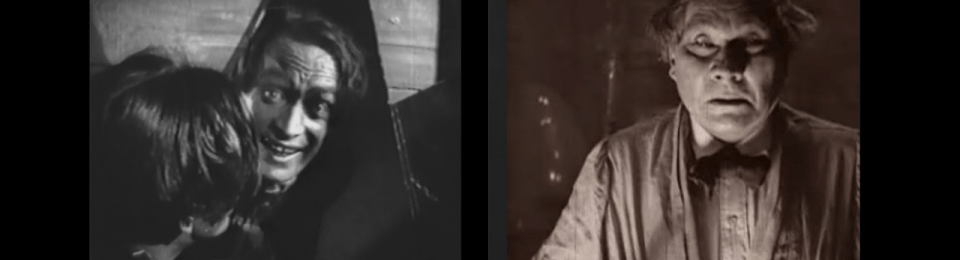
A century ago, cinema was still learning how to make the supernatural visible.
The horror film had not yet settled into the familiar grammar that would emerge during the following decade. There were no established monsters, no Universal template, no rigid distinction between gothic horror, fantasy, science fiction and the occult. Filmmakers were still discovering what the camera could do with dreams, doubles, demons, magic and the irrational. In October 1926, two films arrived within twenty-four hours of one another that demonstrate just how fertile that territory remained: Rex Ingram’s The Magician and Henrik Galeen’s The Student of Prague.
Released in the United States on 24 October and premiering in Berlin on 25 October respectively, the films could hardly be more different in temperament. The Magician is an extravagant Anglo-American fantasy of occultism, alchemy and forbidden experimentation, adapted by Ingram from W. Somerset Maugham’s 1908 novel. The Student of Prague, meanwhile, is a German Expressionist meditation on the divided self, remaking the 1913 film that had already become one of the foundational works of German fantastic cinema.
Yet placed together at their centenary, they reveal something remarkable. Both films are ultimately concerned with the same terrifying proposition: what happens when a human being attempts to cross a boundary that should remain intact?
In one film, that boundary is between life and death.
In the other, it is between the self and its reflection.
Both discover that the supernatural is rarely interested in granting human beings exactly what they want.
The Magician: Where Science Ends and Sorcery Begins
Rex Ingram’s The Magician begins in a world where rationality appears to have the upper hand. Margaret Dauncey is saved by the surgical skill of Dr Arthur Burdon after suffering a terrible accident. Medicine has intervened successfully. The body has been repaired. Science has done what science is supposed to do.
Then Oliver Haddo arrives.
Played by Paul Wegener with a commanding physicality that makes him appear almost to have wandered in from another, darker film, Haddo is part hypnotist, part magician, part scientist and part occultist. He is fascinated by ancient knowledge and obsessed with the possibility of creating life. His ambitions place him beyond conventional scientific inquiry because he is no longer interested in understanding nature. He wants to dominate it.
The premise comes from Maugham’s novel, itself shaped by the author’s encounters with occult circles in Paris and particularly with Aleister Crowley, who became one of the inspirations for the character of Oliver Haddo. Maugham was careful to distinguish his fictional magician from Crowley himself, transforming his real-life acquaintance into something considerably more theatrical, sinister and supernatural.
Ingram takes that literary fantasy and turns it into cinema through image.
This is where The Magician remains fascinating a century later. The narrative may be melodramatic, but Ingram understands that occult cinema depends upon visual suggestion. The film moves from Parisian society and medical science toward hypnosis, pagan imagery, ancient texts, secret experiments and a remote castle. Haddo’s world gradually becomes a visual rejection of the rational world occupied by Burdon.
The conflict is therefore not simply between two men competing for Margaret. It is a conflict between competing ideas of knowledge.
Burdon believes the body can be understood.
Haddo believes it can be conquered.
That distinction gives the film more intellectual weight than its melodramatic structure might initially suggest.
Paul Wegener: The Face of the Occult
The presence of Paul Wegener gives The Magician an extraordinary historical resonance.
Wegener was already an important figure in German fantasy and horror cinema, having appeared as Balduin in the original The Student of Prague in 1913 and having created the role of the Golem across several films, most famously The Golem: How He Came into the World in 1920. His casting as Oliver Haddo therefore brings an entire tradition of European supernatural cinema into an American production.
There is something almost uncanny about watching Wegener embody Haddo. He carries with him the memory of German Expressionism even when the film itself is not operating entirely within that aesthetic tradition. His physical presence suggests that the occult is not merely a subject but a cinematic inheritance.
Haddo is theatrical, imposing and frequently excessive, but Wegener understands that the character’s power depends upon appearing to possess knowledge that other people cannot access. His menace is not simply physical. It comes from the suggestion that he knows something.
And cinema has always understood that the unknown is often more frightening than the monster.
The Occult as Forbidden Science
The most interesting aspect of The Magician may be its treatment of magic as an extension of scientific ambition.
Haddo does not simply cast spells because he enjoys evil. He is conducting an experiment. He wants to create life. His occultism therefore occupies the same conceptual territory as the mad scientists who would soon populate horror cinema. He is not rejecting modernity so much as taking its logic to an extreme.
This makes The Magician an intriguing precursor to the scientific horror that would emerge more fully in the 1930s.
The forbidden experiment becomes the bridge between Gothic supernaturalism and modern horror.
Haddo wants to penetrate the ultimate mystery: the creation of life itself. But his experiment requires the destruction of another human being. Creation and destruction become inseparable.
The film’s horror consequently comes from the transformation of Margaret from person into ingredient.
That idea would become one of horror cinema’s great recurring nightmares.
The Student of Prague: The Monster in the Mirror
If The Magician looks outward toward forbidden knowledge, The Student of Prague looks inward.
Henrik Galeen’s 1926 film revisits the story first brought to cinema in 1913, with Conrad Veidt now playing Balduin and Werner Krauss as the sinister Scapinelli. Set in Prague in 1820, the film follows a student who, ashamed of his poverty and desperate to improve his circumstances, sells his reflection to Scapinelli. Wealth follows. So does tragedy.
The premise is one of the great inventions of early supernatural cinema because the double is not simply a monster stalking the protagonist.
The double is the protagonist.
Balduin has not summoned an external demon to terrorise him. He has surrendered a part of himself.
That makes the film’s horror psychologically richer than its Faustian surface might suggest.
The supernatural transaction is essentially a bargain with the self: give up something fundamental and receive the life you believe you deserve.
The problem is that Balduin cannot control what he has given away.
The Double Takes Control
Galeen understood that the crucial cinematic problem of The Student of Prague was not merely telling audiences that Balduin no longer possessed a reflection.
They had to see it.
Galeen himself explained in 1926 that the earlier version had not exploited the missing reflection sufficiently and that the audience needed to repeatedly witness its absence before the double eventually became an independent physical presence.
This is the essence of cinematic horror.
The impossible has to become visible.
And when Balduin’s reflection begins to move independently, the film achieves something remarkably sophisticated. The mirror image ceases to be a trick of optics and becomes a dramatic character. It is Balduin without restraint, consequence or social control.
Where The Magician imagines forbidden knowledge producing artificial life, The Student of Prague imagines forbidden desire producing an independent self.
Both are forms of creation.
Both become forms of horror.
Conrad Veidt and the Birth of the Modern Horror Face
Conrad Veidt’s performance is central to the film’s power.
Veidt would become one of the defining faces of German Expressionist cinema, and his performance as Balduin contains the physical elasticity and psychological vulnerability that would later make him so effective in films such as The Cabinet of Dr. Caligari and, eventually, The Man Who Laughs.
But what makes him so compelling here is the contrast between the man and his double.
Balduin is initially capable of charm, romance and aspiration. His tragedy is recognisably human. He wants money. He wants love. He wants social status. He wants the humiliations of poverty to disappear.
The supernatural does not create those desires.
It exploits them.
That is why the film remains so potent. Scapinelli does not need to force Balduin into damnation. He simply offers him the opportunity to become the person he thinks he wants to be.
The horror comes later, when Balduin discovers that self-improvement may have required self-destruction.
Scapinelli: The Devil as Broker
Werner Krauss’s Scapinelli is a fascinating counterpart to Wegener’s Haddo.
Haddo is flamboyant. Scapinelli is transactional.
He does not need to seduce the audience with theatrical demonstrations of power. He offers Balduin a deal. Money in exchange for a reflection. The supernatural is presented almost as commerce.
This is one of the film’s most enduring ideas.
The devil does not necessarily need to threaten us.
Sometimes he simply needs to offer us what we already want.
Scapinelli belongs to the same broad tradition as Faust’s Mephistopheles, but Galeen’s film makes the bargain visual. The price is not an abstract promise of damnation. It is the absence of Balduin’s reflection, a literal hole in his identity.
The supernatural contract has become body horror.
Two Films About Creating the Unnatural
Placed together, The Magician and The Student of Prague begin to resemble variations on the same nightmare.
Haddo wants to create life.
Balduin wants to create a better life for himself.
Both attempts depend upon a transaction.
Both violate a natural boundary.
Both produce consequences that cannot be controlled.
And both films ultimately suggest that the greatest danger lies not in supernatural forces themselves but in human beings believing they can manipulate those forces without paying the full price.
That idea would become one of the foundational principles of horror cinema.
Frankenstein would make it scientific.
Dr Jekyll would make it psychological.
Dracula would make it erotic.
The mad scientist would make it technological.
But The Magician and The Student of Prague were already exploring the territory.
From Romantic Fantasy to Expressionist Nightmare
The two films also demonstrate how rapidly cinema was evolving.
The Magician belongs partly to the world of romantic fantasy: exotic locations, occult spectacle, melodrama, mysterious villains and forbidden rituals. Ingram had the resources and visual ambition to transform Maugham’s story into an elaborate cinematic fantasy, filming in actual locations in France and exploiting the picturesque possibilities of the material.
The Student of Prague, meanwhile, belongs much more clearly to the emerging language of Weimar cinema. Its visual world is psychologically charged, and its central conceit — the externalisation of an internal conflict — is almost a definition of Expressionist storytelling.
Cinema is moving from asking:
What if magic existed?
toward asking:
What if the things inside us could become visible?
That is a profound shift.
The supernatural is no longer simply something that enters the human world.
It begins to emerge from the human psyche.
Two Shadows of the Same Decade
There is another reason these films make such compelling centenary companions.
They belong to a cinema standing on the threshold of enormous change.
Within only a few years, sound would transform filmmaking. German Expressionism would produce some of the most influential visual ideas in horror. Hollywood would begin assembling the monster pantheon that would define the genre for generations. The fantastic would become increasingly codified.
But in 1926, the boundaries were still porous.
A magician could be a scientist.
A scientist could be an occultist.
A reflection could become a person.
A human being could bargain away part of himself.
The genre had not yet decided what horror was supposed to look like.
And that freedom is visible in both films.
A Century Later
A hundred years later, The Magician and The Student of Prague remain compelling not because they anticipate every convention that would follow, but because they demonstrate how much horror cinema was already capable of before those conventions existed.
The Magician is an extravagant nightmare about forbidden knowledge, the desire to manufacture life and the transformation of scientific curiosity into occult obsession. Its imagery, its locations and above all Paul Wegener’s presence make it an important bridge between European supernatural cinema and the American horror tradition that would soon emerge.
The Student of Prague is more intimate and psychologically disturbing. Its supernatural conceit remains extraordinarily elegant because the monster is not simply chasing Balduin. It is Balduin’s own discarded identity returning to claim him. Galeen’s decision to make the missing reflection increasingly visible turns a simple Faustian story into an exploration of identity, desire and self-destruction.
One film looks toward the forbidden laboratory.
The other looks into the mirror.
One asks what happens when humanity tries to create life.
The other asks what happens when humanity gives away part of itself.
Both arrive at the same conclusion.
The supernatural does not have to invade our world to destroy us. Sometimes all it needs is something we already want.
At 100, The Magician and The Student of Prague remain fascinating precisely because they stand before horror cinema became a fixed language. They are experiments in what the medium could make visible: magic, doubles, forbidden science, fractured identity and the terrifying possibility that the boundaries separating the human from the monstrous are far less secure than we might like to believe.
A century later, the mirror still moves.
And somewhere beyond it, Oliver Haddo is still trying to manufacture life.
- Saul Muerte

