Tags
There are few horror films that understand the relationship between a city and its inhabitants quite like C.H.U.D. (1984). Beneath its reputation as an unruly creature feature lies a particularly ugly vision of New York: a city of neglected infrastructure, toxic waste, political corruption and people who have effectively disappeared from the social landscape. The monsters merely give physical form to what the city would rather keep hidden.
Its soundtrack understands this.
Composed by Martin Cooper and David A. Hughes, the music of C.H.U.D. does not announce itself with the flamboyance of Fabio Frizzi’s Zombi 2, nor does it construct an elaborate melodic mythology in the manner of Christopher Young’s Hellraiser. Instead, it inhabits the margins. It hums, pulses and drones beneath the images, creating the sensation that something is operating just beyond our awareness.
This is music for a city that has forgotten how to sleep.
A City Beneath the City
The New York of C.H.U.D. is not the postcard metropolis. There are no reassuring skylines or romanticised streets. Instead, the film repeatedly directs our attention downward: into sewers, tunnels, abandoned spaces and the labyrinthine infrastructure that makes urban life possible while remaining largely invisible to those who benefit from it.
That distinction is crucial.
Cities are built upon layers. Modern civilisation depends upon systems of water, electricity, sanitation and transportation that are largely hidden from view. We experience their effects without having to confront their existence.
C.H.U.D. turns that arrangement into horror.
The soundtrack consequently feels less like a conventional film score than an extension of the infrastructure itself. Its electronic textures suggest machinery operating somewhere beyond the frame. Its low-frequency drones create the sensation of pressure beneath the ground. Rather than telling us when to be frightened, the music makes the environment feel inherently wrong.
The city is already sick.
The monsters are simply its symptoms.
The Sound of Neglect
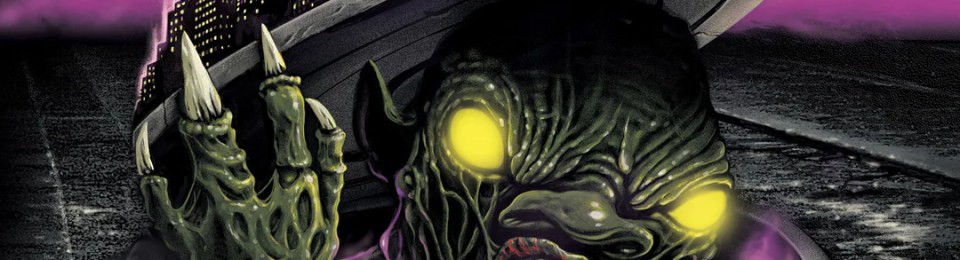
What makes C.H.U.D. particularly interesting as an early-1980s horror film is the way its social anxieties are embedded within its monster mythology. The Cannibalistic Humanoid Underground Dwellers are not supernatural invaders. They are the consequence of human decisions.
The film’s horror is therefore fundamentally ecological and political.
Toxic material has been dumped where it shouldn’t be. Homeless people have been pushed into spaces where nobody wants to look. Institutions are more interested in containing embarrassment than confronting responsibility.
The creatures have been produced by neglect.
Cooper and Hughes’ score rarely needs to underline this explicitly. Its cold electronic palette creates an atmosphere of institutional indifference. There is little warmth in the music because there is little warmth in the world it depicts.
This is not a soundtrack that asks us to fear the unknown.
It asks us to fear what we already know—and what we have chosen not to see.
The Underground as the Unconscious
The underground has always possessed a particular significance in horror.
It is where civilisation puts what it cannot accommodate.
The dead.
The unwanted.
The contaminated.
The forgotten.
In C.H.U.D., the sewer becomes a literalised subconscious. Everything pushed beneath the surface eventually returns.
This brings to mind the anthropological concept of the “non-place”, associated with French theorist Marc Augé: anonymous environments designed for transit rather than belonging. Subways, service corridors, tunnels and other infrastructural spaces are necessary to modern life, yet they remain psychologically peripheral.
C.H.U.D. transforms those spaces into places of revelation.
The characters descend beneath New York and discover that the city’s discarded material has acquired a life of its own.
The score accompanies this descent by gradually stripping away conventional musical familiarity. Melody becomes secondary to texture. Rhythm becomes a pulse. Sound becomes environment.
The deeper we travel, the less recognisable the world becomes.
Music Without a Monster
One of the most effective qualities of the C.H.U.D. soundtrack is its restraint.
Horror music often tells us how to respond. A sudden orchestral sting announces danger; a crescendo prepares us for violence; a sinister melody identifies the villain before the character even appears.
C.H.U.D. frequently works differently.
Its music creates an atmosphere in which danger is simply assumed.
This is particularly effective because the film’s monsters are rarely the most frightening thing in the room. The real unease comes from the possibility that the city has been operating according to rules that ordinary citizens never knew existed.
The soundtrack therefore doesn’t need to announce the creatures.
The environment has already become threatening.
The Early Electronic Horror Sound
There is also something distinctly of its period about the score.
The early 1980s represented a fascinating moment in horror music. Advances in synthesisers and recording technology were making electronic composition increasingly accessible, while filmmakers were discovering that synthetic sounds could produce forms of unease that traditional orchestration could not.
The result was a new sonic vocabulary.
Cold.
Mechanical.
Repetitive.
Alien.
Yet the electronic sound of C.H.U.D. is particularly appropriate because its horror is itself technological. This is not an ancient evil emerging from some forgotten crypt. It is a modern catastrophe produced by industry, infrastructure and institutional failure.
The synthesiser is therefore more than an aesthetic choice.
It belongs to the film’s world.
The Monster Is the System
Perhaps the most interesting way to interpret C.H.U.D. is to realise that its monsters are almost beside the point.
They are memorable because they provide the film with an immediately recognisable physical threat. But the film’s deeper horror comes from discovering how easily people can become invisible within a modern city.
The creatures live beneath the streets because society has created a space where they can exist unnoticed.
That makes the title itself strangely revealing.
Cannibalistic Humanoid Underground Dwellers.
Even their name sounds bureaucratic.
They are classified.
Categorised.
Reduced to an acronym.
The absurdity of the name disguises an uncomfortable truth: these creatures are the product of systems that have failed.
And the soundtrack reflects that failure.
Its cold electronic pulses feel almost administrative in their repetition, as though the machinery of the city continues functioning regardless of what has been buried beneath it.
The trains still run.
The lights still work.
The streets remain crowded.
And somewhere underneath all of it, something is feeding.
Why C.H.U.D. Still Sounds Modern
Four decades later, the soundtrack’s greatest achievement may be how little it dates.
The film itself is unmistakably a product of early-1980s New York, but its music possesses an abstraction that remains surprisingly contemporary.
Modern horror increasingly understands that atmosphere can be more unsettling than melody. Drone, texture, ambient noise and electronic minimalism have become central components of the genre’s musical vocabulary.
C.H.U.D. was already exploring those possibilities.
Its soundtrack does not demand to be remembered as a collection of themes.
It wants to be experienced as an environment.
And perhaps that is why it remains so effective.
Continue the Conversation
The music of C.H.U.D. is easy to overlook because the film itself is so visually and conceptually loud. But listen carefully and another film begins to emerge: one concerned less with monsters than with the hidden systems beneath modern civilisation.
In the latest episode of Sounds of Horror, Saul Muerte descends beneath the streets of New York to explore the score in greater detail, examining how Martin Cooper and David A. Hughes transform urban infrastructure into an instrument of dread.
If the film asks what might be living beneath the city, the soundtrack asks a more unsettling question:
What if the city itself is alive?
The Prognosis:
The most effective horror music does not necessarily frighten us in isolation.
Sometimes its achievement is more subtle.
It changes the way we hear a place.
After C.H.U.D., a subway tunnel is no longer merely a subway tunnel. A distant mechanical hum becomes something worth noticing. A manhole cover becomes a threshold. The familiar infrastructure of the modern city acquires a second, darker identity.
That is the real achievement of the C.H.U.D. soundtrack.
Cooper and Hughes don’t simply score the monsters beneath New York.
They score everything we have built above them.
And perhaps that is why the music remains so unsettling.
Because the most frightening thing beneath the city isn’t necessarily what has crawled out of the darkness.
It’s what we put there.
- Saul Muerte
 Surgeons of Horror