Before Horror Found Its Monsters, It Found Madness
There are horror films that ask us to fear the monster.
There are horror films that ask us to fear the dark.
Then there are films that ask us to fear our own minds.
Nearly a century before psychological horror became one of cinema’s most celebrated subgenres, Teinosuke Kinugasa’s A Page of Madness (狂った一頁) was already dismantling the relationship between audience and reality. It offered no comforting explanations, no reliable narrator and very little dialogue to guide the viewer through its fractured world. Instead, it immersed audiences in an emotional and psychological experience that remains startlingly modern one hundred years later.
Watching A Page of Madness today is less like viewing a silent film and more like stepping into someone else’s nightmare.
Released in 1926, the film arrived during a period of extraordinary artistic experimentation. Across Europe, German Expressionism was transforming architecture and shadow into reflections of emotional distress, while Surrealism was beginning to challenge the boundaries between dreams and waking life. In Japan, however, Kinugasa was forging an entirely different cinematic language.
Working alongside novelist Yasunari Kawabata, whose literary interests centred on perception, memory and emotional subjectivity, Kinugasa rejected conventional storytelling in favour of sensation. Their collaboration sought not simply to tell a story, but to place the audience inside a fractured state of consciousness. The result was a film unlike anything produced before it—and, arguably, unlike anything produced since.
Its premise appears deceptively straightforward.
A janitor secretly works within an isolated mental asylum, hoping to free his wife, who has been institutionalised after attempting to take her own life. Yet this synopsis barely scratches the surface. Narrative quickly gives way to emotion as dreams, memories, fantasies and reality begin folding into one another until they become almost impossible to separate. This is not a mystery designed to be solved. It is an experience designed to be felt.
Perhaps the film’s boldest artistic decision lies in its rejection of explanatory intertitles. While most silent cinema relied heavily upon written cards to propel narrative and clarify motivation, A Page of Madness strips much of that certainty away. Viewers are forced to navigate its emotional landscape through expression, movement, editing and atmosphere alone. The effect is profoundly disorientating.
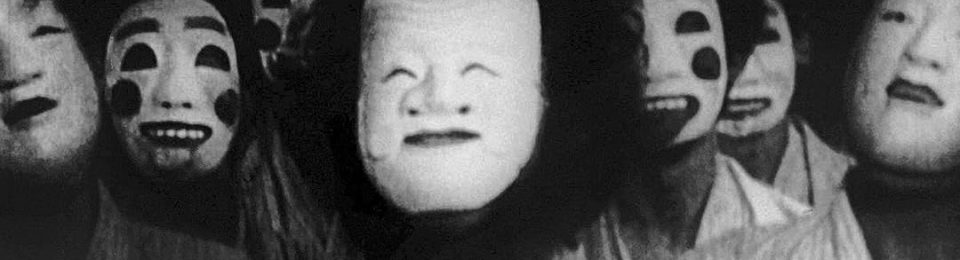
Like the asylum’s patients, we struggle to distinguish memory from hallucination. The film doesn’t merely depict mental illness—it constructs a cinematic language that places us within uncertainty itself. Kinugasa’s direction remains astonishing even by contemporary standards. Rapid montage fractures both time and space. Double exposures allow multiple emotional realities to occupy the same frame. Reflections distort identity. Masks appear and disappear with haunting ambiguity. The camera glides through corridors with dreamlike fluidity before suddenly becoming trapped inside frantic bursts of chaotic movement.
There are moments where the editing feels decades ahead of its time, anticipating techniques later embraced by experimental filmmakers and psychological horror alike. Without claiming direct influence, it is difficult not to recognise echoes of its fragmented subjectivity in films such as Repulsion, Jacob’s Ladder, Perfect Blue, Black Swan and The Lighthouse. Each similarly invites audiences to question whether what they are witnessing is external reality or internal collapse.
Yet A Page of Madness achieves this without the benefit of synchronised sound, modern visual effects or contemporary editing technology.
It relies entirely upon cinema’s most fundamental tools.
Light.
Shadow.
Movement.
Rhythm.
Emotion.
The title itself offers another fascinating clue to Kinugasa’s intentions.
A Page of Madness.
Not The Madman.
Not The Asylum.
Not The Monster.
Just… a page. A fragment. A fleeting glimpse into a consciousness we can never fully comprehend.
Madness here is not presented as spectacle or villainy. Instead, it becomes a deeply human condition, one that exists not only within the institution’s walls but potentially within every one of us. The asylum ceases to function merely as a location and instead becomes a metaphor for the fragile architecture of the human mind. That ambiguity remains one of the film’s greatest strengths.
For all its visual innovation, A Page of Madness is ultimately a remarkably compassionate work. Rather than sensationalising mental illness, it portrays those living within the asylum with empathy and sadness. The janitor’s desperate attempts to reconnect with his wife are driven not by fear, but by love, guilt and hope. Horror emerges not through monsters or violence, but through the devastating possibility that some emotional wounds cannot simply be undone. The film’s own history possesses an almost mythical quality. For decades, A Page of Madness was believed lost.
Like so many silent masterpieces, it seemed destined to survive only through written accounts and fading memories. Then, in the early 1970s, Kinugasa himself discovered a print stored away in his own warehouse. A film concerned with memory, fractured identity and forgotten lives had itself become forgotten before unexpectedly returning to the world. It is difficult to imagine a more fitting fate.
One hundred years after its original release, A Page of Madness continues to resist easy interpretation. It asks audiences to surrender certainty in favour of emotion. To abandon narrative comfort in favour of instinct. To accept that some experiences cannot be neatly explained. Perhaps that is why it still feels so contemporary. Modern psychological horror frequently asks us whether we can trust our senses. Kinugasa asked the same question in 1926.
Long before horror found its vampires.
Long before masked killers stalked suburban streets.
Long before demons possessed isolated cabins.
It found something altogether more unsettling. The terrifying possibility that our greatest fears are not waiting for us in the darkness…
…but quietly taking shape within ourselves.
The Prognosis:
A Page of Madness remains one of the most daring achievements in horror-adjacent cinema—not because it presents terrifying images, but because it dismantles the audience’s certainty. It transforms madness into atmosphere, editing into emotion and silence into psychological unease. A century later, its fractured vision still feels startlingly modern, reminding us that the most enduring horrors have never depended upon monsters. Sometimes, they simply ask us to question whether the world we are seeing was ever real at all.

If you enjoy exploring the forgotten corners of horror history, be sure to visit the Surgeons of Horror archive, where you’ll find retrospectives celebrating landmark works from across the genre’s rich and varied past—from silent cinema and Gothic classics through to modern psychological horror. Every film tells a story. Every anniversary offers a chance to rediscover it.
Kwaidan (1964): A Haunting Masterpiece of Japanese Horror

