Tags
Chicho Ibáñez Serrador, film, horror, Lewis Fiander, Movie review, movies, Prunella Ransome, reviews
There are few films that confront the audience with a question so blunt, so morally paralysing, as Who Can Kill a Child?. Directed by Chicho Ibáñez Serrador, this unnerving slice of Spanish horror does not rely on elaborate mythology or baroque excess. Instead, it weaponises something far more disquieting:
Innocence itself.
The Horror of the Unthinkable
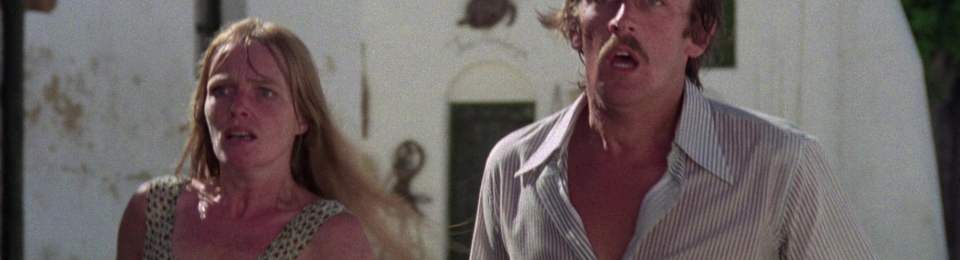
From its opening frames, Serrador signals his intent. A montage of real-world images — war, famine, suffering — grounds the film in a recognisable reality, implicating humanity long before the narrative begins. By the time the English couple arrive on the sun-drenched island of Almanzora, the question has already been posed, quietly but insistently:
What have we done to the world… and what might the next generation do in return?
What follows is a slow unravelling. The absence of adults is not immediately terrifying — merely strange, faintly uncanny. Children play, laugh, and watch. Always watching. It is in their stillness, their smiles, that Serrador finds his dread.
There is no rush to violence. Only the creeping realisation that something is profoundly, irrevocably wrong.
Sunlight as Terror
Unlike the shadow-drenched gothic traditions of horror, Who Can Kill a Child? unfolds largely in broad daylight. The Mediterranean setting — bright, open, deceptively serene — becomes a stage for unease.
Serrador understands that horror need not hide in darkness. Here, it thrives in exposure.
The empty streets, the echo of footsteps, the oppressive quiet of a village stripped of its adult presence — all contribute to an atmosphere that feels less like a nightmare and more like a waking dread. The world is visible, tangible… and entirely hostile.
Morality as the True Battleground
The film’s most enduring power lies in its central dilemma. As the threat becomes undeniable, the question ceases to be abstract.
It becomes immediate. Personal. Inescapable.
Who can kill a child?
Serrador refuses easy answers. The film does not revel in violence, nor does it offer catharsis. Instead, it traps both its characters and its audience within an ethical paradox — survival demands an unthinkable act, yet to commit it is to cross a line that cannot be uncrossed.
In this way, the film transcends its premise. It is not simply about killer children — a trope that would later be explored in films like Children of the Corn — but about the collapse of moral certainty under extreme conditions.
A Measured, Relentless Descent
Serrador’s pacing is deliberate, almost clinical. The tension builds not through escalation, but through accumulation — each moment adding weight to an already suffocating atmosphere.
If there is a flaw, it lies in this restraint. The film’s commitment to its central conceit occasionally limits its emotional range, keeping the characters at a slight remove. We observe their descent more than we fully inhabit it.
And yet, this distance may well be intentional. A buffer between the viewer and the horror they are being asked to contemplate.
Legacy of Unease
Decades on, Who Can Kill a Child? remains one of the most unsettling entries in European horror — not because of what it shows, but because of what it demands.
It asks the audience to consider the unthinkable… and then refuses to let them look away.
In an era where horror often seeks to shock through excess, Serrador’s film endures through precision. Through the careful construction of a scenario in which there are no good choices — only consequences.
The Prognosis:
Who Can Kill a Child? is not an easy film to watch, nor is it meant to be. It is a moral provocation wrapped in the guise of horror, a work that lingers not in the memory of its images, but in the weight of its question.
A chilling, sunlit nightmare that transforms innocence into terror, and forces us to confront the limits of our own humanity.
- Saul Muerte

