• About
  • podcasts
  • Shop

Surgeons of Horror

~ Dissecting horror films

Surgeons of Horror

Tag Archives: sci-fi horror

Pitch Black (2000) at 25: Still a Sci-Fi Horror Classic in the Dark

17 Monday Feb 2025

Posted by surgeons of horror in retrospective

≈ Leave a comment

Tags

alien horror, claudia black, cole hauser, keith david, pitch black, radha mitchell, sci-fi, sci-fi horror, Sci-Fi Movies, vin diesel

A quarter of a century has passed since Pitch Black crash-landed onto screens, delivering a gripping fusion of sci-fi, action, and horror that still holds its own today. In the years since, the film has spawned sequels, a devoted fanbase, and even further cemented Vin Diesel as a genre icon. But more importantly, Pitch Black remains a testament to the power of stripped-down, high-concept storytelling—proof that a simple premise, executed with precision, can stand the test of time.

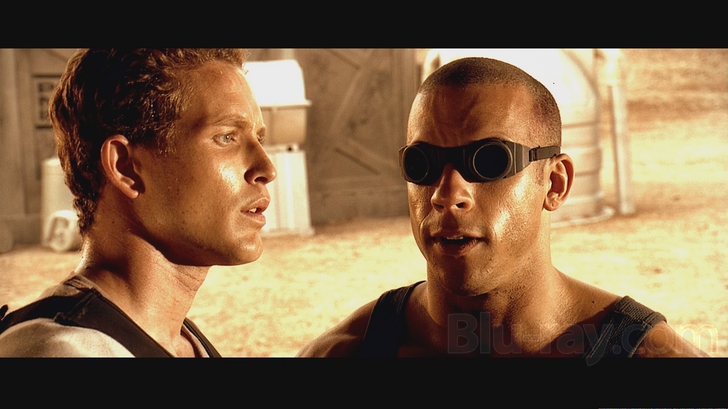
The setup is deceptively straightforward: a transport ship carrying a diverse group of passengers crash-lands on a remote planet, forcing them to rely on the one man they fear the most—Richard B. Riddick (Vin Diesel), an escaped convict with surgically enhanced night vision. But as they struggle to survive, they quickly realise that Riddick isn’t the biggest threat. When the planet is plunged into total darkness during a rare eclipse, it becomes clear that they’re not alone—deadly creatures emerge from the shadows, picking them off one by one.

Director David Twohy crafted a film that defies expectations at every turn. What could have been a forgettable Alien clone instead became an exercise in atmospheric dread and moral ambiguity, where the supposed villain may be the only one capable of ensuring survival. The script is lean, the world-building is compelling without being over-explained, and the film wastes no time in establishing the stakes.

Riddick remains one of the most compelling antiheroes of modern sci-fi. Diesel, on the verge of superstardom at the time, gives a performance that simmers with controlled intensity. His Riddick is unpredictable, calculating, and, at times, genuinely terrifying. But as the film unfolds, it becomes clear that he isn’t just a brute force—he’s a survivor, and unlike the others, he understands the harsh reality of their predicament.

This role launched a franchise, leading to The Chronicles of Riddick (2004) and Riddick (2013), with a fourth installment, Riddick: Furya, in the works. While the sequels took the character in different directions, Pitch Black remains the most effective use of Diesel’s brooding screen presence, where his menace and reluctant heroism are balanced perfectly.

Beyond Diesel, Pitch Black is elevated by its supporting cast. Radha Mitchell delivers one of her best performances as Carolyn Fry, a pilot burdened with guilt and forced into leadership. Keith David brings gravitas as Imam, a man of faith struggling to reconcile belief with brutal reality. Cole Hauser plays the ruthless mercenary Johns, whose morality is as murky as Riddick’s, and Claudia Black—before her Farscape and Stargate SG-1 fame—adds depth in a smaller role.

One of the film’s strengths is how it handles its characters: no one is truly safe, and survival isn’t guaranteed. The film embraces the cruelty of its setting, reinforcing the theme that in extreme conditions, it isn’t just the monsters that are dangerous—human nature can be just as predatory.

Cinematographer David Eggby (Mad Max) gives Pitch Black a distinctive, almost surreal visual palette. The harsh, bleached-out daylight sequences contrast beautifully with the eerie, blue-tinged darkness, immersing the audience in an alien world that feels both hostile and eerily familiar. The decision to film in the Australian outback lends an authenticity to the barren landscape, making it feel truly isolated.

The creature design remains a triumph, blending practical and CGI effects to create monstrous, bat-like predators that feel genuinely threatening. The concept of light as both salvation and a fragile barrier between life and death adds an extra layer of tension, making every flickering torch or dwindling battery a source of dread.

Despite its relatively modest budget, Pitch Black has aged remarkably well. The film’s minimalist approach means it doesn’t rely on flashy effects or convoluted lore—it’s a tightly crafted survival thriller that still delivers genuine tension.

If there’s any flaw, it’s that Pitch Black set such a high bar that the later Riddick films struggled to recapture its magic. The Chronicles of Riddick attempted to expand the mythology but lost some of the rawness that made the original so compelling. Riddick (2013) brought things back to basics, but nothing quite matched the unpredictable intensity of Pitch Black.

But 25 years on, none of that diminishes its impact. Whether you’re revisiting it or discovering it for the first time, Pitch Black remains one of the best sci-fi horror films of the 21st century—lean, mean, and never afraid of the dark.

  • Saul Muerte

Supernova: A Black Hole of Missed Opportunities and Behind-the-Scenes Chaos

14 Tuesday Jan 2025

Posted by surgeons of horror in retrospective

≈ Leave a comment

Tags

angela bassett, james spader, lou diamond phillips, Robin Tunney, sci-fi, sci-fi horror, Sci-Fi Movies

Supernova is a textbook example of how a troubled production can derail even the most promising concept. Billed as a sleek sci-fi thriller, the film instead arrived as a fragmented, disjointed mess that left audiences—and its own cast—wondering what went wrong.

The behind-the-scenes chaos is almost more compelling than the movie itself. Walter Hill, a director known for his gritty, character-driven work, left the project amid creative disputes. Jack Sholder was brought in to salvage it, and eventually, even Francis Ford Coppola was tapped for re-edits. Despite these efforts, the result is a patchwork narrative that never gels.

The cast, including James Spader, Angela Bassett, and Robin Tunney, reportedly distanced themselves from the final product. It’s easy to see why: their performances feel stifled, victims of erratic direction and an incoherent script. Spader’s natural charisma is muted, while Bassett’s talent is wasted on a character given little to do.

Visually, the film oscillates between dated CGI and occasionally striking production design, but even its better moments are overshadowed by the narrative incoherence. What should have been a tense exploration of isolation and the unknown instead devolves into a nonsensical series of events culminating in an ending that feels both rushed and unsatisfying.

Thematically, Supernova had potential, with its exploration of humanity, technology, and the dangers of the unknown. Unfortunately, its lofty ideas are buried beneath the weight of its disastrous production. Twenty-five years on, the film stands as a cautionary tale of how too many cooks—and too little vision—can ruin a cinematic stew.

  • Saul Muerte

40 Years of The Terminator: How James Cameron’s Vision Redefined Sci-Fi and Action Cinema

25 Friday Oct 2024

Posted by surgeons of horror in retrospective

≈ Leave a comment

Tags

arnold schwarzenegger, james cameron, lance henriksson, linda hamilton, michael biehn, sci-fi, sci-fi horror, Sci-Fi Movies, Terminator

In 1984, James Cameron, a relatively unknown director at the time, unleashed The Terminator upon the world—a low-budget sci-fi action thriller that would ultimately redefine both genres and launch one of the most enduring franchises in film history. As we celebrate the film’s 40th anniversary, its legacy looms larger than ever, marking it as a pivotal point in both filmmaking and pop culture.

A Vision Born of Dreams (Literally)

It’s impossible to discuss The Terminator without mentioning Cameron’s origins of the story—a fever dream he had during the production of Piranha II: The Spawning. The haunting image of a skeletal, humanoid machine emerging from flames became the foundation for a story that, at its heart, tapped into deep fears about technology and the human condition. Cameron’s background in visual effects also allowed him to conceive a film that would push the limits of practical effects at the time, despite its modest $6.4 million budget.

Cameron’s relentless drive to make The Terminator was evident in the casting choices, the painstaking attention to detail in the special effects, and the world-building that would expand well beyond this film. He worked closely with Gale Anne Hurd, his producing partner and eventual wife, to secure the rights and get the project off the ground. Together, they were not just creating a movie—they were building a mythology.

Schwarzenegger: From Villain to Icon

At the time of its release, The Terminator offered a breakout role for Arnold Schwarzenegger, who had only recently transitioned into mainstream cinema from bodybuilding. Originally considered for the role of Kyle Reese, it was Schwarzenegger’s imposing physical presence that made him perfect for the titular Terminator—a relentless, emotionless killing machine sent from the future to eliminate Sarah Connor.

Schwarzenegger’s portrayal of the T-800 cyborg became iconic not just for his size, but for his chilling detachment, minimal dialogue, and robotic precision. Phrases like “I’ll be back” and “Hasta la vista, baby” became ingrained in pop culture, although it’s easy to forget that The Terminator wasn’t yet a blockbuster upon release. It was only in hindsight, as The Terminator built momentum through word of mouth, home video, and its eventual 1991 sequel Terminator 2: Judgment Day, that Schwarzenegger’s performance became synonymous with the action genre itself.

A Sci-Fi Noir at Heart

The atmosphere of The Terminator is a perfect blend of sci-fi and noir, with its rain-soaked streets, cold urban environments, and dark alleyways. Set against the backdrop of a dystopian future, Cameron crafted a world where machines had risen against their human creators, but he also grounded the narrative in present-day Los Angeles, giving the film a gritty, grounded feel. The blending of these two worlds—dystopian future and present-day urban decay—provided a foreboding sense of inevitability that makes the film feel eerily relevant even today.

Brad Fiedel’s memorable score, with its mechanical, pulse-like rhythm, became as integral to the film’s atmosphere as its visuals. The iconic “Terminator theme” conveyed both a sense of impending doom and a cold, mechanical world that was indifferent to human survival. This helped solidify The Terminator as more than just an action-packed film—it was a mood piece that explored deeper philosophical questions about fate, technology, and survival.

Sarah Connor: A New Kind of Heroine

While The Terminator is often remembered for Schwarzenegger’s chilling presence, it’s Linda Hamilton’s Sarah Connor who grounds the film emotionally. When we first meet her, she’s an ordinary woman, unaware of her pivotal role in the future of humanity. Her arc from a vulnerable target to a resilient, determined fighter is one of the film’s most compelling elements.

Sarah Connor represented a shift in how women were portrayed in action films—no longer just damsels in distress, but central characters with agency and strength. This was a precursor to the much more hardened, militarized version of Sarah Connor seen in Terminator 2, but it was in The Terminator that the seeds were sown for her evolution into one of cinema’s most iconic heroines.

Michael Biehn’s Kyle Reese: The Unsung Hero

At the heart of the film’s emotional core is Michael Biehn’s performance as Kyle Reese, the soldier sent back in time to protect Sarah Connor. Biehn brings a vulnerability to the role that contrasts with Schwarzenegger’s cold, mechanical villainy, making Reese not just an action hero but a tragic figure. His haunted portrayal of a man from a war-torn future who has little left to lose added gravitas to the film. Reese’s desperate commitment to saving Sarah and the future of humanity adds an emotional weight to the action, grounding the story in a sense of real human stakes. Biehn would later reunite with Cameron in Aliens (1986), where he delivered another memorable performance as Corporal Hicks, cementing his place as one of Cameron’s go-to actors for complex, layered heroes.

Special Effects That Stood the Test of Time

For a film made on such a tight budget, The Terminator showcased groundbreaking practical effects and makeup work, particularly Stan Winston’s animatronic work on the T-800’s skeletal form. The combination of stop-motion animation, practical models, and early animatronics allowed Cameron to realise his terrifying vision of the machine within.

The relentless, unstoppable nature of the Terminator was embodied in the effects, particularly during the climactic scene where the T-800, stripped of its human skin, chases Sarah and Kyle in full skeletal form. While today’s audiences may be used to seamless CGI, the practical effects of The Terminator are still impressive, especially given the constraints of the time.

Themes of Fate, Technology, and Survival

At the core of The Terminator is a meditation on fate. The film presents the terrifying notion that certain events are predestined—whether it’s the rise of machines or Sarah Connor’s role in the survival of the human race. This theme of inevitability resonates throughout the series, but it’s perhaps most impactful in the original, where there’s a palpable sense of helplessness in the face of a seemingly unstoppable future.

Cameron also tapped into growing anxieties about technology. The idea of machines becoming sentient, of artificial intelligence surpassing human control, was still largely science fiction in 1984, but The Terminator presented a vision of what could happen if technology ran amok. This cautionary tale feels even more relevant in today’s age of advanced AI and automation.

The Horror at the Heart of The Terminator

While The Terminator is often categorised as a sci-fi action film, it’s impossible to overlook its deep horror roots. Cameron masterfully weaves suspense and dread throughout the film, presenting the T-800 as a near-unstoppable force reminiscent of classic horror villains like Michael Myers or Jason Voorhees. The relentless pursuit of Sarah Connor gives the film the tension and atmosphere of a slasher, with the Terminator stalking its prey with terrifying precision. Scenes like the police station massacre are not just action set pieces but moments of sheer terror, underscored by the unstoppable, mechanical nature of the T-800. This fusion of horror with science fiction gave The Terminator a distinct edge, setting it apart from other films of the era.

A Lasting Legacy

As we look back 40 years later, it’s clear that The Terminator wasn’t just a genre-defining film—it was the foundation for one of the most successful and influential franchises in cinema history. While the Terminator franchise has had its ups and downs over the years, with numerous sequels, reboots, and TV spinoffs, the original film remains a singular achievement. It captured lightning in a bottle, with its blend of high-concept science fiction, nail-biting action, and surprisingly heartfelt storytelling.

Moreover, The Terminator solidified James Cameron as one of the most visionary directors of his time. He would go on to create other genre-defining films, including Aliens, Titanic, and Avatar, but The Terminator was the launching pad for his meteoric rise.

Conclusion: A Timeless Machine

As we celebrate the 40th anniversary of The Terminator, it’s worth reflecting on how this film, originally conceived as a low-budget B-movie, became a cultural touchstone that continues to influence filmmakers and audiences alike. Its themes of fate, survival, and the dangers of unchecked technological advancement are as timely today as they were in 1984. And much like the unstoppable machine at the film’s core, The Terminator’s legacy is destined to endure for decades to come.

  • Saul Muerte

Retrospective: The Deadly Mantis (1957)

03 Saturday Sep 2022

Posted by surgeons of horror in retrospective

≈ Leave a comment

Tags

alix talton, craig stevens, sci-fi horror, Sci-Fi Movies, the deadly mantis, Universal, Universal Horror, universal pictures, william hopper

Ever since I saw Kamacuras stalking around in the Kaiju movie Son of Godzilla, I’ve had a deep dread of this (let’s face it) fairly timid mantises. Whenever I watched the movie, I must have been at that impressionable age where this triangular headed insect embedded into my mind. Its essentially one of the things that initiated my aerozoophobia.

So imagine my trepidation upon learning that amongst Universal Pictures scifi horror canon during the mid fifties is movie entitled The Deadly Mantis.

Set in the South Seas, a volcanic eruption unearths a 200 foot long praying mantis that has been frozen in ice for hundreds of years.

When one of the remote Canadian outposts fails to return any calls, Col. Joe Parkman (Craig Stevens) is sent into investigate. Upon his arrival, Parkman discovers no sign of life and strange marks imprinted in the snow.

Later, an Air Force plane is grounded by the giant insect and Parkman notices the same slash marks he’d witnessed from the outpost. Only this time who also finds a five foot long spur. Fuelled by curiosity, he hires his top scientist to work our its origin but without success. So, in steps paleontologist Nedrick Jackson (William Hopper) who traces it to the praying mantis species.

When another attack happens at an Inuit village in the Arctic, the press become interested and magazine editor Marge Blane (Alix Talton) talks her way into joining the expedition posing as a photographer.

Its indicative of the time when Marge turns up to the base, all the men are instantly smitten by her presence, but its out hero Parkman that is the most taken by her, and the feeling is mutual between them. As with most trauma based narratives, these events often draw people together and as the the story unfolds between military and mantis attacks, their bond becomes further united.

The films conclusion smacks of earlier giant creature movies, most notably King Kong and Them, where the military bombard the monster with aero dynamic arsenal, this time forcing the Deadly Mantis into the Manhattan Tunnel. Trapped inside, Parkman takes a number of troops inside to kill it once and for all, armed with rifles and chemical bombs.

The feature didn’t live up to its gigantic proportions in the box office however, and failed to ignite massive interest. Looking back at it now, one can’t help but identify with this reaction as i struggled to connect with the plight, nor any fear that it tried to invoke, despite my own animosity.

Much like other sci-fi features of the era it would find itself subject to ridicule in Mystery Science Theatre 3000, a symbol of how these movies were received and the fall from grace that Universal was starting to find itself in.

  • Saul Muerte

Movie review: Nope (2022)

10 Wednesday Aug 2022

Posted by surgeons of horror in Movie review

≈ Leave a comment

Tags

daniel kaluuya, Jordan Peele, keith david, keke palmer, michael wincott, sci-fi horror, steven yeun, universal pictures

Jordan Peele ventures forth with his third outing behind the camera following success with Get Out and Us, with a nod to the B-horror science fiction movies of the 50s. Set in an isolated part of inland California, siblings OJ and Emerald Haywood witness the death of their father when random objects fall from the sky. This prompts them to capture evidence of an unidentified flying object and probable cause of the strange happenings but may lead them to an unnerving discovery.

For me, labelling Nope as a horror film is akin to saying that fish and chips is a healthy eating option. Sure, Nope has jump scares, and blood, and people die, but nothing, and I do mean nothing, about this film makes it a horror flick.

That’s not to say that you won’t have a good time watching it-Daniel Kaluuya is the undisputed king of understated, brooding acting, and Keke Palmer is 100% joy on screen.
Personally, I was thrilled to see Michael Wincott again. As if his frankly ridiculously beautiful speaking voice wasn’t enough, he nails the role of ‘surly but genius cinematographer.

Speaking of cinematography, Hoyte Van Hoytema is behind the lens for this one (he’s they guy who shot Tenet, Interstellar, Dunkirk, and Ad Astra. He’s practically Christopher Nolan’s go-too-guy) and holy smokes does he bring each location to life.
Truly stunning work.

The Prognosis:

I am by no means an edge lord gatekeeper of horror films – I still can’t watch the Thriller video without needing a hug afterwards, but don’t go into Nope expecting to be scared out of your mind.

There’s plenty of questionable plot holes, and I wanted to see much more from Steven Yeun’s character ‘Ricky’, but it’s still a fun watch, and worth seeing at a cinema purely for the sound design alone.

  • John Turnbull

Nope is a homage to classic B movie sci fi horror, but it is NOT made in the usual cookie cutter paint-by-numbers way. It is powered by a unique vision only achievable by Jordan Peele

Antony Yee

Retrospective: The Quatermass Xperiment (1955)

29 Friday Jul 2022

Posted by surgeons of horror in retrospective

≈ 3 Comments

Tags

brian donleby, hammer films, Hammer Horror, james carreras, richard wordsworth, sci-fi, sci-fi horror, Sci-Fi Movies, val guest

In the same year that Universal release This Island Earth, Hammer Films were about to enter a brave new world of their own, and it would all begin with their release of The Quatermass Xperiment. Spearheaded by James Carreras knack for networking and the ability for Hammer to produce the familiar in the eyes of the backers but with their own spin. In this instance, the appeal would come from an adaptation of BBC serial The Quatermass Experiment. 

The tale takes place when a three-manned rocket ship owned by Professor Bernard Quatermass (Brian Donlevy) loses radio contact and crash lands with two of its occupants vanished without a trace. Its sole survivor, Victor Carroon (Richard Wordsworth) has been clearly affected by a parasitic alien organism that slowly engulfs his body and is also transfused with a cactus plant that he came into contact with. 

Part of the attraction to TQX is that Quatermass himself leads questionable character choices. From the get-go, we learn that the rocket ship in question was launched without being sanctioned to do so. This recklessness is still evident too by the films’ end when he is still insistent in going ahead with his scientific plans despite the flaws and drawbacks that were brought about due to his decisions. Was there no lesson learned for him at all? Or is it purely that he is driven to succeed in his experimentations? At what point is it too far to cross? Or does the line simply not exist for the likes of Quatermass?

Richard Wordsworth’s performance is equally compelling, providing heart to the troubled Carroon. His deterioration both physically and mentally on screen keeps the audience gripped and able to connect with his plight.

It should also be noted how integral Director Val Guest’s vision had on defining the style of Hammer’s more sci-fi horror leaning productions, (the more recogniseable Gothic features would very much fall to Terence Fisher) and would have him return for Quatermass 2. There would also be the notable push for adult classification in Hammer’s production releases hence the deliberate X placement in the title to define their approach and the audience they wanted for their movies.

The success of TQX for Britain and across the seas in the States would project them further towards success and unite them in a deal with Columbia Pictures. Hammer Films were a heartbeat away from The Curse of Frankenstein, the movie that would cement their footing in the horror scene, but TQX would provide them with the first footsteps to celluloid history. It’s incredibly riveting and watchable still and highly recommended. 

  • Saul Muerte

Retrospective: This Island Earth (1955)

29 Friday Jul 2022

Posted by surgeons of horror in retrospective, Universal Horror

≈ 2 Comments

Tags

faith domergue, jeff morrow, metulana mtuant, rex reason, sci-fi, sci-fi horror, Sci-Fi Movies, this island earth, Universal Horror, universal pictures

My Universal horror retrospective chronicling the transition away from the genre that made the production company famous throughout the 30s and 40s and into the sci-fi realm continues with This Island Earth. 

At the time of its release the movie was noted for its state-of-the-art effects and use of Technicolor but it would later be famously ridiculed in Mystery Science Theater 3000, showing just how far the film had fallen in the public’s eye.

For me, it will always conjure up the image of the Metaluna Mutant, once a rejected choice for It Came From Outer Space (1953) It’s an iconic character that probably deserves a little more screen time than it actually receives than the short scare towards the film’s climax.

Upon closer scrutiny, TIE does suffer with minimal plot narrative to bind it together; a case of more style than substance. So you can understand the mockery that it fell subject to in more recent years,

The story essentially follows Dr. Cal Meacham (Rex Reason) who is mysteriously rescued when his jet almost crashlands with the aid of a strange green glow. He is then gifted a set of instructions to build a complex machine; a test to see if he has the smarts to be selected for a special research project run by the equally mystifying Exeter (Jeff Morrow).

Before long Cal is recruited by Exeter and meets up with old flame Dr. Ruth Adams (Faith Domergue) and a few other hand-picked scientists. The film quickly develops from a proposed science espionage flick into an intergalactic war when Cal and Ruth are whisked away to the planet Metulana, a planet under attack from the unseen Zagons.   

There are great leaps in the imagination here from a screenplay based on the novel by Raymond F. Jones, and one needs to give in to the mindless direction it takes you in and not pay to close mind to the obvious flaws within.

It remains a film with some great images for its time, despite this, and is indicative of the b-movie sci-fi flicks that would swiftly follow suit and one that would capture the imagination of cinema-goers in the mid 50s. 

On the other side of the pond however, Britain’s Hammer Films were offering up an alternative spin on the science fiction scene with… The Quatermass Xperiment.

  • Saul Muerte

Movie review: Vivarium

15 Wednesday Apr 2020

Posted by surgeons of horror in Movie review

≈ Leave a comment

Tags

imogen poots, jesse eisenberg, sci-fi, sci-fi horror, Sci-Fi Movies

In 2004 a TV series hit our screens called Lost.  Soon after that Heroes.  They heralded a new era of a different kind of storytelling.

One with no consequences.  To elaborate – if you look at a story as an equation of cause & effect, then traditionally the challenge of making a story tight, or just good, was that one flowed into the other creatively WHILST maintaining a strong internal logic.

Bruce Willis is dead at the end of Sixth Sense (effect) and suddenly EVERYTHING he has done (only ever interacting with the kid, always wearing the same clothes, never opening doors) makes sense because (cause) when he got shot at the beginning of the film, he actually died.

(Sorry – spoiler if you haven’t seen it yet.  In which case – REALLY!??)

Anyway – along comes Lost and Heroes and suddenly we were hit with a thought.  What if we didn’t focus on the left side of this equation (the cause) but only on the right (the effect)?

Suddenly dramatic options seemed to gain a new dimension as shows steeped in sci-fi weirdness had a texture to it that sucked in audiences not normally charmed by its usual bells and whistles.

Suddenly high concept narratives had good dramatic writing.  They didn’t focus on the WHY, but on the WHAT.  What does this “why” do to our characters?

It’s consequence free writing.  Don’t worry if the set-up makes sense, just set it up, and then get on with it.

A tropical island with polar bears, a terrifying smog monster, and an underground hatch?  How can they all be connected?  WHO CARES!  The important thing is, does it draw you in?  In fact, the more impossible and weirder you make the set-up, the more interesting the dramatic possibilities, yeah…?

Another way of looking at is Monty Python and their unique approach to comedy. Being professional writers, their frustration when constructing a good sketch was the bow.  The end.  The punchline.  Because coming up with an idea that’s funny?  That’s one thing.  Making it work?  That’s another.  But ENDING it satisfactorily?  You’d be surprised how hard that can be.  Especially if you have to churn out a number of scripts to the demanding schedule of a TV series.

Terry Gilliam was their solution.  By simply linking every skit with a surreal fevered animated piece of art, they realised they didn’t have to write a punchline!  And it worked.  It was genius.

But it WAS a solution.

Is writing drama bereft of accountability the same thing?

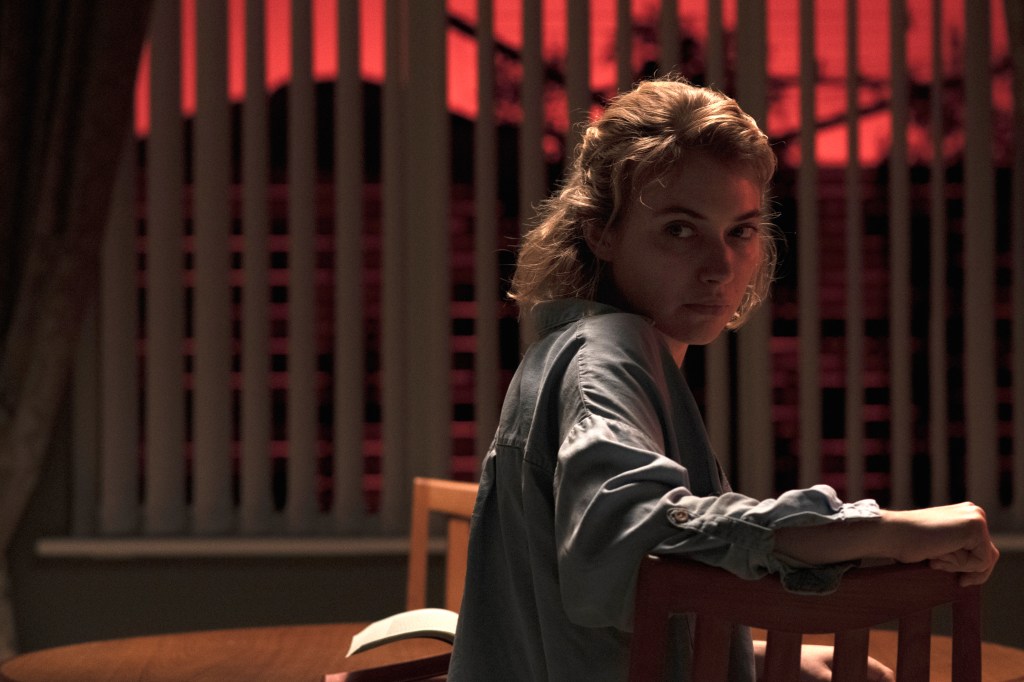
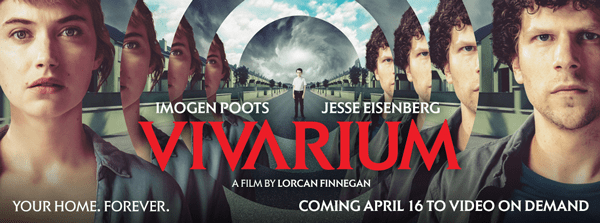
Vivarium – Latin for “place of life” – is a sci fi horror (of sorts) harking back to the best traditions of The Twilight Zone.

It follows a young couple Gemma (Imogen Poots) and Tom (Jesse Eisenberg) living in the UK, and like a lot of happy twosomes wanting to take it to the next level, they wish to buy a house together.

So they find a random real estate agent (Jonathan Aris – AKA Anderson from Sherlock) who is creepy AF.  Upon their first meeting he convinces them to follow him (by car) to a brand new development called Yonder.

All the houses there are finished and fully furbished.  They are also identical, the clouds up above do not move, and there is not a single living soul (or indeed thing) for what seems like miles & miles.

Half way through the tour of a house (#9) the agent ghosts them, and somewhat bemused by what has turned out to be a very odd day, Gemma and Tom hop in their vehicle and proceed to leave.

Or, rather, they try…. 

In classic Twilight Zonian fashion, every block on the estate is identical and the further they drive away from #9, the more they find themselves winding back up in front of it.

And the strangeness kicks off from there.  But if you want to know in what sort of ways – just check out the trailer attached to this article.

The premise is pretty much there.

And from there on in it’s a matter of finding out – what kind of story is this?  Will it explain the (wonderfully stylish and definitely intriguing) set up our 2 lead characters are in?  Or will it be writing without consequence?

And if it is – will the subsequent dramatic interplay between Poots and Eisenberg (2 powerhouse young actors who have worked together before on 2 other occasions – feel free to imdb it) be enough to pull you through?

Diagnosis:

Imdb says one thing.  Rotten Tomatoes says another.  And that’s the place of life.

Antony Yee

That’s the guy from Zombieland!

Sara Yee

 Vivarium is NOW available to view via Video On Demand

Blu-Ray & DVD from June 2020

Retrospective: Pitch Black

20 Thursday Feb 2020

Posted by surgeons of horror in Movie review

≈ 2 Comments

Tags

claudia black, cole hauser, lewis fitz-gerald, radha mitchell, rhianna griffith, sci-fi, sci-fi horror, Sci-Fi Movies, simon burke, vin diesel

It was the year 2000 and I was in the infancy of my young adulthood, still high on the fumes of alcohol and potentially under the influence of some controlled substances, so one could argue that my views or opinions were clouded.
It was also at the turn of the millennium with the promise of new and prosperous things to come. So when two fellow like-minded comrades in celluloid crime and I spooled out of the local auditorium, we found ourselves in deep conversation about the sci-fi action horror film that we had just witnessed. I remember feeling greatly impacted by it with the entire concept and execution leaving me enthralled.
Specifically I recall stating that it was an instant classic with a potential cult following in the making and at least one of my colleagues nodded in full agreement with my bold proclamation.

On paper Pitch Black sounds like your average sci-fi action flick with Vin Diesel at the helm, (poised on the precipice of his portrayal of Dominic Toretto from The Fast and the Furious and Xander Cage from xXx that would cement his name in the genre for years to come) bringing a raw energy to his character that ripples beneath the surface and threatens to let loose on his fellow human counterparts, much like the real enemy lurking beneath the planets surface.
Pitch Black would even project the character of Riddick in a further two adventures on the big screen with a third film announced on its way, proving that there is still a lot of appeal on offer.

It’s this raw energy that still resonates on screen today on repeated viewing and connected once again with me, and this time I was not under the influence….kind of.

Supported by a cracking, primarily Australian cast in Radha Mitchell (Silent Hill, Rogue), Lewis Fitz-Gerald (Breaker Morant), Claudia Black (Farscape, Stargate SG-1), Rhianna Griffith, and Simon Burke (The Devil’s Playground), all of whom bring their “A Game” with a high level of intensity and humanity to their role. The irony in that the more human their characters display, the greater their chance of being exposed, and their emotions leading them to ruin. In order to survive in Pitch Black, you need to strip away all emotions or live with that mask permanently in place.
It also helps that there are a couple of excellent hard-hitters on screen to with hard-boiled futuristic cop without a conscience played by Cole Hauser, and the ultimate survivalist and in this instance, a man of faith, played by Ketih David.

David Eggby keeps the gritty realism throughout his stunning cinematography that eschews a beautiful landscape in a remote Australian landscape to bring an otherworldly factor on screen blasting the audience with a rich array of colours and visuals.

Both the creature effects and visual effects team also deserve their own accolades for bringing a rich and diverse approach to the nocturnal alien creatures that hunt down the humans and fighting among themselves for the scraps, highlighting once again the theme of survival in a desolate and harsh terrain. 

It’s a simple and age-old premise that works because of the combination of all of these elements that make this film still strong today. If you can forgive the odd blemish, Pitch Black deserves high praise and repeat viewing. It may be twenty years old but in this writers’ mind, it is one of the greatest sci-fi horror films since the turn of the century. 

  • Saul Muerte

Movie Review: Rabid

29 Tuesday Oct 2019

Posted by surgeons of horror in MonsterFest, Movie review

≈ 1 Comment

Tags

body horror, jen soska, laura vandervoot, rabid, sci-fi horror, soska sisters, sylvia soska, Twisted Pictures

Why do we keep remaking old trends?

The first lines spoken in The Soska Sisters latest feature is something of an odd choice seeing that the film itself is a remake of David Cronenberg’s science fiction body horror feature that was released back in 1977, but then the ‘Twisted Twins’ have built a reputation on face-lifts and transformations within their features that it should come as no surprise that should revamp a cult classic.
Cronenberg is clearly an inspiration in the Soska Sisters previous features where body horror, mutilation, and the butchering of the beautiful is constantly a running theme through their narrative.
From their low-budget debut feature, Dead Hooker In A Truck, they have been willing to their bodies on the line for the sake of their vision and in doing so, continuously look to raise the stakes, but arguably haven’t attained this since their brilliant sophomore outing behind the director’s chair with American Mary.

So, how does this modern transformation of Rabid fair and does it amount to the twin directors’ previous outings?

I have enjoyed watching the Soska Sisters’ journey, even their paint by numbers WWE venture, See No Evil 2, and I found that Rabid had the right pulse to entertain and satiate the gruesome, and bloody fascination with the human aesthetic and its ultimate destruction.
We cast ourselves deep in the fashion world, where there is an expected elegance and if you don’t measure up, then you’re cast aside and considered insignificant. 

This is where we meet our lead protagonist, Rose (Laura Vandervoot) who works for a fashion designer, Gunther (Mackenzie Gray), but struggles to meet her mark.
One night she is invited out by photographer Brad (Ben Hollingsworth) and believes that her luck could potentially be turning, but soon discovers that it’s a pity date, set up by her best friend, Chelsea (Hanneke Talbot). Humiliated, Rose attempts to flee on her bike but is plowed down by an unseen vehicle and rushed to hospital leaving her disfigured and more depressed.
It is only when she learns of a scientific breakthrough that could potentially restore her figure that Rose seizes the opportunity to be considered normal. Once again though, trust comes into question as we are only willing to expose the mask we choose to wear with people and only every so often do we allow our true selves be seen.
This is a common theme throughout the movie where we should question everyone’s motives and always be suspicious of the characters we encounter, even within the medical profession as hinted by Stephen McHattie’s doctor when he asks his assistant to lend a deformed Rose a mirror, only to contradict himself by saying that Rose should never look at a mirror.

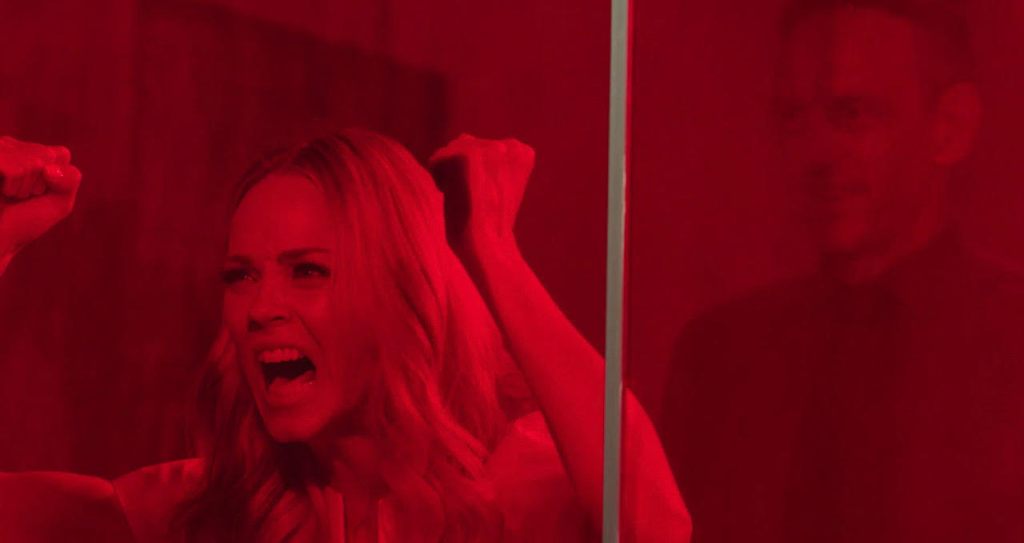
So, Rose undergoes a significant and delicate operation that not only restores her looks but metamorphosed her whole demeanour with mesmerising effect on her persona. Whilst her life suddenly flips for the better, Rose is consumed with lust for blood and meat that sends her into a frenzy and unleashing a creature within that leaves her victims with something that closely resembles rabies, but spreads as quickly as the black plague. 

From here on in the action becomes frenetic and just as uncontrollable as the disease, which is obviously a directorial choice, but I can understand some viewers who might find this approach grating. 

Stuck between pursuing her dreams of having her own design on the catwalk and recognition of her style, and seeking medical aid, Rose steers closer to self-destruction and chaos.

Prognosis:

The Soska Sisters are back in their domain of stripping the human facade and revealing the tortured soul lurking within in their latest turn in the directors’ chair.
Yes, it’s a remake, but there is enough spin on the original and more of the visual style and substance that makes Jen and Sylvia a force to be reckoned with when they are at their best.
As always their films are beautifully shot, and manage to infuse some raw energy within the beats, and Rabid continues to project the Soskas into a twisted limelight that feels gnarly and fresh.

MONSTERFEST AUSTRALIA 2019 SCREENINGS

Fri, 1ST NOVEMBER, 7PM:

GU Film House, Adelaide

Event Cinemas, George St, Sydney

Event Cinemas, Innaloo, Perth

Sat, 2nd NOVEMBER, 8PM

Capitol Cinemas, Manuka, Canberra

Sun, 3rd NOVEMBER, 6PM

Event Cinemas, Myer Centre, Brisbane

  • Saul Muerte
← Older posts

Subscribe

  • Entries (RSS)
  • Comments (RSS)

Archives

  • November 2025
  • October 2025
  • September 2025
  • August 2025
  • July 2025
  • June 2025
  • May 2025
  • April 2025
  • March 2025
  • February 2025
  • January 2025
  • December 2024
  • November 2024
  • October 2024
  • September 2024
  • August 2024
  • July 2024
  • June 2024
  • May 2024
  • April 2024
  • March 2024
  • February 2024
  • January 2024
  • November 2023
  • October 2023
  • September 2023
  • August 2023
  • July 2023
  • June 2023
  • May 2023
  • April 2023
  • March 2023
  • February 2023
  • January 2023
  • November 2022
  • October 2022
  • September 2022
  • August 2022
  • July 2022
  • June 2022
  • April 2022
  • March 2022
  • February 2022
  • January 2022
  • December 2021
  • November 2021
  • October 2021
  • September 2021
  • August 2021
  • July 2021
  • June 2021
  • May 2021
  • April 2021
  • March 2021
  • February 2021
  • January 2021
  • December 2020
  • November 2020
  • October 2020
  • September 2020
  • August 2020
  • July 2020
  • June 2020
  • May 2020
  • April 2020
  • March 2020
  • February 2020
  • January 2020
  • December 2019
  • November 2019
  • October 2019
  • September 2019
  • July 2019
  • June 2019
  • May 2019
  • April 2019
  • March 2019
  • February 2019
  • January 2019
  • December 2018
  • November 2018
  • October 2018
  • September 2018
  • August 2018
  • July 2018
  • June 2018
  • May 2018
  • April 2018
  • March 2018
  • February 2018
  • January 2018
  • December 2017
  • November 2017
  • October 2017
  • September 2017
  • August 2017
  • July 2017
  • June 2017
  • May 2017
  • April 2017
  • March 2017
  • February 2017
  • January 2017
  • December 2016
  • November 2016
  • October 2016
  • September 2016
  • August 2016
  • July 2016
  • June 2016
  • May 2016

Categories

  • A Night of Horror Film Festival
  • Alien franchise
  • Alliance Francaise French Film Festival
  • Australian Horror
  • Best Movies and Shows
  • Competition
  • dark nights film fest
  • episode review
  • Flashback Fridays
  • Friday the 13th Franchise
  • Full Moon Sessions
  • Halloween franchise
  • In Memorium
  • Interview
  • japanese film festival
  • John Carpenter
  • killer pigs
  • midwest weirdfest
  • MidWest WierdFest
  • MonsterFest
  • movie article
  • movie of the week
  • Movie review
  • New Trailer
  • News article
  • podcast episode
  • podcast review
  • press release
  • retrospective
  • Rialto Distribution
  • Ring Franchise
  • series review
  • Spanish horror
  • sydney film festival
  • Sydney Underground Film Festival
  • The Blair Witch Franchise
  • the conjuring franchise
  • The Exorcist
  • The Howling franchise
  • Top 10 list
  • Top 12 List
  • Trash Night Tuesdays on Tubi
  • umbrella entertainment
  • Uncategorized
  • Universal Horror
  • Wes Craven
  • wes craven's the scream years

Meta

  • Create account
  • Log in

Blog at WordPress.com.

  • Subscribe Subscribed
    • Surgeons of Horror
    • Join 227 other subscribers
    • Already have a WordPress.com account? Log in now.
    • Surgeons of Horror
    • Subscribe Subscribed
    • Sign up
    • Log in
    • Report this content
    • View site in Reader
    • Manage subscriptions
    • Collapse this bar
 

Loading Comments...