Flying Lotus has never been a filmmaker to colour inside the lines. With Kuso (2017), he exploded onto the scene with a hallucinogenic blend of body horror, surrealism, and sound design that dared viewers to stick with it—or run screaming. With Ash, he reins in the chaos just enough to create what is arguably his most accessible film to date, while still packing it with enough aural and visual flourishes to remain unmistakably his own.
Set on a remote planet and anchored by a creeping sense of cosmic dread, Ash follows a woman (Elza González) who wakes up to find her crew slaughtered and must unravel the mystery before a darker truth consumes her. It’s a premise steeped in sci-fi tradition, but Flying Lotus isn’t here to offer a straightforward space thriller. Instead, he weaves a waking dream of sound and vision—atmospheric, meditative, and disorienting in equal measure.
The real marvel is in the film’s sensory layering. The soundscape—unsurprisingly exquisite—is a collage of ambient dread, industrial echoes, and meditative melodies that feel like transmissions from another dimension. As a musician, Flying Lotus has always been a sound alchemist; here, he pushes that instinct into the very bones of the film.
Elza González gives a committed, emotional performance that grounds the film’s cerebral tendencies. It’s largely her show, and she rises to the occasion with a mix of vulnerability and resolve. Aaron Paul appears in a supporting role that brings both tension and quiet depth, acting as a counterpoint to González’s isolation and inner turmoil.
The film’s Achilles’ heel is its plot. Beneath the rich surface textures and hypnotic editing, Ash tells a story that is familiar, even predictable. But it’s cleverly concealed beneath the stylistic veneer, like a well-worn book with a mesmerising new cover. There’s craft in how Flying Lotus reshapes and recontextualises sci-fi horror tropes, but at times, it feels like style just barely holding up a sagging structure.
The Prognosis:
There’s no denying Ash is a step forward—a distillation of Flying Lotus’s eccentricities into something more narratively digestible while retaining his unique artistic stamp. For fans of bold sci-fi that dares to flirt with the abstract, Ash may not be the deepest story, but it’s one hell of a ride through an artist’s ever-evolving mind.
A quarter of a century has passed since Pitch Black crash-landed onto screens, delivering a gripping fusion of sci-fi, action, and horror that still holds its own today. In the years since, the film has spawned sequels, a devoted fanbase, and even further cemented Vin Diesel as a genre icon. But more importantly, Pitch Black remains a testament to the power of stripped-down, high-concept storytelling—proof that a simple premise, executed with precision, can stand the test of time.
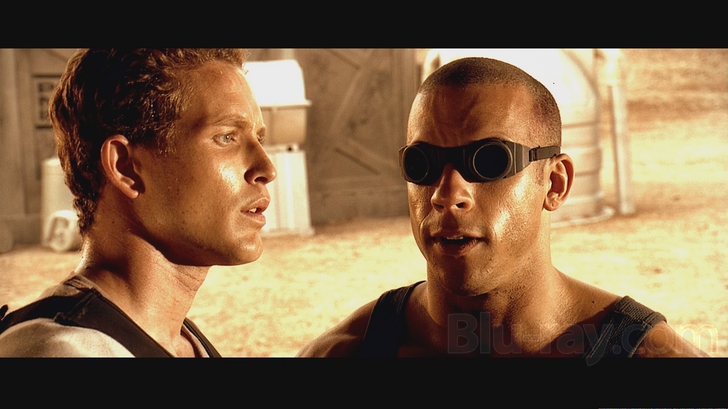
The setup is deceptively straightforward: a transport ship carrying a diverse group of passengers crash-lands on a remote planet, forcing them to rely on the one man they fear the most—Richard B. Riddick (Vin Diesel), an escaped convict with surgically enhanced night vision. But as they struggle to survive, they quickly realise that Riddick isn’t the biggest threat. When the planet is plunged into total darkness during a rare eclipse, it becomes clear that they’re not alone—deadly creatures emerge from the shadows, picking them off one by one.
Director David Twohy crafted a film that defies expectations at every turn. What could have been a forgettable Alien clone instead became an exercise in atmospheric dread and moral ambiguity, where the supposed villain may be the only one capable of ensuring survival. The script is lean, the world-building is compelling without being over-explained, and the film wastes no time in establishing the stakes.
Riddick remains one of the most compelling antiheroes of modern sci-fi. Diesel, on the verge of superstardom at the time, gives a performance that simmers with controlled intensity. His Riddick is unpredictable, calculating, and, at times, genuinely terrifying. But as the film unfolds, it becomes clear that he isn’t just a brute force—he’s a survivor, and unlike the others, he understands the harsh reality of their predicament.
This role launched a franchise, leading to The Chronicles of Riddick (2004) and Riddick (2013), with a fourth installment, Riddick: Furya, in the works. While the sequels took the character in different directions, Pitch Black remains the most effective use of Diesel’s brooding screen presence, where his menace and reluctant heroism are balanced perfectly.
Beyond Diesel, Pitch Black is elevated by its supporting cast. Radha Mitchell delivers one of her best performances as Carolyn Fry, a pilot burdened with guilt and forced into leadership. Keith David brings gravitas as Imam, a man of faith struggling to reconcile belief with brutal reality. Cole Hauser plays the ruthless mercenary Johns, whose morality is as murky as Riddick’s, and Claudia Black—before her Farscape and Stargate SG-1 fame—adds depth in a smaller role.
One of the film’s strengths is how it handles its characters: no one is truly safe, and survival isn’t guaranteed. The film embraces the cruelty of its setting, reinforcing the theme that in extreme conditions, it isn’t just the monsters that are dangerous—human nature can be just as predatory.
Cinematographer David Eggby (Mad Max) gives Pitch Black a distinctive, almost surreal visual palette. The harsh, bleached-out daylight sequences contrast beautifully with the eerie, blue-tinged darkness, immersing the audience in an alien world that feels both hostile and eerily familiar. The decision to film in the Australian outback lends an authenticity to the barren landscape, making it feel truly isolated.
The creature design remains a triumph, blending practical and CGI effects to create monstrous, bat-like predators that feel genuinely threatening. The concept of light as both salvation and a fragile barrier between life and death adds an extra layer of tension, making every flickering torch or dwindling battery a source of dread.
Despite its relatively modest budget, Pitch Black has aged remarkably well. The film’s minimalist approach means it doesn’t rely on flashy effects or convoluted lore—it’s a tightly crafted survival thriller that still delivers genuine tension.
If there’s any flaw, it’s that Pitch Black set such a high bar that the later Riddick films struggled to recapture its magic. The Chronicles of Riddick attempted to expand the mythology but lost some of the rawness that made the original so compelling. Riddick (2013) brought things back to basics, but nothing quite matched the unpredictable intensity of Pitch Black.
But 25 years on, none of that diminishes its impact. Whether you’re revisiting it or discovering it for the first time, Pitch Black remains one of the best sci-fi horror films of the 21st century—lean, mean, and never afraid of the dark.
Supernova is a textbook example of how a troubled production can derail even the most promising concept. Billed as a sleek sci-fi thriller, the film instead arrived as a fragmented, disjointed mess that left audiences—and its own cast—wondering what went wrong.
The behind-the-scenes chaos is almost more compelling than the movie itself. Walter Hill, a director known for his gritty, character-driven work, left the project amid creative disputes. Jack Sholder was brought in to salvage it, and eventually, even Francis Ford Coppola was tapped for re-edits. Despite these efforts, the result is a patchwork narrative that never gels.
The cast, including James Spader, Angela Bassett, and Robin Tunney, reportedly distanced themselves from the final product. It’s easy to see why: their performances feel stifled, victims of erratic direction and an incoherent script. Spader’s natural charisma is muted, while Bassett’s talent is wasted on a character given little to do.
Visually, the film oscillates between dated CGI and occasionally striking production design, but even its better moments are overshadowed by the narrative incoherence. What should have been a tense exploration of isolation and the unknown instead devolves into a nonsensical series of events culminating in an ending that feels both rushed and unsatisfying.
Thematically, Supernova had potential, with its exploration of humanity, technology, and the dangers of the unknown. Unfortunately, its lofty ideas are buried beneath the weight of its disastrous production. Twenty-five years on, the film stands as a cautionary tale of how too many cooks—and too little vision—can ruin a cinematic stew.
In 1984, James Cameron, a relatively unknown director at the time, unleashed The Terminator upon the world—a low-budget sci-fi action thriller that would ultimately redefine both genres and launch one of the most enduring franchises in film history. As we celebrate the film’s 40th anniversary, its legacy looms larger than ever, marking it as a pivotal point in both filmmaking and pop culture.
A Vision Born of Dreams (Literally)
It’s impossible to discuss The Terminator without mentioning Cameron’s origins of the story—a fever dream he had during the production of Piranha II: The Spawning. The haunting image of a skeletal, humanoid machine emerging from flames became the foundation for a story that, at its heart, tapped into deep fears about technology and the human condition. Cameron’s background in visual effects also allowed him to conceive a film that would push the limits of practical effects at the time, despite its modest $6.4 million budget.
Cameron’s relentless drive to make The Terminator was evident in the casting choices, the painstaking attention to detail in the special effects, and the world-building that would expand well beyond this film. He worked closely with Gale Anne Hurd, his producing partner and eventual wife, to secure the rights and get the project off the ground. Together, they were not just creating a movie—they were building a mythology.
Schwarzenegger: From Villain to Icon
At the time of its release, The Terminator offered a breakout role for Arnold Schwarzenegger, who had only recently transitioned into mainstream cinema from bodybuilding. Originally considered for the role of Kyle Reese, it was Schwarzenegger’s imposing physical presence that made him perfect for the titular Terminator—a relentless, emotionless killing machine sent from the future to eliminate Sarah Connor.
Schwarzenegger’s portrayal of the T-800 cyborg became iconic not just for his size, but for his chilling detachment, minimal dialogue, and robotic precision. Phrases like “I’ll be back” and “Hasta la vista, baby” became ingrained in pop culture, although it’s easy to forget that The Terminator wasn’t yet a blockbuster upon release. It was only in hindsight, as The Terminator built momentum through word of mouth, home video, and its eventual 1991 sequel Terminator 2: Judgment Day, that Schwarzenegger’s performance became synonymous with the action genre itself.
A Sci-Fi Noir at Heart
The atmosphere of The Terminator is a perfect blend of sci-fi and noir, with its rain-soaked streets, cold urban environments, and dark alleyways. Set against the backdrop of a dystopian future, Cameron crafted a world where machines had risen against their human creators, but he also grounded the narrative in present-day Los Angeles, giving the film a gritty, grounded feel. The blending of these two worlds—dystopian future and present-day urban decay—provided a foreboding sense of inevitability that makes the film feel eerily relevant even today.
Brad Fiedel’s memorable score, with its mechanical, pulse-like rhythm, became as integral to the film’s atmosphere as its visuals. The iconic “Terminator theme” conveyed both a sense of impending doom and a cold, mechanical world that was indifferent to human survival. This helped solidify The Terminator as more than just an action-packed film—it was a mood piece that explored deeper philosophical questions about fate, technology, and survival.
Sarah Connor: A New Kind of Heroine
While The Terminator is often remembered for Schwarzenegger’s chilling presence, it’s Linda Hamilton’s Sarah Connor who grounds the film emotionally. When we first meet her, she’s an ordinary woman, unaware of her pivotal role in the future of humanity. Her arc from a vulnerable target to a resilient, determined fighter is one of the film’s most compelling elements.
Sarah Connor represented a shift in how women were portrayed in action films—no longer just damsels in distress, but central characters with agency and strength. This was a precursor to the much more hardened, militarized version of Sarah Connor seen in Terminator 2, but it was in The Terminator that the seeds were sown for her evolution into one of cinema’s most iconic heroines.
Michael Biehn’s Kyle Reese: The Unsung Hero
At the heart of the film’s emotional core is Michael Biehn’s performance as Kyle Reese, the soldier sent back in time to protect Sarah Connor. Biehn brings a vulnerability to the role that contrasts with Schwarzenegger’s cold, mechanical villainy, making Reese not just an action hero but a tragic figure. His haunted portrayal of a man from a war-torn future who has little left to lose added gravitas to the film. Reese’s desperate commitment to saving Sarah and the future of humanity adds an emotional weight to the action, grounding the story in a sense of real human stakes. Biehn would later reunite with Cameron in Aliens (1986), where he delivered another memorable performance as Corporal Hicks, cementing his place as one of Cameron’s go-to actors for complex, layered heroes.
Special Effects That Stood the Test of Time
For a film made on such a tight budget, The Terminator showcased groundbreaking practical effects and makeup work, particularly Stan Winston’s animatronic work on the T-800’s skeletal form. The combination of stop-motion animation, practical models, and early animatronics allowed Cameron to realise his terrifying vision of the machine within.
The relentless, unstoppable nature of the Terminator was embodied in the effects, particularly during the climactic scene where the T-800, stripped of its human skin, chases Sarah and Kyle in full skeletal form. While today’s audiences may be used to seamless CGI, the practical effects of The Terminator are still impressive, especially given the constraints of the time.
Themes of Fate, Technology, and Survival
At the core of The Terminator is a meditation on fate. The film presents the terrifying notion that certain events are predestined—whether it’s the rise of machines or Sarah Connor’s role in the survival of the human race. This theme of inevitability resonates throughout the series, but it’s perhaps most impactful in the original, where there’s a palpable sense of helplessness in the face of a seemingly unstoppable future.
Cameron also tapped into growing anxieties about technology. The idea of machines becoming sentient, of artificial intelligence surpassing human control, was still largely science fiction in 1984, but The Terminator presented a vision of what could happen if technology ran amok. This cautionary tale feels even more relevant in today’s age of advanced AI and automation.
The Horror at the Heart of The Terminator
While The Terminator is often categorised as a sci-fi action film, it’s impossible to overlook its deep horror roots. Cameron masterfully weaves suspense and dread throughout the film, presenting the T-800 as a near-unstoppable force reminiscent of classic horror villains like Michael Myers or Jason Voorhees. The relentless pursuit of Sarah Connor gives the film the tension and atmosphere of a slasher, with the Terminator stalking its prey with terrifying precision. Scenes like the police station massacre are not just action set pieces but moments of sheer terror, underscored by the unstoppable, mechanical nature of the T-800. This fusion of horror with science fiction gave The Terminator a distinct edge, setting it apart from other films of the era.
A Lasting Legacy
As we look back 40 years later, it’s clear that The Terminator wasn’t just a genre-defining film—it was the foundation for one of the most successful and influential franchises in cinema history. While the Terminator franchise has had its ups and downs over the years, with numerous sequels, reboots, and TV spinoffs, the original film remains a singular achievement. It captured lightning in a bottle, with its blend of high-concept science fiction, nail-biting action, and surprisingly heartfelt storytelling.
Moreover, The Terminator solidified James Cameron as one of the most visionary directors of his time. He would go on to create other genre-defining films, including Aliens, Titanic, and Avatar, but The Terminator was the launching pad for his meteoric rise.
Conclusion: A Timeless Machine
As we celebrate the 40th anniversary of The Terminator, it’s worth reflecting on how this film, originally conceived as a low-budget B-movie, became a cultural touchstone that continues to influence filmmakers and audiences alike. Its themes of fate, survival, and the dangers of unchecked technological advancement are as timely today as they were in 1984. And much like the unstoppable machine at the film’s core, The Terminator’s legacy is destined to endure for decades to come.
In the same year that Universal release This Island Earth, Hammer Films were about to enter a brave new world of their own, and it would all begin with their release of The Quatermass Xperiment. Spearheaded by James Carreras knack for networking and the ability for Hammer to produce the familiar in the eyes of the backers but with their own spin. In this instance, the appeal would come from an adaptation of BBC serial The Quatermass Experiment.
The tale takes place when a three-manned rocket ship owned by Professor Bernard Quatermass (Brian Donlevy) loses radio contact and crash lands with two of its occupants vanished without a trace. Its sole survivor, Victor Carroon (Richard Wordsworth) has been clearly affected by a parasitic alien organism that slowly engulfs his body and is also transfused with a cactus plant that he came into contact with.
Part of the attraction to TQX is that Quatermass himself leads questionable character choices. From the get-go, we learn that the rocket ship in question was launched without being sanctioned to do so. This recklessness is still evident too by the films’ end when he is still insistent in going ahead with his scientific plans despite the flaws and drawbacks that were brought about due to his decisions. Was there no lesson learned for him at all? Or is it purely that he is driven to succeed in his experimentations? At what point is it too far to cross? Or does the line simply not exist for the likes of Quatermass?
Richard Wordsworth’s performance is equally compelling, providing heart to the troubled Carroon. His deterioration both physically and mentally on screen keeps the audience gripped and able to connect with his plight.
It should also be noted how integral Director Val Guest’s vision had on defining the style of Hammer’s more sci-fi horror leaning productions, (the more recogniseable Gothic features would very much fall to Terence Fisher) and would have him return for Quatermass 2. There would also be the notable push for adult classification in Hammer’s production releases hence the deliberate X placement in the title to define their approach and the audience they wanted for their movies.
The success of TQX for Britain and across the seas in the States would project them further towards success and unite them in a deal with Columbia Pictures. Hammer Films were a heartbeat away from The Curse of Frankenstein, the movie that would cement their footing in the horror scene, but TQX would provide them with the first footsteps to celluloid history. It’s incredibly riveting and watchable still and highly recommended.
My Universal horror retrospective chronicling the transition away from the genre that made the production company famous throughout the 30s and 40s and into the sci-fi realm continues with This Island Earth.
At the time of its release the movie was noted for its state-of-the-art effects and use of Technicolor but it would later be famously ridiculed in Mystery Science Theater 3000, showing just how far the film had fallen in the public’s eye.
For me, it will always conjure up the image of the Metaluna Mutant, once a rejected choice for It Came From Outer Space (1953)It’s an iconic character that probably deserves a little more screen time than it actually receives than the short scare towards the film’s climax.
Upon closer scrutiny, TIE does suffer with minimal plot narrative to bind it together; a case of more style than substance. So you can understand the mockery that it fell subject to in more recent years,
The story essentially follows Dr. Cal Meacham (Rex Reason) who is mysteriously rescued when his jet almost crashlands with the aid of a strange green glow. He is then gifted a set of instructions to build a complex machine; a test to see if he has the smarts to be selected for a special research project run by the equally mystifying Exeter (Jeff Morrow).
Before long Cal is recruited by Exeter and meets up with old flame Dr. Ruth Adams (Faith Domergue) and a few other hand-picked scientists. The film quickly develops from a proposed science espionage flick into an intergalactic war when Cal and Ruth are whisked away to the planet Metulana, a planet under attack from the unseen Zagons.
There are great leaps in the imagination here from a screenplay based on the novel by Raymond F. Jones, and one needs to give in to the mindless direction it takes you in and not pay to close mind to the obvious flaws within.
It remains a film with some great images for its time, despite this, and is indicative of the b-movie sci-fi flicks that would swiftly follow suit and one that would capture the imagination of cinema-goers in the mid 50s.
On the other side of the pond however, Britain’s Hammer Films were offering up an alternative spin on the science fiction scene with… The Quatermass Xperiment.
In 2004 a TV series hit our screens called Lost. Soon after that Heroes. They heralded a new era of a different kind of storytelling.
One with no consequences. To elaborate – if you look at a story as an equation of cause & effect, then traditionally the challenge of making a story tight, or just good, was that one flowed into the other creatively WHILST maintaining a strong internal logic.
Bruce Willis is dead at the end of Sixth Sense (effect) and suddenly EVERYTHING he has done (only ever interacting with the kid, always wearing the same clothes, never opening doors) makes sense because (cause) when he got shot at the beginning of the film, he actually died.
(Sorry – spoiler if you haven’t seen it yet. In which case – REALLY!??)
Anyway – along comes Lost and Heroes and suddenly we were hit with a thought. What if we didn’t focus on the left side of this equation (the cause) but only on the right (the effect)?
Suddenly dramatic options seemed to gain a new dimension as shows steeped in sci-fi weirdness had a texture to it that sucked in audiences not normally charmed by its usual bells and whistles.
Suddenly high concept narratives had good dramatic writing. They didn’t focus on the WHY, but on the WHAT. What does this “why” do to our characters?
It’s consequence free writing. Don’t worry if the set-up makes sense, just set it up, and then get on with it.
A tropical island with polar bears, a terrifying smog monster, and an underground hatch? How can they all be connected? WHO CARES! The important thing is, does it draw you in? In fact, the more impossible and weirder you make the set-up, the more interesting the dramatic possibilities, yeah…?
Another way of looking at is Monty Python and their unique approach to comedy. Being professional writers, their frustration when constructing a good sketch was the bow. The end. The punchline. Because coming up with an idea that’s funny? That’s one thing. Making it work? That’s another. But ENDING it satisfactorily? You’d be surprised how hard that can be. Especially if you have to churn out a number of scripts to the demanding schedule of a TV series.
Terry Gilliam was their solution. By simply linking every skit with a surreal fevered animated piece of art, they realised they didn’t have to write a punchline! And it worked. It was genius.
But it WAS a solution.
Is writing drama bereft of accountability the same thing?
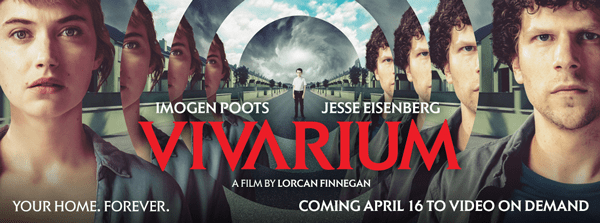
Vivarium – Latin for “place of life” – is a sci fi horror (of sorts) harking back to the best traditions of The Twilight Zone.
It follows a young couple Gemma (Imogen Poots) and Tom (Jesse Eisenberg) living in the UK, and like a lot of happy twosomes wanting to take it to the next level, they wish to buy a house together.
So they find a random real estate agent (Jonathan Aris – AKA Anderson from Sherlock) who is creepy AF. Upon their first meeting he convinces them to follow him (by car) to a brand new development called Yonder.
All the houses there are finished and fully furbished. They are also identical, the clouds up above do not move, and there is not a single living soul (or indeed thing) for what seems like miles & miles.
Half way through the tour of a house (#9) the agent ghosts them, and somewhat bemused by what has turned out to be a very odd day, Gemma and Tom hop in their vehicle and proceed to leave.
Or, rather, they try….
In classic Twilight Zonian fashion, every block on the estate is identical and the further they drive away from #9, the more they find themselves winding back up in front of it.
And the strangeness kicks off from there. But if you want to know in what sort of ways – just check out the trailer attached to this article.
The premise is pretty much there.
And from there on in it’s a matter of finding out – what kind of story is this? Will it explain the (wonderfully stylish and definitely intriguing) set up our 2 lead characters are in? Or will it be writing without consequence?
And if it is – will the subsequent dramatic interplay between Poots and Eisenberg (2 powerhouse young actors who have worked together before on 2 other occasions – feel free to imdb it) be enough to pull you through?
Diagnosis:
Imdb says one thing. Rotten Tomatoes says another. And that’s the place of life.
Antony Yee
That’s the guy from Zombieland!
Sara Yee
Vivarium is NOW available to view via Video On Demand
It was the year 2000 and I was in the infancy of my young adulthood, still high on the fumes of alcohol and potentially under the influence of some controlled substances, so one could argue that my views or opinions were clouded. It was also at the turn of the millennium with the promise of new and prosperous things to come. So when two fellow like-minded comrades in celluloid crime and I spooled out of the local auditorium, we found ourselves in deep conversation about the sci-fi action horror film that we had just witnessed. I remember feeling greatly impacted by it with the entire concept and execution leaving me enthralled. Specifically I recall stating that it was an instant classic with a potential cult following in the making and at least one of my colleagues nodded in full agreement with my bold proclamation.
On paper Pitch Black sounds like your average sci-fi action flick with Vin Diesel at the helm, (poised on the precipice of his portrayal of Dominic Toretto from The Fast and the Furious and Xander Cage from xXx that would cement his name in the genre for years to come) bringing a raw energy to his character that ripples beneath the surface and threatens to let loose on his fellow human counterparts, much like the real enemy lurking beneath the planets surface. Pitch Black would even project the character of Riddick in a further two adventures on the big screen with a third film announced on its way, proving that there is still a lot of appeal on offer.
It’s this raw energy that still resonates on screen today on repeated viewing and connected once again with me, and this time I was not under the influence….kind of.
Supported by a cracking, primarily Australian cast in Radha Mitchell (Silent Hill, Rogue), Lewis Fitz-Gerald (Breaker Morant), Claudia Black (Farscape, Stargate SG-1), Rhianna Griffith, and Simon Burke (The Devil’s Playground), all of whom bring their “A Game” with a high level of intensity and humanity to their role. The irony in that the more human their characters display, the greater their chance of being exposed, and their emotions leading them to ruin. In order to survive in PitchBlack, you need to strip away all emotions or live with that mask permanently in place. It also helps that there are a couple of excellent hard-hitters on screen to with hard-boiled futuristic cop without a conscience played by Cole Hauser, and the ultimate survivalist and in this instance, a man of faith, played by Ketih David.
David Eggby keeps the gritty realism throughout his stunning cinematography that eschews a beautiful landscape in a remote Australian landscape to bring an otherworldly factor on screen blasting the audience with a rich array of colours and visuals.
Both the creature effects and visual effects team also deserve their own accolades for bringing a rich and diverse approach to the nocturnal alien creatures that hunt down the humans and fighting among themselves for the scraps, highlighting once again the theme of survival in a desolate and harsh terrain.
It’s a simple and age-old premise that works because of the combination of all of these elements that make this film still strong today. If you can forgive the odd blemish, Pitch Black deserves high praise and repeat viewing. It may be twenty years old but in this writers’ mind, it is one of the greatest sci-fi horror films since the turn of the century.
Here’s the thing about the golden age of drama we’re currently living in: it has put movies on the back-foot. Which would be a really good analogy if The Endless were a boxing movie.
But it’s not. It’s not even a horror movie – but we’ll circle back to that.
Back to high end TV drama and their ability to craft complex story-lines and characters over a solid (but not too long) period of time. It’s clear these days movies (with their relatively short 2-3 hour sittings) are losing ground as a “competing” format.
It did have cinematic-ness in its corner (which is a real word, no need to look it up) until CGI balanced that ledger too. Sure as a science and an art-form computer imagery is still evolving, but if done right, big screen special FX can be just a mouse click away for even the tiniest micro-budget film.
So what do these two developments have to do with The Endless – the latest offerings from Indie filmmakers Aaron Moorhead and Justin Benson?
Well for a start it has the 5D aesthetic of an Indie offering (although no doubt it was shot on a much bigger gauge) but towards the end it has surprising quality special FX for a movie that initially looks so sparse, it almost feels like a found footage film!
And secondly it is an adjunct to Moorhead and Benson’s 2012 effort, Resolution. By that I mean The Endless takes place parallel to the events in Resolution (and literally about a block away from it).
So yes – TheEndless is a cross-over film. And this brings me to an interesting thing film has done to “push back” against the serialised superiority of TV drama. And that’s franchising, i.e. Movies that aren’t sequels per se, ‘cause not all sequels respect or even acknowledge films in their own canon (James Bond much?) but rather ‘share the same universe’.
Marvel are the current bar setters of this trend, and movie studios everywhere are following suit (lack of originality will ‘always’ be a universal constant with Hollywood).
But it also appears independent filmmakers don’t need an excuse to franchise off their own bat. Which would have helped to know in advance when events from The Endless crossed over into Resolution.
But on with some actual review stuff! The Endless centres around 2 cult “survivors” (played by Moorhead and Benson themselves). They are brothers trying to subsist in an ‘ordinary world’ that cult living failed to prepare them for.
The younger brother especially (Aaron played by Aaron) feels rudderless and out of sync, and retains more good memories about the compound they grew up in, and as such convinces his older brother Justin (played by Justin) to go back and visit for a day or two.
This is after they mysteriously receive a VHS tape featuring a woman who used to babysit them there (played by Callie Hernandez of Blair Witch and Alien Covenant fame).
And this is where the first confusion sets in, as all the characters we meet ‘appear’ to be roughly the same age. Throw in the fact that the boys themselves seem to have left the compound in the 90’s (if news footage of them exiting is to be believed) yet they themselves look to not have aged a day in 20 years.
Yet continual references by Justin to his younger brother that there appears to be a “spark” between him and their former sitter seem odd, as Hernandez looks several years younger than both of them. Yet no one makes any attempt to explain these discrepancies in any sort of story-telling capacity; and so you’re left confused. No doubt this is a deliberate ploy from the filmmaking duo who brought us the Bonestorm segment from VHS Viral, but unfortunately it does tend to come across as if the film is gleefully disappearing up its own mythos (something re-enforced when it crosses over into Resolution).
Now despite all this, The Endless does evolve at an intriguing pace and is a sci-fi page turner that has the courage to be both sparse and visually spectacular where it needs to be. Something ‘is’ going on at the compound, and you ‘do’ want to see it to the end.
The movie’s central theme is time, whereas Resolution was story. Where & when they cross over – once you know what’s going on – does work.
But is it a horror film? Not by a long stretch. Is it worth seeing? Definitely.




 Surgeons of Horror