Even after a century in the shadows, The Phantom of the Opera (1925) remains an indelible force—its mask both a symbol of horror and heartbreak, its underground lair a stage for primal emotions too vast for daylight. The film’s enduring power lies in its ability to exist between worlds: the sacred and profane, the beautiful and grotesque, the seen and the unseen.
At its heart, this Phantom is more than a monster—he is the ultimate tragic outsider, yearning not just for love, but for recognition, for humanity. Lon Chaney’s transformation, so physical yet so intimate, continues to cast a long shadow over every actor who dares don the mask after him. The Paris Opera House set—designed like a gothic cathedral—stands not only as a marvel of production design but as a symbolic battleground for the soul, where music, love, and horror converge.
Throughout this anthology, we’ve traced the Phantom’s trajectory from literary adaptation to silent screen myth, from visual innovation to emotional devastation. We’ve seen how its themes echo through time—obsession, artistry, and alienation—and how it helped shape the very contours of horror cinema in the silent era and beyond. We explored its architectural symbolism, its Expressionist lineage, and its shifting cultural legacy, from Andrew Lloyd Webber’s romanticised musical to countless reinterpretations in media high and low.
And yet, there remains something unknowable, something ineffable about the Phantom. Perhaps this is why he refuses to fade. He is not just a character but an archetype—a spectre who haunts not only opera houses but also our collective fears and desires. Each generation rediscovers him, reshapes him, yet never fully explains him.
In that way, The Phantom of the Opera is more than a film. It is a mirror held up to the darkest corners of the soul, reflecting back our own longings and shadows. And in that reflection, he lives on—not just in reels of nitrate or on stage under chandelier light—but in the very idea of horror as poetry, as tragedy, as truth.
Few cinematic figures have endured quite like the Phantom. Rising from the shadows of a silent-era soundstage, Lon Chaney’s masked outsider has taken on a life well beyond the flicker of nitrate film. More than just a horror character, the Phantom has become a symbol—of unrequited love, artistic obsession, and the monstrous within us all. And from film to stage, parody to prestige, his presence continues to echo through popular culture.
The legacy of The Phantom of the Opera is perhaps most visible in the realm of theatre. Andrew Lloyd Webber’s 1986 musical reimagining catapulted the Phantom to mainstream global fame. Romanticised and operatic in a way that Chaney’s original never intended, the musical softened the grotesque and leaned into the tragic yearning. It was a Phantom tailored for new audiences—less terrifying, more tortured. Still, it retained the core elements of secrecy, seduction, and spectacle, paying homage to the original’s grandeur even as it remixed its emotional palette. Its success—over 13,000 performances on Broadway and counting—cements Phantom not just as a cinematic relic but as a living myth.
But stage success is just one thread in the Phantom’s sprawling afterlife. Hollywood has returned to the Opera House time and again: from the 1943 Technicolor remake starring Claude Rains to Hammer’s Gothic revision in 1962, to the campy rock version Phantom of the Paradise (1974), and even a heavy metal slasher rendition in the form of 1989’s Phantom of the Opera with Robert Englund. These remakes, reinterpretations, and reimaginings speak less to fidelity and more to the character’s adaptability. The Phantom fits horror, romance, satire, and music equally well—his mask reshaped for every era’s anxieties and aesthetics.
In pop culture, references abound. From cartoons like Scooby-Doo to dark satirical nods in The Simpsons, the Phantom’s visage is instantly recognisable: the half-mask, the cape, the subterranean lair. He’s an icon in the truest sense—instantly legible, instantly loaded with meaning. Even outside of horror, the trope of the scarred genius lurking beneath society, creating beauty in isolation, owes a debt to Chaney’s Erik.
Academia, too, has embraced Phantom. Scholars dissect it as a prototype of the modern antihero, a forerunner of “beauty and the beast” archetypes, and a text rich in psychoanalytic subtext—exploring trauma, desire, and the gaze. The Phantom, after all, is not just a villain but a mirror. Whether viewed through the lens of disability, queerness, or outsider identity, he reflects back cultural fears and fascinations with startling clarity.
And yet, perhaps the greatest legacy of The Phantom of the Opera lies in its mythic status. The original film is no longer just a film—it is legend. Its behind-the-scenes lore (from lost footage to production feuds), its technical innovations, and Chaney’s transformation have merged into a kind of folklore. Like the catacombs beneath the opera house, the Phantom’s story now tunnels through genre history—always present, even when unseen.
In every shadowy figure, every haunted genius, every romantic villain scorned by the world, there is something of the Phantom. He lives on—in sound and silence, in theatre and film, in tragedy and parody. He is deathless because he was never just a man. He is myth. He is mask. He is memory.
For all its eerie grandeur, The Phantom of the Opera (1925) is not simply a tale of horror—it’s a deeply tragic story of longing, beauty, and unrequited love. At its core lies a desperate ache for connection, veiled by a mask of terror. While Lon Chaney’s Phantom may haunt the opera house, it is his tortured soul—wounded by rejection and driven by a perverse devotion—that makes him unforgettable.
This is where the film transcends its genre roots. Unlike the mindless monsters of other early horror tales, Erik is painfully aware of his deformity and isolation. He composes music, writes letters, and navigates the underground labyrinth of his own making, not as a beast, but as a man shaped by the cruelty of others. His obsession with Christine is not merely a possessive infatuation—it’s a twisted hope for redemption through love. She becomes his muse, his salvation, and ultimately, his undoing.
This romantic fixation draws clear lines back to the Gothic tradition—the brooding figures of Frankenstein or The Hunchback of Notre Dame—but with a sharper emotional intimacy. Where Frankenstein’s creature lashes out against his creator and society, and Quasimodo resigns himself to fate, Erik is actively trying to shape his world, rewriting his tragedy as a love story, even as it inevitably collapses into horror.
The film also plays with the dualities of beauty and monstrosity. Christine, caught between the dashing Raoul and the shadowy Phantom, becomes more than a damsel—she’s the axis of a moral and emotional triangle. Her eventual pity for Erik, especially in the final scenes, brings an unexpected grace to the story. Unlike many horror films of the era, Phantom grants its monster a moment of tenderness before death—a silent farewell, not just to Christine, but to the dream of being loved.
Chaney’s performance imbues this romantic tragedy with raw, physical emotion. His gestures are operatic yet sincere; every tilt of the head or clutch of the heart echoes with yearning. When he reveals his face to Christine, the horror is visceral—but so too is the heartbreak.
In the end, The Phantom of the Opera is less a monster movie and more a requiem for those who live in the shadows, yearning to be seen. It tapped into a universal fear—not of creatures lurking in the dark, but of being unloved and alone. That’s the true horror at the heart of the Phantom—and perhaps why, a century later, we still feel his pain.
In the dim candlelit corridors and vertiginous staircases of The Phantom of the Opera lies a deep debt to German Expressionism—a cinematic movement that left an indelible mark on horror during the silent era. While the film is proudly American, its visual soul often drifts through the distorted dreamscapes of German classics like The Cabinet of Dr. Caligari (1920) and Nosferatu (1922), whose stylised aesthetics helped shape the visual grammar of horror cinema.
Though Phantom doesn’t lean fully into the extreme angularity and painted shadows that defined Expressionist sets, its moody chiaroscuro lighting, cavernous lairs, and symbolic use of architecture all channel the spirit of the movement. The Paris Opera House becomes a labyrinthine purgatory, with secret doors, subterranean lakes, and impossibly steep staircases that twist and descend like something from a fevered hallucination.
Lon Chaney’s Phantom, too, feels born of this tradition—his grotesque visage and tortured, isolated psyche akin to Caligari’s Cesare or Murnau’s Count Orlok. He is less monster than metaphor: a manifestation of anguish, obsession, and decay lurking beneath society’s grandest stage. Expressionism reveled in such figures—outsiders who moved through broken worlds, their inner torments reflected in warped surroundings. In Phantom, the opulence of the opera is a fragile mask over this subterranean madness.
Universal’s production didn’t imitate German Expressionism so much as absorb it, combining its stylised shadows with Hollywood scale and narrative structure. The result was a transatlantic hybrid: a film both gothic and grotesque, tethered to American melodrama yet haunted by European horror. And this synthesis would prove influential. Just a few years later, Universal would lean more heavily into Expressionist stylings with Dracula (1931) and Frankenstein (1931), cementing a house style that echoed the shadows of Weimar cinema.
The Phantom of the Opera may not always be cited alongside Caligari or Nosferatu in academic treatises on Expressionism, but its DNA is unmistakable. It stands as one of the first major American horror films to weave that spectral influence into the foundations of studio filmmaking—proof that the horror genre, even in its infancy, was already a global dialogue in shadows and silence.
Few films wear their fractures quite as elegantly as The Phantom of the Opera (1925). Though now revered as one of the great achievements of silent horror, its making was less a symphony and more a cacophony—directorial disputes, shifting visions, endless recuts, and one star whose iron will was often the only anchor. What remains is a beautiful Frankenstein of a film: stitched together from studio desperation, creative conflict, and a flair for the dramatic that defined Universal’s golden age.
A Phantom Director
At the heart of the chaos lies Rupert Julian, a theatre-trained actor and journeyman director whose name appears in the credits but whose influence over the final product remains… spectral. His clashes with Lon Chaney were legendary—Chaney, a fiercely creative force with a precise vision for his characters, often refused to take direction. On many days, Julian wouldn’t even speak directly to his star. Chaney, for his part, reportedly directed his own scenes, shaping the Phantom’s pathos and menace through sheer stubborn artistry.
Whether due to these tensions or his own shortcomings, Julian was eventually removed from the project. Universal scrambled to salvage the shoot. Enter Edward Sedgwick and Ernst Laemmle—each brought in at various stages to shoot new material or repair narrative dead ends. Sedgwick, known for his comedic work with Buster Keaton, tried to inject romance and levity into the film’s darker recesses. Laemmle, nephew of Universal head Carl Laemmle, became something of a patchwork foreman, attempting to unify divergent pieces into a marketable whole.
Cut, Recut, and Re-Resurrected
What emerged from this creative scrum was hardly a singular vision. In fact, multiple versions of The Phantom of the Opera circulated for years—each with different edits, intertitles, and even actors in key roles (notably Mary Philbin’s love interest Raoul, portrayed alternately by Norman Kerry or with reshot scenes from another actor in certain reissues).
The most infamous moment of this production patchwork is the film’s ending. Early audiences reacted so poorly to the original climax—where Erik dies quietly of a broken heart—that Universal commissioned a new, action-packed chase ending. Chaney, unsurprisingly, refused to return. His absence forced the crew to use stand-ins and quick cuts, adding to the jagged quality of the film’s finale. For decades, this dual-ending oddity haunted film restorers, and only recent efforts have brought some cohesion to the film’s various prints.
The Phantom Temple: Universal’s Monument to Cinema
Despite the chaos, The Phantom of the Opera gave birth to one of Universal’s most iconic achievements: the Paris Opera House set. Designed by Charles D. Hall, and built to full scale on Stage 28, the massive structure was a marvel of studio engineering—five stories tall with working elevators, staircases, and backstage corridors that would feature in countless Universal productions for decades.
More than just a backdrop, the Opera House became the architectural heart of the film, its labyrinthine design mirroring Erik’s twisted psyche. From the grand chandelier to the shadowy catacombs below, this set symbolised the collision of artifice and emotion—a stage on which the tragic grotesque could play out with operatic grandeur.
Universal’s marketing team leaned hard into this opulence. Pre-release promotions touted the realism and scale of the set, and Chaney’s grotesque makeup was shrouded in secrecy to fuel curiosity. When the curtain finally rose, audiences were not just watching a movie—they were stepping into a cinematic cathedral, built from horror and heartbreak.
“The Opera is a house of masks, but none so compelling as the one that hides the soul.” —from the scribbled margins of a draft, circa 1924, stained with espresso and dreams.
Let us descend once more into the gilded oubliette of the Opéra Garnier, where velvet hangs heavy with secrets and the chandeliers hold their breath in anticipation of ghostly gossip. In 1910, French journalist-turned-dream-weaver Gaston Leroux birthed a monster swathed in shadows and romantic agony—a figure part Svengali, part Satan, and wholly misunderstood. Le Fantôme de l’Opéra, that grand gothic fable of unrequited obsession and subterranean song, was a strange beast even in its native tongue: a serialised novel crouched between mystery, melodrama, and psychological horror.
When Universal Pictures chose to adapt Leroux’s tale for the silent screen in 1925, they weren’t merely translating a story—they were transmuting a fever dream into myth. And like all alchemists worth their salt, they meddled with the materials, folding in terror where once lay tenderness, and igniting the monstrous sublime in the visages of the damned.
Julian’s Mad Alchemy
Director Rupert Julian, a man known as much for his temper as his eye, took Leroux’s moody manuscript and refashioned it into a celluloid nightmare. Gone was the subtle, spectral mystery of the novel. What emerged instead was operatic hysteria, thick with fog and madness. But it wasn’t Julian alone who summoned this vision. No, dear reader—Universal, then drunk on the success of The Hunchback of Notre Dame, had found its new martyr in Lon Chaney, a man who painted agony upon his face with wire, wax, and unparalleled commitment to the grotesque.
Chaney’s Erik, the Phantom, is no brooding poetic spectre but a living corpse in formal wear, his skeletal death’s-head revealed in a moment that shattered audience composure like glass beneath a soprano’s high C. This was not merely adaptation; it was desecration made divine. Leroux’s Erik, for all his cruelty, bore the weight of a man cursed with genius and ugliness in equal measure. Chaney’s was fury incarnate.
Shadows of Phantoms to Come
Let us now glance sidelong at those who followed in Erik’s bloodstained footsteps.
Claude Rains, in Universal’s 1943 Technicolor reimagining, shed the mask for pathos. His Phantom, a disfigured violinist, exchanged the menace of the catacombs for the melancholy of lost artistry. Herbert Lom’s portrayal in Hammer’s 1962 gothic rendition continued the tragic thread, giving us a Phantom less monstrous than misunderstood, soaked in tragic grandeur rather than terror. One might say he wore his heart on his sleeve—albeit a tattered one.
Then came the 1989 phantasmagoria starring Robert Englund, a gory operetta of flesh-sewing and devilish pacts, where Erik becomes a slasher icon rather than a tragic muse. It was opera filtered through entrails, a demonic waltz that traded velvet for viscera.
And what of Andrew Lloyd Webber? Ah yes, the maestro of chandelier-dropping Broadway spectacle. In 1986, he replaced horror with haunting. His Phantom crooned rather than cursed, seduced rather than stalked. The theatregoers swooned; the purists groaned. Webber’s Erik may wear the mask, but his face is that of a rockstar poet aching for connection, not control.
Endings, Altered and Abandoned
Leroux offered us an ending steeped in bittersweet resignation: Erik, dying of love, allows Christine to go free, her kiss redeeming him. But Julian and Universal flirted with alternate finales like a coquette at the masquerade. One ending saw Erik die of a broken heart in his lair, much like Leroux intended. Another had the mob deliver justice in the form of fists and fury beside the Seine, a brutish ballet of moral clarity that denied the Phantom any redemption.
Test audiences wrinkled their noses. Producers panicked. Re-shoots ensued. The film was recut, reordered, reimagined—somewhere between a romantic tragedy and a horror parade float. The final release was stitched together like Frankenstein’s monster, yet somehow, gloriously alive.
A Legacy in Echoes
So where does that leave us, a century hence, sipping wine and typing on laptops under the flicker of gaslamp mood lighting? The Phantom of the Opera remains an eternal figure—not because he terrifies, but because he represents that exquisite pain we dare not name. The ache of being unseen, unlovable, yet desperate to create beauty from ruin.
Julian’s adaptation may have strayed from Leroux’s elegant despair, but in doing so, it birthed a mythology of masks that still dances across stages and screens. Every Phantom since has chased that same note—half horror, half heartbreak. And in that echo, we find a truth as old as tragedy itself: beneath every monster lies a man with a broken song.
By moonlight and candle smoke, let us descend into the catacombs of time. There, amongst the cobwebbed corridors of cultural memory, a figure haunts us still—his name whispered on velvet drapes and echoed in opera houses long silenced. The Phantom of the Opera: a spectre born not of flesh alone but of longing, madness, and cinematic obsession. It is now a century since his shadow first flickered upon the silver screen, and yet his masked visage remains unforgotten, undiminished, and disturbingly intimate.
Permit me, dear reader, to wax poetic with ink black as midnight and sentiment heavy as incense in a Parisian crypt. This is no mere stroll through the decades, no dusty archival detour. What lies ahead is an exhumation—an ecstatic disinterment of film reels, fractured dreams, and fevered interpretations. Think of this as less historical treatise, more seance. A communion with the many faces of Erik, our melancholy maestro.
And oh, what faces he has worn: from the silent scream of Lon Chaney’s skull-like transformation to the velvet purr of Claude Rains, the bombast of Herbert Lom, the tragic pout of Robert Englund, and the rock-god theatrics of Gerard Butler. Each incarnation a mirror, cracked and trembling, reflecting the anxieties of its age. What began as Gaston Leroux’s pulp romance has since metastasised into a grand gothic opera of celluloid and shadow.
In this anthology, we shall waltz with these ghosts. We shall trace the inkblots of adaptation and mutation. We shall praise and pillory. We shall wonder aloud at the strange endurance of this story, and why it refuses to go gentle into that cinematic night.
For the Phantom is not merely a character. He is myth wearing greasepaint. He is trauma recast as melody. He is beauty disfigured and thus made eternal.
Join me. The curtain rises. The chandelier trembles. The century beckons.
UNIVERSAL HORROR’S follow up to The Hunchback of Notre Dame would continue to see that success flourish further and continue to explore Gothic Literature as its source, this time with Gaston Leroux’s masterpiece.
Once again Lon Chaney would appear in one of his finest on-screen transformations as the titular Phantom and the film would generate over $2million at the box office despite critics generally calling it an average movie.
It has since found its place and recognition as a significant impact in film history by the Library of Congress.
Personally I feel this movie suffers from the similar lag in pace as its predecessor, a fault that is entirely a subject of its time and place.
It’s also hard to reflect upon when you learn that the original ending was to involve the Phantom dying of a broken heart, instead of the ultimate chase sequence and brutal death at the hands of the mob.
Pacing aside, I still can’t help but marvel at the lengths that Chaney would go to in order to become the monsters on-screen and there’s nothing finer than the make-up reveal when the Phantom’s mask is revealed. It’s a credit to his time, commitment and craftsmanship.
If you’re a keen horror movie fan and would like to take a look at one of the genre’s earliest influences in celluloid history, I would highly recommend giving this a go.
If however, the thought of sitting through a silent, black and white feature as too archaic and far-removed from the modern format with all the blood and gore at its highest depiction, then maybe this ones not for you.
As for me, I love to indulge in the genre, no matter what its form.
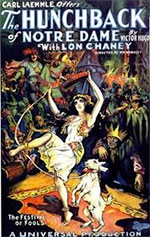
IN 1923 Universal Pictures embarked on a series of horror movies that would stamp their mark on the genre for decades to come.
Their choice of story to launch them into a world of Gothic Horror and literature would be in the guise of Victor Hugo’s 1831 novel, The Hunchback Of Notre Dame. And considering it we’re still talking about a movie in the silent era, the success that the movie received was enormous and understandably would Universal would capitalise on this success.
With every great story though, a great actor would be needed to portray the lead role.
In this instance Universal would score big with “The Man of a thousand faces” Lon Chaney as Quasimodo.
Part of Chaney’s appeal was his devotion to his craft, dedicated to transforming himself physically, particularly with the aid of make up, which helped style his performance of these dark, twisted, and tortured souls.
The movie itself can feel incredibly slow in the first half as Quasimodo is ordered by his master, Johan to kidnap the fair Esmeralda only to be thwarted by the dashing Phoebus, who instantly falls in love with his damsel.
The result leads Quasimodo to be tortured and ridiculed by his captors and the townsfolk.
It’s only in the latter half of the movie when the people start to revolt against the regime and free Esmeralda once again that it really does start to gain enough momentum to keep your interest.
Essentially it’s a tragic tale and if it were not for Chaney’s performance, this would be instantly forgettable.
As such, he carries the movie and his attention to detail and characterisation is a journey worth the wait.


 Surgeons of Horror