Retrospective: The Cat O’Nine Tails (1971)

Tags

, , , ,

The Cat O’Nine Tails (Il gatto a nove code) identified as a Giallo film from Italy, with its themes of mystery and heightened thrillers that became popular through the 70s and 80s boasts the great Italian director Dario Argento.
Despite having some visual traits and symbolism throughout that still tie this movie to the giallo scene, Argento has cited the film as one of his least favoured among his credits.

These may seem like modest words but under closer scrutiny the film does struggle a little under the weight of its exposition and in doing so, can be hard to navigate through its narrative.

The story needs to have some twists and turns along the way to allow the mystery to bear fruit but the telling of that journey can feel laborious at times.

The main context of the tale centres on a mysterious break in of the Terzi Medical Institute where it appears that nothing was taken, and yet one of the doctors, Calabresi believes he knows the culprit, and when he attempts to blackmail the individual is then murdered when pushed before a train.

This opens up the investigation for an unlikely duo, reporter Carlo Giordani (James Franciscus) and former hot shot reporter, the elderly, blind Franco “Cookie” Arno (Karl Malden) who still has a nose for a story. Between them, they identify nine possible leads that they could follow in order to identify the killer. The nine leads are the basis of the title Cat o’nine tails and along with it the mysterious journey to our conclusion begins and takes us through the local crypt and a thrilling conclusion on a rooftop. The tension of which is fueled by Franco’s blindness.

Despite the unfavourable comments of his own work, I found The Cat O’Nine Tails an entertaining one despite its complexity. I personally found the intricate narrative added to the mystery and allows the audience to traverse its murky case to a satisfying and thrilling conclusion. The hands of Argento manage to mould his visual style through the giallo lens and produce a worthy addition to the Italian celluloid movement that is well worth your time and satisfies on many levels.

  • Saul Muerte

Retrospective: Vampyros Lesbos (1971)

Tags

, , , , ,

I remember sometime ago reading an article from the team at Diabolique Magazine about this fascinating, prolific film director Jesús Franco, who was synonymous for his exploitative work in the horror genre, and was immediately intrigued.

Celebrating 50 years since its initial release back in 1971, Vampyros Lesbos is an erotic horror story which follows Linda Westinghouse (Ewa Strömberg) who has a series of erotic dreams about a vampire Countess Nadine Carody (Soledad Miranda) who seduces her and feeds off her blood. Despite being warned not to, Linda travels to an island to seek a new home, but in doing so, soon encounters the afore-mentioned Countess in a house where the infamous Count Dracula once resided. It is not long before Linda succumbs to Nadine’s advances and they are embroiled in a sexual encounter and ultimately drawing blood from her neck.

The story itself takes some convoluted turns through its telling, including a nod to another Stoker creation, Dr. Seward (Dennis Price) who treats Linda from her wounds. But he has an ulterior motive in trapping Nadine and convincing her to turn him into a vampire.
There is also a warped and malicious torturer, Memmet, (played by Franco) who seems hellbent on kidnapping Linda and carrying out his salacious desires upon her. All of which leads to Linda needing to expel her curse by killing Nadine.

Where the film suffers from a fairly leaden acting across the board, Vampyros Lesbos makes up for this through its visual exposition combined with the psychedelic funk soundtrack (which had a reawakening of its own in the 90s when remixed and released as an album called Vampyros Lesbos: Sexadelic Dance Party). It hardly stretches the imagination, but has a certain appeal to it that marks an identity of its own and along with Franco’s other ‘71 release She Killed in Ecstacy make a cracking double feature.

  • Saul Muerte

Retrospective: The Blood on Satan’s Claw (1971)

Tags

, , , , , ,

Mention British folk horror and most film enthusiasts will automatically strike up The Wicker Man into conversation, or perhaps The Witchfinder General. But where both these features were lifted by icons in the genre, Sir Christopher Lee and Vincent Price, The Blood on Satan’s Claw doesn’t have the weight of talent on display. It does however, like its counterparts, boast a cult following. And for good reason, as it marks an identity of its own with a unique tale spun by writer Robert Wynne-Simmons (The Outcasts) and director Piers Haggard. 

At its core, the tale that is woven is one of demonic possession in early 18th Century England. The oddities begin when Ralph (Barry Andrews) unearths a deformed skull from the ground, but despite his proclamations of the devil’s work, when it comes to proving his case before the local Judge (Patrick Wymark), the skull in question mysteriously vanishes.

Furthermore, when Peter (Simon Williams) brings home his ill-matched fiance according to social status, Rosalind, she suddenly screams through the night, falls ill and is then committed to by the Judge.

TBOSC has a way of getting beneath your skin in a curiously appealing way and when Peter starts to question his own sanity following an attack by a creature in the night only to find that he has severed his own hand. It also plays with the pack mentality too with a menacing presence led by some of the local youths, who gang up and hunt down their prey in the name of the prince of darkness. 

There is so much going for this film and it lures you in with its quirky simplicity and lifts the maniacal pandemonium that arises in a small town without any sense of order, led astray by their frenzy and beliefs in a greater power. Witchcraft is not a loose term in these times and with some strange happenings, decisions are made to stoke the flames of the occult. 

The mob will eventually rise armed with flaming torches to bring down the blasphemous brood, but will it be too late?

TBOSC deserves its place in British Horror hall of fame, and if you’re a fan of folk horror, this is well worth your time and is not surprising that it has influenced many filmmakers for holding true to its identity and not shying away from making its mark on the celluloid soul

  • Saul Muerte

Movie review: An Unquiet Grave (2021)

Tags

, , ,

If I could cast a single element of praise towards Terence Key’s directorial feature debut An Unquiet Grave, it would be for the bold attempt to have two actors carry the entire 1hr and 12 min running time. The problem is that despite what is admittedly fairly short for a feature, it still stretches the premise too thinly to warrant your complete attention.

The premise itself feels like something drawn out of Pet Sematary, where a man Jamie (Jacob A. Ware) hatches a plan to bring his wife back from the dead with the help of her twin sister Ava (Christine Nyland, who also co-wrote the screenplay with Key). Using some dark magic macguffin which relies on a ritualistic act taking place at the site of the death, Jamie drives Ava to the location in order to carry out said deed. What he fails to mention is that a blood sacrifice is in order.

From here on in the movie drags its light plot to a bitter end using a few tricks of the trade in scares and thrills until the restless grave can find peace once more for its occupant. Both Nyland and Ware do incredibly well to lift the film using every ounce of acting prowess and for this the film can be thankful for their on screen presence but there’s not much else on show here.

The Diagnosis:

It was always a tough task to add depth to a shallow conceptual grave but there is enough substance here to keep you engaged… just. 

Both actors chew on as much of the dialogue to keep up the momentum and there are also some choice decisions from director Keys to make his mark for hopefully more budget to expand on his and Nyland’s writing and directing future.

  • Saul Muerte

Retrospective: The Pit and the Pendulum (1991)

Tags

, , , ,

For those in the know, there’s a special place in the heart of the Surgeons team for the work of Stuart Gordon. If you haven’t already, please check out our podcast episodes on Re-Animator, From Beyond, Dagon, and Dolls.
Links are found at the end of this article.

At the time that we recorded these episodes, I remarked that we had neglected to include his take on the Edgar Allan Poe novella, The Pit and the Pendulum.
Now celebrating 30 years since its release, it seems as good a time as any to retrospectively look back at this film which starred Lance Henriksen.

Upon review, this clearly isn’t Gordon’s finest hour behind the camera, but that’s not to say that there’s not fun to be had in viewing the movie, and most of that is in part due to Henriksen’s performance, quietly subdued take of the evils that humans resort to in the name of lust and infatuation.

Henriksen plays the Grand Inquisitor, Torquemada,  during the torturous time of 15th Century Spain. His tirade has no bounds until he meets Maria (Rona De Ricci) and is immediately enamoured by her beauty. Torquemada struggles with the conflict that arises between his infatuation towards Maria and his devotion to the Church and decides to repress his sinful ways and subject his cruel desires outwardly, charging Maria with witchcraft and a trial by torture.

Whilst imprisoned by a confessed Witch, Esmerelda (Frances Bay – Arachnophobia, Critters 3, In the Mouth of Madness). Here, Maria’s upturned world suddenly spawns new life and the possibility of something beyond our imaginations, but when her husband’s failed attempt to rescue sends him to the new torture device, the pit and the pendulum, is it all too late for resurrection to save him from certain doom.

The Pit and the Pendulum suffers from adding little substance to the subject at hand and while it isn’t a terrible film, it does fail to spark the imagination from a director known to stimulate the visual senses.  It does boast the great Jeffrey Combs aka Herbert West in Re-Animator amongst the cast, but there’s not enough primordial fat for either Combs nor Henriksen to chew upon to make the film stand out. Instead it simmers rather than scorches the fiery subject matter.

It could have been so much more, but quite possibly the adaptation was a step to far for Gordon to handle or make his own, reduced to the shadows of Roger Corman and Vincent Price’s classic take from the sixties.

  • Saul Muerte

Movie review: Saint Maud (2020)

Tags

, , , , ,

It’s a crying shame that Saint Maud has only just now been released to a wider audience through home entertainment here in Australia. Having been released in the UK back in 2019, and then picked up by A24 films, a company known for its ‘highbrow horror’ releases, such as The Lighthouse, Midsommar, and The Hole In The Ground. It easily sits in good company with these movies with themes of faith, madness, and salvation at its helm. 

The narrative focuses on the burden that we carry through our lives when dealt with a traumatic episode. In this instance, we follow a nurse, Katie (Morfydd Clark – Crawl) who fails to save the life of a patient despite attempting CPR. So affected by this ordeal, Katie takes leave of her role in public health to invent a whole new identity in private care, and adopts the personna, Maud.

The story itself soon picks up with Maud assigned with the care of Amanda Kohl (Jennifer Ehle) a former dancer and choreographer who has succumbed to lymphoma. Believing that Amanda has been enveloped in sin, Maud then takes it upon herself to heal her through her faith and connection with God. So devoted is Maud to her beliefs that she begins to experience physical reactions that she believes is a testament to her unfounded devotion to the Lord. The beauty of the film is that it doesn’t question the faith itself but the extreme actions that manifest in an unstable mind when reduced to the base forms that life can subject us to. When we have nothing to fall upon other than our beliefs, then what can materialise out of faith can be an ill-fated journey through a twisted form of salvation. In Maud’s case, her salvation comes through not only cleansing her own soul, but by saving the soul of the atheist and sin-ridden Amanda, pushing these thoughts to its conclusion through pain, struggles, and ultimately redemption.

Charged with bringing this tale to fruition is writer, director Rose Glass, who’s debut feature is a mature and psychological venture into the heart of humankind, constantly questioning our role in the world and what drives us, or steers us towards our fate.

The Diagnosis:

Both Clark and Ehle produce powerhouse performances that twist and turn through a beautiful mix of power and vulnerability. They are beyond exceptional in their perceptions of both Katie/Maud and Amanda respectively and help solidify and ground the fantastical in reality, so that by the film’s resolution, the horror that unfolds with a deep and unsettling feeling that resonates long after the closing credits.

Glass proves that she is a talent to watch in the future who is able to tackle some dark, psychological subjects with the confidence of a veteran in her field.
Saint Maud is quite possibly one of my favourite movies in recent years.

  • Saul Muerte

Retrospective: Slither (2006)

Tags

, , , , ,

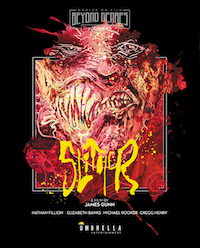
15 years ago, before he would helm the Guardians of the Galaxy movies, Director James Gunn would mark his directorial debut with Slither, a black comedy, sci-fi horror movie centred around a small town in South Carolina that comes under siege from an alien parasite.
It’s a visual spectacle peppered with some humorous dialogue, highlighting the slow paced energy of the townsfolk suddenly thrust into a frenzied assault on their humble town and investing their bodies.
Upon its release, Slither was considered a flop, as it never fell short of the budget used to make the film by a few million.
I remember being a little bewildered by this at the time of its release as I thoroughly enjoyed its energy and direction, coupled with its strong influences from both Carpenter and Cronenberg, directors with whom I greatly admire their work.

It also boasted cracking performances from Nathan Fillion (who had already made a name for himself in Firefly) as Police Chief Bill Pardy, Elizabeth Banks (Brightburn) as Starla Grant, our female heroine, and Michael Rooker as her overbearing and protective husband Grant, who also becomes the first infected by the parasite.

The effects on show are its main selling point who create the tentacled, worm-like creatures with an element of Lovecraftian, body morphia. The humour too is light and zestful, which suits Fillion’s on-screen persona and a testament to Gunn’s writing ability.

This June, Umbrella Entertainment have released a blu-ray edition of the film as part of their Beyond Genres series with some cracking extras including: 

  • Audio Commentary with James Gunn and Nathan Fillion 
  • The Slick Minds and Slimy Days of Slither: Making of featurette – 10 Mins 
  • Who Is Bill Pardy? – 5 Mins 
  • Slither Visual Effects Progressions – 5 Mins 
  • Bringing Slithers Creatures to Life: FX Featurette – 19 Mins 
  • Slithery Set Tour With Nathan Fillion – 5 Mins 
  • The Gorehound Grill: Brewin’ The Blood – 3 Mins 
  • The King of Cult: Lloyd Kaufman’s Video Diary – 9 Mins 
  • Deleted Scenes – 11 Mins 
  • Extended Scenes – 8 Mins 
  • Gag Reel – 8 Mins

All of which resurrect the fun element that was notably present behind the scenes and projected in all facets of what we see on-screen with the final product. This further cemented for me that Slither is a gem of a movie and the reason why it has garnered a cult following as a result.

If you haven’t caught this film, or was deterred by the low box office attendance at the time of its initial release, then I highly recommend that you check it out.

  • Saul Muerte

The Conjuring Universe: How does it fair under the sequels scrutiny?

At the time of writing The Conjuring Universe has firmly established itself in the horror genre scene and James Wan et al have created a world of scares and delights across eight feature films. Arguably one of those features, The Curse of La Llorana has been demoted from the universe by its director Michael Chaves.
I feel like I’d like to argue this point as it clearly is connected with Annabelle, mainly due to the presence of Father Perez, but if we are to take this as gospel, then we can put it to one side for the purpose of this article which is to look at trilogies when adopting the Surgeons theory of what makes a good sequel as outlined by Antony Yee in his article, Movie review: A Quiet Place Part II.

To recap, here is the criteria that we believe marks a decent sequel:

  1. Identify the ideas, themes & executional elements that make the first film great.  Or at least good.  Or at least worthy of being sequelised.
  2. Pay homage and do not violate/ignore said ideas and themes and elements.
  3. Introduce new/expanded themes, ideas and elements that will NATURALLY ALIGN to your first ideas, themes & elements.  (Ie: Don’t use your second movie to discredit & contradict your first).
  4. To underline point 3 – DO NOT rehash the first film and just give people “more of the same”.
  5. DO NOT-NOT rehash the first film by giving more of the same…. BUT “BIGGER”.
  6. Be a good enough stand-alone film by itself.

The reason I am drawn to this in the realms of The Conjuring Universe, there is in effect two sets of trilogies at play, if we were to also put The Nun to one side.It’s yet to be seen if The Nun will establish a trilogy in its own right. There’s the Ed and Lorraine Warren Conjuring trilogy and the Annabelle trilogy, which is slightly more complex to scrutinise as it contains a prequel in the mix.

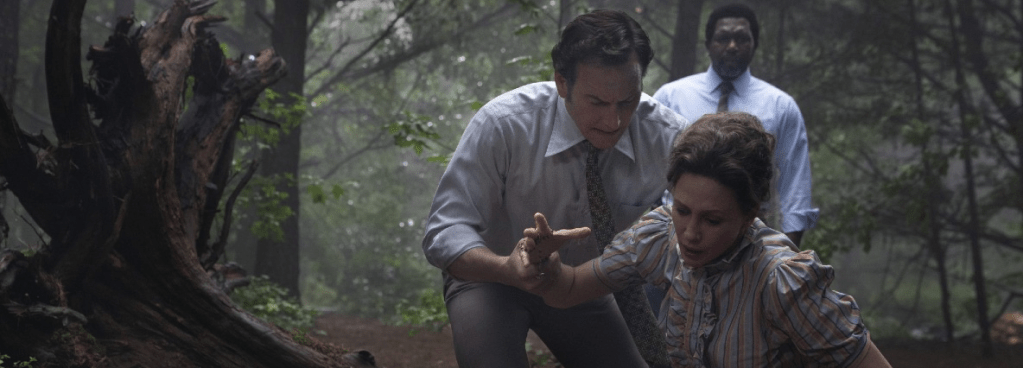
So let’s start by looking at the initial Conjuring trilogy which focuses on the paranormal investigations of Ed (Patrick Wilson) and Lorraine (Vera Farmiga) starting with…

The Conjuring 2

  1. Does it identify the ideas, themes and executional elements from The Conjuring?
    Here it definitely does, Not only it incorporates the central characters Ed and Warren but similarly places them in another paranormal investigation centred on a family under duress from a spiritual entity that threatens them physically and mentally.
  1. Does it pay homage to the original in the process?
    Once again, yes, and centralises on the core elements that were set up in the first feature, establishing the key themes and ideas, and not demolishing them in any way. This is in large part due to James Wan taking the helm as director and in doing so, firmly establishes the look and feel of the movies through clever trickery of shadows and light to build up the tension.
  1. Introducing new ideas.
    The biggest component that comes into this movie is the expansion of the spiritual encounters with not just one paranormal entity but three. It’s main antagonist appears to be Bill Wilkins, but is also supported by The Crooked Man, and most notably Valak. A fearful entity that was so striking that launched a spin-off film of its own.
    In addition, Ed and Lorraine’s roles are provided some more depth and centres on their relationship to one another which I felt was a nice touch and gave both Farmiga and Wilson more to play with respectively.
  2. Is it a re-hash?
    This is a tricky one because in many ways it is a bit same-same. Same investigators, Similar poverty stricken family under distress. The shift in location to the UK does disguise this element and because of the question around the genuine haunts that were aimed at the Enfield Haunting, it adds an extra component, but effectively, it doesn’t stray too much from the original notes.
  3. More of the same but bigger?
    Which is why unfortunately it falls short and three spirits instead of one element makes it exactly that. A bigger premise from the first. 
  1. Does it stand alone as a film?
    100% yes. You don’t need to have watched the first film and the elements that are played with are strong enough to establish its own identity. For this, it is a worthy follow up and rightfully exists within the universe.

SCORE: 4/6
It’s a decent effort and a strong film but without the added depth to the Warrens and the introduction of Valak, the film treads a very similar path to its predecessor.

The Conjuring: The Devil Made Me Do It

  1. Does it identify the ideas, themes and executional elements from The Conjuring?
    This film starts to feel like a different beast, which makes sense when the change of director comes into effect with Michael Chaves taking the helm. While the core ideas and elements are in place especially with the exorcism introduction, its style and execution is different.
  1. Does it pay homage to the original in the process?
    These ideas are not ignored but play a more secondary role due to the change in approach to the storytelling.
  2. Introducing new ideas.
    The expansion of the story comes through the further development of the Warren’s relationship, but central to this is Lorraine’s gift of sight into the other world and her connection with another gifted person.
    The main change centres more as an investigation on said exorcism and how powers outside of the mainframe such as the judicial period weighs in on and impacts the perspective of the universe.
  1. Is it a re-hash?
    Definitely not. If anything, I applaud the approach of trying something different with the story direction, even if it does miss a few beats away from the original look and feel in doing so.
  2. More of the same but bigger?
    Conjuring 3
    feels bold in taking the franchise in a different direction as it steps away from the formula that was set up by the first two movies. It’s both its benefit and detriment. 
  3. Does it stand alone as a film?
    It does stand alone to a degree. Especially as the story holds up through style and substance. What it does well is use the investigation and turns in on itself, questioning the paranormal inquiry process, which feels refreshing and plays with the black and white, the yin and yang of paranormal experiences.

SCORE: 4/6
This instalment does well to make an identity of its own and for trying something different but in the process takes a lot away from what drew us to the original and what made that movie so good to begin with.
With the introduction of Annabelle as a spin-off franchise, it generated enough success at the box office for the producers to look at its own trilogy of movies, despite it not being anywhere near as good as The Conjuring. So how does the Annabelle trilogy square up under scrutiny.

Annabelle: Creation

  1. Does it identify the ideas, themes and executional elements from Annabelle?
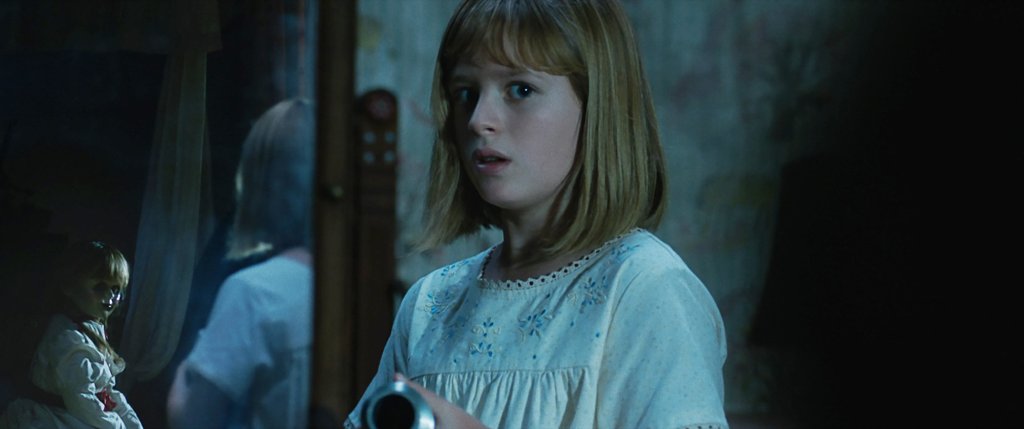
    This is more of a strange one as Annabelle: Creation did one of two things. Firstly, it chose to go to the genesis of Annabelle’s fruition allowing a way to create rules of its own and improve upon the original film. Secondly, It focused on the core elements of what makes a possessed doll so scary, and reinvents the concept.
  2. Does it pay homage to the original in the process?
    If anything, this film pays homage to the initial component that Annabelle was introduced from The Conjuring film. This feels more in keeping with the Conjuring universe than its predecessor.
  1. Introducing new ideas.
    The new ideas are discussed above in point 1, and expands on the possession route. It also strands our would-be victims in the middle of nowhere rather than a suburban environment like in the original. This helps to amplify the feeling of helplessness.
    Much like The Conjuring 2, it also adds a few other elements in the mix; a scarecrow, and parents hellbent on doing anything to bring their daughter back to them.
  1. Is it a re-hash?
    No. It feels more like a reinvention and more of a revamp than a rehash.
  1. More of the same but bigger?
    This is a very different movie and is all the more better for it. David Sandberg does a great job of breathing new life into this franchise, and what’s more does the impossible by making a movie that is better than its predecessor.
  1. Does it stand alone as a film?
    100%. This film adds some great moments that help it stand alone as a movie, injected with humour and new ways to scare the audience.

SCORE: 4/6
Annabelle: Creation marks a bold entry into the universe and reinvents the Annabelle franchise. It was a bold approach but executed really well to become a better movie as a result. Off the top of my head, only Ouija: Origin of Evil has been able to do something similar. 

Annabelle Comes Home

  1. Does it identify the ideas, themes and executional elements from Annabelle?
    Another interesting element comes into play here as this movie also tries for a different approach, making it about the haunted house / possession mixed with a teen horror component rather than the more adult based horror.
    It also uses both Annabelle and The Conjuring elements together and for that feels like the most balanced movie in the universe.
  2. Does it pay homage to the original in the process?
    Taking the notion that Annabelle: Creation is the main rule setter when it comes to Annabelle, this film definitely does pay homage to that film rather than the original film. But like I have stated. This film blends nicely into the Conjuring universe so pulls a lot from all the movies that have taken place before it.
  3. Introducing new ideas.
    The teen horror element marks this as a very different film in tone, whilst still in keeping with the Conjuring universe. It nicely plays with the idea of how Annabelle can harbour her power and force this onto weak or vulnerable people. It’s a simple premise but effective in this case.
  1. Is it a re-hash?
    Yes. But like Creation actually works to its advantage and provides the notion of each film having its own style and identity.
  1. More of the same but bigger?
    With the change in direction and style comes a film that is part of the universe but provides some of its own rules along the way. 
  1. Does it stand alone as a film?
    This film does stand alone, but also relies on flashbacks of the first film to cement it in the universe. This does prevent it from standing on its own entirely but the vision and narrative is strong enough to allow the film to have an identity of its own.

SCORE: 3/6
Seems a little unfair to mark it down but if we’re playing by the rules of how it relates to the original Annabelle film then it suffers.
It is a far superior film from the first film though and as part of the Conjuring universe more than holds its own.

  • Saul Muerte

How Annabelle and the Conjuring universe is connected to the Manson family murders

Movie review: The Superdeep

Tags

,

Don’t be deterred by this Russian flick and it’s admittedly slow start to build up its central protagonist, Russian epidemiologist Anya Federova (Milena Radulovic) from smart but failed scientist out to prove herself into full on action guru.

Inspired by the real location of the Kola Superdeep Borehole, (one of Russia’s experiments to bore to the Earth’s core, which at its deepest reaches 12, 262 meters down), Anya gets the opportunity to redeem herself when a supposed viral outbreak has occurred in a Secret underground research facility.

Set in 1984 Russia, The Superdeep evokes the stark and oppressive nature that woke out of The Cold War era.

As soon as Anya arrives with a squad of soldiers to find out what has happened at the facility and is charged with retrieved with finding some samples of the unknown disease which appears to be infecting all who work at the facility.

They are greeted by Dr. Grigoriev, the head researcher at the facility but it soon becomes apparent that he has an ulterior motive and refuses to allow them access to to the lowest level of the facility, trapping them on one of the other levels.

It then becomes a race against time to prevent the spread of the infection from reaching the surface and potentially wiping out all of humanity in the process.

The Diagnosis:

There are some nice little elements at play here, especially with the virus that is threatening the characters. It’s essentially a fungal type of entity that infests it’s hosts and shows signs of high functioning intelligence.

The idea behind this is a worthy one and keeps the audience entertained along with some decent effects to ground the film and support the believability of the film

Where it does fall down however is in some of the dialogue and action points that slip into predictability all too often.

It is still entertaining however and Radulovic’s performance and portrayal of Anya is strong enough to keep you invested til the end.

-Saul Muerte

Movie review: Occupation: Rainfall

Tags

, , , , , , , , , ,

Spanning the last five years Director Luke Sparke has hit the ground running, producing, writing, and directing three feature length movies and showcasing that Australia can release high budget, slick looking films.

Whilst you can’t fault Sparke for pushing the visuals and action sequences to the limit, producing some fantastic, fast-paced, frenetic moments with an effective punch, he has come under fire for weak characters and convoluted plotlines that dampen the spectacle.

His latest venture, (an extension of his pet post-apocalyptic project Occupation series, and first sequel) Occupation: Rainfall, is unfortunately no different.

The story picks up following the band of Australian survivors after the alien invasion of Earth and throws the audience in the thick of a war, where the allies’ numbers are dwindling.

Dan Ewing returns once more as hard headed Matt Simmons, who effectively brings the braun to the piece whilst struggling to collaborate with alien accomplice Gary (Lawrence Makoare) and find a common ground to work on so that they can rise above their obvious differences to defend the alliance. In many ways Sparke is drawing from the buddy cop movies that many action films have drawn from as their central character journey. Some of the shared moments work really well in this instance and are engaging, but too often they are quashed by the need to drive more action into your face rather than pause for breath and build on character. This does however highlight an absence of originality when it comes to story development. 

Through the cloud of combat and explosions there are moments where the supporting cast prove their worth and lift the script above its potential, hiding the notable flaws. Chief among them is Temeura Morrision returning as Peter Bartlett, Daniel Gillies as Wing Commander Hayes who tries to do everything according to the book in order to ensure human survival, and Jet Tranter taking over the role of Amelia Chambers from Stephanie Chambers to provide the heart of the film.

The Diagnosis:

Yes, Director Luke Sparke more than proves his worth of high-budget, slick looking action movies in a system that falls outside of Hollywood here in Australia.

It’s just a shame that three movies into his credits, Sparke hasn’t managed to get a grasp on his writing. I can see why he is hanging onto his vision through the Occupation series, and he certainly is a visual director, but too often the action sequences smother the characters and plot, which feel secondary as a result.
If more time were spent on developing some engaging and believable characters along with solidifying the narrative, Sparke would be a force to reckon with in the film industry.
As it stands though there is some work to be done to finesse what is obviously a creative mind, to harness this vision and strengthen what promises to be a further instalment in this franchise.

  • Saul Muerte