HATS OFF to The Autopsy of Jane Doe for attempting to contain the entire movie within the same “four walls”.
The exception being the prologue, (when the body is discovered) and the epilogue.
This is testament to the acting prowess of the films leads in Brian Cox and Emile Hirsch, who most of the scenes involve just the two of them, so they have no choice but to carry the story.
Thankfully, we’re in good hands as they take on the roles of Father/Son team of the Morgue in which the film takes place.
Tommy (the father) has resigned to his role as the town coroner, much like his own father and takes pride in his position.
In some cases it would seem at the expense of forming a solid relationship with his son, especially with the absence of a mother figure.
Austin (the son) has spent most of his life trying to fill the chasm between his himself and his father.
He becomes a medical practitioner and studies under his father’s guise, but with one eye on the outside world, whilst feeling forever entombed.
The beauty of this film comes with the arrival of the Jane Doe, and the beginning of their dissection, when supernatural elements begin to occur.
The deeper their investigation goes, the more scars that appear in their lives, and the darker their domain becomes.
The scare and thrill factors are secondary to the humanity that is on show, which some horror fans may be disappointed by, but there is enough gore and blood on show to rise this psychological, supernatural horror above the level of most its recent counterparts in the genre and is a gem of a movie as a result.
THIS MOVIE slipped under the radar last year, and whilst part of me can understand the reasons why.
Largely this movie is not to everyone’s taste and it’s raw, independent vibe can put certain viewers off, who are used to the polished, Hollywood mainstream.
Antibirth though is definitely worth of closer scrutiny as it embarks in an area not often looked upon, body horror, and even more so, the effect of pregnancy.
It often feels like a strange hybrid between something that David Cronenberg would produce and 1997’s Nowhere, with its strange and complex tale.
Namely, we follow Natasha Lyonne’s (Orange Is The New Black, Yoga Hosers) character, Lou, a drug-addled, pill-popping woman living in a remote town in Montana.
Unwittingly, she had become a part of a science experiment when her dealers use her as a science experiment with a new drug that they are pushing.
The side effects of which, induce pregnancy in women.
The question is, without the ‘usual’ method of insemination, who are what is growing inside her?
Lyonne has her character down pat and infuses some of the type of roles that she has become known for struggling with drug dependency.
She is ably supported by some notable female actors though in the under-used Chloe Sevigny (potentially just ringing this one in) as Lou’s friend, Sadie, and the welcome sight of Meg Tilly on the big screen as a quirky, eccentric stranger with more than a few secrets of her own.
Ultimately, it’s a strange concoction though, which some critics have described as muddled and confusing, and with no sense of direction.
But I for one, for one found it refreshing, despite the feeling of swimming upstream in treacle.
There’s enough intrigue to keep you within the story as Lou’s plight and body transformation elevates into the bizarre and grotesque.
This is only Danny Perez’s second feature, (which he wrote and directed) and if he were able to harness his voice whilst maintaining that raw energy throughout, he could very well be a director to keep an eye on in the future.
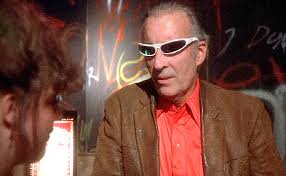
And Christopher Lee donning some awesome shades whilst blending into a night club scene. Hell yes.
French born, Australian film director, Philippe Mora takes the original movie, based on the Gary Brandner novels, takes it by the scruff of the mane and literally shakes the living shit out of it, so that it’s hardly recognisable anymore.
There is a notion that sequels are made to improve upon or enhance a franchise, but here, Mora takes the essence of the original and adds his unique flavour to the mix.
With Sybil Danning serving as his muse by playing the enchantress, Stirba, Howling 2 is a feast on the eyes and plays with your senses.
It’s an acquired taste that has gained a cult following as a result.
And would mark a strange and interesting direction that would prove to not be the last of the franchise, nor the last time that Mora would return to the director’s chair, as he would steer the follow up, Howling III: The Marsupials.
Check out more in the Full Moon Sessions podcast below to get the point of view from The Surgeons.
CRITICS AND AUDIENCES have been praising this film for sometime now.
And I may be a little late to the scene, but I finally managed to board the Train To Busan recently to see what all the fuss was about.
And boy did it live up to my expectations.
Not only was it enjoyable and action-packed, it also left you feeling satisfied as a result.
This film will stand the test of time and become a modern classic and should be on every horror fans must watch list.
Here’s 5 Killer reasons why…
Plenty of heartThe first two points are all about character development.
It’s the core to any good storyline. Make the people care about the characters by building up the relationships they have with each other and in doing so cement our relationship with said character before ripping out our hearts when they inevitably die.
A lot of soul
Continuing on the character theme, it’s also important to establish flaws in the key characters in which they will be punished for accordingly – death by zombie horde, or overcome and redeem themselves but sub sequentially meet their demise anyway, because in horror, only the pure of heart and soul will survive.
Stamina to stay the distance
The perfect recipe for any decent horror is to establish the rhythm and build up the tension to the nth degree by the time you reach the climax.This is when of the key strengths in Train To Busan.
Most horror films can find themselves derailed by the halfway point, but we’re kept well on track, thanks to the brilliant pace depicted by director Yeon Sang-ho and his crew.
Fucking sick zombies
When dealing with the big ‘Z’, you’re generally dealing with the archaic shuffling zombies from George Romero’s ‘Dawn of the Dead‘ or the kick-ass-quick in ‘28 Days Later‘.And although Train To Busan does lean more towards the latter, it does add another element to the mix – Mass.
When these zombies strike, they come as a group and and hunt down their prey with viscous abundance.
Killer instinctAnd finally, to top it off.
If you’re gonna have a cracking zombie flick, you’ve got to deliver the gore and kills with as much relish and glee as possible to salivate the hungry horde.
And in this instance I’m referring to the audience.
It’s not just the methods of the kills that count here, but the brutal reality of it all as our heroes fight blood tooth and nail in the name of survival.
It raises questions about how we would face such a dire situation, stares humanity in the face and shows us for the savage creatures that we are.
AS IF TO extend his acting prowess, Boris Karloff strides back onto the screen to establish himself as far more than the man of many monsters.
He had already made a name for himself as The Monster in Frankenstein, and Morgan in The Old Dark House, and true he would don the bandages to perform another iconic monster, but in The Mummy, he is able to deliver not one, but two characters in Imhotep and Ardath Bey.
The story of Imhotep has been used time and time again, but arguably no one has conveyed the heartache and desperation than Karloff’s performance back in 1932.
It is with Ardeth Bey though, that Karloff really shines and show off his acting muscles.
With each scene Karloff oozes cunning and devilry whilst weaving his way through every moment with the right amount of gravitas, capturing his sinister and evil plans throughout.
Universal may not have realised the true potential that Karloff could deliver up until this moment, and from here-on in, his career in Hollywood was well and truly established.
You only need to check out his filmography to see just how much he brought to the horror movie genre.
The Mummy isn’t simply a one-man show though, Karloff id ably supported by Zita Johann who plays Helen Grosvenor, the reincarnated Ankh-es-en-amon; and David Manners, and Arthur Byron as the father and son Whemples.
As does Edward Van Sloan playing the voice of wisdom in Doctor Muller, and once more provides the knowledge needed to vanquish their foes in a similar fashion to his Van Helsing (Dracula) and Doctor Waldman (Frankenstein).
Stepping into the Director’s chair this time around would be Karl Freund, a man born in a region that is now part of the Czech. Republic.
The Mummy was and probably will be the sole film that Freund would be known for as a director, but as a cinematographer, he provided some stunning visuals with movies such as, The Golem, Metropolis, Dracula, and Key Largo, to name but a few.
He also picked up an Academy Award for Best Cinematography with The Good Earth.
Ultimately though, The Mummy is a solid enough film and would help solidify the winning formula that had reaped such success for Universal in their golden era with plenty more successes along the way.
Just as Bela Lugosi followed up on his role of Dracula with Murders in the Rue Morgue, Boris Karloff would have his turn in front of the camera after scaring audiences as The Monster in Frankenstein.
Once more he would team up with James Whale, who would be on hand for directorial duties, and his craft is well toned in this cross between light-hearted drama and haunted house horror.
It certainly takes its time to get the wheels moving as it sets up the multiple of characters that descend upon the strange house and its odd occupants to shelter from a passing storm.
There’s the argumentative couple who we first meet and the dialogue feels stilted and all due respect, as thought they are lifting the lines off the page instead of embodying it.
It’s only when Melvyn Douglas arises from the back of the car with his upbeat banter that you start to think, ‘thank fuck for that’, even if it does come across as a little overbearing.
When they arrive at the house, they are greeted by the mute butler ably played by Karloff, who it turns out, does not make a happy drunk.
Boy, we’ve all met one of them, haven’t we?
Alongside Karloff, we also meet a couple of the Femm family, the neurotic Horace and his sister, Rebecca, who is not only partially deaf, but a bit of a grumpy cow.
There is something deliberately off beat about this movie and because of this, the audience play into the hands of the director, who leads through our uneasiness, which can’t seem to shift, despite the presence of the charismatic performance of Charles Laughton in his first Hollywood film, and a romantic interest thrown in for good measure.
Gladys even remarks on how there is something odd about the house and is reluctant to go back inside.
Of course she does, and in doing so, the audience is greeted by more oddities and peculiarities.
Karloff’s Morgan has hit the bottle by this point and has gone on the rampage.
The arguing couple are no longer doing so and appear to show genuine care for each other.
In this state of enlightenment, they meet the patriarch of the Femm household, a bed-ridden Sir Roderick, who despite being billed as John Dudgeon was actually played by Elspeth Dudgeon, because apparently Whale couldn’t find a man who looked old enough to play the 102 year old.
The problem is that it clearly looks like a woman with a few tufts of hair to form the guise of a beard.
Is that supposed to make her look more “manly”?
The result is that it took me further out of the movie than I already was.
What does pull you back in though, is the introduction of another brother, who has been locked in a room upstairs, and for good reason, for he’s clearly insane and is played with clear mania and glee by Brember Wills.
Said brother, Saul is also a pyromaniac and when his appears on the screen, the level of menace and sinister is heightened because of it, a testament to Wills’ performance.
There are some ingredients in here to make the movie a worthwhile viewing and yet, some say that William Castle’s version that came about in 1963 is arguably a better adaptation.
What is strange though is that in a Top 100 horror movie list as conducted by Time Out magazine and selected by authors, directors, actors and critics of the genre, The Old Dark House reached No. 71, a fact that I find hard to believe when there have been so many glorious movies in the horror realm that trump this film.
But it’s our diversity in taste that keeps us united and divided in our love of horror.
It keeps us debating and talking, to challenge each other and find common ground.
And some cases, change our opinions or go back to review those films again.
The second instalment of Kevin Smith’s True North Trilogy follows in the same vein of its predecessor, Tusk, in that it captures the quirky, dark, and curious side to Canada.
In this instance, the story follows two convenience store workers, Colleen Collette and Colleen McKenzie, played by Depp and Smiths daughters, Lily-Rose Depp and Harley Quinn Smith.
As expected the movie is infused with pop culture and gamification references such is Smith’s repertoire of language and style on screen.
Perhaps because of its leads, Yoga Hosers has a youthful vigour to the story, which just about makes it passable along with the style and substance involved.
All parties appear to be having fun in the making of this movie and that energy feels infectious as a result.
Behind the glitz though, the movie is simply that.
A facade of fun, but ultimately it’s logic is so far removed from reality that you have no sense of connectivity to the plot.
Essentially the girls end up fending off little yellow wiener men controlled by a Canadian Nazi, Andronicus Arcane.
It’s so convoluted and downright bizarre, that you’re only choice is to go with the flow or tune out.
As it stands it remains to be seen whether or not Smith will complete his True North Trilogy, by closing out with Moose Jaws.
Despite the two films generally negative reception, there’s a part of me that would like to see Smith carry out his vision, if only to see a killer Moose on the loose in Canada.
But I guess that’s just the quirky, warped side of my personality that identifies with the craziness of it all.
The obscurity of this movie admittedly had me questioning how such a bizarre story could ever be entertained let alone actually pulled of as a feature.
But all ideas and inspirations have to start from somewhere.
When filmmaker Kevin Smith and Scott Mosier picked up on a bizarre advertisement of guys walrus fetish as part of the Smodcast discussions, the subject resonated with Smith to run with this crazy notion and turn it into a feature, Tusk, the first instalment to a trilogy that he’s dubbed, The True North trilogy.
The second having already been released, titled Yoga Hosers, and a final instalment called Moose Jaws is on its way.
The underlying theme that ties these movies together examines the quirky tales born out of the depths of Canadian lifestyle and translates as a warped cousin of the X-Files as Johnny Depp cameos as French Canadian detective investigator of the bizarre, Guy LaPointe.
The central story to Tusk follows repugnant and loathing, podcast host, Wallace Bryton.
His podcast, The Not-See Party is basically a chance for him and friend/ co-host (played by a welcome Haley Joel-Osmont) to mock viral videos of guys making fools of themselves.
This one in particular is of a guy playing around with a samurai sword in his garage when he severs his own leg off.
Wanting to milk this story and take advantage of this poor soul for all his worth, Wallace ventures out to interview him for the podcast only to arrive at the chaps funeral.
By chance however, Wallace believing to be down on his luck, stumbles across a written advertisement in the Gents toilets that piques his interest with a free room and lifetime of interesting stories.
Little does he know that he’s about to get his comeuppance when he meets up with wayward extraordinaire, Howard Howe and his curious obsession with walruses.
Kidnapped and drugged, Wallace then has to face a gruelling undertaking that allows his assailant to transform him into the creature of his curious fantasies.
Will his girlfriend and best friend be able to save him from his ordeal?
What will be left of him by the end of it all?
Tusk is a movie that lives up to its description with its strange tale, which was always going to be a tough sell for audience and critics alike.
It takes someone like Kevin Smith to carry out this vision and brandish it with his unique sense of humour.
And for that it hangs in there just barely by a single thread and may well generate an audience from his loyal fans.
Once again I find myself commending a director on their bold choice and pushing the boundaries of storytelling by challenging themselves and offering something new, even if the execution itself doesn’t eventually pay off.
I’D REALLY LOVE to get Adam Wingard and Simon Barrett’s school of thought on the aftermath of this movies release.
Fans and critics alike didn’t warm to the film and because of this, Blair Witch is deemed a failure.
The big question really though is did the movie fall victim to the Blair Witch curse?
The premise was to take a look into what the Blair Witch mythology brought to the screens back in 1999 by Eduardo Sanchez and Daniel Myrick with The Blair Witch Project, a film that sent shock waves through the horror movie scene and the cinema industry with its bold choice of storytelling through found footage.
Found footage was a medium which at the time hadn’t been as widely explored, unlike today where it seems like everyone under the sun has attempted it, with nowhere near the success.
Is this over-saturation of the sun-genre partly to blame?
Yes – I’m looking at you Paranormal Activity.
Despite this, Wingard and Barrett chose to explore and set the Blair Witch 18 years after the original (and rightfully ignoring Blair Witch 2: Book of Shadows, which I think everyone can agree was a complete dud).
There are elements within the movie that feels a little disjointed with the timelines a little, but hey, that’s one of the anomalies within this universe that you could use your BS around, with the Witch’s strange effect on time and space.
So, it’s easy to forgive this little quibble and give in to the suspension of disbelief.
The filmmakers also try to throw in all the latest mod-cons to make it feel more like a bunch of present day kids venturing into the woods, armed with drones and the like.
But it does feel a little forced, especially as for me, it treads a little too closely to the original to make it stand apart from its predecessor.
Perhaps by viewing the original movie and being so affected by it, my observations and responses to Blair Witch are automatically going to be tainted.
It would be interesting to chat with someone who hasn’t seen The Blair Witch Project and therefore not been consumed or tainted by the hyperbole that surrounded that film and get their take on it.
There’s no doubt that Wingard and Barrett had set themselves a difficult challenge to undertake.
It was a bold move and falls in line with the kind of filmmakers that they are and have proven to be, with rightful praise thrown their way for previous films they have released.
A notable element in my mind that did stand out and raised the worthiness of the film came towards the climax with a knowing nod to the story of Lot.
By this time it really does feel like the current survivors are trying to escape from the destruction of Sodom and Gomorrah.
Ultimately though, the film does miss the mark in establishing the same kind of hysteria that hit our screens back in 1999.
So does Blair Witch fall foul of the supposed curse? Maybe.
Should we commend Wingard and Barrett for doing what filmmakers should be doing? Making bold decisions to challenge themselves and their craft? Absolutely.
It may be a hiccup in their career so far, but I for one can’t wait to see what they deliver next and delve into their vision once more.
ONE YEAR AFTER Alexandre Aja’s remake of Wes Craven’s The Hills Have Eyes received (quite rightfully) positive reviews, it was almost inevitable that the films creators would start looking toward creating a franchise.
It’s main drive would come from the films’ original creator, Craven and his son, Jonathan.
And on face value, the initial premise that was laid out ignited a sense of passion in me. “I’d like to fucking see that!”, I proclaimed, until that is that on closer scrutiny, it was just a rehash of “Aliens” but instead of xenomorphs that an army faces up to, it’s a group of mutants out in New Mexico that need to be annihilated.
Wait, maybe that does sound awesome. Craven apparently even planned to have the surviving daughter, Brenda enlist in the army to overcome her demons only to go all “Ripley-esque” when called upon to go back into the wilderness to physically face them head to head, as she is the only person who knows their lay of the land.
Only problem was that Emile de Ravin, who played Brenda in the remake was committed to TV series, Lost at the time the film was due to go into production.
That’s okay, we’ll just create a new protagonist in Amber, who will walk the same path as had been intended for Brenda. Job done, yes?
So why then did the movie fall short and not launch this franchise into stronger territory?
Ironically enough, The Hills Have Eyes 2 would suffer the same fate as the original remake, The Hills Have Eyes Part 2did.
Both films completely ignored the concept of a family pitted in terror against an unknown assailant that was both brutal and destructive, stripped down to the very essence of what it is to be human.
In a raw, animalistic approach to survival, the family has no option but to resort to drastic measures in order to live through the torment.
It is that rage that is buried within us all that rises to the surface when we have nothing else to fall back on and nothing left to lose.
That’s why the original movie resonated so strongly in societies ethos.
It cut out all the bullshit and crap that comes with our social make up and shone a mirror to our flaws and pretentiousness to convey who we all are underneath.
It’s why Aja’s version was so well received, because it managed to carry that same message and deliver tenfold on the anarchy.
By ignoring the very premise and notion or hunger for survival, you tear away all the drama and beauty that encapsulated the original movie and from there you will always fall short.
Yes, you should probably commend Craven for trying to push the story in a new direction.
Hell, they even teamed up with Fox Atomic comics to produce a stand alone comic called The Hills Have Eyes: The Beginning, which also treads along the path of the army vs the mutants theme, but in this instance it creates and additional pet peeve of mine, in trying to humanise the mutants.
In doing so, it destroys not only the mystery behind them, but also the threat that they once posed in the original is destroyed in the process.
So, whilst it does strive to explore the universe further, in doing so, the essence of what made the world so great, just crumbles and withers away.
It’s a shame, because I feel there is still merit in exploring that world once more.
And there’s a lot of political commentary that is ripe for the picking if they chose that journey wisely, but it remains to be seen if the film industry will choose to go back into the hills once more.

 Surgeons of Horror