Movie review: Come To Daddy

Tags

, , , , , ,

As sons, we always have unfinished business with our fathers. So I thought, ‘What would happen if that unfinished business came looking for us?

Ant Timpson – Director

These words surmise the kernel of Ant Timpson’s vision and directorial debut feature, Come To Daddy and its this beating heart that drives the narrative forward and compels you further into what is essentially a dark and twisted comedy. 

Visually and choreographically, this is a simply glorious film, with a beautifully hypnotic and enchanting score by Karl Stevens, that infuses old school 70s espionage thrillers with an eerie, unearthly bass-fuelled playfulness that is the perfect accompaniment to the narrative.

Come To Daddy encloses some of our greatest fears and trepidations by tapping into a family divided by place and time, but connected by blood and loyalty and this becomes tested by opening up Pandora’s Box to be faced with uncertainty and morbid curiosity.
What lies beneath the surface may be better left untouched, and for those that probe and tweak a little further, can herald some unpleasant surprises. Timpson had a clear vision in mind for his feature, drawing from a personal account with the passing of his own father as his inspiration.
This is evident throughout the film and gives the storyline the much-needed gravitas to direct the audience through the wild and strange happenings that occur and explores the relationship of father and son.

When Norval (Elijah Wood), a ‘privileged man-child’ receives a letter from his estranged father of thirty years to come and visit him. Seeing this as a chance to rekindle their relationship, Norval is surprised to find that his father may not be who he had envisioned. And what’s more, carries some baggage that he may not necessarily wish to inherit.

There’s something quite remarkable about off-kilter, independent films that despite appearances play a tune that is so perfectly in sync with its equilibrium and defies expectations and in this case, Timpson belies his novice attempt at a feature and you’d be forgiven for thinking that he was a veteran in his craft.
The notes and beats are flawless as Norval’s trials and tribulations play out on screen to the delight of its audience. Despite its macabre storyline, Come To Daddy peppers along with much amusement as it playfully dances with our hearts in the most dire of situations and keeps us guessing about the fate of Norval.

Wood is fantastic as the lead and is chameleonic in that way that he brings life to the character with his curious eccentricity, both physically and mentally, showing the flaws and humanity, which is both refreshing and ultimately rewarding as we follow Norval’s journey.
Wood’s performance is even more elevated by his support players, who are a real treat to watch, from Stephen McHattie’s suitably unbalanced Gordon, to the always fantastic Michael Smiley as Jethro, and Martin Donovan’s all-round solid delivery of Brian, make this an ensemble cast that would make most directors proud to be involved with.

The Prognosis:

So many ingredients that combine to make this a gem of a movie. 
It’s not something I can pigeonhole, if I’m honest.
Is it a quirky, yet intriguing independent feature? Yes
Does it produce some high quality visual treats in harmony with scintillating audio stimulation? Yes
Does it tickle the darkest humour of the human psyche? Yes
Does it prove Ant Timpson to be a master of his craft with an array of stellar talent? Yes.
So, what are you waiting for? Head over to Umbrella Entertainment and treat yourself to a superbly entertaining movie, that will not disappoint.

  • Saul Muerte

 Come To Daddy is NOW available to view via Video On Demand

Blu-Ray & DVD from June 2020
Podcast: Season 6 – Ep 33. A Nightmare on Elm Street (2010) remake

Tags

, , , , ,

Our last episode of the season and our journey through the Nightmare franchise ends with the remake.

What do the Surgeons team think of this film 10 years after its initial release?

Check out the episode below to find out.

Podcast: Season 6 – Ep 26. A Nightmare on Elm Street: Wes Craven’s New Nightmare

Tags

, , , , , , ,

They said he was dead, but Freddy returned although not as we may have expected him.

Wes Craven resurrected the beloved villain in a bold new enterprise back in 1994. Did it pay off? Does it still stand true today? The Surgeons team dissect and discuss this film to find out some of these answers.

Listen to the episode below:

Retrospective: The Cabinet of Dr. Cagliari

Tags

, ,

Director Robert Wiene was once creully dubbed a one-hit wonder following the success of his German expressionist silent film, The Cabinet of Dr Cagliari, which celebrates its centenary this year. Cruel because its stature as a film both in the horror genre and the celluloid art form as a whole is elevated, even now in modern times, audiences can still view the film and appreciate its vivid structure and powerful storytelling. This concept has been carried out through a number of Wiene’s films since and as such places the auteur in a higher pedigree as a result.

Part of the reason for TCoDC’s success is its beauty and why I believe that it still resonates today is because of how the Expressionist movement that Wiene articulates throughout the narrative heightens the sense of fear, horror and dread. The use of exaggerated framing within the set, scenery, dramatic lighting and obscure camera angles, all of which have been harnessed and inspire many great film directors today. This abstract style of filmmaking that broke down the parameters of the environment is a welcoming device that unsettles the viewer, and it’s this discomfort that is dialled up and emphasised during the early 1920s with films such as Phantom, Nosferatu, and The Golem: How He Came Into The World, that captured the imaginations of their audience and captivated them. 

I’ve alway been drawn to this style of storytelling and combined with Hans Janowitz and Carl Mayer’s screenplay that twists and turns our perception of the world, we are left questioning our judgement and a little foolish at our trust in the storytellers.

The device is a simple one that plays with the audience, who have come accustomed to the conviction of the author, that when the reveal happens we see that the true horror lies within the mind of our narrator. This device has oft been repeated, but the simplicity of its tale is what continues to captivate audiences and any cinephile who has yet to catch this masterpiece, should do so without haste, and it is fairly easy to stream it without any restriction involved. Without it, the term calgiarism wouldn’t have been formed, a word that I might add warrants resurrection to highlight madness and obsession with distorted visuals.
In short, don’t judge this film by its age, black and white images, and lack of audio dialogue, as it is a strong and compelling film and a fascinating insight into the formation of the horror genre on screen. We at Surgeons of Horror raise a goblet and celebrate its centenary.

  • Saul Muerte

Movie Review: The Invisible Man

Tags

, , , , ,

There is someone walking behind you

The Invisible Man brought the fear of the unknown to the forefront.

Playing harmoniously with the horror classic first seen on the big screen back in 1933, The Invisible Man involves many untapped elements of what scares everyone.
Forget “there is someone walking behind you”, or that sound that suggests someone is next to you, what if they were right in front of you.
It’s haunting enough to make you watch your every step but to couple that with an obsessed, abusive ex who is known for his manipulative gaslighting and violent rage, this quickly becomes a great narrative, if only the trailer didn’t reveal everything! AGAIN!
I saw an awful cut of the new James Bond movie on television one night, and it looked bland and awful but then saw another trailer for it in the cinema and it looked like it has a great, engaging story. I was already halfway through the plot in my head, waiting for the movie to catch up, and it did just over halfway through the film.

Fantastic performances by the cast who all lead a stoic role in aid to the plot. I like the way films aren’t shying away from the kind of traumatic scares like in the recent Doctor Sleep and in this film, which were obviously showing off what the visual effects department could pull off. 

The Prognosis:

I feel like this is one that can be enjoyed by all, there is an ambiguity that lends to the possibility of multiple outlooks regarding events and perspective, coupled with the intriguing use of technology and optics.

It was great to see the NSW funding in the credits

It’s a great movie to watch on a first date! Just try and avoid the trailer before you see it but yeah definitely one for date night.

  • Richard Lovegrove

Movie review: Brahms: The Boy II

Tags

, , , , ,

When I first about the release of Brahms: The Boy II there was two thoughts that crossed my mind.

1. Was it really necessary to make a sequel? Sure the first film was okay and had a fairly decent plot line that didn’t irritate too much, with a twist that was well played out. Plus Lauren Cohan will always focus my attention. But, did it warrant a franchise to be generated? Evidently, the production team felt the desire to resurrect the porcelain doll and his antics for the big screen again. At least the same director, William Brent Bell would be attached, so the vision and style should be consistent.

2. It starred Katie Holmes, which struck me that I hadn’t seen her since the whole Tom Cruise situation and the last horror film that I can recall her starring in was Don’t Be Afraid of the Dark, which didn’t exactly ignite any passion in my heart.

The end result though is a curious one as it felt as though it completely forego the previous movies’ conclusion and went back to the heart of a possessed doll.

This in itself would be forgiven if the filmmakers really decided to ramp up the scares, but sadly this is lacking. I think they were attempting to build up on tension with a minimalistic approach, which didn’t come across at all. I know that the Brits (the supposed setting of the film is the UK) are incredibly reserved in many ways, but that’s taking the realism of the feature to the extreme.

The sequel does try to keep a theme throughout its franchise by having its central characters as victims of physical abuse. This time around mother, Lisa (Katie Holmes) and her son, Jude (Christopher Convery) of a house break-in that leaves them both mentally scarred. The latter is unable to talk since the ordeal.

So after numerous bouts of counseling, the father, Sean (Owain Yeoman) who is also feeling guilty from being away at work at the time of the attack, decides that the family needs to have a break and get away from it all. This brings them to the Heelshire’s property from the first film where Jude discovers a partially buried Brahms and instantly forms a close bond with it.

From here on in the feature attempts to instill some animosity with strange events occurring around the house, which Lisa believes is just her son playing up, but when things start to take a sinister turn, she begins to question her own sanity. Is Brahms real? Again this could have been played with more intelligence and evoked a reaction from both the character in delving into the psyche of Lisa and played upon the impact that physical abuse can have on people, especially if it ramped up the isolation component, a hard thing to do with 3 main characters, but not impossible. Instead it just coasts along content with ticking the boxes.

The only other character of note is Joseph the ominous groundskeeper who in fairness is expertly played by Ralph Ineson (The Witch). In fact all the cast deliver worthy performances, but the script and plotline is all too obvious. The only question I had for a brief second was whether there was an ulterior motive from the father Sean. Was he somehow involved in the ruse, but this was quickly swiped aside when it was evident that the movie was going in a very different direction.

The Prognosis:

There was ample opportunity to create a franchise from a fairly average film, but both director and the creative team seem content to rest on their laurels

The scares are absent. The thrill factor is non-existent. And my interest waned before the half hour mark, as I had no care or interest in what happened to the characters.

Another disappointment for the start of 2020.

– Saul Muerte

Retrospective: Pitch Black

Tags

, , , , , , , , ,

It was the year 2000 and I was in the infancy of my young adulthood, still high on the fumes of alcohol and potentially under the influence of some controlled substances, so one could argue that my views or opinions were clouded.
It was also at the turn of the millennium with the promise of new and prosperous things to come. So when two fellow like-minded comrades in celluloid crime and I spooled out of the local auditorium, we found ourselves in deep conversation about the sci-fi action horror film that we had just witnessed. I remember feeling greatly impacted by it with the entire concept and execution leaving me enthralled.
Specifically I recall stating that it was an instant classic with a potential cult following in the making and at least one of my colleagues nodded in full agreement with my bold proclamation.

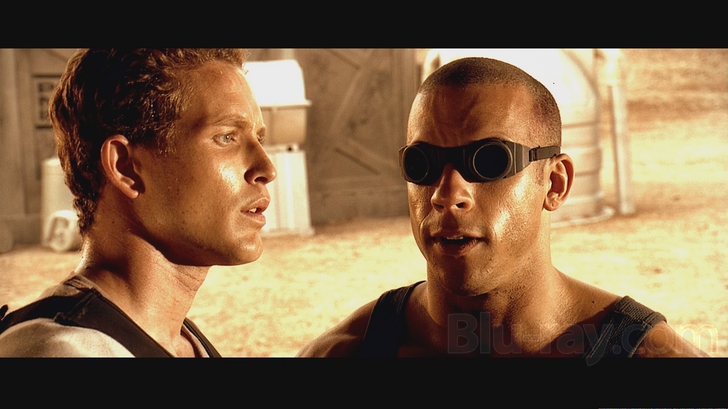
On paper Pitch Black sounds like your average sci-fi action flick with Vin Diesel at the helm, (poised on the precipice of his portrayal of Dominic Toretto from The Fast and the Furious and Xander Cage from xXx that would cement his name in the genre for years to come) bringing a raw energy to his character that ripples beneath the surface and threatens to let loose on his fellow human counterparts, much like the real enemy lurking beneath the planets surface.
Pitch Black would even project the character of Riddick in a further two adventures on the big screen with a third film announced on its way, proving that there is still a lot of appeal on offer.

It’s this raw energy that still resonates on screen today on repeated viewing and connected once again with me, and this time I was not under the influence….kind of.

Supported by a cracking, primarily Australian cast in Radha Mitchell (Silent Hill, Rogue), Lewis Fitz-Gerald (Breaker Morant), Claudia Black (Farscape, Stargate SG-1), Rhianna Griffith, and Simon Burke (The Devil’s Playground), all of whom bring their “A Game” with a high level of intensity and humanity to their role. The irony in that the more human their characters display, the greater their chance of being exposed, and their emotions leading them to ruin. In order to survive in Pitch Black, you need to strip away all emotions or live with that mask permanently in place.
It also helps that there are a couple of excellent hard-hitters on screen to with hard-boiled futuristic cop without a conscience played by Cole Hauser, and the ultimate survivalist and in this instance, a man of faith, played by Ketih David.

David Eggby keeps the gritty realism throughout his stunning cinematography that eschews a beautiful landscape in a remote Australian landscape to bring an otherworldly factor on screen blasting the audience with a rich array of colours and visuals.

Both the creature effects and visual effects team also deserve their own accolades for bringing a rich and diverse approach to the nocturnal alien creatures that hunt down the humans and fighting among themselves for the scraps, highlighting once again the theme of survival in a desolate and harsh terrain. 

It’s a simple and age-old premise that works because of the combination of all of these elements that make this film still strong today. If you can forgive the odd blemish, Pitch Black deserves high praise and repeat viewing. It may be twenty years old but in this writers’ mind, it is one of the greatest sci-fi horror films since the turn of the century. 

  • Saul Muerte

Movie review: Fantasy Island

Tags

, , , , , , ,

“Ze plane, boss, ze plane”

Whilst we’re a far cry from the original tv series inspiration that spawned this horror-themed adaptation, it is hard to shake off the image of Hervé Villechaize’s infamous cry at the beginning of most episodes to announce the arrival of the next unwitting visitors to Fantasy Island. The film does have its own nods with an entirely different character, Julie (loosely based on Mr. Roarke’s God-daughter from the series in name mainly) declaring the arrival of our main characters Melanie (Lucy Hale), Gwen (Maggie Q), Patrick (Austin Stowell), Brax (Jimmy O. Yang), and JD (Ryan Hansen).

Each of these characters come with their own baggage that slowly unravels as they try to live out their fantasy with inevitable consequences. 

Michael Pena does his best to wrangle out the magnanimous and mysterious Mr Roarke, so closely identified with Ricardo Montalbán’s tv portrayal, who in my pre-adolescent mind has strangely warped with Christopher Lee’s Saramanga from The Man With The Golden Gun, partly due to Villechaize starring in both projects. The problem is that Pena is left with little to do other than to play out the characters fantasies. Despite harbouring a secret of his own, this is underplayed to serve out the interactions of the island itself. 

This may have been a wise choice if these fantasies had any firm grounding, but instead seem a bit wishy-washy. Melanie is out for revenge from being bullied at school and admittedly the initial encounter is fun and intriguing as she unwittingly dishes out her anger through what she believes is a hologram of her tormentor, but once that has played its part the rest of her journey is left wanting. 

Likewise Patrick’s army pursuit to live out his father’s life only to encounter his real father, and brothers Patrick and Brax living up a bachelor style freedom and entertainment lacks any personality or appeal.

The only hook for me was Maggie Q’s performance of Gwen that remains believable, who at first believes her fantasy is to change her history by saying yes to a man’s proposal whom she loved and to have a daughter, however she never really believes she deserves this version of her life as like the others, she has a darker history lurking beneath and it is this reproduction that she realises needs to play out. 

Oh and a great cameo from Kim Coates who simply hams up his role gloriously. More of him was desperately needed.

The prognosis:

As the audience is left weaving their way through a convoluted storyline and the various morals and dilemmas that each of the characters faces, we’re left unable to truly connect to any of them as there simply isn’t enough substance. 

When the big reveal finally happens, it feels tacked on and peels slowly away with an incredibly unsatisfying conclusion. 

It’s poorly managed and no matter how much Michael Rooker tries to inject some much needed gravitas into the fold as the strange guy who knows the secret of the island, he simply can’t lift it out of the quagmire of murkiness. The problem appears to be that the film doesn’t know how to present itself; horror, comedy, thriller.

Blumhouse who have made a name for attracting audiences to their take on teen horror, may have fallen into tired territory now with the relatively week turnouts in  Ma, and Black Christmas last year. Has the fizz run out from this production company?

It would have been interesting to see it played out by masters of the fantastical in either Del Toro or Bayona and really blend those eerie mystical moments with horror elements. 

Maybe it just isn’t our fantasy that’s being played out after all and perhaps i should just go back to my morphed take of Montalbán and Lee to deliver my ideal of Mr. Roarke and a dark world that lay beneath Fantasy Island. A missed opportunity.

  • Saul Muerte 

Movie review: The Lighthouse

Tags

, , , , , ,

Director Robert Eggers seems destined to divide audiences between digging his jam or struggling to connect with the style and pace that he subjects to his stories.
Thankfully, I fall into the former and simply adored his directorial debut, The VVitch starring Anya Taylor Joy which was an incredibly slow burn but was rich in storytelling and strongly supported by some fantastic acting, grounding the fantastical in reality. Combined with his brother and fellow scribe Max, The Eggers offer a fresh approach to the genre and for that I was eager to see what and how he would follow it up.

This love song to Greek mythology pits two strangers on an isolated location, in this case a two-manned lighthouse on a remote and savage island. During its 1hr 49 minute running time, audiences are subjected to a battle of egos, a battle of wills and a fight for power and sanity. Through the fantastical delusions on show, The Lighthouse relies heavily on its two central performers; Ephraim Winslow (Robert Pattinson), contracted to serve 4 weeks at the lighthouse and continually forced to endure gruelling physical tasks by Thomas Wake (Willem Defoe), a miserable irate drunk who appears to get his kicks from punishing Winslow and basking naked in the glow of the light in the tower. Propitiously, both actors more than bring the goods as the bitterness between their characters escalates to an inevitable climax that forces an eruption of testosterone-fueled energy to overflow.

The Prognosis:

Shot entirely in black and white, Robert Eggers proves once again to be a master in storytelling and exerts a narrative that twists and turns, providing a remarkable modern spin merging together two age old tales.
Will it suit everyone’s tastes? No

Can it be classed as horror? Not really.

But it’s harrowing and beautifully crafted from one of this generation’s most imaginative directors. 

  • Saul Muerte