By 1942 Lionel Atwill had firmly established himself as a veteran of the silver screen and rightfully deserves top-billing in this horror / thriller from Universal Pictures. He hits every note of the titular character in his stride with relative ease, both dialling up the mania and subtly downplaying the more reserved moments whilst still coming across as sinister in his mannerisms. The narrative quickly shifts from science experiment gone awry when Atwill’s Dr. Benson inadvertently kills his subject when trying to resurrect the dead. Think Flatliners but on a minimum scale.
Now a fugitive on the run, he goes in hiding on a ship to New Zealand. Unfortunately a police detective had also boarded the ship on a hunch that Benson is among its passengers. This results in Benson resorting to drastic measures and pushing said detective overboard. The drama doesn’t end there however, as somehow a fire erupts on the ship causing the passengers to abandon ship and our key players (including Benson) washing up on a remote island. Once on the island the film starts to show its age, depicting the islanders as savages and easily manipulated by Benson’s medical knowledge when he resurrects one of the villagers from a supposed death (in reality, a stroke) with a potion (adrenaline). It’s a she because this depiction does jar when viewed with a modern lens and shifts the gaze away from the terror that is trying to be depicted.
It is then down to the survivors (all of whom are pretty formulaic) to try and outwit and expose Benson his true malicious interests without putting their own lives on jeopardy.
The script does suffer from falling into predictable terrain and it could have amped up Benson’s maniacal moments to make his presence more terrifying, but hats off to director Joseph H Lewis for crafting together a fairly decent effort from a very low budget. With a running time that’s just over the hour mark, The Mad Doctor of Market Street still amazed to entertain.
Director Matthew John Lawrence’s vision of fusing his love of horror movies and punk rock is presented in Uncle Peckerhead, the story of deadbeat musicians willing to drop everything and pursue their own dream of musical recognition. Said punk act, Duh! consist of band leader and bassist, Judy (Chet Siegel) who ironically is incredibly neurotic and unwilling to lose control of herself, a juxtaposition against the anarchic veins that form the punk movement. Here it serves well as Judy’s character strives to free herself of her inhibitions and letting go of her self-made constraints.
Accompanying her in the band is deadpan doomsayer drummer, Mel (Ruby McColliister), and socially awkward guitarist and frontman. Max (Jeff Riddle).
As the trio prepare to hit the road in order to gain enough festival experience to perform at their hometown, they hit a stumbling block in having their van towed away by the repo men.
Just when it appears that they are down on their luck, they have a chance encounter with Peckerhead (David H. Littleton), a seemingly sweet and friendly guy, all too willing to assist them with the use of his own van on the condition that he comes along.
What could go wrong? The fact that Peckhead happens to transform into a blood-sucking demon at the stroke of midnight, may cause some mishap along the way.
Lawrence does his best to tap into the kind of movie that you would watch with mates over a beer and some pizza, riffing on some cool, bloody, and gore-tastic vibes and in many ways he satiates the needs of the salivating horror enthusiasts, but there is something a little off key and jarring in its presentation.
When it works, the energy of the group are positively buzzing and the effects and gore on screen are suitably macabre with a hint of dark humour, a testament to the comedic talent involved. The problem is on the down beats, the sizzle is lost and it falls flat, so the audience can feel like there’s a dead weight being dragged along to the film’s conclusion, which is painful in a non-pleasurable way.
The Prognosis:
If it’s cheap beer, decent food, and a bloody enjoyable ride you’re after, then Uncle Peckerhead has your back.
If you want a bit more of a fine-dining experience in your horror serving, then this ain’t your kind of movie.
Best to keep on the good side of Peckerhead, let the good times roll, find your rhythm and let loose.
Self-confessed old-style thriller fan, Andrew Traucki has carved out a career telling stories of survival on screen since his debut feature, Black Water released in 2007. He’s no stranger to the harsh environments that humanity must endure with his follow up features, The Reef, and Jungle, so it comes as no surprise that when offered the chance to revisit the subject that launched his directing pilgrimage.
Billed as a sequel to his croc attack movie, upon review Black Water: Abyss serves more of an anthological piece as none of its original stars nor its cranky chompster return to continue the storyline. Instead we are introduced to a quintet of extreme sport enthusiasts (Jessica McNamee – The Meg, Luke Mitchell, Amali Golden, Benjamin Hoetjes, and Anthony J.Sharpe), who go in search of their latest thrill, some wilfully, others begrudgingly as they find an unexplored cave system, which just so happens to have a snappy predator lurking in the watery caves.
Traucki shows his experience behind the camera, pairing back the action to allow the suspense to rise to the surface and draw out the group’s plight which takes them through the bold, ignorant, panic-stricken, heartache. On show are two couples on the verge of destruction as the film serves as a metaphor for the physical weathering of their relationships. If they are to survive this ordeal, what will become of them at the end of it all. Is there life worth salvaging or are they better off as croc fodder?
The prognosis:
The cast showcase their acting chops grounding their situation in reality, moulded by a talented director.
Try not to judge the film from its opening 15 minutes or so with admittedly a bit of a shaky script. It takes a while for the mechanisms to take a hold, but once it has its grip it takes you on a death roll towards its conclusion that leaves you asking just exactly how they will escape, if at all.
It may not be ground-breaking and doesn’t quite match its predecessor in raw appeal, but it’s an enjoyable flick that again uses real crocs in real situations to amp up the thrills.
I distinctly remember when Deerskin was doing the festival circuits and that I felt strangely intrigued by its subject but equally there wasn’t enough there to draw me in, which just goes to say that old phrase…
Never judge a book by it’s cover.
Or at least don’t judge a film by its synopsis…
Yes, this film oozes independent movie making and the stereotypical associations that come with it when it comes to ‘quirkiness’, but there’s more going on beneath the surface of the weird and wonderful.
Part of my initial rebuke came down to a couple of things: My misunderstanding of the context, which on face value tells the story of a man going through a midlife crisis, blowing his entire fortune to fulfil his obsession for a deerskin jacket, resorting to criminal misgivings in order to attain his dream.
Whilst here at Surgeons of Horror, we dedicate our love to horror films, this isn’t your typical out and out horror. This is psychologically disturbing using its oddity and humour as a mask to the human psyche. We’re witnessing a descent into madness and delusion in pursuit of one man’s dream. A pursuit that leads him to shed his skin to regain an identity in order to feel, to emote and connect to something. It just so happens that this connection to the world comes in the form of a deerskin jacket.
The second misjudgement I casted was towards the films’ director, Quentin Dupiuex aka Mr Oizo! Remember that guy? Brought this hit to the late 90s…
Yeah that dude! Plus he was responsible for creating a film about a homicidal tyre in pursuit of a woman, called Rubber. Yeah, you read that right. So you can forgive me for casting assumptions on his craft, when in actuality, when you scrutinise his credits, there’s a strong theme that resonates through his work. The subject of obsession and the organic, physiology and biology of humanity. That desire or in some cases, killer instinct that compels us to pursue the impossible.
Part of Deerskin’s appeal is through its unpredictable, spontaneous nature. In this instance, Georges, our obsessed man on the brink, (Jean Dujardin – The Artist, in another compelling performance) as he shifts and turns with a touch of improvisation, living in the moment and responding to whatever life throws his way. He is in the NOW, damn the consequences. Some scenes are shocking, some macabre, but there’s always the hint of dark humour that comes out of the maniacal and when things are deliberately off kilter.
The deeper he goes on his quest for fulfilment, the murkier and thwarted his life becomes, and the more loose and carefree he gets with his actions. One identity that he attached himself to is that of a director of a film, which one can instinctively connect to that of a voyeur, but instead of looking outward, he casts himself as the subject matter. Ably assisting him in creating his vision, is a bartender, Denise (Adèle Haenel- Portrait of a Lady on Fire) with an interest in becoming an editor, who leaps at the opportunity when presented to her to be a part of Georges’ movie. For Georges, there is only one drive. One passion. Deerskin.
The Prognosis:
Like any pursuit, our journey can lead to destruction and ruin. Dupiuex manages to craft a curious descent into the lengths that one man will go to in order to pursue his dream.
It is truly an original, strengthened by solid, realistic performances. Deeply compelling, with a subject that lures you in and keeps you captivated, through its idiosyncratic mindset.
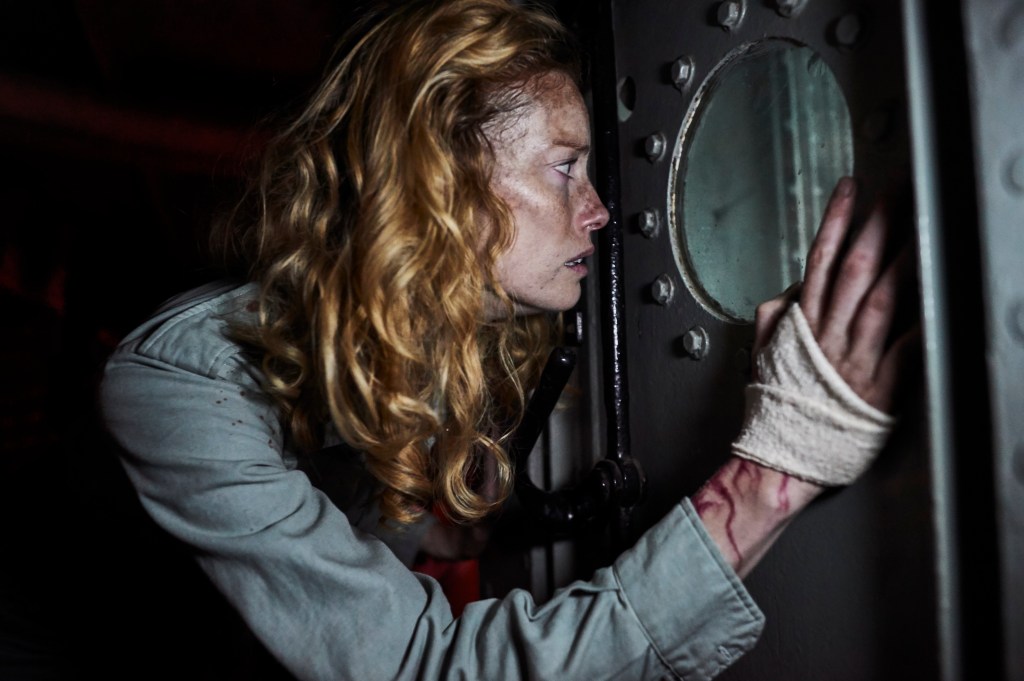
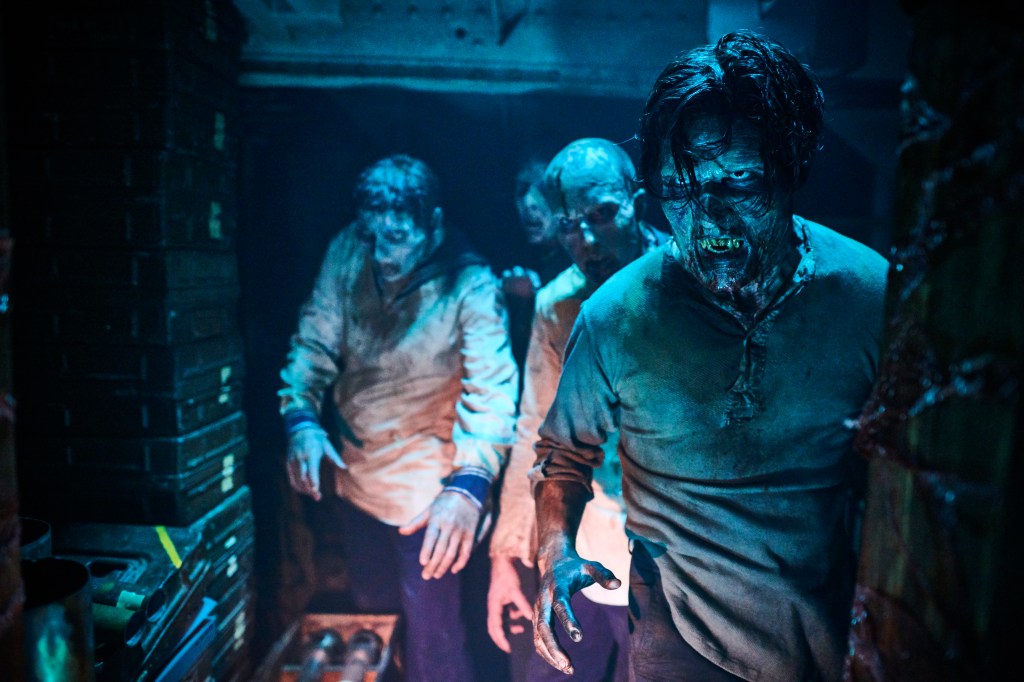
The film opens with what feels like a notable nod to Alfred Hitchcock’s Lifeboat as we are greeted with a group of survivors floating in a life raft, having escaped from their torpedoed hospital ship. They have no food, no water, and are close to giving up when a small thread of hope arrives in the shape of a German U-Boat, but what lies aboard is a descent into hell where the battle of survival has just begun.
Like Lifeboat, the group are at odds with one another and suspicious of some among them including Russian POW, Alexander (Alex Cooke), who happens to be a crack shot with a rifle and probably the most natural survivalist of the crew. Also casting a dubious past to his character is the token Brit, the weedy Gerard Faraday. Leading the charge is Nathan Sinclair (Nathan Philips) who captivates the viewer with his magnanimous presence and die hard attitude, but when they are faced with an unknown evil presence onboard the ship, they must learn to put aside their differences and look to unite if they are ever going to make it through “this bloody war”.
It is Alyssa Sutherland (Vikings), that the audience really gets behind however as the heart of the crew and it helps that she is a ‘medic” who has a pained past with a desire to heal everyone. She really captures the attention which is a testament to her on screen appeal and her weight as an actor, pulling you into the storyline and connecting with her character.
This is also a huge accomplishment of Justin Dix’s cinematic gaze for his sophomore outing in the director’s chair. Dix manages to craft a highly engaging storyline, that is essentially vampires on a boat, using his incredible skill set with visual and creature effects to boost the appeal above and beyond the usual fanfare. The screenplay which is also overseen by Dix and his co-writer, Jordan Prosser, weave together enough ups and downs and moments of turmoil for the crew, as they fight against the odds. A massive plus is that we’re presented with characters that are incredibly believable, and with whom you want to see survive, when you know in your heart simply ain’t gonna happen, and in doing so casts you at odds as you also secretly want their demise to come.
The Prognosis:
Hands down, Director Justin Dix has crafted a highly engaging, action-packed thrill ride with characters that you care for.
Combined with some decent effects and a creative storyline, Dix has in my humble opinion put himself and his production company Wicked of Oz firmly on the map. A must see film that will definitely entertain.
Saul Muerte
Available on DVD at JB Hi Fi and Sanity and Video on Demand through iTunes/Google /Fetch/Foxtel Store/Umbrella Entertainment from August 5th.
I See You is something of a rare gem of a movie that warrants your time and attention.
A bold statement but one I stand by. For its strength lies in its narrative, from a screenplay by Devon Graye Fleming, who as a little bit of trivia played a young Dexter from the Dexter series. Fleming manages to craft a delightful tale that twists and turns, inverting and reverting subgenres along the way.
One moment it’s supernatural, then family drama, full-on suspense drama, before shifting again into an out and out horror thriller. With each turn of the storyline cog, there also comes a collection of characters who are so dimensional that you continuously guess their motives and just when you think you have them sussed out, Fleming drops another background reveal, that makes you question your judgement all over again.
We open with a typical suburban town where we follow a hapless young kid, Justin Whitter, out on a bike ride through the woods, when a mysterious force suddenly ejects him from his seat out of nowhere.
So far, so supernatural.
We’re then introduced to Greg Harper (Jon Tenney) the lead detective in the search for Justin Whitter and through the investigation a green pocket knife is discovered, an MO from a series of crimes years earlier, promoting the question, did they police get the wrong man or is this a copycat killer?
The story then follows Harper and his home life with his wife, Jackie played by Helen Hunt, who I can’t recall when I last saw her in a movie. Here she again proves her worth displaying the strength and vulnerability of Jackie, a woman who it turns out has had an affair, which she claims has ended and is now scrambling around to not just save her marriage but repair the relationship she has with her son, Conor (Judah Lewis), who can’t forgive her for her actions. We’re witnessing a family on the rocks, but that’s not the most unsettling thing at hand here, as there is something that doesn’t sit right and all the while you get the sense the family is being watched by some kind of spiritual energy.
What happens next is another shift in tone that if I were to disclose here, would be a massive spoiler and as such I will refrain from going any further with the plotline, only to say that it’s the first change in direction that at first is bit of a jolt that you think is a big misfire, but as the next chapter unfolds, it soon settles in and then you’re in for the ride.
The film is filled with a great cast of characters that add weight to the drama including Gregory Alan Williams and Libe Barer, but the standout is Owen Teague, (Parick Hockstetter – It and It: Chapter Two) who is suitably unhinged and the most questionable character in the mix before all the pieces start falling into place.
The Prognosis:
I See You may not measure up for some, especially those who prefer to have a less fractured narrative presented to them, at least tonally speaking.
But this film hits all the notes perfectly in my opinion, and the shifts and changes that occur throughout the film are bold and on point, that it doesn’t hide from its direction, striding from one tonal switch to the next.
Released as a double feature alongside Man-Made Monster, Horror Island would be billed as a mystery horror film but after viewing this 1940s film, it bears similarity to The Dark House, a decade its senior.
The storyline loosely follows brash and down on his luck Bill (Dick Foran) who is always looking for his next scheme, in a role all too familiar to his portrayal of Steve Banning in The Mummy’s Hand. Like that film, Dick has an offsider to bounce off in the form of Fuzzy Knight playing the role of “Stuff”. Unfortunately Fuzzy doesn’t quite carry the same charisma as Wallace Ford. Instead, the banter comes more from Leo Carillo as the peg-legged sailor Tobias Clump. It’s a shame then that Clump becomes more secondary to the scene as the story develops into a whodunnit.
Clump serves as the instigator to Bill’s quest when he turns up with a treasure map leading to a small island, which Bill owns. When he is informed that the map isn’t genuine, Bill turns this into another plot to get money, by tauting a trip to his island to find the treasure, but claiming that it is haunted, so only the hardiest of people should go. From here a range of misfits are pitted together in search of a thrill or merely to be entertained, among them is love interest, Wendy (Peggy Moran – The Mummy’s Hand).
Once they arrive on the island however, things take a sinister turn as the guests start to be popped off one by one, ala Agatha Christie’s And Then There Were None with the prime suspect being a mysterious figure known as The Phantom lurking around behind the scenes.
Considering its 60 minute time, Horror Island tries to cram a lot in, but in doing so continuously feels like it misses the mark by trying too much. So as such, the movie is neither scary, mysterious, nor comical. Instead it is mediocre, especially compared to some of the other films released around the same time.
Yakov, is a young male Hassid, who has lost his faith and become isolated from his sect. When we first meet him, Yakov (Dave Davis) is socially awkward, out of his depth, and the last person you would expect to triumph over evil, should it raise its demonic head his way. The fragility of Yakov is partly what lures you into his world, and as a viewer we become intrigued by the journey he is about to undertake. The weight of his character is captured through Keith Thomas’ direction as he produces a slow-burn descent into Yakov’s personal hell, where he must confront his trauma head-on if he has any hope to survive through the night. Thomas’ care and dedication to creating atmosphere is The Vigil’s masterstroke and is truly captivating, but hey… I’m a sucker for the slow burn. Plus, it has a wealth of talent behind the films creation, from cinematographer Zach Kuperstein (The Eyes of My Mother), editor Brett W. Bachman (Mandy), and a score by Michael Yezerski (The Devil’s Candy) who combine to create a beautifully crafted film. So, what is this ordeal that Yakov must face?
Enticed by his Rabbi, Yakov agrees to become a shomer, a Jewish practice that involves watching over a recently deceased member of the community (seriously, who would do that? Feels far to eerie to me). Yakov takes up this charge with the promise of payment to protect the soul of the deceased by spending the night in his house, and receives a none-too-friendly welcome from the elderly widow. What we take as a frosty reception is actually, one of warning, but Yakov doesn’t take heed, and as such gets more than he bargained for.
The Prognosis:
The ambience generates a sense of creepiness and isolation that trauma survivors must endure to overcome their ordeal. This is a testament to the writing and direction of Keith Thomas which belies his status as a debut feature in the directors chair, and his smart enough to combine with some of the greatest artists in their field. While the scares maybe few and far between, the atmosphere and acting sure as hell make up for it, forging an incredibly unsettling movie about survival and once again Blumhouse have backed an impressive movie as part of their production canon.
Historically speaking, Man-Made Monster marks a significant point in horror film history as it marked the Prince of Pain, Lon Chaney Jr’s first lead role in the genre.
Here Chaney Jr plays the happy-go-lucky Dan McCormick, a man with a curious immunity to an overdose of electricity that propels him to life on the road with a travelling circus. The story picks up however when McCormick is the sole survivor of a tragic bus accident that collides into a power-line. Think David Dunn from the Unbreakable series, but less dramatic and moody.
His survival comes to the attention of Dr. John Lawrence (Samuel S. Hinds – It’s A Wonderful Life), who just so happens to be studying the effects of electricity.
The horror element comes in when Lawrence’s assistant, Dr. Paul Rigas (Lionel Atwill – Doctor X) takes the experiment into his own hands to manipulate an unwitting McCormick to undergo a series of tests with massive side effects. McCormick soon shows signs of fatigue and irritability as a result of the tests and the transformation turns him into a super-charged monster (a walking atomic light bulb) with the ability to kill with a single touch. This is exactly what occurs when Dr Lawrence finds out and attempts to shed light on Rigas’ illegal scientific experiments. That won’t hold water and Rigas ensures that McCormick (who is now under the mad scientists’ rule) stops Lawrence at all costs.
Despite a fairly low box office return and that it bared all too similarity to the Lugosi/Karloff feature, The Invisible Ray (a reason that the film had been shelved for a few years), it is a fairly stable movie and boasts great performances from both Atwill and Chaney Jr. For Chaney Jr. it would propel him into stardom and into a career that he could never shake, especially with The Wolf Man just around the corner, but there’s good reason as he’s definitely a captivating presence on screen.
A U.S. movie that came out with a trailer JBC (Just Before Covid) that looked “kinda interesting”, “might be cool” in a “popcorn/shut-off-the-brain & enjoy-the-carnage” sort of way. You know – like Ready or Not! (which is a good ‘un…).
But THIS film gets banned, and you hear it’s for reasons around politics (or some such) and you automatically assume it might have something to do with… umm… guns? I mean, it’s clearly a violent film, and let’s face it, if there’s one country that is insanely messed up around the issue of firearms, it’s blah blah blah.
So we all move on without giving it further thought, as there are plenty of other things to devote our daily quota of brain-focus towards. For example, for Aussie audiences at the time, it was all about trying to not catch on fire… (remember around Xmas when THAT was a thing?)
But we are in the now-now time, and in terms of entertainment stocks, pretty much any content today (see the date this review was/is posted) has a chance of finding an audience via a streaming service; whether it be old (Community), new (Tiger King) or banned…
If The Hunt was hoping to slot into that 3rd category, it severely misread the room. Because when you live in an age where a global pandemic can be politicised, releasing a film that pisses off the American President (and therefore a hoard of his followers) for INCORRECT reasons (he hadn’t seen it) and Snowflake Liberals (for fairly legit reasons) then you’re just being annoying.
And not in a cool “look at us – we’re so out there! We’re-provoking! We don’t care if-you’re-offended! You’ve-reacted-so-our-point-is-made! We’re-forcing-you-to-look-at-the-issue!” sort of way. (For a start, if any of those were true, you would’ve made a better film…).
So premise – and for this review we will be entering spoiler territory, so beware – we have a Predators-esque/Hunger Games style set-up where a bunch of random “everyday” Americans wake up in the countryside, bound, groggy and with no idea how they got there.
A cache of weapons is found, and as soon as they arm themselves the hunt is on.
They are shot/blown up and generally hounded in what these people called “Manorgate”. An extreme right-wing conspiracy sorta along the lines of Pizzagate (wiki that one!) that in this instance, claims rich Liberal elites kidnap people and hunt them for sport on the grounds of one of their mansions.
And considering every one of the hunties are right wing fanatics in some form or another (bloggers/vloggers/YouTube & Facebook Commentators etc.) this is both Xmas and Reverse Xmas at once.
The former because for all their nutjob ramblings, they have been proven right. And the latter because… well…hunted…
And the divide between the victims (The Right) and the bad guys (The Left) are underlined even more when it is revealed that some of the hunters are the sort of people who equate soft drink to poison (‘cause you know, sugar ‘n shit) and one of them admits to being (in effect) a Crisis Actor; one of THE MOST abhorrent things in the world to ever admit being real, let alone being one.
What’s more, these snowflakes are so useless (a term The Right love to label The Left with) they need to be taught how to kill by a military consultant who is not that qualified – again kneeling to the notion The Left don’t do their research or “check their facts”. Fakes news anyone?
So you get the idea. The victims are portrayed as mostly ineffectual and somewhat simple folk – apart from when they go on an Alex Jones-esque rant. But their horribleness (as determined by the Evil Liberals who selected them) is never fully explored because the majority of them get killed in the first few minutes.
But the Liberals haven’t even played their worst mistake card yet. Because here is another thing they didn’t fact check – the real identity of one of The Deplorables, Crystal Creasey (played by Glow’sBetty Gilpin. AKA Ghost Town’s ghost-nurse Betty Gilpin).
Crystal has the same name as one of the selected victims, but is in truth not her (‘cause, as established, Lefties get things wrong) so she’s worse than a Deplorable. She’s an innocent.
But not a helpless innocent. Oh no, she is ex-military – sour, quiet, smart, tough and resourceful. She scowls like a female Clint Eastwood, and kicks ass methodically and intuitively. She is not only cool, but she wins. She takes charge. And she doesn’t give a shit what anybody else does, or whether they need her help or not. Just so long as they don’t get in her way. (Remind you of any kind of person?)
So this Libertarian poster child kills her way to the Boss Fight, featuring the Mastermind behind it all, Athena – played by Academy Award winner Hilary Swank. Where it is revealed this whole murderball spree has come about because of a scourge act of the 21st century. Mob outrage over an inappropriate internet comment. In this case a private messenger conversation between the Liberal Elites about Deplorables that gets leaked, that – jokingly or not – sees them lose their careers because political correctness is clearly out of hand yada-yada-yada.
So as an act of revenge they create Manorgate for realsies…
Anyway, back to the final confrontation – where we also discover that not only has Athena made a mistake with Crystal, but she somewhat condescendingly is shocked to realise her would-be victim knows Animal Farm; an in-joke revolving around their codename for Crystal (it’s Snowball) which plays into yet another notion about The Left. They assume everyone outside their bubble is uneducated.
So where does this leave us – the audience?
Well – seeing as one of the writers is a man not immune to internet outrage – Damon Lindelof – you can expect to be annoyed (and you will be. Although to his credit he’s achieved this outside his normal modes. Ie: There are no spirals of logic leading to nowhere with this one).
In fact, it’s all pretty straight forward plot wise. Just the why & the what of it really hits you.
The set-up is unoriginal, which in itself is not a sin. But it’s outcome? All Crystal had to do was show that she was politically above or below all this in some way, and suddenly you have a palpable indicator of what this film is trying to say.
“BUT WAIT! Why does it have to say anything at all? Why does she have to take a political stance!?” To which the booming answer is – the filmmakers started it! But yeah, the film certainly didn’t HAVE to. A really great example how this type of movie can be a fun popcorn ride with no political lacing is the afore mentioned Ready or Not, where the only people it seems to slag off are rich ones who worship Satan. Which, as targets go, seems easy, but still pretty legit….
So Lindelof and co-writer Nick Cuse start a project that definitely wants to say something about the party divide in America. But the only 2 immediately obvious outcomes you can hope for is that they are against both, or they are on the side of the victims. Which is the right. And if Crystal – their avatar – does indeed sit somewhere on the elephant/donkey spectrum, it’s never revealed, as she’s a fairly shallow character whose only virtue is she can take an unrealistic knife wound to the gut and live.
So that leaves us with the “Aww – don’t be so wound up, it’s only a bit of fun” brigade.
And in a different time, that could be a fair enough point to let through the gate. But in a PC age (Post Covid, not the other one) idiocy is a virus more virulent than the one that’s currently killing a whole lot of people. And if there’s one thing today’s idiots don’t need, its misguided fuel in any way, shape or form. Even if it is silly entertainment.
Yes. This review is THAT condescending.
Because – and this is a reverse spin kick to contemplate – what if this movie actually says “Yeah! The Right ARE victims! This film shines a spotlight on how harshly and unfairly they are treated by The Left and their Big Government Ideas, fake media and social justice bullshit”. In which case I say to you…
STAY RIGHT THERE. Resistance is futile. We will find you. We will get you. We will make it painless. Probably. Just as soon as we finish implementing universal health care so we can inject you all with autism causing brain tracking lifesaving vaccines…
Prognosis
If you hate this film you are an uptight lefty elitist wanker. If you like it you are deplorable. Either way watch Ready or Not. It’s much better.





 Surgeons of Horror