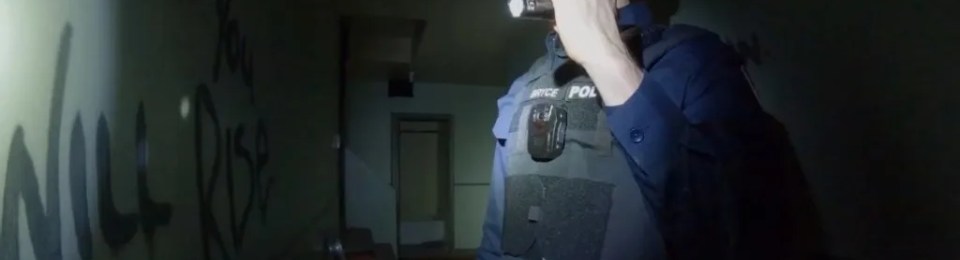
The found-footage format has long been one of horror’s most effective narrative devices. When done well, it places audiences directly inside the unfolding terror, collapsing the distance between viewer and victim. Yet it’s also a subgenre littered with misfires, where shaky cameras and contrived setups often undermine the illusion of authenticity. Bodycam, the latest Shudder Original from Canadian filmmaker Brandon Christensen, sits somewhere between those two extremes — a competent genre exercise that understands the mechanics of found-footage horror, even if it doesn’t entirely reinvent them.
Christensen has quietly carved out a niche within contemporary supernatural horror. His earlier films, particularly Still/Born and Superhost, demonstrated a knack for building tension through confined spaces and psychological unease. With Bodycam, he expands that approach into a story rooted in modern surveillance culture, using the now-familiar lens of police body cameras to frame a tale where guilt, paranoia, and something far more sinister begin to blur together.
The premise is deceptively simple. Two police officers respond to what initially appears to be a routine domestic disturbance call. When the situation spirals into a tragic accident, the pair make a desperate decision to conceal the truth, fearing the consequences of public scrutiny and institutional fallout. Yet as they attempt to rewrite the narrative, they begin to realise that the technology designed to document the truth may not be the only witness present.
And perhaps something else is recording.
Christensen leans heavily into the aesthetics of surveillance — dashboard cameras, bodycam footage, and fragments of security recordings stitched together to tell the story. This multi-camera structure echoes the fragmented style seen in genre landmarks like The Blair Witch Project, Paranormal Activity, and REC, all of which demonstrated how technological mediation can heighten a sense of realism. The trick, however, lies in convincing audiences that every camera angle exists for a plausible reason — one of the classic “dos and don’ts” of found-footage filmmaking.
To Christensen’s credit, Bodycam largely understands those rules. The body camera format itself naturally justifies the constant presence of a recording device, avoiding the common genre pitfall where characters inexplicably continue filming while their lives are clearly in danger. The immediacy of the footage lends several scenes a raw intensity, particularly when the supernatural elements begin to bleed into the frame in subtle, fleeting glimpses.
Where the film falters slightly is in its reliance on familiar beats. The escalating paranoia, the creeping suggestion that unseen forces are manipulating events, and the eventual collision between guilt and supernatural consequence follow a trajectory that seasoned horror audiences will likely recognise. Christensen proves adept at staging tension, but the narrative rarely deviates far from the established playbook.
Still, the film’s thematic core gives it an added layer of intrigue. By centring the story on police officers attempting to hide a mistake, Bodycam taps into contemporary anxieties surrounding accountability, surveillance, and the uncomfortable reality that technology can both reveal and obscure the truth. The idea that the cameras designed to protect authority figures might ultimately condemn them adds an unsettling moral dimension to the proceedings.
Visually, the film embraces the claustrophobic aesthetic that Christensen has proven comfortable with throughout his career. Much like Superhost, the tension builds through confined environments and a slow tightening of psychological pressure. Darkness becomes a character in its own right, with the limited field of vision offered by the body cameras forcing viewers to search every corner of the frame for signs of what might be lurking just outside the light.
As with many entries in the found-footage canon, the film’s success ultimately depends on how much patience audiences have for the format’s limitations. Shaky visuals, fragmented storytelling, and a reliance on atmosphere over spectacle are all part of the package.
For fans of the subgenre, Bodycam offers a solid if familiar addition to the catalogue — a tense supernatural thriller that understands the rules of the game without necessarily rewriting them.
The Prognosis:
A competent found-footage chiller that proves Brandon Christensen knows how to work within the genre’s framework, even if he occasionally plays it a little too safe.
- Saul Muerte
Bodycam streams on Shudder from Fri 13 Mar
 Surgeons of Horror