Tags
argentine horror, carmen maura, Daniel Hendler, film, horror, Horror movies, Martín Mauregui, movies
Premiering exclusively on Shudder and AMC+ on 27 February, Crazy Old Lady arrives at a moment when Argentine horror is no longer a niche curiosity but a steadily rising force within global genre cinema. Directed by Martín Mauregui, the film won Best Director in the Horror Competition at Fantastic Fest and screened at the Sitges Film Festival, signaling its pedigree within the festival circuit.
Argentina’s Expanding Horror Identity
Over the past decade, Argentine horror has carved out a distinct tonal space — one steeped in psychological dread, moral decay, and socio-political unease. Films like Terrified (Aterrados) and When Evil Lurks, both from Demián Rugna, have demonstrated a willingness to confront spiritual rot with startling brutality. Meanwhile, works such as The Last Matinee have blended nostalgia with escalating carnage.
Crazy Old Lady situates itself within this movement but opts for a more intimate chamber-piece approach. Gone are demonic outbreaks or grand supernatural set-pieces. Instead, the horror is confined to a single home — and to a single voice.
The House as a Psychological Trap
The premise is elegantly simple: on a storm-lashed evening, Pedro answers a desperate plea from his ex-girlfriend to watch over her senile mother, Alicia. What begins as reluctant caretaking morphs into entrapment when Alicia refuses to let him leave. From here, Mauregui crafts a claustrophobic duel between youth and decay, autonomy and obligation.
The house becomes less a haunted space than a psychological maze. Doors lock. Power flickers. Corridors stretch under dim lighting. Yet the most unnerving element is Alicia herself.
Generational Trauma as Curse
At its core, Crazy Old Lady explores generational trauma — the emotional inheritance passed down like an heirloom no one wants. Alicia’s ramblings oscillate between fragility and cruelty, revealing buried resentments and manipulative patterns that echo through her daughter and now ensnare Pedro.
The horror lies not only in her sadistic “games,” but in the suggestion that her worldview — her bitterness, her warped moral logic — has already seeped into the next generation. Words linger long after they’re spoken. They calcify. They shape behavior.
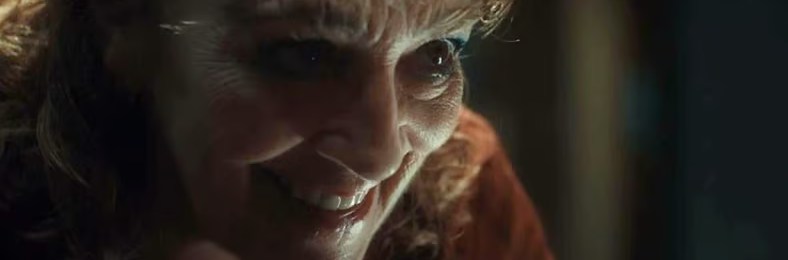
Mauregui repeatedly frames Alicia in tight close-ups as she mutters aphorisms that feel both cryptic and venomous. These fragments of speech function almost like incantations, embedding themselves in the atmosphere. In this sense, the film’s haunting is linguistic rather than spectral.
It’s a compelling thematic hook, even if the script occasionally circles its ideas without deepening them.
Mauregui’s Controlled Minimalism
Martín Mauregui directs with restraint, favoring sustained tension over sudden shocks. The pacing is deliberate, sometimes to a fault, but his control of confined space is impressive. The storm outside acts as sonic punctuation, underscoring Pedro’s isolation.
Where the film falters slightly is in escalation. The psychological cat-and-mouse dynamic promises a crescendo of either shocking revelation or cathartic confrontation. Instead, the climax feels muted — more simmer than explosion. For some viewers, this restraint will read as sophistication; for others, as hesitation.
Still, Mauregui’s festival recognition feels justified. There’s a clear authorial voice at work — one attuned to emotional cruelty rather than spectacle.
A Solid Entry in a Strong Movement
Crazy Old Lady may not reach the ferocity of When Evil Lurks or the nerve-shredding intensity of Terrified, but it contributes to the ongoing evolution of Argentine horror by narrowing its focus to the domestic sphere. It suggests that sometimes the most enduring hauntings are not demons or ghosts, but the toxic narratives families pass down through generations.
Not a breakout masterpiece, but another confident step in Argentina’s increasingly compelling horror renaissance.
- Saul Muerte
 Surgeons of Horror