• About
  • podcasts
  • Shop

Surgeons of Horror

~ Dissecting horror films

Surgeons of Horror

Tag Archives: hp lovecraft

Re-Animator (1985) – Mad Science, Maximum Splatter!

17 Friday Oct 2025

Posted by surgeons of horror in retrospective

≈ Leave a comment

Tags

80s horror, barbara crampton, bruce abbott, david gale, herbert west, hp lovecraft, jeffrey combs, re-animator, stuart gordon

“Herbert West has a very good head… on his shoulders. And another one… in a dish on his desk.”

If you haunted the horror aisle of your local video store in the 1980s, chances are you’ve seen Re-Animator glaring back at you from a lurid neon-green VHS sleeve. Released in 1985, Stuart Gordon’s cult classic is the stuff of midnight movie legend: a delirious cocktail of Lovecraft, gore, black comedy, and mad science that set a new standard for splatter cinema.

Loosely adapted from H.P. Lovecraft’s Herbert West—Reanimator, the story plunges into the twisted experiments of medical student Herbert West (Jeffrey Combs, in a career-defining role). West has discovered a serum capable of reanimating the dead—though what comes back is never quite what was lost. As corpses twitch, shriek, and explode back into grotesque parodies of life, West’s obsession pushes medicine, morality, and sanity to their breaking point.

What makes Re-Animator endure, 40 years later, is the sheer precision of its madness. Stuart Gordon, in his feature debut, creates a bold visual aesthetic: sterile hospital halls colliding with garish splatter, glowing syringes of radioactive-green fluid cutting through shadow, and a pace that never lets you catch your breath. It’s both theatrical and grimy, like Lovecraft dragged kicking and screaming into the grindhouse.

Then there are the performances. Jeffrey Combs doesn’t just play Herbert West—he becomes him. Clinical, arrogant, and perversely charismatic, West is one of horror’s most iconic creations, a character whose clipped delivery and maniacal focus have carved him a permanent place in the genre pantheon. Beside him, Barbara Crampton brings heart and vulnerability to Megan Halsey, grounding the film’s madness in a performance that makes her both victim and survivor. The chemistry between Combs and Crampton, along with Bruce Abbott as the conflicted Dan Cain, is the human spine of the film’s monstrous body.

And then, of course, there’s the gore. Re-Animator doesn’t just dip into blood—it wallows in it. Heads roll (literally), entrails spill, and practical effects run wild with gleeful excess. This is splatter at its peak: not just shocking, but imaginative, choreographed chaos that keeps finding new ways to disturb and delight. Gordon walks the razor’s edge between horror and comedy, and somehow, miraculously, never loses balance.

Four decades on, Re-Animator is still a head of its class. It’s soaked in Lovecraftian dread, powered by unforgettable performances, and dripping with the kind of splatter that defined an era of VHS horror. Whether you’re a first-time renter or a long-time cult devotee, Re-Animator remains that rare horror feature that shocks, entertains, and endures—an unholy hybrid of brains, blood, and black humour that refuses to die.


📼 Staff Pick!
“One of the goriest, funniest, and most unforgettable horror films of the ‘80s. Jeffrey Combs IS Herbert West. Be warned: once you’ve seen it, you can’t unsee it… and you won’t want to.”

  • Saul Muerte

“Reality Bleeds: Revisiting John Carpenter’s In the Mouth of Madness – A Lovecraftian Nightmare”

10 Tuesday Dec 2024

Posted by surgeons of horror in retrospective

≈ Leave a comment

Tags

hp lovecraft, John Carpenter, Jurgen Prochnow, lovecraft, sam neill, Sutter Cane

Few films manage to capture the sheer cosmic dread and creeping insanity of H.P. Lovecraft’s writing, but John Carpenter’s In the Mouth of Madness not only achieves this, it arguably transcends it. As the third entry in Carpenter’s “Apocalypse Trilogy”—following The Thing (1982) and Prince of Darkness (1987)—this 1994 film stands tall as one of the finest examples of Lovecraftian horror on screen. For many, it’s also regarded as Carpenter’s last truly great film, a testament to his mastery of mood, pacing, and his ability to weave terror into every frame.

A Spiral Into Madness

Sam Neill delivers a career-defining performance as John Trent, an insurance investigator hired to locate the missing horror author Sutter Cane (Jürgen Prochnow). What begins as a seemingly straightforward investigation swiftly devolves into a kaleidoscopic nightmare, as Trent journeys to the ominous town of Hobb’s End—a fictional place that exists only in Cane’s novels, or so he believes.

Neill’s portrayal of Trent is pitch-perfect. He oscillates between skepticism, defiance, and pure, unhinged terror with ease. His descent into madness is as gripping as it is harrowing, with Carpenter using him as a surrogate for the audience, dragging us deeper into the abyss of Cane’s twisted reality.

Lovecraft Brought to Life

The film is an unapologetic love letter to Lovecraft. Themes of forbidden knowledge, crumbling sanity, and eldritch horrors permeate every corner of the story. The monstrous, otherworldly creatures lurking in the shadows and the unrelenting sense of dread feel ripped straight from Lovecraft’s pages. Yet, In the Mouth of Madness also stands as a uniquely Carpenter creation, blending the author’s cosmic nihilism with the director’s penchant for kinetic storytelling and sharp social commentary.

Books Within Films Within Madness

The layers of meta-textual storytelling are dizzying. Sutter Cane’s novels don’t just terrify; they infect reality itself, reshaping the world into his grotesque vision. Carpenter masterfully blurs the line between fiction and reality, leaving audiences questioning whether Trent’s unraveling is the result of supernatural forces or his own fragile psyche. The meta-commentary on the power of storytelling—and its ability to reshape perception—is hauntingly prescient in a world increasingly shaped by media narratives.

A Visual Nightmare

Carpenter’s direction is both methodical and chaotic, amplifying the film’s escalating insanity. The eerie small-town setting of Hobb’s End is a masterpiece of unsettling design, with its shifting geography and uncanny atmosphere. Cinematographer Gary B. Kibbe’s use of shadows, distorted perspectives, and surreal imagery keeps the audience on edge, while the practical effects, including the grotesque creatures, are a horrifying delight.

A Horror Swan Song

For Carpenter, In the Mouth of Madness represents a culmination of his lifelong exploration of apocalyptic dread. While he would go on to direct more films, none would achieve the same level of craftsmanship, ambition, or raw terror. It’s a film that demands repeat viewings, with new layers of meaning and horror revealed each time.

Final Thoughts

In the Mouth of Madness is an unrelenting descent into the heart of madness—a film where reality, fiction, and insanity bleed together in a cacophony of terror. It’s Carpenter’s boldest and most thematically rich work, a fitting capstone to his reign as one of horror’s greatest auteurs. Sam Neill’s towering performance, combined with the film’s Lovecraftian sensibilities and Carpenter’s confident direction, solidifies it as a masterpiece of cosmic horror.

  • Saul Muerte

The Shuttered Room (1967): A Decent Attempt That Falters in Execution

29 Friday Nov 2024

Posted by surgeons of horror in retrospective

≈ Leave a comment

Tags

1960s horror, 1960s retrospective, august derleth, bryan woods, carol lynley, david greene, film, gig young, heretic, horror, hp lovecraft, hugh-grant, kenneth hodges, oliver reed

The Shuttered Room, based on a story attributed to H.P. Lovecraft and August Derleth, offers an atmospheric dive into the macabre, set against the backdrop of a crumbling New England mill town. Directed by David Greene, the film’s most notable strength lies in its brooding atmosphere and unsettling locale, which captures the decayed charm of its rural setting. Yet, while the tone and setting intrigue, the narrative struggles to rise above mediocrity, leaving audiences with an experience more evocative than substantive.

Central to the film is the electrifying performance of Oliver Reed as the menacing Ethan. Reed commands the screen with an unpredictable energy, adding a palpable edge of danger that keeps the audience engaged. His interactions with Gig Young, playing the stalwart husband Mike, and Carol Lynley as the haunted Susannah, highlight the clash between Reed’s raw intensity and the more subdued performances of his co-stars. Lynley brings an understated fragility to Susannah, effectively conveying her character’s torment and vulnerability, though her role is often overshadowed by Reed’s larger-than-life presence.

The film’s atmospheric strength is undeniable. Cinematographer Kenneth Hodges crafts a visually arresting aesthetic, juxtaposing the rustic beauty of the mill with its sinister underpinnings. The eerie sound design and haunting score further amplify the sense of unease. However, The Shuttered Room falters when it comes to its central plot. The narrative’s slow pacing and predictable developments prevent it from fully delivering on the psychological horror and suspense it hints at, leaving viewers yearning for a sharper, more cohesive story.

Ultimately, The Shuttered Room stands as a fascinating but flawed entry in 1960s horror. While it showcases an engaging Oliver Reed and an immersive atmosphere, the film’s inability to break free from its languid storytelling prevents it from achieving the impact it so clearly aspires to. For fans of moody, vintage thrillers, this is worth a watch—but don’t expect it to haunt your thoughts.

  • Saul Muerte

Die, Monster, Die! (1965) – Boris Karloff Shines in a Manic Gothic Horror Adaptation

28 Saturday Sep 2024

Posted by surgeons of horror in retrospective

≈ Leave a comment

Tags

1960s horror, 1960s retrospective, Boris Karloff, daniel haller, hp lovecraft, nick adams, niock adams, suzan farmer, the colour out of space

Die, Monster, Die! (1965), directed by Daniel Haller, is an intriguing yet flawed adaptation of H.P. Lovecraft’s The Colour Out of Space, blending Gothic horror with science fiction elements to create a moody, if uneven, 1960s fright fest. Anchored by another chilling turn from the legendary Boris Karloff, the film successfully captures a sense of eerie dread, even if the narrative struggles to live up to the actor’s powerhouse presence.

Set in the decaying mansion of the Witley family, the film follows young American Stephen Reinhart (Nick Adams) as he visits his fiancée’s mysterious ancestral home. It’s here that he encounters Nahum Witley (Karloff), the wheelchair-bound patriarch, who harbors dark secrets tied to a glowing meteorite that has slowly corrupted the land—and everyone in it.

Boris Karloff’s portrayal of Nahum Witley is a masterclass in restrained menace. Even in his later years, Karloff radiated a sinister charisma that few could match, and Die, Monster, Die! is no exception. His depiction of a once-powerful man slowly descending into madness is what keeps the film afloat, drawing on his talent for playing tortured, tragic figures. Witley’s deteriorating condition mirrors Karloff’s physicality, making him a looming presence despite his wheelchair-bound state. It’s another reminder of Karloff’s enduring ability to inject even the most outlandish material with gravitas and unease.

The film’s roots are clear in its mix of Gothic horror tropes and science fiction weirdness. The Witley mansion, draped in shadows and fog, feels like a throwback to classic Universal monster movies—an appropriate setting for Karloff, given his legendary role in that era. The eerie, almost surreal atmosphere is one of the film’s strengths, with director Daniel Haller, a frequent collaborator with Roger Corman, effectively using set design and lighting to heighten the sense of decay and dread.

However, Die, Monster, Die! is far from perfect. The pacing can be sluggish, especially in the first half, as the story meanders through its setup. The plot itself, loosely based on Lovecraft’s work, fails to capture the cosmic horror of the source material, instead relying on more conventional horror devices. The screenplay doesn’t delve deeply into the psychological terror that could have made the story more compelling, leaving the narrative feeling somewhat shallow and predictable.

That being said, the film redeems itself with its second-half escalation, as the corruption of the Witley estate becomes more apparent. The grotesque imagery, including deformed plants and monstrous mutations, adds a layer of visual horror that feels appropriately eerie for a Lovecraft-inspired tale. The practical effects, while limited by the era’s technology, have a certain charm and complement the film’s Gothic atmosphere.

Supporting performances, including Nick Adams as the skeptical outsider and Suzan Farmer as Susan Witley, are serviceable, but they pale in comparison to Karloff’s towering presence. The film’s biggest strength lies in its atmosphere and Karloff’s portrayal of Nahum, with the rest of the cast often serving as mere vehicles for the narrative.

The Prognosis:

Die, Monster, Die! is an atmospheric but uneven entry in 1960s horror cinema. It’s not a flawless adaptation of Lovecraft, nor is it the most exciting entry in Karloff’s career. Yet, for fans of Gothic horror and those who relish Karloff’s maniacal performances, it offers enough thrills and eerie moments to make it a worthwhile watch. Karloff’s ability to elevate even the most conventional material shines through once again, and that alone makes Die, Monster, Die! a film worth revisiting.

  • Saul Muerte

Movie review: Suitable Flesh (2024)

24 Wednesday Jan 2024

Posted by surgeons of horror in Movie review

≈ Leave a comment

Tags

barbara crampton, bruce davison, heather graham, horror, hp lovecraft, joe lynch, johnathon schaech, shudder, shudder australia

Music in film achieves a number of things: it establishes setting; it creates atmosphere; it calls attention to elements; it reinforces or foreshadleaningsows narrative developments; it gives meaning to a character’s actions or translates their thoughts; and it creates emotion.

(K. Kalinak, 2024)

Such is the weight that music has in films that to find the right balance is imperative in delivering the right intonation or mood to a piece. If it’s off kilter in any way, then you risk thrusting your audience out of the narrative and falling into an abyss of disconnection.  Unfortunately, this becomes common place during Joe Lynch’s latest offering from the directorial chair. It feels intentional but the choice to mix up the erotic ambience with mystery and intrigue, ends up feeling like a late night straight to tv from the 80s. 

One might argue that Suitable Flesh is aiming to present itself in this field, tipped as a successor to Stuart Gordon’s Lovecraftian classics, From Beyond and Re-Animator, it even boasts one of stars from both of these features, Barbara Crampton. And thank God as she is head and shoulders, one of the most interesting components to the film.

There is plenty to praise on the basis of its premise alone, but its execution gets too muddled through amplifying different genres with a hazy mix of confusion. Another example of how the composition never hits the right note throughout. 

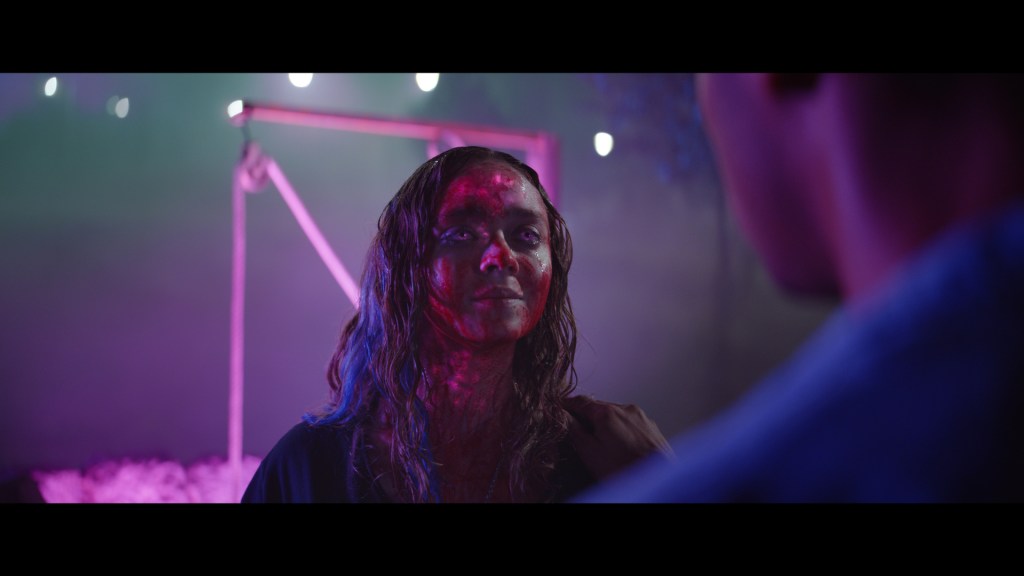
When psychiatrist, Dr. Elizabeth Derby (Heather Graham) becomes involved and obsessed with one of her clients, Asa White (Judah Lewis – The Babysitter) she soon becomes entangled in an ancient curse; one with octopedal ramifications, another of Lovecraft’s signature themes arises. 

The first and second act hinges on this lustful interaction, accompanied by murderous deeds, and psychological leanings. So embroiled in this component that Lynch neglects to add any depth to the proceedings and skates along the surface hoping that the intrigue is salvageable enough to keep the plot afloat.

The supporting roles from Johnathon Schaech (Quarantine) and Bruce Davison (X-Men) are woefully underused, with the exception of Crampton who plays Derby’s confidante and lifelong friend, Dr. Daniella Upton, this is Graham’s picture to deliver, but too often she is trapped in a two-note affair, struggling to break out of her fixed portrayal of a woman in crisis.

Suitable Flesh’s saving grace comes in the final act, when Lynch finally decides to dial up the tension and leans heavily into a gripping climax, with a disappointing and predictable final reveal.

The Prognosis:

What promised to be a reawakening of Lovecraftian themes brought to light in the 80s, Suitable Flesh leaves you floundering, in search of something to grip onto, waiting all too late in the final act to serve up anything remotely appealing to its audience.

  • Saul Muerte

Suitable Flesh is available on Shudder from Fri 26th Jan. 

Kalinak, Kathryn, ‘What does film music do?’, Film Music: A Very Short Introduction, 1st edn (New York, 2010; online edn, Oxford Academic, 24 Sept. 2013), https://doi.org/10.1093/actrade/9780195370874.003.0001, accessed 24 Jan. 2024.

Movie review: Color Out of Space

05 Tuesday May 2020

Posted by surgeons of horror in Movie review, umbrella entertainment

≈ 1 Comment

Tags

color out of space, hp lovecraft, joely richardson, nic cage, nicolas cage, richard stanley

H.P Lovecraft’s influence is fundamental to modern horror, it can be seen most strongly in the DNA of countless Stephen King stories, John Carpenter’s Apocalypse Trilogy (The Thing, Prince of Darkness & In the Mouth of Madness), Event Horizon, the video game Bloodbourne and the Alien series, its influence is often met with varying success but direct adaptations have been few and far between.
For years there has been talk of a Guillermo Del Toro helmed At the Mouth of Madness that seemed to ultimately stall thanks to Ridley Scott’s Prometheus stealing it’s philosophical fire.
Stuart Gordon was probably the most successful, or at least prolific adaptor of H.P’s work with Re-Animator, From Beyond and Dagon, all adaptations of Lovecraft short stories (Dagon being an amalgam), but these all held a considerable helping of cheese, camp and tongue in cheek that, for the most part, enshrined their cult status (how appropriate).
Recently though there must be something contaminating the well water because within the last 6 months we had 3 films massively inspired by the H.P Lovecraft; Underwater, The Lighthouse, and the most faithful of the 3, Color Out of Space.

We start at the edge of a river, west of the fictional rural town of Arkham, Massachusetts, as the young Lavinia Gardner (Madeleine Arthur) performs a ritual of healing.
Here she meets Ward (Elliot Knight), a surveyor taking water readings.
In the original story Ward was our nameless narrator but in this tale he has far more involvement with the story developing a bit of an attraction to the aspiring young witch.
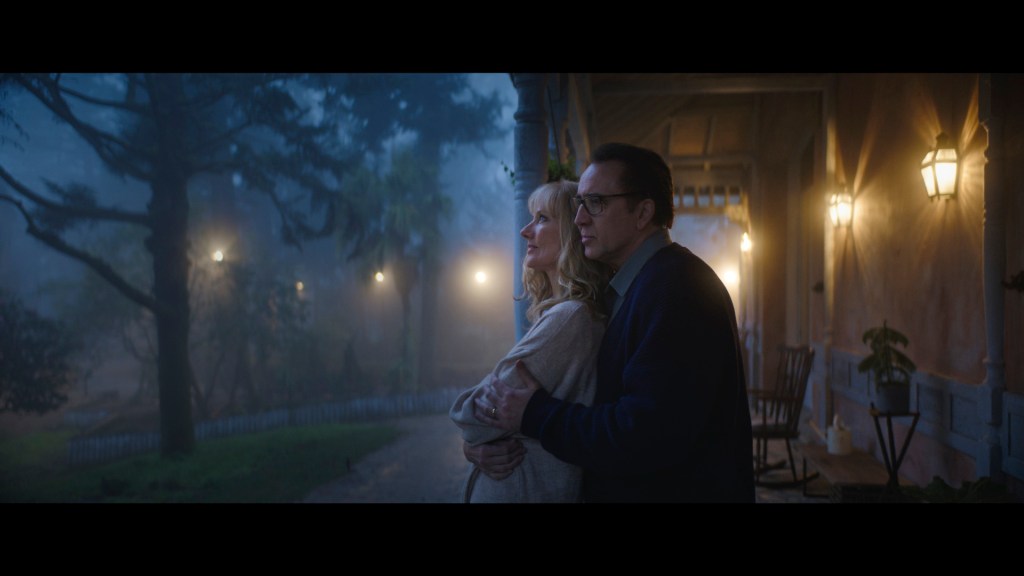
Six months ago Lavinia’s father Nathan (Nicholas Cage) moved his family to this country house so that his wife Theresa (Joely Richardson) could recover from her mastectomy.
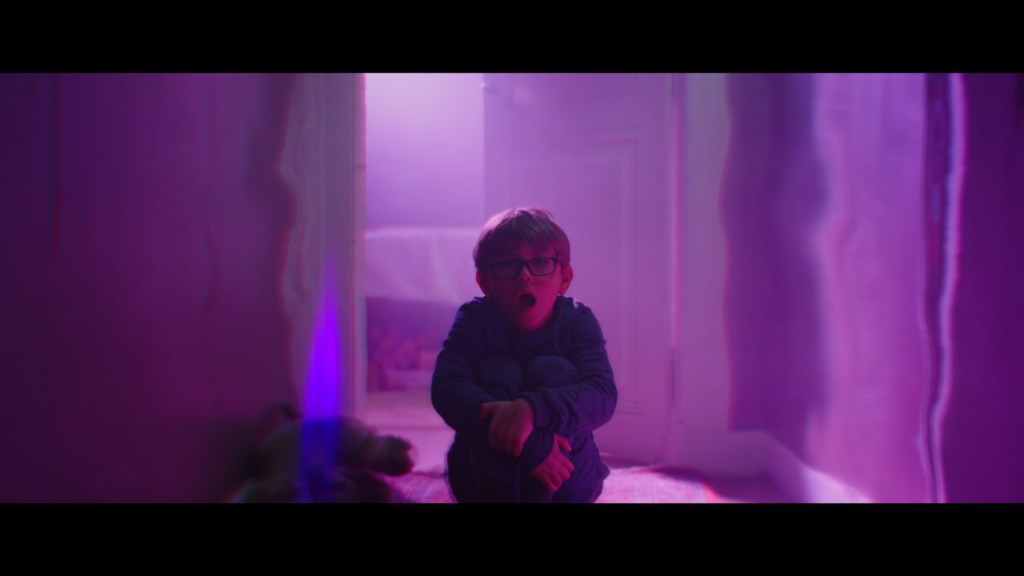
Rounding out the family is Brother’s Benny and the young Jack (Brendan Meyer & Julian Hilliard respectively).
The whole Gardner family have been struggling with the adjustment, Nathan has been trying his hand as a tomato farmer and raiser of alpacas, Theresa is struggling with her financial consolation business thanks to the shitty internet connection, Benny has been smoking weed with the local hermit Ezra (Tommy Chong) and Jack is self-isolating taking solace in the family dog.
The change in their lives is dwarfed entirely when a meteorite crashes in their front yard one night with a flash of light and colour never seen before on this earth.
What follows is a slow descent into insanity as the cosmic colour spreads transforming the landscape and life around it and warping the minds of the Gardner family.

This is Director Richard Stanley’s feature length return to our screens since the disastrous ‘Island of Dr. Moreau’ which was filled with all of the meddling and power struggles that this film feels utterly devoid of.
Stanley’s vision is what we are seeing.
Now this is a relatively low budget indie flick ($12 Million budget) sometimes you can feel it but for the most part I think they make this film feel so much bigger.
It is a really gorgeous looking film with a mostly excellent use of CGI, particularly when it’s used to create the near alien landscape that this quaint little farmhouse transforms into, sharpening colours and extending the mutations surrounding them.
Fans of gooey body horror will be pleased with a lot of the practical effects used here as well, one particular change in the family is deeply disturbing and honestly heartbreaking.
You can certainly feel the influence of other films of its ilk (The Mist, From Beyond, The Thing) but it has a strong enough identity and a visual flair that the homages never feel like all this film has to offer.
It is a deeply creepy film as the characters are separated yet so close to each other, lost in the fog their minds have become, where time has lost meaning and they just don’t notice how wrong things have become.
The Composer, Colin Stetson, has created a truly beautiful score that compliments the growing mutation and helps make the titular colour, a pinkish purple, feel more than a colour, more than a sound.

Pacing wise Color Out of Space may lag a little in the second act but that eerie feeling never goes away.
Don’t get me wrong, this isn’t a wholly serious film and a big part of that is thanks to Nicholas Cage.
Now the Nic Cage we get in the first half of the film is a dorky and daggy Dad, feeling relatively restrained compared to his recent output but once the alien insanity starts to spread Cage turns up the dial with gusto.
I would say there’s almost a little bit of Jack Nicholson in the Shining, where the character already feels a little unhinged when we first meet him so when the jump happens it doesn’t feel like that big a change, having said that though he is still a lot of fun and there are many ridiculous lines he spouts off that you couldn’t even comprehend another more self-serious actor taking a stab at.
The rest of the cast are really complimentary, bringing to life this struggling family beset by a greater force.
This is Joely Richardson’s second eldritch horror outing after the late 90’s Event Horizon, and as Theresa she brings the balance that makes her and Nathan’s relationship feel a lot more believable, struggling to spark their intimacy after her operation.
And the trio of kids, who really take the main stage after Mom and Dad drive off for medical help, give really good performances developing a believable sibling dynamic that carries most of this film.

The Prognosis

For the most part I really enjoyed this film, it’s a kaleidoscopic quagmire of madness with a brilliant score, fun performances and excellent goo.
It might not fully land it’s ending which for me is a hard blow to recover from, reducing it from my favourite Cosmic Horror film to just one of the better ones and like most of the Lovecraft adaptations of the past this will not be for everyone but it’s a hell of a ride if you’ll brave the eldritch horrors of the Color Out of Space.

  • Oscar Jack
This image has an empty alt attribute; its file name is umbrella.png

Color Out of Space is available to view via Video On Demand
from Wed, 6th May

Subscribe

  • Entries (RSS)
  • Comments (RSS)

Archives

  • December 2025
  • November 2025
  • October 2025
  • September 2025
  • August 2025
  • July 2025
  • June 2025
  • May 2025
  • April 2025
  • March 2025
  • February 2025
  • January 2025
  • December 2024
  • November 2024
  • October 2024
  • September 2024
  • August 2024
  • July 2024
  • June 2024
  • May 2024
  • April 2024
  • March 2024
  • February 2024
  • January 2024
  • November 2023
  • October 2023
  • September 2023
  • August 2023
  • July 2023
  • June 2023
  • May 2023
  • April 2023
  • March 2023
  • February 2023
  • January 2023
  • November 2022
  • October 2022
  • September 2022
  • August 2022
  • July 2022
  • June 2022
  • April 2022
  • March 2022
  • February 2022
  • January 2022
  • December 2021
  • November 2021
  • October 2021
  • September 2021
  • August 2021
  • July 2021
  • June 2021
  • May 2021
  • April 2021
  • March 2021
  • February 2021
  • January 2021
  • December 2020
  • November 2020
  • October 2020
  • September 2020
  • August 2020
  • July 2020
  • June 2020
  • May 2020
  • April 2020
  • March 2020
  • February 2020
  • January 2020
  • December 2019
  • November 2019
  • October 2019
  • September 2019
  • July 2019
  • June 2019
  • May 2019
  • April 2019
  • March 2019
  • February 2019
  • January 2019
  • December 2018
  • November 2018
  • October 2018
  • September 2018
  • August 2018
  • July 2018
  • June 2018
  • May 2018
  • April 2018
  • March 2018
  • February 2018
  • January 2018
  • December 2017
  • November 2017
  • October 2017
  • September 2017
  • August 2017
  • July 2017
  • June 2017
  • May 2017
  • April 2017
  • March 2017
  • February 2017
  • January 2017
  • December 2016
  • November 2016
  • October 2016
  • September 2016
  • August 2016
  • July 2016
  • June 2016
  • May 2016

Categories

  • A Night of Horror Film Festival
  • Alien franchise
  • Alliance Francaise French Film Festival
  • Australian Horror
  • Best Movies and Shows
  • Competition
  • dark nights film fest
  • episode review
  • Flashback Fridays
  • Friday the 13th Franchise
  • Full Moon Sessions
  • Halloween franchise
  • In Memorium
  • Interview
  • japanese film festival
  • John Carpenter
  • killer pigs
  • midwest weirdfest
  • MidWest WierdFest
  • MonsterFest
  • movie article
  • movie of the week
  • Movie review
  • New Trailer
  • News article
  • podcast episode
  • podcast review
  • press release
  • retrospective
  • Rialto Distribution
  • Ring Franchise
  • series review
  • Spanish horror
  • sydney film festival
  • Sydney Underground Film Festival
  • The Blair Witch Franchise
  • the conjuring franchise
  • The Exorcist
  • The Howling franchise
  • Top 10 list
  • Top 12 List
  • top 13 films
  • Trash Night Tuesdays on Tubi
  • umbrella entertainment
  • Uncategorized
  • Universal Horror
  • Wes Craven
  • wes craven's the scream years

Meta

  • Create account
  • Log in

Blog at WordPress.com.

  • Subscribe Subscribed
    • Surgeons of Horror
    • Join 229 other subscribers
    • Already have a WordPress.com account? Log in now.
    • Surgeons of Horror
    • Subscribe Subscribed
    • Sign up
    • Log in
    • Report this content
    • View site in Reader
    • Manage subscriptions
    • Collapse this bar
 

Loading Comments...