
Tags
cara seymour, julie pacino, lucy fry, madeline brewer, matt rife, sheryl lee, suff, Sydney Underground Film Festival
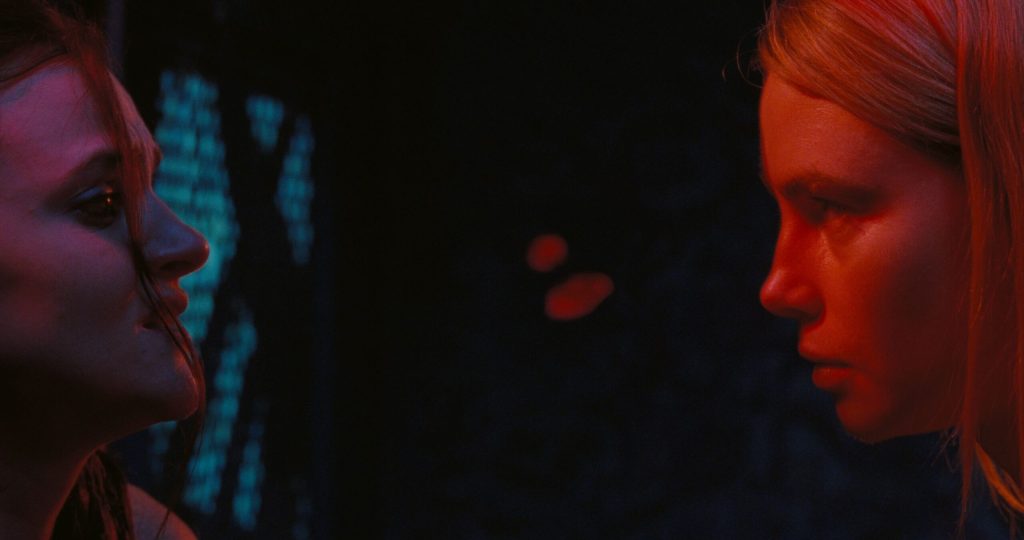
Julie Pacino’s debut feature announces itself less as a narrative than as a hypnotic state of being. With I Live Here Now, she crafts a film that drifts between dream, paranoia, and fractured identity, where each scene feels like a step deeper into a psychological labyrinth. It is a strikingly assured first feature, one that refuses to provide a map, demanding instead that its audience surrender to its vertiginous rhythms.
Lucy Fry, in a career-defining performance, embodies Rose, a young actress who retreats to a remote hotel in Idyllwild, California, in search of respite from her unraveling life. But the more she seeks refuge, the more porous the walls of her reality become. Time loops back on itself, doubles materialise, and memory seeps into performance until the categories lose meaning altogether. Fry is magnetic precisely because she grounds this hallucinatory descent in something tangible: the unease of someone who no longer trusts her own perceptions.
Pacino wears her influences with confidence. Sheryl Lee’s presence inevitably conjures the spectre of Twin Peaks, and David Lynch’s fingerprints are felt in the film’s elastic time, uncanny repetitions, and ominous hum that seems to vibrate through the very air. Yet Pacino’s aesthetic is not mere homage. Her saturated colour palette recalls Argento’s lush operatics, while the film’s elliptical logic suggests Buñuel’s surreal provocations. Layered on top is a contemporary awareness of performance itself — how identity, memory, and desire are all rehearsed roles, prone to fracture under pressure.
Shot on 35mm, the film achieves a tactile, dreamlike fragility. Every frame looks like a half-remembered photograph, poised on the edge of fading. The supporting cast — Madeline Brewer, Cara Seymour, Sheryl Lee, and a gleefully slippery Matt Rife — all slot into the hallucinatory mood, each embodying figures that may be confidantes, doubles, or projections of Rose’s disintegrating psyche. The film offers no clear answers; its power lies in its refusal to resolve whether we are witnessing dream, reality, or a fragmented plurality of selves.
If Tokyo Evil Hotel was SUFF’s splatter assault on the senses, then I Live Here Now is its slow, intoxicating hypnosis. It burrows into the subconscious and gnaws away at the seams of certainty, drawing the viewer into a space where dread and desire cohabit uneasily. As Rose descends, so do we — through layers of paranoia and fractured selfhood, into the uncanny realisation that the mind itself is the ultimate haunted house.
The Prognosis:
I Live Here Now is not a film to be solved. It is a film to be inhabited, to be surrendered to. And in that surrender, Julie Pacino has crafted a debut that is both daringly elusive and deeply resonant — a Lynchian dream refracted through her own distinct lens.
- Saul Muerte
 Surgeons of Horror