• About
  • podcasts
  • Shop

Surgeons of Horror

~ Dissecting horror films

Surgeons of Horror

Category Archives: retrospective

Captain Clegg (Night Creatures): A Haunting Departure from Hammer’s Traditional Horror

13 Thursday Jun 2024

Posted by surgeons of horror in retrospective

≈ Leave a comment

Tags

captain clegg, hammer films, Hammer Horror, nightmare creatures, peter cushing

Released in 1962, Hammer Film Productions’ Captain Clegg (also known as Night Creatures) stands as a unique entry in the studio’s illustrious catalogue. Known primarily for their gothic horror films featuring iconic monsters like Dracula, Frankenstein’s creature, and the Mummy, Hammer took a fascinating detour with Captain Clegg, blending swashbuckling adventure with eerie, supernatural elements. This film, while not as instantly recognizable as Hammer’s monster features, is a testament to the studio’s versatility and creativity.

A Departure from Gothic Horror

Captain Clegg deviates from the typical gothic imagery and dark castle settings that defined Hammer’s earlier successes. Instead, it transports viewers to the windswept marshes and coastal villages of 18th century England, a setting more commonly associated with pirate tales than horror stories. This shift in scenery alone sets the film apart, offering a fresh visual palette and a different kind of atmospheric tension.

The film’s plot centers around the enigmatic Reverend Doctor Blyss (Peter Cushing), who harbors a dark secret. By day, he is the respected leader of a quiet coastal village, but by night, he is the infamous pirate Captain Clegg. The arrival of Captain Collier (Patrick Allen) and his band of naval officers to investigate reports of smuggling brings tension and suspense, as Blyss must outwit his adversaries while maintaining his façade.

Blending Pirates with Haunting Mystique

Despite the absence of Hammer’s traditional monsters, Captain Clegg infuses its pirate story with haunting and supernatural undertones. The eerie marsh phantoms—glowing skeletons that ride ghostly horses—create a chilling atmosphere reminiscent of Hammer’s more conventional horror elements. These spectral figures are used to great effect, not just to frighten, but to underscore the film’s themes of deception and hidden identities.

Peter Cushing’s performance is central to the film’s success. As Blyss/Clegg, he masterfully balances charm and menace, embodying a character who is both sympathetic and fearsome. Cushing’s portrayal adds depth to the narrative, highlighting the duality of his character and the thin line between hero and villain.

The film also delves into themes of justice and retribution. Clegg’s transformation from a feared pirate to a community leader reflects a complex moral landscape, where redemption is pursued through dubious means. This moral ambiguity adds a layer of sophistication to the story, elevating it beyond a simple tale of good versus evil.

Atmosphere and Cinematography

The cinematography of Captain Clegg further distinguishes it from Hammer’s earlier works. The film makes excellent use of its coastal setting, with expansive shots of the marshes creating a sense of isolation and foreboding. The nighttime scenes, in particular, are beautifully crafted, using shadows and fog to evoke a ghostly ambiance that complements the film’s supernatural elements.

Director Peter Graham Scott effectively balances action and suspense, ensuring that the film’s pace remains engaging. The sequences involving the marsh phantoms are particularly well-executed, blending practical effects and atmospheric cinematography to create genuinely unsettling moments.

The Prognosis:

Captain Clegg (or Night Creatures) stands out in Hammer Film Productions’ oeuvre as a unique and engaging blend of pirate adventure and supernatural horror. While it may lack the instantly recognizable imagery of the studio’s gothic classics, it compensates with a richly atmospheric setting, complex characters, and a compelling narrative. Peter Cushing’s standout performance and the film’s haunting undertones ensure that Captain Clegg remains a memorable and distinctive entry in Hammer’s filmography. This film is a testament to Hammer’s ability to innovate and experiment within the horror genre, offering audiences a thrilling departure from their traditional fare.

  • Saul Muerte

Revisiting Madness: Uncovering the Chilling Depths of The Cabinet of Caligari

08 Saturday Jun 2024

Posted by surgeons of horror in retrospective

≈ Leave a comment

Tags

1960s horror, 1960s retrospective, glynis johns, robert bloch, roger kay, the cabinet of calgari

While Robert Bloch’s The Cabinet of Caligari may not have reached the same cultural zenith as his seminal work Psycho, this cinematic adaptation of the classic tale deserves recognition for its own unique merits and contributions to the horror genre.

Released in 1962, The Cabinet of Caligari sought to reimagine the timeless story of madness and manipulation originally brought to life in Robert Wiene’s 1920 silent film masterpiece. While Bloch’s interpretation may not have captured the zeitgeist in the same way as Psycho, it nevertheless offers a fascinating glimpse into the evolution of horror cinema in the early 1960s.

One of the most notable qualities of The Cabinet of Caligari lies in its visual style and atmosphere. Director Roger Kay, known for his keen eye for cinematography, brings the eerie world of Dr. Caligari to vivid life, with stark contrasts and expressionistic flourishes reminiscent of the silent film era. From the twisted architecture of the asylum to the haunting landscapes of the German countryside, every frame is imbued with a sense of dread and unease.

At the heart of the film is Bloch’s reimagining of the enigmatic Dr. Caligari and his mesmerizing hold over his unwitting patients. While Bloch may not have captured the same psychological depth and complexity as in Psycho, his interpretation offers a compelling exploration of the darker aspects of human nature and the blurred lines between sanity and madness.

Another noteworthy aspect of The Cabinet of Caligari is its cast, led by the incomparable Glynis Johns as the tormented Jane Lindstrom. Johns brings a palpable sense of vulnerability and fear to her role, serving as the audience’s guide through the labyrinthine corridors of Dr. Caligari’s asylum.

While The Cabinet of Caligari may not have achieved the same level of acclaim as Psycho, it nevertheless stands as a testament to the enduring power of Wiene’s original vision and the timeless appeal of the mad genius archetype. With its striking visuals, atmospheric score, and compelling performances, it remains a worthy addition to the pantheon of horror cinema, offering a fresh interpretation of a classic tale for a new generation of audiences to enjoy and appreciate.

  • Saul Muerte

Gremlins at 40: The Mischief, Mayhem, and Merry Madness of a Cult Christmas Classic

08 Saturday Jun 2024

Posted by surgeons of horror in retrospective

≈ Leave a comment

Tags

gizmo, gremlins, Joe Dante, mogwai, phoebe cates, Steven Spielberg, zach galligan

As we mark the 40th anniversary of Gremlins, it’s a perfect time to reflect on why this 1984 classic continues to charm and terrify audiences. This film, directed by Joe Dante and produced by Steven Spielberg, is more than just a quirky horror-comedy; it’s a multifaceted narrative that weaves together themes of bullying, satire, and the holiday spirit into a unique cinematic experience.

A Commentary on Bullying

At its core, Gremlins serves as a darkly humorous critique of small-town America and its social dynamics, particularly focusing on the theme of bullying. Billy Peltzer (Zach Galligan), the protagonist, is a kind-hearted but often marginalized young man, working at a job below his potential and dealing with the condescending treatment from authority figures like his boss and the bank’s mean-spirited Mrs. Deagle (Polly Holliday). Billy’s struggles resonate with many who have faced similar social hierarchies and injustices.

The arrival of the adorable Mogwai, Gizmo, who subsequently spawns the malevolent gremlins when fed after midnight, can be seen as a metaphor for the hidden, darker side of human nature that bullying can bring out. The gremlins themselves embody unchecked chaos and rebellion, turning the tables on the town’s bullies and hypocrites, serving them their just desserts in comically exaggerated fashion.

Satirical Humour

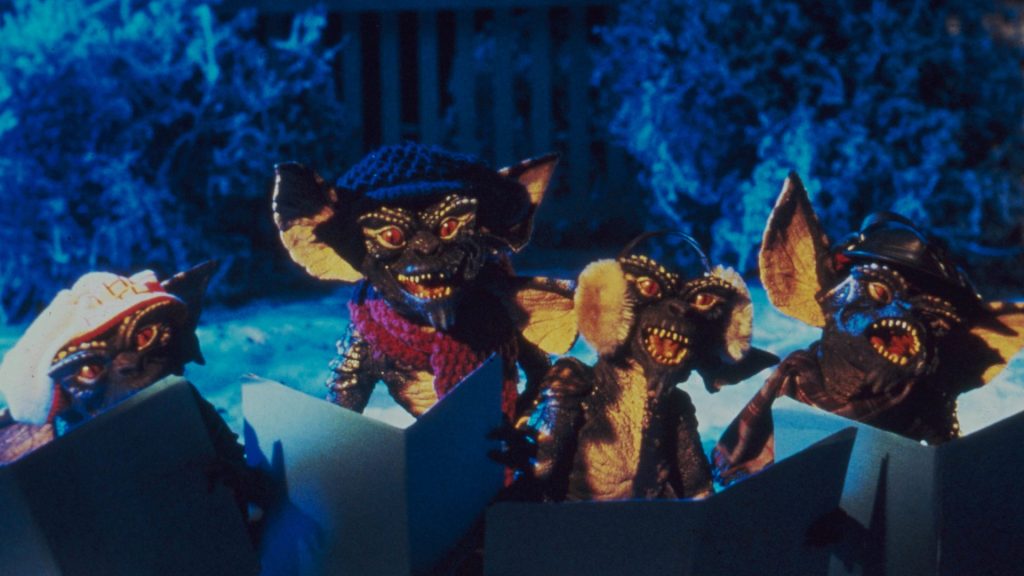
Gremlins masterfully blends horror with satire, using its monstrous antagonists to lampoon a range of cultural and societal norms. The gremlins’ antics, from disrupting Christmas carolers to mimicking iconic scenes from movies, are laced with a sardonic wit that underscores the absurdity of the situations. The film’s dark humour is especially evident in scenes where the gremlins wreak havoc in a local bar, parodying human vices with gleeful abandon.

This satirical edge is a significant reason why Gremlins has endured over the decades. It offers a commentary on consumerism, suburban life, and the veneer of civility that thinly masks our baser instincts. By exaggerating these elements, the film invites viewers to laugh at the absurdity while simultaneously reflecting on the underlying truths.

A Cult Christmas Horror

Despite its summer release, Gremlins has since become a staple of Christmas viewing, carving out a unique niche as a cult holiday horror film. The movie’s setting during the festive season, complete with snowy landscapes and twinkling lights, provides a stark contrast to the chaos unleashed by the gremlins. This juxtaposition heightens the film’s impact, blending the cozy familiarity of Christmas with the unexpected terror of a gremlin invasion.

The festive backdrop also amplifies the film’s themes of family and tradition, albeit through a twisted lens. From the heartwarming relationship between Billy and Gizmo to the darkly comedic mishaps involving Christmas decorations and carolers, Gremlins offers a refreshingly unconventional take on holiday cheer.

The Prognosis:

Four decades on, Gremlins remains a beloved classic, celebrated for its innovative blend of horror, humour, and social commentary. Its enduring appeal lies in its ability to entertain while provoking thought, making us laugh even as we shudder at the chaos on screen. As we revisit this gem on its 40th anniversary, it’s clear that Gremlins is not just a film about mischievous creatures; it’s a timeless observation of human nature, cleverly disguised as a holiday horror-comedy.

  • Saul Muerte

Retrospective: The Awful Dr. Orloff “From Controversy to Cult Classic”

07 Friday Jun 2024

Posted by surgeons of horror in retrospective

≈ Leave a comment

Tags

1960s horror, 1960s retrospective, Jesus Franco, the awful dr orloff

Released amidst the burgeoning wave of European horror cinema in 1962, The Awful Dr. Orloff initially faced a storm of negative reviews and comparisons to the iconic Eyes Without a Face. However, as time has passed, this atmospheric tale of terror has carved out its own unique place among the X certifications of the 1960s, earning a cult following for its blend of Gothic horror and psychological intrigue.

Directed by the prolific Jesus Franco, known for his avant-garde approach to filmmaking, The Awful Dr. Orloff stands out as one of his most accessible works. Franco, often associated with controversial and experimental cinema, demonstrated his mastery of the genre with this chilling tale of obsession and madness.

At its heart, The Awful Dr. Orloff is a haunting exploration of the dark recesses of the human psyche, as seen through the lens of the enigmatic Dr. Orloff and his macabre experiments. Played with sinister charisma by Howard Vernon, Dr. Orloff is a mesmerizing figure, drawing viewers into his twisted world of cruelty and depravity.

Despite initial criticisms and comparisons to Georges Franju’s masterpiece Eyes Without a Face, “The Awful Dr. Orloff” possesses its own distinct identity and merits. While both films explore themes of identity and morality within the realm of surgical horror, Franco’s vision offers a more visceral and lurid experience, unapologetically delving into the depths of human depravity.

What sets The Awful Dr. Orloff apart is its relentless atmosphere of dread and unease, fueled by Franco’s keen eye for visual storytelling and his willingness to push the boundaries of conventional horror. From its haunting cinematography to its evocative score, every element of the film is crafted to immerse viewers in a world of gothic terror and psychological torment.

Over the years, The Awful Dr. Orloff has found a devoted audience among horror aficionados, drawn to its blend of Gothic aesthetics, chilling atmosphere, and unabashed embrace of the macabre. While it may have been overlooked in its time, it has since earned its place as a cult classic of European horror cinema, standing as a testament to Franco’s visionary approach and the enduring power of cinematic terror.

  • Saul Muerte

Retrospective: Night of the Eagle Soars as a Timeless Classic of Occult Horror”

06 Thursday Jun 2024

Posted by surgeons of horror in retrospective

≈ Leave a comment

Tags

1960s horror, 1960s retrospective, burn witch burn, conjure wife, fritz lieber, janet blair, night of the eagle, peter wyngarde

Night of the Eagle, released in the United States as Burn, Witch, Burn, stands as a landmark in the realm of occult horror films, leaving an indelible mark on the genre that continues to resonate even today.

The film’s narrative, adapted from Fritz Leiber’s novel “Conjure Wife,” deftly weaves together the clash between rationalism and superstition within the mundane setting of academia. At its core, it’s a gripping exploration of belief systems and the unseen forces that shape our lives, all set against a backdrop of escalating tension and supernatural intrigue.

One of the film’s greatest strengths lies in its ability to create a palpable sense of unease, drawing viewers into a world where the line between reality and the supernatural is blurred. From the eerie atmosphere to the chilling sequences of occult practices, every moment is crafted with meticulous attention to detail, keeping audiences on the edge of their seats until the very end.

Director Sidney Hayers masterfully navigates the intricate web of suspense, delivering a cinematic experience that is both atmospheric and understated, reminiscent of the atmospheric works of Val Lewton. His direction, though occasionally rhetorical, adds an eerie effectiveness to the proceedings, heightening the sense of dread with each passing scene.

Central to the film’s success is the stellar performances delivered by the cast, led by Peter Wyngarde and Janet Blair. Wyngarde’s portrayal of the skeptical psychology professor, torn between reason and superstition, is both nuanced and compelling, while Blair shines as his conflicted wife, caught in a web of dark forces beyond her control.

Night of the Eagle received acclaim from critics upon its release, with many praising its suspenseful narrative, taut direction, and realistic portrayal of campus politics. While not universally regarded as a classic, its impact on the horror genre cannot be overstated, influencing countless filmmakers and paving the way for a new wave of occult-themed films.

In an era where horror often relies on cheap thrills and jump scares, Night of the Eagle stands as a testament to the power of atmospheric storytelling and psychological terror. It remains a timeless classic that continues to captivate audiences with its timeless tale of witchcraft, superstition, and the dark forces that lurk in the shadows of everyday life.

  • Saul Muerte

Exploring the Haunting Beauty: A Retrospective Review of ‘The Cursed Palace’ (1962)

01 Saturday Jun 2024

Posted by surgeons of horror in retrospective

≈ Leave a comment

Tags

1960s horror, 1960s retrospective

Released in 1962, The Cursed Palace, also known as “El-Qasr el-Maloon,” stands as a haunting gem in the realm of classic cinema. Directed by [Director’s Name], this film unfolds a spectral mystery within the confines of a foreboding palace, where the realms of the living and the dead blur into an eerie tapestry of intrigue.

Set against the backdrop of an old manor shrouded in legend and whispered tales of curses, the narrative follows the journey of a lawyer tasked with preparing a testament for the enigmatic resident of the palace. As he delves deeper into the labyrinthine corridors of the estate, he becomes entangled in a web of secrets, uncovering the haunting past that binds the palace’s strange inhabitants.

One of the film’s most striking elements is its atmospheric prowess. From the moment the audience is introduced to the looming silhouette of the cursed palace, a palpable sense of unease permeates every frame. The director masterfully crafts an ambiance of foreboding, employing shadow and light to weave a visual symphony that lingers long after the credits roll.

Central to the film’s allure are its characters, each imbued with a complexity that adds layers to the unfolding mystery. From the enigmatic old man whose past is veiled in shadow to the spectral figures that wander the halls, every persona contributes to the rich tapestry of the narrative. The performances, steeped in nuance and subtlety, breathe life into these characters, drawing the audience deeper into their world of secrets and intrigue.

At its core, The Cursed Palace is a tale of the human condition, exploring themes of guilt, redemption, and the relentless passage of time. Through its spectral lens, the film invites viewers to confront their own fears and desires, prompting reflection on the nature of mortality and the legacy we leave behind.

Despite its age, The Cursed Palace remains a timeless classic, its allure undiminished by the passage of time. With its haunting beauty and masterful storytelling, it continues to captivate audiences, inviting them to journey into the heart of darkness and emerge forever changed.

The Prognosis:

The Cursed Palace stands as a testament to the enduring power of cinema to transport audiences to realms both fantastical and haunting. With its evocative imagery, compelling characters, and timeless themes, it remains a shining example of the artistry and magic of filmmaking.

  • Saul Muerte

Unearthing Dread: Reflecting on “The Premature Burial” (1962)

31 Friday May 2024

Posted by surgeons of horror in retrospective

≈ Leave a comment

Tags

1960s horror, 1960s retrospective, ray milland, roger corman

In the pantheon of Edgar Allan Poe adaptations, Roger Corman’s The Premature Burial (1962) stands as a haunting testament to the macabre. This atmospheric horror film, inspired by Poe’s chilling tale of premature interment, captivates audiences with its blend of gothic imagery, psychological tension, and tragic inevitability.

Set in the gloomy recesses of a decaying mansion, the film follows Guy Carrell, played with eerie intensity by Ray Milland, a man haunted by a morbid fear of being buried alive. Milland’s portrayal of Carrell is a masterclass in psychological torment, his descent into madness palpable with each paranoid glance and trembling hand.

Corman’s direction imbues the film with an oppressive sense of claustrophobia, as shadowy corridors and dimly lit chambers serve as the backdrop for Carrell’s descent into madness. The use of atmospheric lighting and haunting musical cues heightens the sense of dread, keeping audiences on the edge of their seats until the film’s shocking climax.

One of the film’s most striking features is its exploration of mortality and the fear of the unknown. Through Carrell’s obsession with death and his relentless pursuit of immortality, The Premature Burial delves into the darker recesses of the human psyche, confronting audiences with their own mortality and the inevitability of their demise.

While not without its flaws, including occasional pacing issues and narrative contrivances, The Premature Burial remains a chilling reminder of the fragility of life and the terror of the grave. Its enduring legacy as a classic of gothic horror is a testament to Corman’s visionary direction and Milland’s unforgettable performance.

In retrospect, the legacy of The Premature Burial is inextricably linked to the talents of Roger Corman and Ray Milland. Corman, known for his prolific output and innovative approach to low-budget filmmaking, leaves behind a legacy of genre-defining classics that continue to inspire filmmakers to this day. His keen eye for atmospheric detail and mastery of suspense are on full display in The Premature Burial, cementing his status as a true maestro of horror.

Similarly, Ray Milland’s contribution to the film cannot be overstated. With a career spanning decades and encompassing a wide range of roles, Milland’s portrayal of Guy Carrell stands as one of his most memorable performances. His ability to convey the character’s descent into madness with nuance and subtlety elevates the film beyond mere genre fare, earning him a place among the pantheon of horror greats.

The Prognosis:

The Premature Burial remains a haunting reminder of the power of cinema to confront our deepest fears and darkest desires. Its enduring legacy as a classic of gothic horror ensures that it will continue to chill audiences for generations to come.

  • Saul Muerte

Eclipsing Darkness: Exploring the Legacy of ‘The Slaughter of the Vampires’ by Roberto Mauri

30 Thursday May 2024

Posted by surgeons of horror in retrospective

≈ Leave a comment

Tags

1960s horror, 1960s retrospective, italian horror, la strage dei vampiri, roberto mauri, the slaughter of the vampires

The Slaughter of the Vampires stands as a peculiar artifact within the realm of cult horror cinema, directed by Roberto Mauri and released in 1962. This Italian gothic horror film, also known as “La Strage dei Vampiri,” captivates audiences with its unique blend of traditional vampire lore and avant-garde storytelling.

Set against the backdrop of a decaying castle in a remote European village, the film unfolds a tale of forbidden love, betrayal, and supernatural terror. Mauri’s direction infuses the narrative with an eerie atmosphere, using shadowy cinematography and haunting musical scores to evoke a sense of dread and foreboding.

One of the film’s standout features is its portrayal of vampires. Departing from the romanticized image popularized by earlier works, Mauri presents vampires as grotesque and menacing creatures, with pale visages and feral instincts. This departure from convention lends the film a sense of freshness and unpredictability, keeping viewers on the edge of their seats.

Central to the film’s allure is its exploration of themes such as desire, mortality, and the corruption of power. Through the character dynamics and plot twists, Mauri crafts a narrative that delves into the darker recesses of the human psyche, challenging audiences to confront their deepest fears and desires.

However, “The Slaughter of the Vampires” is not without its flaws. The film’s low budget is evident in its production values, with occasional instances of stilted acting and rudimentary special effects. Some viewers may also find fault with the pacing, as the film meanders at times before reaching its climactic conclusion.

Nevertheless, despite its shortcomings, “The Slaughter of the Vampires” remains a captivating piece of cinema that has earned its place in the annals of horror history. Its unapologetic embrace of the macabre and its willingness to push the boundaries of the genre make it a must-see for aficionados of cult cinema and vampire lore alike.

  • Saul Muerte

Retrospective: Infernal Trio (1974) 50 years of Taboo-breaking cinema

29 Wednesday May 2024

Posted by surgeons of horror in retrospective

≈ Leave a comment

Tags

francis girod, georges-alexandre sarret, infernal trio, mascha gonska, michel piccoli, romy schneider, solange fasquelle

Drawing inspiration from the source material by Solange Fasquelle, “The Infernal Trio” marks the directorial debut of Francis Girod. Girod, like any aspiring filmmaker, undoubtedly aimed to make a lasting impression with his inaugural work, and this dark and chilling portrayal of body disposal certainly succeeded in leaving its mark, albeit for reasons that may unsettle some viewers.

The film centers on the notorious case of Georges-Alexandre Sarret, whose gruesome methods of disposing of his victims’ remains drew comparisons to infamous criminals like John George Haigh, the ‘acid bath murderer’. Sarret’s story culminated in a date with Madame la Guillotine in 1934, while his Bavarian accomplices, the Schmidt sisters, faced their own justice with lengthy prison sentences.

Portrayed by the talented Michel Piccoli and Romy Schneider, alongside Mascha Gonska as Catherine Schmidt, the film delves into the twisted dynamics of this utterly depraved trio. It’s the compelling performances and charisma of these three actors that elevate the film, making it bearable even during its most gruesome moments, such as the harrowing ‘acid bath’ sequence.

Particularly noteworthy is Schneider’s portrayal of Philomena Schmidt, a role that challenged her previous screen persona and showcased her versatility as an actress. In her mid-thirties at the time of filming, Schneider delivers a powerhouse performance, fully embodying the complexities of her character’s dark desires and actions.

While the film takes creative liberties for dramatic effect, omitting certain events like Sarret’s trial and execution, it remains a haunting and thought-provoking exploration of human depravity and moral decay. The decision to end the film with Sarret’s marriage to Philomena adds a chilling final note, leaving audiences to ponder the true depths of evil that lurk within the human soul.

In the end, The Infernal Trio stands as a testament to the courage of its cast and crew, who fearlessly tackled taboo subject matter with unflinching honesty and artistic integrity. As the film celebrates its 50th anniversary, it serves as a reminder of the power of cinema to confront the darkest aspects of humanity and challenge our perceptions of good and evil.

  • Saul Muerte

50th Anniversary Retrospective: Exploring the Dark Secrets of “The Cars That Ate Paris”

26 Sunday May 2024

Posted by surgeons of horror in retrospective

≈ Leave a comment

Tags

Aussie horror, australian film, Peter Weir, The Cars That Ate Paris

An outback town with a dark secret is the setting for this Aussie New Wave classic directed by Peter Weir. A beautiful 50th-anniversary restoration presented by the National Film and Sound Archive brings this haunting tale back to life, reminding audiences of its enduring impact on Australian cinema.

After surviving a car accident, Arthur finds himself in the peculiar town of Paris, NSW. Welcomed with open arms by the local community, Arthur’s initial relief soon turns to suspicion as he uncovers the sinister truth lurking beneath the surface. Why do so many car crash victims keep arriving? And what kind of strange influence does the Mayor, portrayed by the legendary John Meillon, hold over his constituents?

With its atmosphere of mounting dread and eye-popping production design, “The Cars That Ate Paris” takes viewers on a journey into Australia’s violent car culture, leaving an indelible mark on the landscape of Australian cinema. This film marked a stunning feature debut for the great Australian filmmaker Peter Weir, who would go on to captivate audiences with masterpieces like “Picnic at Hanging Rock” (1975) and “Master and Commander: The Far Side of the World” (2003).

“The Cars That Ate Paris” premiered at Cannes and the Sydney Film Festival in 1974, garnering attention for its bold storytelling and unique perspective. Its exploration of societal themes and intricate character dynamics continues to resonate with audiences, even fifty years after its initial release.

Peter Weir: Director Extraordinaire

Peter Weir is an Australian BAFTA-awarded filmmaker whose impact on Australian cinema is immeasurable. A six-time Academy Award nominee, Weir’s films like “Picnic at Hanging Rock,” “The Last Wave,” and “Gallipoli” have made renowned contributions to the 1970s Australian New Wave, defining a generation of filmmakers and inspiring future storytellers.

Beyond his contributions to Australian cinema, Weir has achieved international success with a diverse range of features, including “Dead Poets Society,” “The Truman Show,” and “Witness.” His ability to craft compelling narratives and evoke powerful emotions has cemented his legacy as one of the most influential directors of his time, inspiring generations of filmmakers to push the boundaries of storytelling and explore the human experience through the lens of cinema.

As we celebrate the 50th anniversary of “The Cars That Ate Paris,” we reflect not only on the enduring impact of this landmark film but also on the incredible work of Peter Weir and his invaluable contributions to the world of cinema.

  • Saul Muerte
← Older posts
Newer posts →

Subscribe

  • Entries (RSS)
  • Comments (RSS)

Archives

  • April 2026
  • March 2026
  • February 2026
  • January 2026
  • December 2025
  • November 2025
  • October 2025
  • September 2025
  • August 2025
  • July 2025
  • June 2025
  • May 2025
  • April 2025
  • March 2025
  • February 2025
  • January 2025
  • December 2024
  • November 2024
  • October 2024
  • September 2024
  • August 2024
  • July 2024
  • June 2024
  • May 2024
  • April 2024
  • March 2024
  • February 2024
  • January 2024
  • November 2023
  • October 2023
  • September 2023
  • August 2023
  • July 2023
  • June 2023
  • May 2023
  • April 2023
  • March 2023
  • February 2023
  • January 2023
  • November 2022
  • October 2022
  • September 2022
  • August 2022
  • July 2022
  • June 2022
  • April 2022
  • March 2022
  • February 2022
  • January 2022
  • December 2021
  • November 2021
  • October 2021
  • September 2021
  • August 2021
  • July 2021
  • June 2021
  • May 2021
  • April 2021
  • March 2021
  • February 2021
  • January 2021
  • December 2020
  • November 2020
  • October 2020
  • September 2020
  • August 2020
  • July 2020
  • June 2020
  • May 2020
  • April 2020
  • March 2020
  • February 2020
  • January 2020
  • December 2019
  • November 2019
  • October 2019
  • September 2019
  • July 2019
  • June 2019
  • May 2019
  • April 2019
  • March 2019
  • February 2019
  • January 2019
  • December 2018
  • November 2018
  • October 2018
  • September 2018
  • August 2018
  • July 2018
  • June 2018
  • May 2018
  • April 2018
  • March 2018
  • February 2018
  • January 2018
  • December 2017
  • November 2017
  • October 2017
  • September 2017
  • August 2017
  • July 2017
  • June 2017
  • May 2017
  • April 2017
  • March 2017
  • February 2017
  • January 2017
  • December 2016
  • November 2016
  • October 2016
  • September 2016
  • August 2016
  • July 2016
  • June 2016
  • May 2016

Categories

  • A Night of Horror Film Festival
  • Alien franchise
  • Alliance Francaise French Film Festival
  • Australian Horror
  • Best Movies and Shows
  • Competition
  • dark nights film fest
  • episode review
  • Flashback Fridays
  • Friday the 13th Franchise
  • Full Moon Sessions
  • Halloween franchise
  • In Memorium
  • Interview
  • japanese film festival
  • John Carpenter
  • killer pigs
  • midwest weirdfest
  • MidWest WierdFest
  • MonsterFest
  • movie article
  • movie of the week
  • Movie review
  • New Trailer
  • News article
  • podcast episode
  • podcast review
  • press release
  • retrospective
  • Rialto Distribution
  • Ring Franchise
  • series review
  • Spanish horror
  • sydney film festival
  • Sydney Underground Film Festival
  • The Blair Witch Franchise
  • the conjuring franchise
  • The Exorcist
  • The Howling franchise
  • Top 10 list
  • Top 12 List
  • top 13 films
  • Trash Night Tuesdays on Tubi
  • umbrella entertainment
  • Uncategorized
  • Universal Horror
  • Wes Craven
  • wes craven's the scream years

Meta

  • Create account
  • Log in

Blog at WordPress.com.

  • Subscribe Subscribed
    • Surgeons of Horror
    • Join 220 other subscribers
    • Already have a WordPress.com account? Log in now.
    • Surgeons of Horror
    • Subscribe Subscribed
    • Sign up
    • Log in
    • Report this content
    • View site in Reader
    • Manage subscriptions
    • Collapse this bar
 

Loading Comments...