• About
  • podcasts
  • Shop

Surgeons of Horror

~ Dissecting horror films

Surgeons of Horror

Author Archives: surgeons of horror

Retrospective: Slither (2006)

19 Saturday Jun 2021

Posted by surgeons of horror in retrospective

≈ Leave a comment

Tags

Elizabeth Banks, james gunn, michael rooker, Nathan Fillion, slither, umbrella entertainment

15 years ago, before he would helm the Guardians of the Galaxy movies, Director James Gunn would mark his directorial debut with Slither, a black comedy, sci-fi horror movie centred around a small town in South Carolina that comes under siege from an alien parasite.
It’s a visual spectacle peppered with some humorous dialogue, highlighting the slow paced energy of the townsfolk suddenly thrust into a frenzied assault on their humble town and investing their bodies.
Upon its release, Slither was considered a flop, as it never fell short of the budget used to make the film by a few million.
I remember being a little bewildered by this at the time of its release as I thoroughly enjoyed its energy and direction, coupled with its strong influences from both Carpenter and Cronenberg, directors with whom I greatly admire their work.

It also boasted cracking performances from Nathan Fillion (who had already made a name for himself in Firefly) as Police Chief Bill Pardy, Elizabeth Banks (Brightburn) as Starla Grant, our female heroine, and Michael Rooker as her overbearing and protective husband Grant, who also becomes the first infected by the parasite.

The effects on show are its main selling point who create the tentacled, worm-like creatures with an element of Lovecraftian, body morphia. The humour too is light and zestful, which suits Fillion’s on-screen persona and a testament to Gunn’s writing ability.

This June, Umbrella Entertainment have released a blu-ray edition of the film as part of their Beyond Genres series with some cracking extras including: 
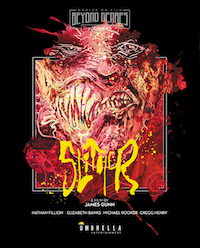
  • Audio Commentary with James Gunn and Nathan Fillion 
  • The Slick Minds and Slimy Days of Slither: Making of featurette – 10 Mins 
  • Who Is Bill Pardy? – 5 Mins 
  • Slither Visual Effects Progressions – 5 Mins 
  • Bringing Slithers Creatures to Life: FX Featurette – 19 Mins 
  • Slithery Set Tour With Nathan Fillion – 5 Mins 
  • The Gorehound Grill: Brewin’ The Blood – 3 Mins 
  • The King of Cult: Lloyd Kaufman’s Video Diary – 9 Mins 
  • Deleted Scenes – 11 Mins 
  • Extended Scenes – 8 Mins 
  • Gag Reel – 8 Mins

All of which resurrect the fun element that was notably present behind the scenes and projected in all facets of what we see on-screen with the final product. This further cemented for me that Slither is a gem of a movie and the reason why it has garnered a cult following as a result.

If you haven’t caught this film, or was deterred by the low box office attendance at the time of its initial release, then I highly recommend that you check it out.

  • Saul Muerte

The Conjuring Universe: How does it fair under the sequels scrutiny?

19 Saturday Jun 2021

Posted by surgeons of horror in Uncategorized

≈ Leave a comment

At the time of writing The Conjuring Universe has firmly established itself in the horror genre scene and James Wan et al have created a world of scares and delights across eight feature films. Arguably one of those features, The Curse of La Llorana has been demoted from the universe by its director Michael Chaves.
I feel like I’d like to argue this point as it clearly is connected with Annabelle, mainly due to the presence of Father Perez, but if we are to take this as gospel, then we can put it to one side for the purpose of this article which is to look at trilogies when adopting the Surgeons theory of what makes a good sequel as outlined by Antony Yee in his article, Movie review: A Quiet Place Part II.

To recap, here is the criteria that we believe marks a decent sequel:

  1. Identify the ideas, themes & executional elements that make the first film great.  Or at least good.  Or at least worthy of being sequelised.
  2. Pay homage and do not violate/ignore said ideas and themes and elements.
  3. Introduce new/expanded themes, ideas and elements that will NATURALLY ALIGN to your first ideas, themes & elements.  (Ie: Don’t use your second movie to discredit & contradict your first).
  4. To underline point 3 – DO NOT rehash the first film and just give people “more of the same”.
  5. DO NOT-NOT rehash the first film by giving more of the same…. BUT “BIGGER”.
  6. Be a good enough stand-alone film by itself.

The reason I am drawn to this in the realms of The Conjuring Universe, there is in effect two sets of trilogies at play, if we were to also put The Nun to one side.It’s yet to be seen if The Nun will establish a trilogy in its own right. There’s the Ed and Lorraine Warren Conjuring trilogy and the Annabelle trilogy, which is slightly more complex to scrutinise as it contains a prequel in the mix.

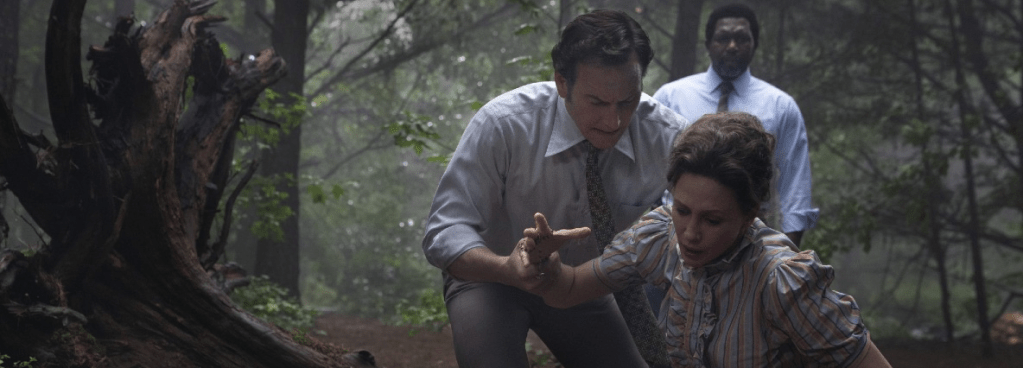
So let’s start by looking at the initial Conjuring trilogy which focuses on the paranormal investigations of Ed (Patrick Wilson) and Lorraine (Vera Farmiga) starting with…

The Conjuring 2

  1. Does it identify the ideas, themes and executional elements from The Conjuring?
    Here it definitely does, Not only it incorporates the central characters Ed and Warren but similarly places them in another paranormal investigation centred on a family under duress from a spiritual entity that threatens them physically and mentally.
  1. Does it pay homage to the original in the process?
    Once again, yes, and centralises on the core elements that were set up in the first feature, establishing the key themes and ideas, and not demolishing them in any way. This is in large part due to James Wan taking the helm as director and in doing so, firmly establishes the look and feel of the movies through clever trickery of shadows and light to build up the tension.
  1. Introducing new ideas.
    The biggest component that comes into this movie is the expansion of the spiritual encounters with not just one paranormal entity but three. It’s main antagonist appears to be Bill Wilkins, but is also supported by The Crooked Man, and most notably Valak. A fearful entity that was so striking that launched a spin-off film of its own.
    In addition, Ed and Lorraine’s roles are provided some more depth and centres on their relationship to one another which I felt was a nice touch and gave both Farmiga and Wilson more to play with respectively.
  2. Is it a re-hash?
    This is a tricky one because in many ways it is a bit same-same. Same investigators, Similar poverty stricken family under distress. The shift in location to the UK does disguise this element and because of the question around the genuine haunts that were aimed at the Enfield Haunting, it adds an extra component, but effectively, it doesn’t stray too much from the original notes.
  3. More of the same but bigger?
    Which is why unfortunately it falls short and three spirits instead of one element makes it exactly that. A bigger premise from the first. 
  1. Does it stand alone as a film?
    100% yes. You don’t need to have watched the first film and the elements that are played with are strong enough to establish its own identity. For this, it is a worthy follow up and rightfully exists within the universe.

SCORE: 4/6
It’s a decent effort and a strong film but without the added depth to the Warrens and the introduction of Valak, the film treads a very similar path to its predecessor.

The Conjuring: The Devil Made Me Do It

  1. Does it identify the ideas, themes and executional elements from The Conjuring?
    This film starts to feel like a different beast, which makes sense when the change of director comes into effect with Michael Chaves taking the helm. While the core ideas and elements are in place especially with the exorcism introduction, its style and execution is different.
  1. Does it pay homage to the original in the process?
    These ideas are not ignored but play a more secondary role due to the change in approach to the storytelling.
  2. Introducing new ideas.
    The expansion of the story comes through the further development of the Warren’s relationship, but central to this is Lorraine’s gift of sight into the other world and her connection with another gifted person.
    The main change centres more as an investigation on said exorcism and how powers outside of the mainframe such as the judicial period weighs in on and impacts the perspective of the universe.
  1. Is it a re-hash?
    Definitely not. If anything, I applaud the approach of trying something different with the story direction, even if it does miss a few beats away from the original look and feel in doing so.
  2. More of the same but bigger?
    Conjuring 3
    feels bold in taking the franchise in a different direction as it steps away from the formula that was set up by the first two movies. It’s both its benefit and detriment. 
  3. Does it stand alone as a film?
    It does stand alone to a degree. Especially as the story holds up through style and substance. What it does well is use the investigation and turns in on itself, questioning the paranormal inquiry process, which feels refreshing and plays with the black and white, the yin and yang of paranormal experiences.

SCORE: 4/6
This instalment does well to make an identity of its own and for trying something different but in the process takes a lot away from what drew us to the original and what made that movie so good to begin with.
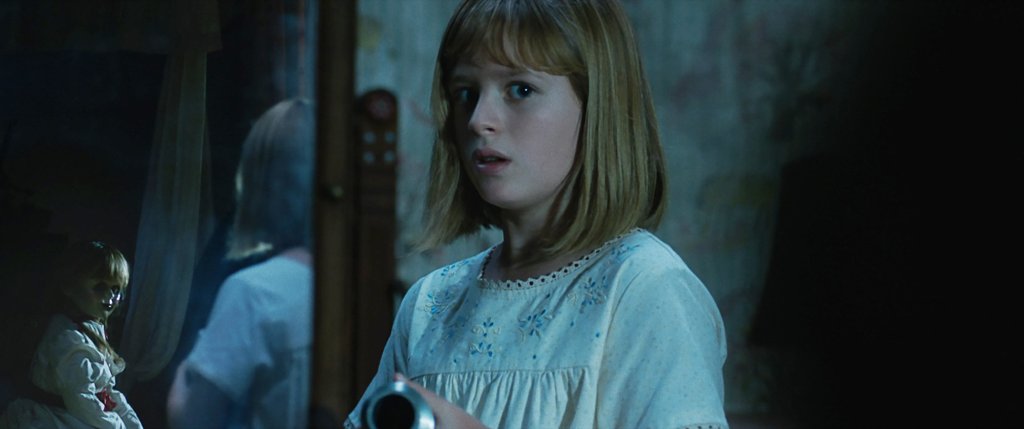
With the introduction of Annabelle as a spin-off franchise, it generated enough success at the box office for the producers to look at its own trilogy of movies, despite it not being anywhere near as good as The Conjuring. So how does the Annabelle trilogy square up under scrutiny.

Annabelle: Creation

  1. Does it identify the ideas, themes and executional elements from Annabelle?
    This is more of a strange one as Annabelle: Creation did one of two things. Firstly, it chose to go to the genesis of Annabelle’s fruition allowing a way to create rules of its own and improve upon the original film. Secondly, It focused on the core elements of what makes a possessed doll so scary, and reinvents the concept.
  2. Does it pay homage to the original in the process?
    If anything, this film pays homage to the initial component that Annabelle was introduced from The Conjuring film. This feels more in keeping with the Conjuring universe than its predecessor.
  1. Introducing new ideas.
    The new ideas are discussed above in point 1, and expands on the possession route. It also strands our would-be victims in the middle of nowhere rather than a suburban environment like in the original. This helps to amplify the feeling of helplessness.
    Much like The Conjuring 2, it also adds a few other elements in the mix; a scarecrow, and parents hellbent on doing anything to bring their daughter back to them.
  1. Is it a re-hash?
    No. It feels more like a reinvention and more of a revamp than a rehash.
  1. More of the same but bigger?
    This is a very different movie and is all the more better for it. David Sandberg does a great job of breathing new life into this franchise, and what’s more does the impossible by making a movie that is better than its predecessor.
  1. Does it stand alone as a film?
    100%. This film adds some great moments that help it stand alone as a movie, injected with humour and new ways to scare the audience.

SCORE: 4/6
Annabelle: Creation marks a bold entry into the universe and reinvents the Annabelle franchise. It was a bold approach but executed really well to become a better movie as a result. Off the top of my head, only Ouija: Origin of Evil has been able to do something similar. 

Annabelle Comes Home

  1. Does it identify the ideas, themes and executional elements from Annabelle?
    Another interesting element comes into play here as this movie also tries for a different approach, making it about the haunted house / possession mixed with a teen horror component rather than the more adult based horror.
    It also uses both Annabelle and The Conjuring elements together and for that feels like the most balanced movie in the universe.
  2. Does it pay homage to the original in the process?
    Taking the notion that Annabelle: Creation is the main rule setter when it comes to Annabelle, this film definitely does pay homage to that film rather than the original film. But like I have stated. This film blends nicely into the Conjuring universe so pulls a lot from all the movies that have taken place before it.
  3. Introducing new ideas.
    The teen horror element marks this as a very different film in tone, whilst still in keeping with the Conjuring universe. It nicely plays with the idea of how Annabelle can harbour her power and force this onto weak or vulnerable people. It’s a simple premise but effective in this case.
  1. Is it a re-hash?
    Yes. But like Creation actually works to its advantage and provides the notion of each film having its own style and identity.
  1. More of the same but bigger?
    With the change in direction and style comes a film that is part of the universe but provides some of its own rules along the way. 
  1. Does it stand alone as a film?
    This film does stand alone, but also relies on flashbacks of the first film to cement it in the universe. This does prevent it from standing on its own entirely but the vision and narrative is strong enough to allow the film to have an identity of its own.

SCORE: 3/6
Seems a little unfair to mark it down but if we’re playing by the rules of how it relates to the original Annabelle film then it suffers.
It is a far superior film from the first film though and as part of the Conjuring universe more than holds its own.

  • Saul Muerte

How Annabelle and the Conjuring universe is connected to the Manson family murders

Movie review: The Superdeep

19 Saturday Jun 2021

Posted by surgeons of horror in Movie review

≈ Leave a comment

Tags

shudder australia, superdeep

Don’t be deterred by this Russian flick and it’s admittedly slow start to build up its central protagonist, Russian epidemiologist Anya Federova (Milena Radulovic) from smart but failed scientist out to prove herself into full on action guru.

Inspired by the real location of the Kola Superdeep Borehole, (one of Russia’s experiments to bore to the Earth’s core, which at its deepest reaches 12, 262 meters down), Anya gets the opportunity to redeem herself when a supposed viral outbreak has occurred in a Secret underground research facility.

Set in 1984 Russia, The Superdeep evokes the stark and oppressive nature that woke out of The Cold War era.

As soon as Anya arrives with a squad of soldiers to find out what has happened at the facility and is charged with retrieved with finding some samples of the unknown disease which appears to be infecting all who work at the facility.

They are greeted by Dr. Grigoriev, the head researcher at the facility but it soon becomes apparent that he has an ulterior motive and refuses to allow them access to to the lowest level of the facility, trapping them on one of the other levels.

It then becomes a race against time to prevent the spread of the infection from reaching the surface and potentially wiping out all of humanity in the process.

The Diagnosis:

There are some nice little elements at play here, especially with the virus that is threatening the characters. It’s essentially a fungal type of entity that infests it’s hosts and shows signs of high functioning intelligence.

The idea behind this is a worthy one and keeps the audience entertained along with some decent effects to ground the film and support the believability of the film

Where it does fall down however is in some of the dialogue and action points that slip into predictability all too often.

It is still entertaining however and Radulovic’s performance and portrayal of Anya is strong enough to keep you invested til the end.

-Saul Muerte

Movie review: Occupation: Rainfall

19 Saturday Jun 2021

Posted by surgeons of horror in Movie review

≈ Leave a comment

Tags

dan ewing, daniel gillies, jet tranter, lawrence makoare, luke sparke, Monster Pictures, occupation, occupation:rainfall, Sci-Fi Movies, temeura morrison, umbrella entertainment

Spanning the last five years Director Luke Sparke has hit the ground running, producing, writing, and directing three feature length movies and showcasing that Australia can release high budget, slick looking films.

Whilst you can’t fault Sparke for pushing the visuals and action sequences to the limit, producing some fantastic, fast-paced, frenetic moments with an effective punch, he has come under fire for weak characters and convoluted plotlines that dampen the spectacle.

His latest venture, (an extension of his pet post-apocalyptic project Occupation series, and first sequel) Occupation: Rainfall, is unfortunately no different.

The story picks up following the band of Australian survivors after the alien invasion of Earth and throws the audience in the thick of a war, where the allies’ numbers are dwindling.

Dan Ewing returns once more as hard headed Matt Simmons, who effectively brings the braun to the piece whilst struggling to collaborate with alien accomplice Gary (Lawrence Makoare) and find a common ground to work on so that they can rise above their obvious differences to defend the alliance. In many ways Sparke is drawing from the buddy cop movies that many action films have drawn from as their central character journey. Some of the shared moments work really well in this instance and are engaging, but too often they are quashed by the need to drive more action into your face rather than pause for breath and build on character. This does however highlight an absence of originality when it comes to story development. 

Through the cloud of combat and explosions there are moments where the supporting cast prove their worth and lift the script above its potential, hiding the notable flaws. Chief among them is Temeura Morrision returning as Peter Bartlett, Daniel Gillies as Wing Commander Hayes who tries to do everything according to the book in order to ensure human survival, and Jet Tranter taking over the role of Amelia Chambers from Stephanie Chambers to provide the heart of the film.

The Diagnosis:

Yes, Director Luke Sparke more than proves his worth of high-budget, slick looking action movies in a system that falls outside of Hollywood here in Australia.

It’s just a shame that three movies into his credits, Sparke hasn’t managed to get a grasp on his writing. I can see why he is hanging onto his vision through the Occupation series, and he certainly is a visual director, but too often the action sequences smother the characters and plot, which feel secondary as a result.
If more time were spent on developing some engaging and believable characters along with solidifying the narrative, Sparke would be a force to reckon with in the film industry.
As it stands though there is some work to be done to finesse what is obviously a creative mind, to harness this vision and strengthen what promises to be a further instalment in this franchise.

  • Saul Muerte

Retrospective: Docteur Jekyll et les femmes

17 Thursday Jun 2021

Posted by surgeons of horror in retrospective

≈ Leave a comment

Tags

Marina Pierro, Patrick Magee, Robert Louis Stevenson, The Strange Case of Doctor Jekyll and Mr Hyde, Udo Kier, Walerian Borowczyk

Anyone familiar with the works of Polish film director Walerian Borowczyk will no doubt identify his craft with his overtly pornographic imagery. Docteur Jekyll et les femmes, is no different to this association and one would be forgiven for misinterpreting this movie for its blatant sexual depiction and depravity of the female form that is on display throughout the narrative. Yet, this is also part of its genius and the reason that it won over many critics and why Borowczyk walked away with the coveted Best Feature Film Director award at the 1981 Sitges Film Festival.

Based on Robert Louis Stevenson’s novella, The Strange Case of Doctor Jekyll and Mr Hyde, Borowczyk brings the subject material down to its core animalistic roots, namely sex and violence, and how the ‘Mr Hyde’ that remains buried in our inner human traits, can be brought to the surface and inflicted on all those around you, if you are drawn to do so.

This is Dr Jekyll’s (Udo Kier) secret and one he wishes to harbour from his socialite guests, but like any drug, it is hard to contain, and when the drive becomes greater than the human will, then it will break to the surface and ultimately be the ruin of everyone.

If anything, the film is a social commentary on the oppression that we inflict on ourselves in order to ‘fit in’ to what is accepted and any such inhibitions should be kept hush hush, only to be carried out behind closed doors. One of Jeckyll’s guests, General Carew (Patrick Magee) has his own sexual fantasies towards his daughter and this becomes the subject of ridicule from Mr Hyde.

Throughout the film, Jekyll is betrothed to Miss Fanny Osborne (Marina Pierro) and appears to be reserved about this engagement. The irony however is that the sexually curious Osborne uncovers his dark secret and rather than being repulsed, is drawn into his carnal sin, immersing herself into the pool of eroticism and accompanies him on this dark and devious journey on the brink of human existence.

If you are unaware of Borowczyk’s films, then don’t be deterred by what the initial images on display but rather bide your time, as the result is a spotlight on our venereal and lustful acts and how gothic literature can be the perfect subject to bring the taboo to the fore.

  • Saul Muerte

Retrospective: Lake of Dracula (1971)

16 Wednesday Jun 2021

Posted by surgeons of horror in retrospective

≈ Leave a comment

Tags

Jaoanese horror, lake of dracula, Midori Fujita, Mori Kishida, Toho Studios

Lake of Dracula epitomises the substance which resides at the kernel of J-Horror with its evocative imagery and atmospheric style. On face value, the film has very little to offer in plot, but poses some interesting characters and has a psychologically eerie feeling throughout.

In many ways, there are similarities to its namesake in that a vampire arrives on the scene and quickly makes a bride in the supported female character.
Where it does stray in the storyline is through its central figure, Akiko (Midori Fujita), who was scarred from a chance encounter with the vampire (Mori Kishida) 18 years prior. In the same confrontation, Akiko discovers a dead woman and is unable to shake that image from her mind.
So when a white coffin turns up from overseas and the body count begins to rise, along with mysterious bite holes in Akiko’s sister, Natsuko’s neck, the nightmares are about to begin again.

It is down to Akiko and her doctor boyfriend, Takashi Saki (Osahide Takahashi) to confront the evil and put a stop to any further torment that has arisen in their seaside community.

Lake of Dracula buries itself in vampirism folklore and rests on this subject to paint and weave its visuals. There is a decent backstory to the vampire that is revealed towards the end of the movie and the inevitable climax, which admittedly is a little low in its delivery, but there is enough here to whet the appetite of the average horror enthusiast, especially for those interested in the historical vault of Japanese horror.
As part of three vampire films produced by Toho Studios in the 70s, I’m intrigued to watch their other features The Vampire Doll and Evil of Dracula. Another couple for the horror movie bucket list. 

  • Saul Muerte

Movie review: Skull: The Mask

06 Sunday Jun 2021

Posted by surgeons of horror in Movie review

≈ 2 Comments

Tags

anhanga, armando foncesca, kapel furman, natallia rodrigues, ricardo gelli, shudder australia, skull: the mask, wilton andrade

Skull: The Mask is one of those movies that has a complexity of moments that form a conglomerate of the mad and macabre. 

Each piece of the puzzle seems out of sorts with one another but when placed together it somehow works.

The fact that it is set in Brazil just adds to the vibrant and energetic personality that is on show.

Written and directed by the dual partnership of Armando Foncesca and Kapel Furman, the film centres loosely on Brazilian mythology which dates back to the pre-Columbian era of Anhangá, a demon-type spirit according to the Christian version who wanders the earth after death.
In this instance Anhangá initially takes the form of a skull that has been heavily guarded over the centuries but is commandeered by Nazis (yes, them again) before once again being lost in time. 

That is until an archaeologist unearths the artefact and brings it back to Brazil to be stored in a museum.
Before it gets there though, a sacred ritual is performed and the spirit is unleashed, killing everyone in its path.
With every kill, it starts to take on human form, presumably with the blood of those it’s killed.

The only thing that can potentially stop this entity is Padre Vasco Magno (Ricardo Gelli), who has no faith in the old religions; Manco Ramirez (Wilton Andrade), a kick-ass vigilante who seems to have inhuman strength; and Beatriz Obdias (Natallia Rodrigues), a crooked, hard-boiled detective who is trying to redeem her old ways. 

The performances are top-notch with no one pulling any punches, allowing the grit and determination to pour forth.
The directing team have definitely leaned into their strengths with Foncesca seemingly bringing out the best from the cast, and Furman producing some gloriously gnarly and bloody moments with his brutal special effects on display. Making them a force to be reckoned with in the South American film-making scene.

The Diagnosis:

The storyline may be a fractured and complex one, but Skull: The Mask more than makes up for its faults by producing a frenzied and energetic slasher flick that taps into the heart of its country’s mythological roots.

It’s hard-edged approach and cracking SFX make this an enjoyable and crazed journey with some wickedly dark humour along the way, that if you’re willing to let it course through your visual senses, will prove to be well worth your time.

Hats off to the creative team Foncesca and Furman.
You’ve made a fan out of this writer.

  • Saul Muerte

Movie review: Caveat (2021)

05 Saturday Jun 2021

Posted by surgeons of horror in Movie review

≈ 3 Comments

Tags

ben caplan, caveat, damian mc carthy, jonathon french, leila sykes, shudder australia

Damian Mc Carthy’s directorial debut that taps right into my heart with its psychological twists and turns that are so fractured that I can’t help but be lured in to its complexities. 

This style of narration can turn some people off and get frustrated by the director’s choice. Especially with the convoluted ending to the tale.

I just lap this stuff up as if addicted to the abstract approach to fear, guilt, and paranoia.

Clearly, its tight budget constraints are on show, but Mc Carthy manages to utilse the deficits to his advantage, and wrangles everything that his actors can muster to the fore, particularly through our lead protagonist, Isaac (Jonathon French), who struggles to piece things together because he is suffering amnesia. Also, placing the setting on an desolate house on a remote island fuels the anxiety and isolation, amping up emotions of both characters and his audience. 

The film is quite hard to unpack, but essentially we follow Isaac to this isolated island when hired to look after Olga (Leila Sykes), who also appears psychologically disturbed and constantly falls into catatonic states, hence the need for someone to supervise her. Our first introduction to Olga is deeply scarring as she wields a curiously freakish wind up toy, a symbol of the unhinged minds of all that enter the house.

We have to allow our minds to stretch into the realms of the unimaginable to a degree, when Issac agrees to the caveat in question, being chained into a harness that restricts him from accessing certain parts of the house; another metaphor for the ties that bind us to our past regrets. The wielder of the caveat is Olga’s uncle Barret (Ben Caplan), who comes and goes throughout the piece but his presence is always felt.
As Isaac fumbles around the crevices of the ramshackled abode, more truths are uncovered but still steers us further away from transparency. The deeper he delves, the more unhinged and dangerous the characters become.

The Diagnosis:

It’s a bold and momentous achievement for a directorial debut, and while it doesn’t necessarily tick all the boxes, the performances are faultless, and the fragmented narrative are compelling enough to keep you chained to the storytelling. 

It will either grip you, or grind you up.

For me, it was a well-constructed tale, that is just the right side of deranged.

  • Saul Muerte

Movie review: The Reckoning (2021)

05 Saturday Jun 2021

Posted by surgeons of horror in Movie review

≈ Leave a comment

Tags

charlotte kirk, neil marshall, sean pertwee, shudder australia, steven waddington

When Director, Neil Marshall hit the horror scene with his debut feature, Dog Soldiers, he hit hard with a werewolf film that not only had its own identity but packed with a little humour.
He then went on to prove that he wasn’t just a one-hit wonder with his sophomore outing The Descent, strengthened his position as a genre film director and won some dedicated supporters of his craft.

It would appear though, that Marshall’s magic was waning as he struggled with his third attempt to appeal to his audience with Doomsday, despite high hopes abound. And even his follow up feature, Centurion, starring Michael Fassbender stuck to average mediocrity.

By the mid 2010’s though, he managed to strike gold twice for popular tv series Game of Thrones with two of its best episodes, Blackwater and The Watchers On The Wall, which led some to believe that he still could captivate and entertain on a large scale. Those walls of expectations fell down however with the re-imagined Hellboy missing the beats once again.

Despite all this, Marshall’s name still fills me with optimism and so when it came to light that his latest feature, The Reckoning was to stream on Shudder, I was front and centre for its debut.

Unfortunately, it falls short of my expectations and struggles with a saturated introduction to its central character, Grace (Charlotte Kirk, who also co writes the screenplay alongside Marshall and Edward Evers-Swindell) whose husband falls foul to the plague and rather than become a burden to his family and possibly infect them, takes his own life. This leaves Grace to try and make her own way and find the means to support her baby. Easier said than done with a horrible landlord Pendleton (Steven Waddington) abusing his power and corruption to force Grace to drastic means. 

But such is the way of the world, as soon as a woman should stand up for herself, she’s labelled a witch, taken away to be trialed for these convictions.

All this seems to take an age to get to this point and has a wishy-washy way of taking us there, coming across as made for a TV feature.

It’s such a shame as it feels so strained and without substance. In fact, it’s not until the ever-dependable Sean Pertwee makes his entrance as the witchfinder Moorcroft that the film starts to lift out of the quagmire of stales. He chomps and chews his way through each scene with glorious humour and glee, that it was a joy to watch him. By this stage I was only too relieved as I’m not so sure I could have endured anymore if his presence wasn’t made.

By the end of the movie though, it trudges to a conclusion with a thinly veiled attempt to tie this back to history, but by this point, I was beyond caring.

The Diagnosis:

I so wanted Marshall to come good with this film, as he definitely has the directing chops to pull it off.

The bang is quickly turned to a whimsical whimper though and fails to flicker on the pulsometer of fun.

It’s only appeal is Sean Pertwee, whose larger than life witchfinder is gloriously fun.

The rest of the movie however, just doesn’t resonate. 

Shame. 

  • Saul Muerte

Movie Review: Psycho Goreman

04 Friday Jun 2021

Posted by surgeons of horror in Movie review

≈ 2 Comments

Tags

astron-6, nita-josee hanna, owen myre, psycho goreman, shudder australia, steven kostanski, umbrella entertainment

Since Steven Kostanski and the Aston-6 collective first hit the scene back in 2011 with their feature, Manborg, the Canadian outfit have been producing low-budget creature features that hark back to the movies we grew to love in the 80s Home Entertainment scene.
In 2016, Astron-6 turned heads and a few tentacles with their Carpenter/Lovecraftian inspired gem The Void, but I would venture to say that their latest offering, Psycho Goreman is their most triumphant feature to date. 

Infused with a perfect blend of humour and stylistic visuals that project the look and feel of 90s hit series Mighty Morphin Power Rangers, Psycho Goreman comes across as a dark and twisted take on a kids adventure flick.

The premise follows two siblings, bossy and overbearing Mimi (Nita-Josee Hanna) and an overtly agreeable Luke (Owen Myre) stumble across a hidden gem buried in their backyard.
Unbeknownst to them, this gem also yields absolute power over an evil monster, hellbent on bringing about the destruction of the universe.
Unfortunately for this overlord, he didn’t anticipate the ignorant and cruel youth that would hold him in their grip to play stupid pranks and games, the usual silly stuff that kids get up to.

Along the way, the kids and their puppet monster that they have dubbed Psycho Goreman or PG for short, encounter The Paladins of Obsidian, PG’s former army that overthrew the Templars before he was incarcerated, the Planetary Alliance, and their two quarrelling parents, all in search for their own means of power and or corruption.
This leads to an ultimate battle where they compete in a diabolical game of Crazy Ball with its confusing rules.
Who will claim victory?

The Diagnosis:

Kostanski manages to direct a beautiful love song to the 90s period of home entertainment with a warped and visually appealing feature. 

Psycho Goreman is peppered with humour and is the dark candy of kids sci-fi adventures of yester-year.
It rekindles the energy of the visual treats we hold dear to our hearts in our childhood and garnishes it with gore-tastic moments that Kostanski and the team have made their signature style.

PG should firmly be on your genre-film pulse. Tap into this baby and enjoy its insanity.

  • Saul Muerte
← Older posts
Newer posts →

Subscribe

  • Entries (RSS)
  • Comments (RSS)

Archives

  • April 2026
  • March 2026
  • February 2026
  • January 2026
  • December 2025
  • November 2025
  • October 2025
  • September 2025
  • August 2025
  • July 2025
  • June 2025
  • May 2025
  • April 2025
  • March 2025
  • February 2025
  • January 2025
  • December 2024
  • November 2024
  • October 2024
  • September 2024
  • August 2024
  • July 2024
  • June 2024
  • May 2024
  • April 2024
  • March 2024
  • February 2024
  • January 2024
  • November 2023
  • October 2023
  • September 2023
  • August 2023
  • July 2023
  • June 2023
  • May 2023
  • April 2023
  • March 2023
  • February 2023
  • January 2023
  • November 2022
  • October 2022
  • September 2022
  • August 2022
  • July 2022
  • June 2022
  • April 2022
  • March 2022
  • February 2022
  • January 2022
  • December 2021
  • November 2021
  • October 2021
  • September 2021
  • August 2021
  • July 2021
  • June 2021
  • May 2021
  • April 2021
  • March 2021
  • February 2021
  • January 2021
  • December 2020
  • November 2020
  • October 2020
  • September 2020
  • August 2020
  • July 2020
  • June 2020
  • May 2020
  • April 2020
  • March 2020
  • February 2020
  • January 2020
  • December 2019
  • November 2019
  • October 2019
  • September 2019
  • July 2019
  • June 2019
  • May 2019
  • April 2019
  • March 2019
  • February 2019
  • January 2019
  • December 2018
  • November 2018
  • October 2018
  • September 2018
  • August 2018
  • July 2018
  • June 2018
  • May 2018
  • April 2018
  • March 2018
  • February 2018
  • January 2018
  • December 2017
  • November 2017
  • October 2017
  • September 2017
  • August 2017
  • July 2017
  • June 2017
  • May 2017
  • April 2017
  • March 2017
  • February 2017
  • January 2017
  • December 2016
  • November 2016
  • October 2016
  • September 2016
  • August 2016
  • July 2016
  • June 2016
  • May 2016

Categories

  • A Night of Horror Film Festival
  • Alien franchise
  • Alliance Francaise French Film Festival
  • Australian Horror
  • Best Movies and Shows
  • Competition
  • dark nights film fest
  • episode review
  • Flashback Fridays
  • Friday the 13th Franchise
  • Full Moon Sessions
  • Halloween franchise
  • In Memorium
  • Interview
  • japanese film festival
  • John Carpenter
  • killer pigs
  • midwest weirdfest
  • MidWest WierdFest
  • MonsterFest
  • movie article
  • movie of the week
  • Movie review
  • New Trailer
  • News article
  • podcast episode
  • podcast review
  • press release
  • retrospective
  • Rialto Distribution
  • Ring Franchise
  • series review
  • Spanish horror
  • sydney film festival
  • Sydney Underground Film Festival
  • The Blair Witch Franchise
  • the conjuring franchise
  • The Exorcist
  • The Howling franchise
  • Top 10 list
  • Top 12 List
  • top 13 films
  • Trash Night Tuesdays on Tubi
  • umbrella entertainment
  • Uncategorized
  • Universal Horror
  • Wes Craven
  • wes craven's the scream years

Meta

  • Create account
  • Log in

Blog at WordPress.com.

  • Subscribe Subscribed
    • Surgeons of Horror
    • Join 220 other subscribers
    • Already have a WordPress.com account? Log in now.
    • Surgeons of Horror
    • Subscribe Subscribed
    • Sign up
    • Log in
    • Report this content
    • View site in Reader
    • Manage subscriptions
    • Collapse this bar
 

Loading Comments...